In the first live stream of the new year, Lei Jun dissected the YU7 and directly responded to the controversy over the "green belt god of war" claim. He said, "The public opinion left us a bit stunned."
"The overwhelming public opinion left us a bit dazed," said Lei Jun during a live broadcast on January 3rd.
During the live broadcast, in response to public opinions about Xiaomi cars, such as the "Green Belt God of War", "Ultra - strong Steel Marketing", and the "7000 - member Legal Team", Lei Jun, the founder, chairman, and CEO of Xiaomi Group (01810.HK), and Xu Jieyun, the special assistant to the chairman of Xiaomi Group and the deputy general manager of the Strategic Marketing Department, gave positive responses. Xu Jieyun said, "The term 'Green Belt God of War' is an act of some people trying to stir up trouble and label others, which has hurt car owners."
Lei Jun said that in the new year, he hopes to strengthen the construction of the legal team and resolutely combat the online trolls who smear Xiaomi and its car owners.
Lei Jun Responds to Recent Controversies
The live broadcast, which took place at the Beijing Xiaomi Automobile Factory, mainly focused on product safety and technical architecture. Through a full - process disassembly, key modules such as the integrated die - cast body structure of the YU7, the design of the door anti - collision beam, the layout of the three - electric system, and the front - cabin thermal management system were fully displayed.
In response to the previously concerned issue of door handle safety, Xiaomi's car engineers provided specific explanations during the disassembly session. The door locks are equipped with three sets of power redundancies, and there are mechanical cables both inside and outside. After an extreme collision, the door locks can switch to an independent power supply and enter the mechanical control mode, ensuring that the doors can still be opened mechanically from the outside. The inner door handle located at the bottom of the door panel can be directly operated under any circumstances.
Xiaomi car designer Li Tianyuan also responded to the discussions about the exterior design. Regarding the "long front end" design of the YU7, he explained that the body proportion is the key to creating a sense of luxury, and the long front end conforms to the styling proportion logic of classic luxury cars.
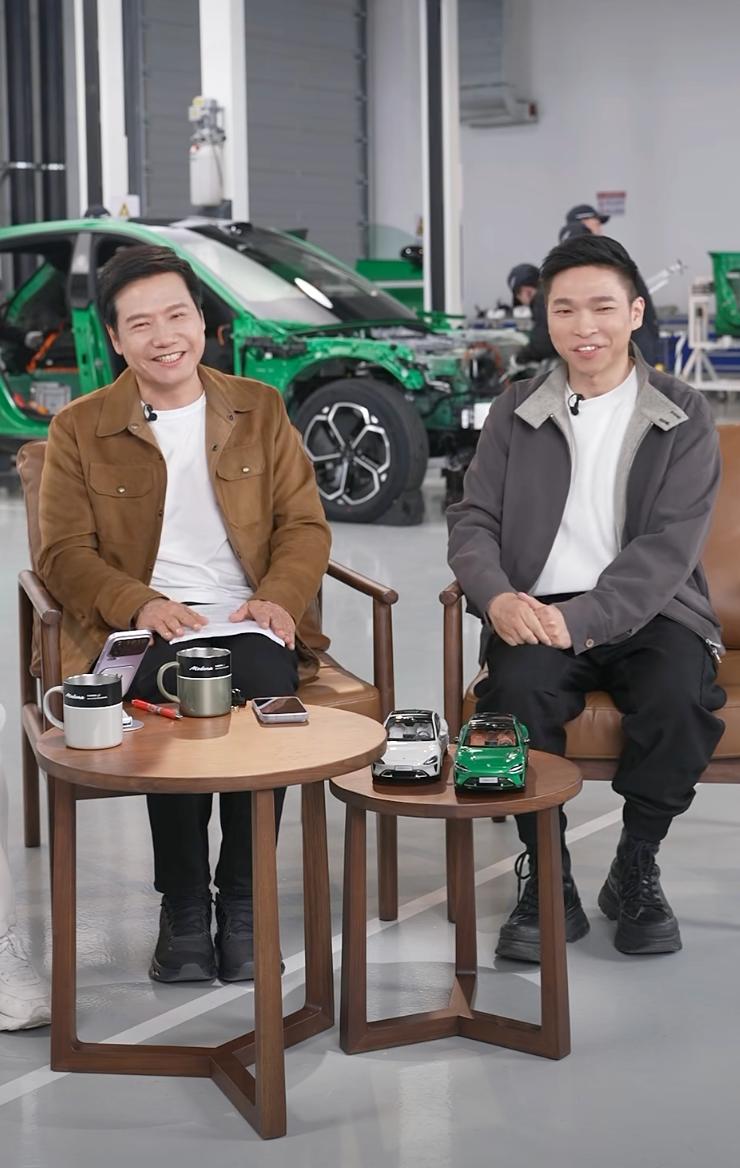
The scene of Lei Jun's live broadcast (Lei Jun on the left, Li Tianyuan on the right). Source: Official live broadcast
In terms of vehicle dynamic safety, Lei Jun explained the issue of side - slipping that the public is concerned about. In most cases, it is caused by the ESP (Electronic Stability Program) being turned off. He specifically reminded drivers, "When in danger, slamming on the brakes is the safest option. At the same time, avoid turning the steering wheel while braking."
When responding to the controversy about the 2054 - horsepower power system, Lei Jun once again clarified that this power system is achieved by a combination of dual - motors (equivalent to the horsepower of two V8 engines) and dual front - motors. He emphasized that the original intention of high - performance R & D is to improve the smoothness and response speed of daily driving, rather than encouraging road racing. Everything is guided by safe driving.
In addition, the live broadcast also provided a detailed explanation of modules such as the vehicle's overall structure, motors, and chassis. Regarding the controversies over product details that emerged during development, Lei Jun admitted that previously adhering to the concept of "proving technology by itself", he believed that the product's strength would withstand market tests. However, as more user feedback came in, the team decided to take a more open attitude and actively disclose technical details. They also plan to respond to industry concerns in stages, and this live broadcast focused on the core technical modules of the YU7.
Lei Jun specifically stated that this system still belongs to the L2 - level assisted driving, and drivers must remain focused. For this reason, the system has launched a multi - level takeover reminder mechanism.
410,000 Vehicles Delivered Throughout the Year
In 2025, Xiaomi cars delivered a market performance that exceeded expectations. Not only was the annual sales target, initially set at 300,000 vehicles at the beginning of the year, later raised to 350,000 vehicles, but the actual annual delivery volume reached 410,000 vehicles, a year - on - year increase of up to 155%.
What's more noteworthy is that from the delivery of the first car in April 2024 to the cumulative delivery exceeding 500,000 vehicles in November 2025, Xiaomi cars only took 602 days, setting the fastest delivery record in the global new - energy vehicle industry.
In the segmented market, the SU7, with an annual delivery volume of 260,000 vehicles, topped the sales list of new - energy sedans priced over 200,000 yuan. The SUV model YU7 received 240,000 orders within 18 hours of its launch, won the sales championship of mid - to - large SUVs for four consecutive months, and in October, with a monthly delivery of 48,700 vehicles, it surpassed the Tesla Model Y for the first time.
Xiaomi Group's financial report for the third quarter of 2025 showed that the revenue from the automotive business reached 29 billion yuan, the average price per vehicle increased to 260,000 yuan, the business gross profit margin climbed to 25.5%, and it achieved a core operating profit of 680 million yuan in a single quarter for the first time. It only took six quarters from the delivery of the first car to achieving quarterly profitability.
As of the end of 2025, the sales network covered 119 cities, with over 400 stores opened.
Source: Unsplash
However, during the rapid development process, Xiaomi cars also faced some controversies over product details. Lei Jun once publicly stated that building cars must respect industrial laws. Technological iteration and quality improvement are continuous processes. Xiaomi cars will always focus on user feedback to continuously improve product strength.
After achieving large - scale accumulation in 2025, the development focus of Xiaomi cars is shifting from "rapid volume increase" to "technological in - depth exploration and quality optimization". And enriching the product matrix to meet diverse needs has become its core strategy for the next stage.
Previously, some media reported that in 2026, Xiaomi plans to launch four new car models, covering both pure - electric and range - extended technology routes, with a price range spanning from 200,000 to 550,000 yuan.
Among them, the new - generation SU7 and a range - extended seven - seat SUV may make their debut first. The new - generation SU7 is expected to be upgraded with an 800V high - voltage platform. The range - extended seven - seat SUV (internally codenamed Kunlun N3) will target flagship models such as the Li L9. It will be over 5.2 meters long, with a pure - electric range of 400 - 500 kilometers, targeting the multi - person family travel market.
In the second half of the year, the administrative version of the SU7 and a range - extended five - seat SUV will be launched successively.
In addition, the official also confirmed again that the statement about Xiaomi cars' 2200MPa ultra - strong steel is correct. Lei Jun also "revealed" that Xiaomi cars are currently researching 2400MPa ultra - strong steel.
This article is from the WeChat official account "Time Weekly" (ID: timeweekly), author: Zhao Lingwei, editor: Liu Xue. It is published by 36Kr with authorization.