The person in charge of Huawei Cloud's embodied robots has left the company to start a business, aiming to "transform" the robot's brain with brain cognition | Exclusive from Intelligence Emergence
Text by | Qiu Xiaofen
Edited by | Su Jianxun
Zhu Senhua is a person who has ingrained rigor in his bones.
As a postdoctoral fellow in neuroscience, on the day of our interview, he turned the interview outline we provided into a seven - page, nearly ten - thousand - word response. He used letters and numbers to categorize his viewpoints and even made diagrams to aid understanding, as if he were completing a genuine academic paper.
Studying the brain means studying humans. This can be seen from Zhu Senhua's chatting habits. He doesn't just talk on and on unilaterally. Instead, he will stop to ask for our opinions on certain questions. He will also adjust his way of answering according to my "liberal arts background and media experience".
During his six - year tenure at Huawei, Zhu Senhua served as the director of Huawei Cloud's AI Algorithm Innovation Lab. He was also the pioneer of the intelligent robot business in Huawei Cloud's AI department and one of the interviewers for Huawei's "Genius Teens".
He led a "Ph.D. army" to build Huawei Cloud's brain and brain - like AI cloud platform and intelligent robot business from scratch. He also incubated Huawei Cloud's first embodied large - scale model.
In this wave of embodied intelligence, Huawei has not been very high - profile. But if you have an impression of Huawei's HDC (Developer Conference) in 2023, you should remember that Huawei Cloud released the first "embodied craftsman" ability prototype capable of real - human interaction before many domestic big tech companies.

△ Huawei first released the embodied large - scale model at the HDC conference in 2023
This prototype is equipped with the first - generation Pangu embodied large - scale model of Huawei Cloud, which was led by Zhu Senhua. Judging from the results at that time, this embodied brain already had human - like abilities. It could autonomously plan complex tasks and generate action instructions independently.
In October 2025, Zhu Senhua left Huawei and founded the embodied brain company "Ju Nao Pan Shi". He described starting a business at this time as "all things being ready".
Two months after its establishment, the core team of "Ju Nao Pan Shi" was set up. One of the company's co - founders is Liu Jinyu, the general manager of Geek+ Smart Forklift & Geek+ Chain Product Division. Other members come from Huawei, Lenovo, Megvii, and Geek+, with over 10 years of R & D and delivery experience in AI + robotics.
According to exclusive information obtained by "Intelligent Emergence", "Ju Nao Pan Shi" founded by Zhu Senhua has recently completed a seed - round financing of tens of millions of yuan. The investors include Leju Robotics, Shanghai Daohe Long - term Investment, Sichuan Science and Technology Innovation Investment Group, and Dongfang Seiko.
In terms of technical reserves, different from the well - known end - to - end and hierarchical embodied intelligence technology routes completely based on deep learning in the past, Zhu Senhua wants to take a more special path - to improve embodied intelligence VLA with the paradigm of brain - cognitive inspiration (Neural AI).
"Intelligent Emergence" learned that "Ju Nao Pan Shi" will draw on the cognitive neural mechanism of the human brain to transform the algorithm architecture of embodied intelligence VLA. For example, it will introduce the unique abstract concept learning and selective attention of the human brain. Through these algorithm "add - ons", it can reduce the robot's dependence on data and computing power and improve generalization ability.
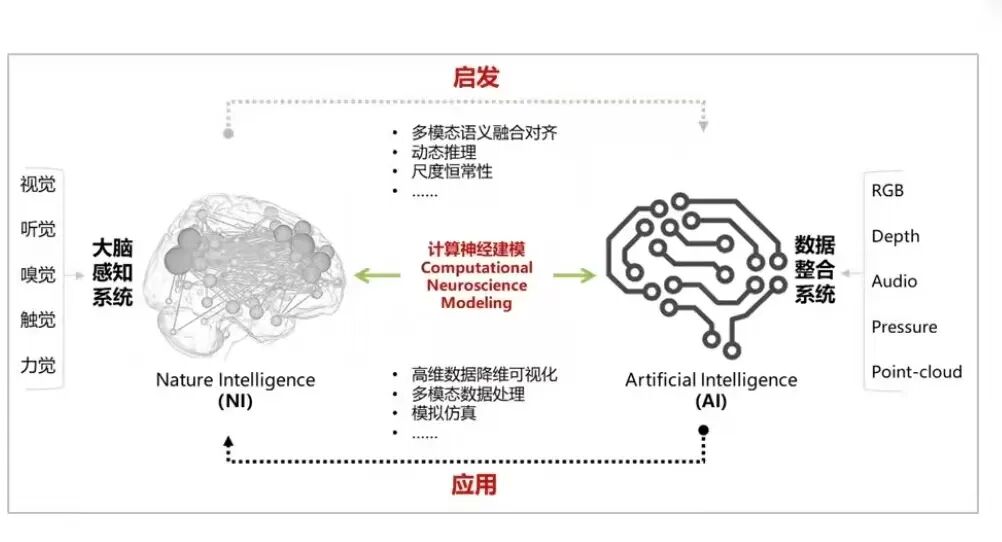
The transformation relationship between AI and NI
In the future, with the accumulation and iteration of brain - inspired algorithm engineering practice, Zhu Senhua expects to complete the replacement of the deep - learning algorithm paradigm in 3 - 5 years and completely move towards the brain - inspired technology paradigm.
"The human brain is the only and most powerful embodied intelligent brain in the world. There's no reason for us not to use it as a blueprint for technological iteration," said Zhu Senhua.
This is not just Zhu Senhua's opinion. Drawing on the "human" in the architectural design of embodied intelligence is also a recent trend in the industry.
For example, Yann LeCun, the former chief scientist of Meta and a Turing Award laureate, recently reminded the industry that the current LLM architecture is a 'dead end' on the way to AGI. He believes that AI should learn like humans and build an internal "world model".
Making embodied intelligence learn from humans is more difficult than before. It requires designers to understand both AI, computers, and the neural mechanism of the human brain. And Zhu Senhua is exactly such a scarce talent.
On the other side of "all things being ready" is business resources.

Ju Nao Pan Shi
Zhu Senhua told us that "Ju Nao Pan Shi" has reached cooperation agreements with Niutaige, a leading listed company in the domestic automotive parts field, and another listed company in intelligent manufacturing. He positions the company's strategy as global. For the first - stage implementation, they chose the commercial service and industrial scenarios in the Asia - Pacific region.
Zhu Senhua believes that the biggest contradiction in current embodied intelligence lies in the gap between the 'half - baked' embodied robots and people's overly high expectations. The most difficult part of implementation is to find customers willing to pay for the immature embodied intelligence.
In China, the business model of "robots completely replacing humans" cannot be implemented on a large scale in the short term. However, different from China, developed countries abroad are facing a particularly serious "factual labor shortage".
Take Japanese convenience stores as an example. One of their core competitiveness is to provide 7×24 - hour service. However, the aging of Japanese clerks and the insufficient labor supply currently restrict this service model. In the night - shift scenario of convenience stores, embodied robots can play a role and undertake basic work such as night - time on - duty and store shelving to ensure the normal operation of the service.
Zhu Senhua said that in the case of an objective shortage of labor supply, customers are willing to pay for the embodied robots with only 60 - 70% of the human ability. Moreover, the robots are constantly evolving.
Below is the record of the conversation between "Intelligent Emergence" and Zhu Senhua: (Slightly edited)
Deep learning: 'The more manual effort, the more intelligence'
"Intelligent Emergence": The current technological paradigms of embodied intelligence are not convergent. How do you think they should be classified? What are the differences in your approach?
Zhu Senhua: Currently, there are mainly three major technological paradigms in AI or embodied intelligence -
① The deep - learning paradigm (DNN) of connectionism, which believes that "compression is intelligence". This is also the mainstream paradigm of LLM - based AI, represented by OpenAI, etc.
Under this paradigm, there are roughly two major technical solutions: Transformer and Diffusion. Among them, the fast - slow system, hierarchical structure, and end - to - end are just permutations and combinations or local optimization variants of different technical solutions under this technological paradigm.
② The reinforcement - learning paradigm (RL) of behaviorism, which emphasizes "Learn from Experience". It is represented by Richard Sutton (the founder of reinforcement learning and a Turing Award laureate), etc.
③ The brain - cognitive inspiration Neural AI paradigm (Brain Inspired Neural AI), which emphasizes "Learn from Neuroscience". It is represented by Yann LeCun, etc.
We belong to the third category.
"Intelligent Emergence": Currently, the mainstream technical solutions of most embodied intelligence manufacturers are end - to - end and hierarchical. What problems might these routes have?
Zhu Senhua: These technical solutions are generally restricted by the upper limit of the deep - learning technological paradigm. For example, they face problems such as high data requirements, high power consumption, low generalization ability, low interpretability, and low online learning ability.
This is why, although the engineering optimization of large models based on deep learning in the past two years has indeed improved the local application experience, it is still difficult to promote large - scale application.
You must have heard the saying, "The more manual effort, the more intelligence". Today's large models are no exception. Most players in the field have focused most of their attention on continuously finding technical solutions to build datasets more quickly and cheaply.
"Intelligent Emergence": Will these technical routes converge in the future? Which paradigm will prevail?
Zhu Senhua: I think that in today's world, whether it is AI or embodied intelligence, humanity has entered a technological "black forest" without a definite answer. The maturity cycles of different technological claims vary, and it is difficult to linearly predict technological breakthroughs.
In the "black forest", many paths need to be explored separately. Therefore, for any technical team, as long as it has a clear technological claim and corresponding talent investment, it is worthy of support.
"Intelligent Emergence": Which other manufacturers or scientists are also following the brain - cognitive inspiration path you have chosen?
Zhu Senhua: If we have to make a comparison with the industry, I think the brain - inspired embodied intelligence adopted by "Ju Nao Pan Shi" is highly consistent with the world - model architecture design concept of Yann LeCun, a Turing Award laureate and the former chief AI scientist of Meta.
We have conducted in - depth analysis and research: The underlying cognitive neuroscience of Yann LeCun's JEPA - based World Model has greatly borrowed from the "Free Energy Principle" (FEP). There are many similar theoretical concepts between them.
In addition, the AI technological claim of "small data, large tasks" by Professor Zhu Songchun from the Beijing Institute of General Artificial Intelligence is fundamentally based on the theory of cognitive neuroscience.
Professor Zhu believes that the human brain does not learn by "memorizing massive amounts of data". Instead, it can quickly establish an understanding of the laws of the world through a very small amount of observation and experimentation.
(Note from "Intelligent Emergence": The FEP free energy was proposed by Karl Friston, a scientist in the field of cognitive neuroscience. It means that any surviving system is constantly reducing prediction errors about the environment. For example, when walking, the brain predicts where the ground is for the next step. If the prediction is wrong, it will adjust the posture next time. This process is to minimize free energy.)
How can a robot's brain learn from the human brain?
"Intelligent Emergence": Why do you want to learn from the human brain to transform embodied intelligence?
Zhu Senhua: The fundamental goal of embodied intelligence is to make robots act like humans. The human brain is the only and most powerful "embodied intelligent brain" in the world, and it is also the origin of the concept of "artificial intelligence". There's no reason for us not to use it as a blueprint for technological iteration.
Therefore, we advocate using clear brain - inspired ideas to replace blind calculations.
"Intelligent Emergence": What parts of the human brain are most worth learning for robots? From which dimensions do you upgrade?
Zhu Senhua: For the capabilities of embodied robots, there are two key parts: operational skills and autonomous movement.
In the dimension of "operational skills", taking the task of "teaching a robot to drink water with a cup" as an example, most embodied intelligence companies' approach is to collect sufficient data using as many types of cups as possible, such as round, flat, square, blue, green, large, small... When the robot has seen enough types of data, it may still be able to complete the action of drinking water through associative reasoning when it encounters a similar but unseen cup, achieving generalization ability.
But if it were the human brain, imagine that when humans are young, parents don't need to teach children in such an endless way. Even if you are thrown into the forest, you can use a coconut shell as a container to get water to drink, showing a higher - dimensional generalization ability.
Therefore, one of the characteristics of human - brain intelligence is the powerful ability to abstract concepts, which enables small - sample learning by analogy.
"Intelligent Emergence": How to achieve "free movement"?
Zhu Senhua: In the dimension of "autonomous movement", whether it is a food - delivery robot or a floor - cleaning robot, when they enter a strange environment, there is a process of collecting the environmental map in advance.
However, humans don't need this process. Just relying on the visual perception of the eyes, humans can freely move in an open space they have never been to. This is another characteristic of human - brain intelligence, the powerful ability to freely explore in an open environment.
"Intelligent Emergence": Have you applied these two parts to the field of robotics?
Zhu Senhua: We have carried out algorithm prototype verification in the free movement in an open environment and brain - inspired small - sample operation respectively.
Specifically, in terms of movement, we built a human - like cognitive mapping mechanism based on the "simulation of grid cells and place cells", enabling the robot to freely explore in open indoor and outdoor scenarios, and the deployment efficiency has been improved by 40%.
In terms of small - sample learning, the verification result is that the data has been reduced by 90% compared with before. In the future, it is also expected to break away from the "brute - force aesthetics" of piling up computing power in embodied intelligence.
"Intelligent Emergence": How do you achieve it without piling up computing power?
Zhu Senhua: There is a core term in large models called "Attention", which simply borrows from the cognitive neural mechanism of the human brain. However, in a computer, the weight of each pixel in every picture it receives is the same, so it requires an extremely large amount of GPU computing power.
However, the human brain doesn't collapse even though it receives a huge amount of visual information every second because human - brain attention has a focus and can dynamically focus on local information according to the point of concern.
For example, when I just entered the door, you only paid attention to whether I came or not, and ignored other information.
A person eats three meals a day for energy supply, and the power consumption of an adult's brain is only 25 watts, which can maintain the operation of 86 billion neurons. The brain greatly reduces the cost of processing information through the attention mechanism and finally achieves low power consumption. This is also what a robot's brain needs to learn from in the future.
"Intelligent Emergence": How do you specifically introduce human abstract thinking into robots?
Zhu Senhua: We introduced an abstract concept representation Encoder into the model to achieve this, guiding and enabling the model to "Learn from Concept" instead of "Learn from Tokens". In the field of embodied intelligence, we also see that some teams have adopted similar technical methods.
(Author's note: The abstract concept representation Encoder is a neural network module that automatically extracts and encodes core abstract features from specific data.)
"Intelligent Emergence": How to understand the human - like