AI pet-raising gadgets capture the hearts of young people
Amid the trend of "meticulous pet - keeping", young people try to save money on themselves, fully implementing the concept of cost - effective alternatives and value - for - money consumption. However, when it comes to their furry friends, they adhere to the principle of "spend when necessary" without any hesitation. They celebrate their pets' birthdays, take professional photos of them, and also purchase high - tech smart devices that can cost thousands of yuan, including the trendy AI litter boxes, AI pet collars, and so on.
The "In - depth Exploration and Investment Decision - Making Analysis Report on China's Pet Products and Services Industry from 2025 to 2030" released by the China Commercial Industry Research Institute shows that in 2024, the market size of China's smart pet products was approximately 10.2 billion yuan, accounting for 20% of the entire pet products market. Analysts from the China Commercial Industry Research Institute predict that the market size of China's smart pet products will reach 11 billion yuan in 2025.
However, a trust crisis has quietly emerged. Are these AI litter boxes, dog language translators, and smart collars, which are dressed in high - tech guises, really "miracle tools" or just "IQ taxes"? The young people who are constantly buying things for their pets have become the first "guinea pigs" in the era of cyber pet - keeping.
AI Litter Boxes: Ripping off Cat Owners
It took less than three months for Zhu Ying, a post - 2000s office worker, to shift from high - tech pet - keeping to a more laid - back approach to cat - raising.
It all started when Zhu Ying came across a video after work. In the video, a Ragdoll cat jumped into a high - tech - looking white litter box. The owner could see on the mobile app that the cat finished defecating in 50 seconds, and the feces were in good shape. According to AI analysis, the cat's defecation was normal, and there were no urinary problems. The blogger in the video claimed that after using this AI - enabled litter box that could detect the cat's defecation situation, she saved the hefty fees at the pet hospital, which could easily amount to thousands of yuan.
This made Zhu Ying a bit tempted. She had a three - year - old Ragdoll cat named Doudou, which had a delicate stomach. A change in the weather or a switch in cat food would cause soft stools. Last year, Doudou vomited frequently, and Zhu Ying spent more than 5,000 yuan just on hospital visits, and Doudou lost two catties in weight.
"As a worried mother, I still want to give Doudou the best," Zhu Ying said. She spent nearly 3,000 yuan on this so - called "miracle cat - raising tool", the AI litter box. Although the price of 3,000 yuan was higher than most litter boxes on the market, what attracted Zhu Ying was the ability to use AI to detect the cat's health. "Spending 3,000 yuan on a private doctor for my pet means Doudou doesn't have to go to the hospital every season. It's not that expensive when you think about it," she thought.
When the litter box first arrived, Zhu Ying thought it looked like a small spaceship, and the camera on the body was quite prominent. She excitedly filmed an unboxing vlog, then installed it according to the instructions, connected it to the Internet, and entered Doudou's "iris" (actually just taking a photo of the cat's face). Doudou sniffed around the box for a long time before daring to jump in.
At first, when Zhu Ying received the AI health reports, she would check them repeatedly. On the app, every time Doudou used the litter box, there would be a corresponding push notification: "Doudou has used the toilet, staying for 2 minutes and 15 seconds, weighing 7.3 kilograms." Then the litter box would start to automatically remove odors and clean itself.
According to the promotion, this litter box had an exclusive image - capturing algorithm that could detect the cat's feces from multiple angles. The AI could monitor the accompanying cat litter through the camera and remind the owner of urinary abnormalities through pH value detection.
Less than a month later, Zhu Ying began to suspect that she had been "cheated".
After the new litter box was installed, while at work, Zhu Ying received a push notification saying that "the cat is using the toilet frequently" and was advised to take the cat to the hospital for a check - up. Fearing that Doudou had a urinary problem, Zhu Ying immediately took a leave and rushed to the hospital with Doudou. However, the check - up showed that it was a false alarm.
After returning home, when Zhu Ying reviewed the video from the litter box, she found that the problem lay with the camera, which was supposed to be based on an image - capturing algorithm. The reminder of "frequent toilet use" was because the litter box would mistake a person walking by for the cat entering. Sometimes, it would even detect a cat entering when the box was empty. Since it couldn't even do the recognition properly, Zhu Ying began to doubt the core function of this AI litter box - health monitoring.
Zhu Ying noticed that the monitoring reports always seemed to say the same things, like "feces are normal" and "sufficient water intake is recommended". She suspected that these were just randomly combined texts based on the frequency and duration of the cat's toilet use. Once, after feeding Doudou new cat food, it was visibly having soft stools. While Zhu Ying was waiting for an AI alarm, the push notification still said "everything is normal, keep it up". Instead of the promised artificial intelligence, Zhu Ying only felt like it was "artificial stupidity".
Ultimately, the only real use of this 3,000 - yuan litter box was the built - in camera, which allowed Zhu Ying to remotely watch Doudou's "funny postures" while using the toilet. However, this function could be easily achieved by a camera that cost only a few dozen yuan. Moreover, to simply review the surveillance footage, she had to pay an additional fee.
What made Zhu Ying even more frustrated was that not only were the advertised AI functions of this 3,000 - yuan litter box useless, but there were also problems with the most basic product quality. The litter box, which was supposed to be self - cleaning, smelled terribly. It turned out that the cat litter and feces had leaked into the interlayer at some point. When Zhu Ying contacted the customer service, she had to bear the shipping cost for returning it for repair. "It's too much of a hassle, and I'm not even sure if it can be fixed. I might as well just stop using it," she said.
Finally, Zhu Ying switched back to a simple hardware toolbox as a "cost - effective alternative" litter box, which only cost a dozen yuan. After cleaning the expensive AI litter box, she put it up for sale on Xianyu at a 20% discount of the original price.
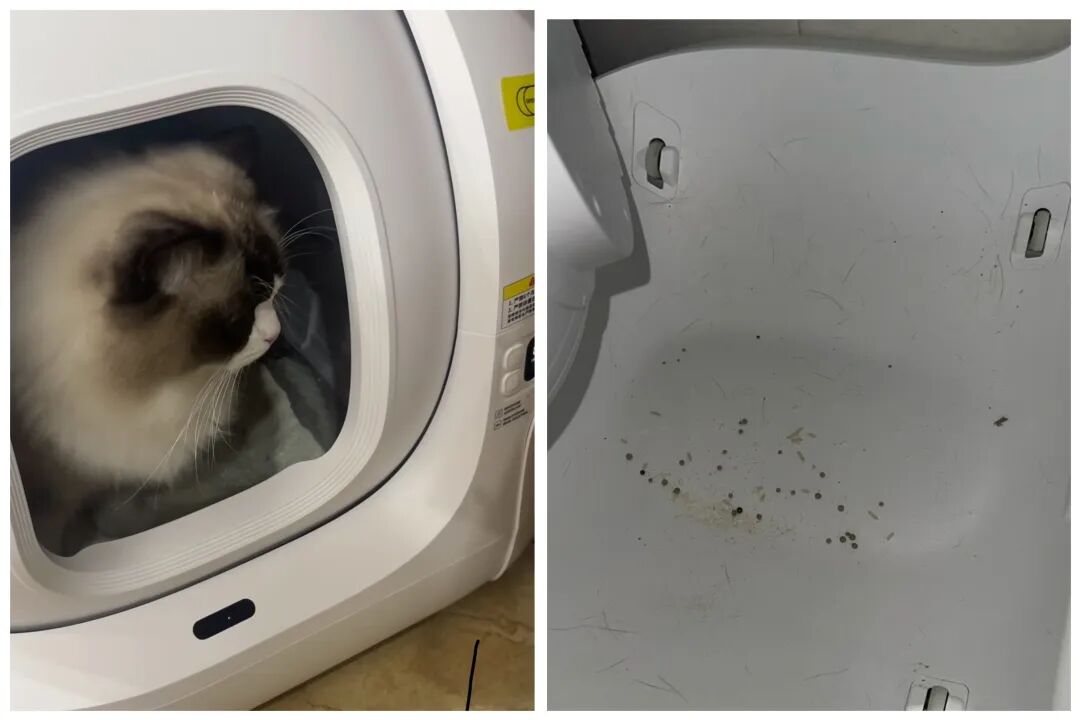
The sand - leaking AI litter box. Source: The interviewee
Costing Only a Few Dozen Yuan, but Sold for Thousands with AI Label
Zhu Ying was not the only one who was ripped off by spending 3,000 yuan. There is a whole community of cyber pet owners who have had similar bad experiences. Their stories resonate on second - hand platforms. Resale posts for "AI litter boxes" and "smart pet collars" are everywhere, and the reasons for resale are highly consistent: "The cat doesn't use it" and "It's inaccurate".
Zhang Cheng, a post - 1995s young man, bought an AI smart collar worth 300 US dollars for his Border Collie. This AI collar claimed to be able to monitor the dog's heart rate, body temperature, and activity level and generate health reports using AI. Zhang Cheng, who is a tech enthusiast and one of the early adopters of AI glasses and AR headsets, said, "I'm willing to pay for technology."
Zhang Cheng's Border Collie is a large - breed dog. As it got older, it developed chronic diseases such as joint wear and heart problems. Zhang Cheng would arrange a comprehensive physical examination for the dog every six months. At the beginning of this year, a friend of Zhang Cheng's lost his Golden Retriever due to sudden liver failure because of untimely check - ups. This made Zhang Cheng quite anxious. When he saw this AI collar, he was immediately attracted to it, hoping to use AI to assess and avoid the dog's health risks.
When he first got the collar, Zhang Cheng would often post photos on WeChat Moments of his Border Collie playing with the AI collar on. The cool - black body of the collar gave his dog a high - tech, elite look. However, it didn't take long for Zhang Cheng to start doubting the intelligence of this collar.
Firstly, there were frequent inaccuracies in the detection of key indicators. When Zhang Cheng was playing with his dog on the lawn at home, the heart rate on the collar would suddenly jump from 110 beats per minute to 140 beats per minute, even though the dog's activity level didn't increase significantly, and there was no rapid breathing. When Zhang Cheng took the dog to the hospital for a check - up, the results showed that the dog's cardiopulmonary function was normal.
"It's understandable that the collar may be inaccurate when the dog is running, but it's also inaccurate when the dog is lying still," Zhang Cheng said. After using the collar for one and a half months, the collar detected that the dog, which was sleeping on the sofa, had a slow heart rate (below 60 beats per minute) and arrhythmia. These false alarms made Zhang Cheng exhausted. After using the AI collar for two months, Zhang Cheng had to take the dog to the hospital ten times, and every time the check - up showed that everything was normal. "I can't sleep well because of the anxiety this collar has brought me," Zhang Cheng said helplessly.
Zhang Cheng felt that he had been "cheated", and he stuffed the collar into a drawer.

A dog wearing a smart collar. Source: Visual China
While the health detection function may have some limited reference value, there are some even more absurd functions that are simply "IQ taxes".
At the beginning of this year, when DeepSeek became extremely popular, Lin Fang, who had never used an AI app before, also joined the trend. He noticed an "AI dog language translator". The developer claimed that it was connected to the DeepSeek large - language model and could use AI to recognize the dog's emotions. Lin Fang couldn't wait to download it and give it a try.
When Lin Fang's dog, Chengzi, barked at the delivery guy, Lin Fang opened the app to record. The analysis result was "a guarding behavior is detected. It's saying: 'This is my territory. Leave quickly!'". When Chengzi tugged at Lin Fang's trouser leg and whined cutely, the AI analysis said "the owner should go out, and the dog wants to have fun". This brought Lin Fang a lot of joy.
However, there seems to be only a thin line between AI's recognition of dog barks and "random nonsense". "As time passed, the AI started to give random responses," Lin Fang said. When he took a photo of Chengzi yawning, the AI said the dog looked tired. When Chengzi was happily wagging its tail, the AI judged that the dog was overly excited and at risk of stress. "These AI products can only be used as entertainment tools. Those who take them seriously will lose," Lin Fang said.
Zhang Cheng also found that in addition to the inaccurate indicator detection, the most basic positioning function of the AI collar he bought was also poorly implemented.
One weekend, he took his dog to a suburban park. When the dog was having a great time running around, the positioning point on the collar's app disappeared for half an hour for no reason and then briefly jumped one kilometer away. This greatly disappointed Zhang Cheng.
"Even children's smart watches can now achieve accurate positioning, make calls, and take photos, but this AI smart collar can't even do that, let alone use AI to recognize the pet's emotions," Zhang Cheng added.
Lao Sun, who is focusing on AI - based emotion recognition entrepreneurship, told the Jingxiang Studio that there are technical difficulties in using AI to recognize pets' emotions, whether through sensors like collars or by tagging pets' emotions based on certain indicators.
Firstly, it is difficult for current sensors to penetrate the fur of cats and dogs to collect information. Secondly, it is very challenging to label pets' emotions. From the perspective of animal behavior science, animals' emotional expressions are different from the human emotional system. A dog wagging its tail may express excitement, anxiety, or even aggression, rather than simply "happiness". We have no way of telling whether the detection is accurate.
There are also credibility issues with the so - called AI health warnings. Chen Yong, who has his own stall in Huaqiangbei, told the Jingxiang Studio that there are many factories in Shenzhen that specialize in the production of smart pet hardware. For example, a pet collar with an "AI smart" label, which has a factory price of 30 - 60 yuan, can be sold for hundreds or even thousands of yuan.
Many of these so - called AI smart features are just "baits". The AI health reports they provide are often based on a few simple indicators, such as an abnormally fast or slow heart rate, and do not take into account specific breeds and complex situations. Therefore, their reference value is quite limited.
Young Pet Owners No Longer Trust AI
Zhu Ying put the 3,000 - yuan AI smart litter box up for sale on Xianyu at a 20% discount of the purchase price. In the product description, she decided to tell the truth: "The camera function is intact. It's suitable for those who like to watch live - streams of cats using the toilet."
Surprisingly, there were many private messages from potential buyers, and their questions were surprisingly consistent: "Is the AI accurate?" "Can it really detect health problems?" Zhu Ying's standard reply was, "It's okay to use it as an ordinary litter box with a camera." Usually, the other party would then send an emoji that seemed to say "I understand".
After two months on Xianyu, the litter box still hadn't been sold. Zhu Ying simply modified it and placed it in the grass in the neighborhood for the stray cats she regularly fed to use as a cat house.
After all these troubles, Zhu Ying found it hard to trust products with the "AI smart" label. She decided to take a more laid - back approach to cat - raising, returning to the most primitive way of regularly cleaning the litter box when going to and coming back from work. As for her concerns about the cat's stomach problems, Zhu Ying now takes Doudou to the hospital for a check - up every month to get more professional test reports. She also bought a camera for less than 100 yuan and installed it near the litter box so that she can check the footage anytime if Doudou has diarrhea or vomiting.
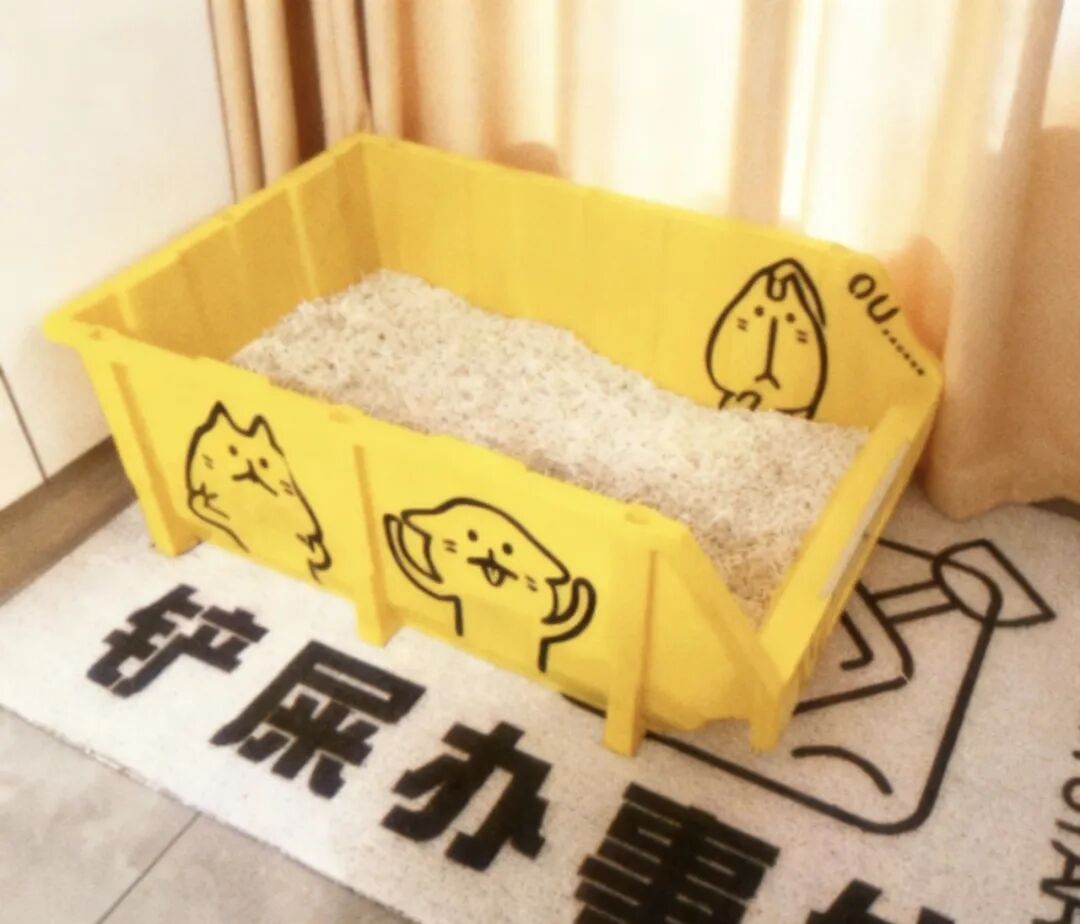
Zhu Ying's new litter box, which only costs a dozen yuan. Source: The interviewee
Zhang Cheng replaced the AI collar with a "Xiaotiancai" kids' smart watch, which can accurately locate the dog no matter how far it runs when excited. Now, his dog - walking equipment has become extremely simple: a sturdy leash and a worn - out rubber frisbee. Zhang Cheng found that to tell whether his dog is happy, there's no need to look at the comprehensive indicators like heart rate and body temperature in the app. Just observing the amplitude of its tail - wagging and the position of its ears is enough. And to judge its health, the best way is to observe its appetite, defecation, and the sparkle in its eyes, along with professional check - ups every two months.
To better prevent chronic diseases such as joint