HarmonyOS Selection: Behind the Evolution of an Open Ecosystem, from "Connection" to "Symbiosis"
As the city is immersed in the night, the lights outside the window gradually light up. When you arrive at your doorstep, the door lock automatically recognizes your face and unlocks the door. Meanwhile, the lights in the entrance hall will automatically turn on, the smart speaker will automatically play music and announce in a pleasant voice, "Welcome home." The smart camera will also automatically turn off to protect your privacy.
The room temperature has been adjusted to the most comfortable 24 degrees. As you walk towards the sofa, the main lights in the living room will immediately become soft and focused. The blackout curtains will silently slide towards the middle and close. The ultra-thin smart screen in the center of the living room will silently light up, and the screen will stop at the interface of the movie you didn't finish watching last night.
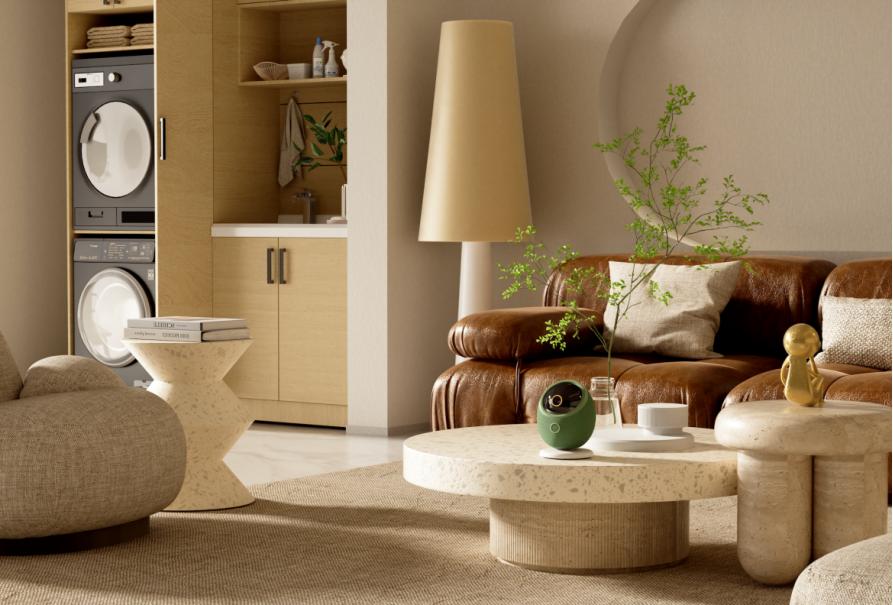
Huawei HarmonyOS Smart Home - Smart Living Room
This is not a future concept in a technology exhibition hall, but a real daily experience that more and more Chinese families are having. Behind all these smooth experiences, the HarmonyOS is like the "soul of the home", precisely coordinating every detail. Dozens of HarmonyOS ecosystem devices, such as lights, household appliances, and audio-visual equipment, operate in an orderly manner under its coordination, jointly constructing a complete and intelligent living scenario.
In June 2025, at the Huawei Developer Conference, Yu Chengdong, the chairman of Huawei Terminal BG, officially announced that the "Huawei Smart Selection" brand was comprehensively upgraded to "HarmonyOS Smart Selection". Behind this is a key calibration and focus on Huawei's HarmonyOS hardware ecosystem strategy.
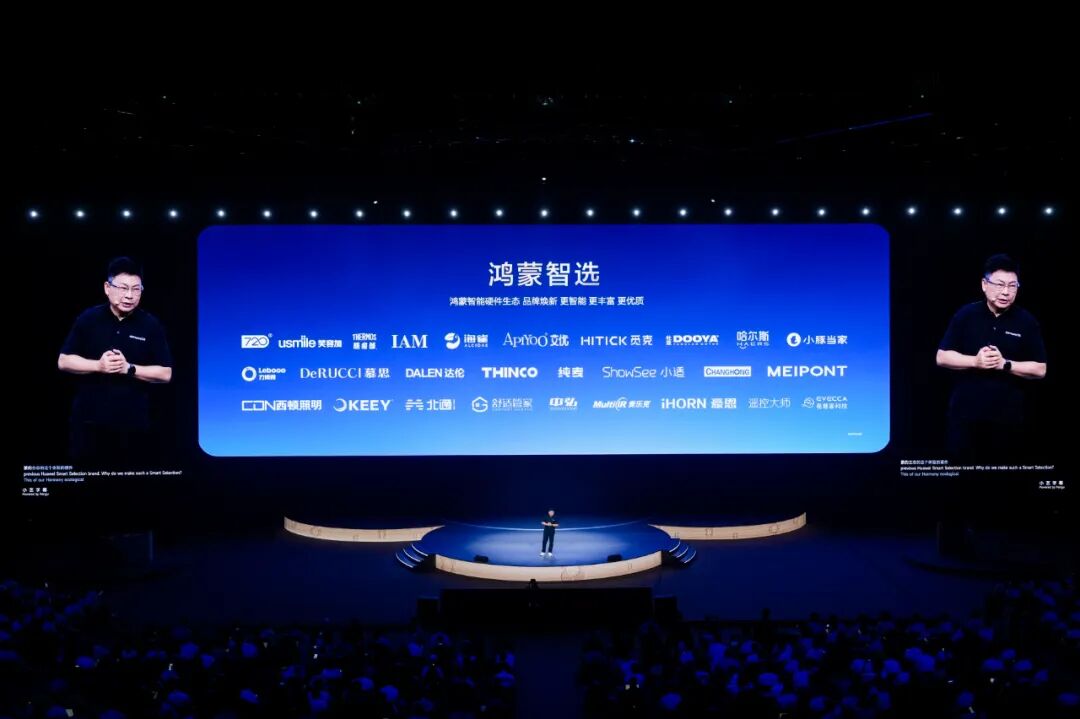
At the HDC2025 event, Yu Chengdong announced the brand upgrade of HarmonyOS Smart Selection
This upgrade focuses on the HarmonyOS and the full-scenario ecosystem, deeply anchors the refinement and upgrade of the scenario experience, and conveys to the industry the determination of HarmonyOS Smart Selection to build a more open and altruistic ecosystem. At the same time, it is also an upgrade of the product strategy. On the basis of the original focus on HarmonyOS Connect technology, it deeply co-creates with partners, helps more products to efficiently and conveniently access the HarmonyOS, creates high-end HarmonyOS ecosystem products, and builds an ecosystem product matrix with quality and experience that can match Huawei's self-developed "1+8" products.
So far, the new positioning of "HarmonyOS Smart Selection" has clearly emerged.

The brand concept of HarmonyOS Smart Selection
It uses strict standards as a "product manager" and a "quality filter". Based on the HarmonyOS, it conducts in-depth co-creation. Through a unified operating system, connection protocol, and interaction standard, it integrates physical devices with different brands and fragmented experiences into an organic collaborative entity. At the same time, centered on the full-scenario experience refinement of Huawei HarmonyOS Smart Home, it enables each ecosystem product to have a consistent high-end texture and smooth user experience, and sets a quality benchmark for the HarmonyOS ecosystem.
Devices and services in different scenarios are no longer information islands. A series of deeply collaborative scenario-based solutions derived from the HarmonyOS ecosystem are gradually reshaping users' lives, enabling individual products to achieve an experience leap from "independent device control" to "space-linked active service".
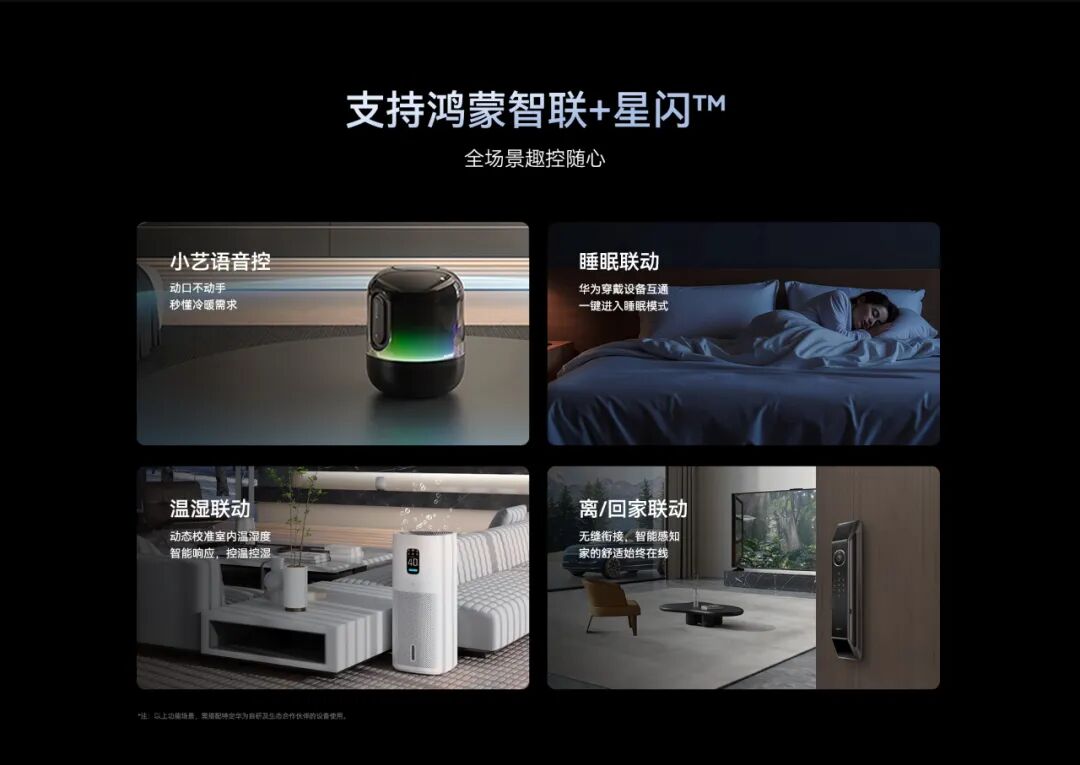
HarmonyOS Connect full-scenario solution
This experience upgrade driven by a systematic ecosystem is gradually infiltrating and changing the lifestyles of tens of millions of families. It attempts to define the next decade of smart hardware, a new era that shifts from competing for single hardware parameters to competing for a complete ecosystem experience.
Driven by user needs
For a long time, there has been a common fragmented experience in the smart home industry: users have different brands of devices and different protocols at home. Even if they achieve a smart scenario in a single space, users need to manually switch and debug between multiple apps.
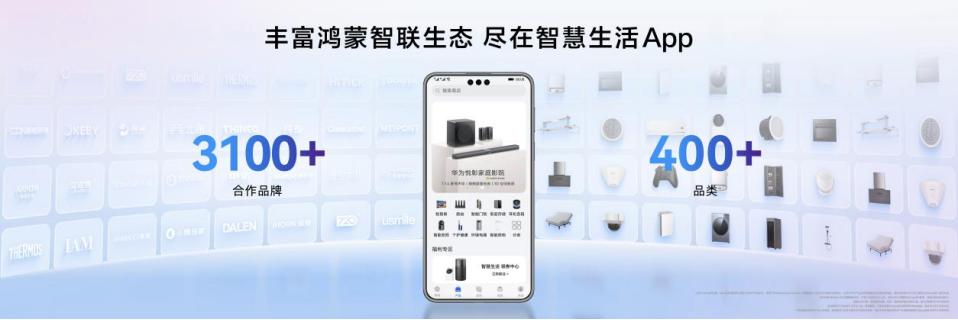
HarmonyOS ecosystem products are uniformly connected to the Smart Life app
The brand upgrade of HarmonyOS Smart Selection essentially precisely caters to the fundamental change in user needs. In the past, users' understanding of products mostly stayed at the single-product function level. For example, a smart air conditioner that can adjust the room temperature or a smart bed that can optimize sleeping postures could meet the basic expectations for the sleep scenario.
However, with the improvement of living standards, user needs have shifted to a scenario-based collaborative experience - pursuing the seamless connection of the whole-house devices actively responding to needs. For example, before going to bed at night, consumers can trigger the "sleep mode" with just one sentence without operating each device one by one. The lights will automatically dim and turn off, the air conditioner will precisely maintain a comfortable temperature, the fresh air system will synchronously switch to the sleep mode, and all devices will cooperate in harmony to achieve a truly smooth experience without intervention.
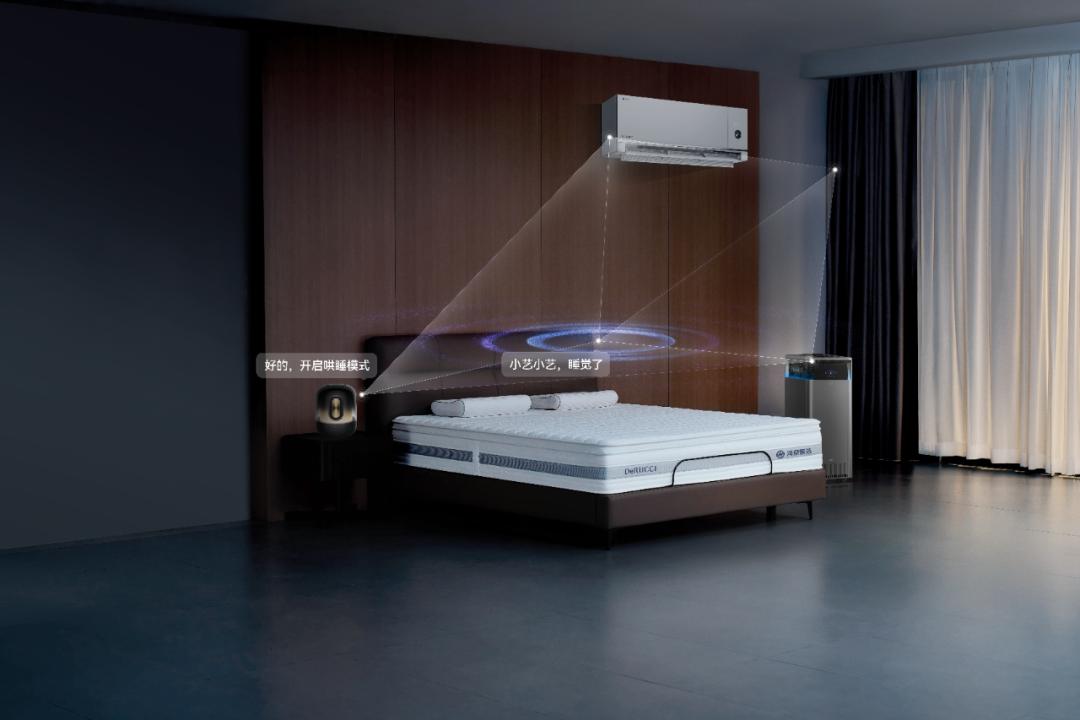
Huawei HarmonyOS Smart Home - Smart Bedroom
However, to turn the scenario-based concept of whole-house device collaboration into a reliable experience that can withstand daily tests, it is obviously difficult to bridge the last mile of the full-scenario experience with just one smart host or one central control screen.
Therefore, Huawei HarmonyOS Smart Home constructs a smart home central framework with the "1+2+N" model. And HarmonyOS Smart Selection is the key link that undertakes and enriches the "N" end ecosystem devices.
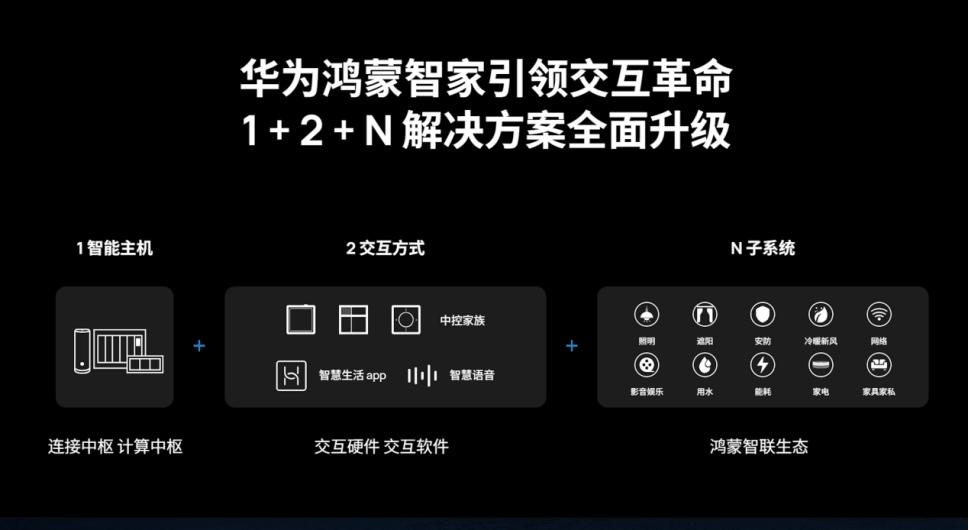
The architecture diagram of Huawei HarmonyOS Smart Home's "1+2+N" model
Among them, "1" is the smart host that acts as the "brain of the smart home", undertaking the core responsibilities of coordinating all device connections, management, and local computing power scheduling, and solving the problems of how to stably connect different brand devices and make them collaborate more intelligently from the bottom layer. "2" is the "interaction nerve" composed of hardware central control such as smart central control screens and software central control such as Xiaoyi voice and the Smart Life app. The former enables users of all ages, including the elderly and children, to easily operate through the touch screen, while the latter simplifies the complex device linkage logic into "one voice command" or "one-key scenario mode", completely eliminating the bottlenecks in users' smooth experience.
However, for a truly operational smart home, the central framework of the "brain" and "nerve" is far from enough. It also needs the support of "N" specific system functions such as air conditioners to adjust the room temperature, lighting to adapt to scenarios, security systems to protect safety, and bathroom facilities to improve comfort. The core advantage of HarmonyOS Smart Selection lies in deeply inheriting Huawei's connection management and interaction design capabilities.
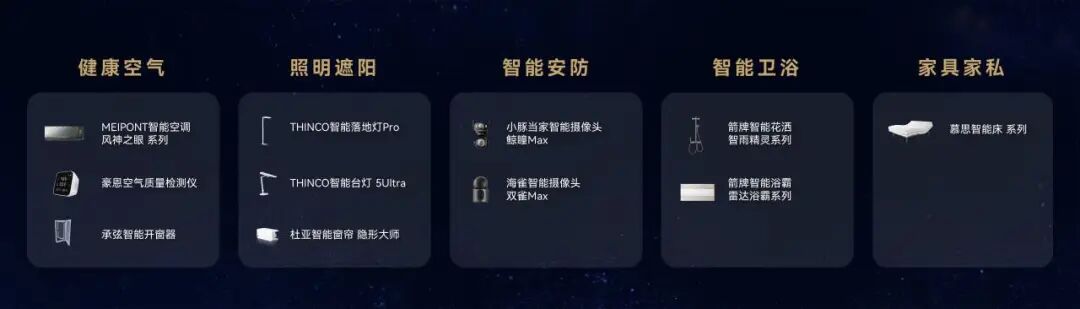
New products of HarmonyOS Smart Selection in 2025
Huawei HarmonyOS Smart Home first defines and builds a unified central framework, providing a stable and consistent experience base for ecosystem devices. Relying on this framework, HarmonyOS Smart Selection, with a lightweight platform ecosystem model, deeply integrates the technological advantages of the HarmonyOS in connection and interaction with the "hard manufacturing" capabilities of its partners, providing high-quality smart terminal products covering the full scenario.
In this process, HarmonyOS Smart Selection partners can concentrate their resources on core technology R & D and manufacturing upgrades, such as improving the cooling efficiency of air conditioners, the heating performance of bathroom heaters, or the filtration technology of water purifiers. The complex cross-brand connection, scenario-based interaction construction, and the most crucial quality control and experience calibration will also be deeply involved and completed by HarmonyOS Smart Selection throughout the process.
HarmonyOS Smart Selection draws on Huawei's experience and processes in creating self-developed products, and applies strict standards throughout the entire product life cycle. From partner selection, R & D process co-construction, to reliability testing and user experience refinement, each link is strictly reviewed by the HarmonyOS Smart Selection team.
This efficient and professional industrial division of labor and quality co-control model not only makes HarmonyOS Smart Selection an important part of supporting Huawei's multi-scenario solutions, but also allows all parties in the ecosystem to create maximum value in their areas of expertise through clear quality benchmarks, and provides users with product choices that are "reliably connected, quality-controllable, and consistent in experience".
More intelligent, high-quality, and full-scenario
As the industry moves from single-product intelligence to whole-house collaboration, most brands are still trapped in category stacking and homogeneous competition. There are many products but different standards, which actually make users fall into the dilemma of "the more devices, the more chaotic the operation".
The difference of HarmonyOS Smart Selection lies in breaking out of the traditional logic of "stacking devices and neglecting linkage". Instead of being a collection of scattered hardware, it conducts systematic construction around real-life scenarios. Its path can be broken down into three cores: "HarmonyOS", "Intelligence", and "Selection", corresponding to three dimensions of intelligence, quality, and full-scenario.
The early development of the smart home industry was once trapped in a simplified concept. Many products were generally classified as smart devices just because they supported remote switching or basic parameter adjustment. In fact, they still did not break away from the logic of "moving the physical remote control to the mobile phone" and were still far from the real intelligence that understands users and provides active services.
The "intelligence" proposed by HarmonyOS Smart Selection is a complete ability that runs through the hardware and the HarmonyOS.
Yang Haisong, the general manager of the OEM ecosystem product area of Huawei Terminal BG, told 36Kr, "It senses the environment and people's states through various sensors distributed in the space and transmits the information to the smart central in real-time. Based on the complete sensing data, the products can make linkage decisions and respond actively. This is not only a closed-loop solution from sensing, decision-making to execution, but also makes the products of HarmonyOS Smart Selection present an intelligence that surpasses the single networking function and approaches a life-like form."
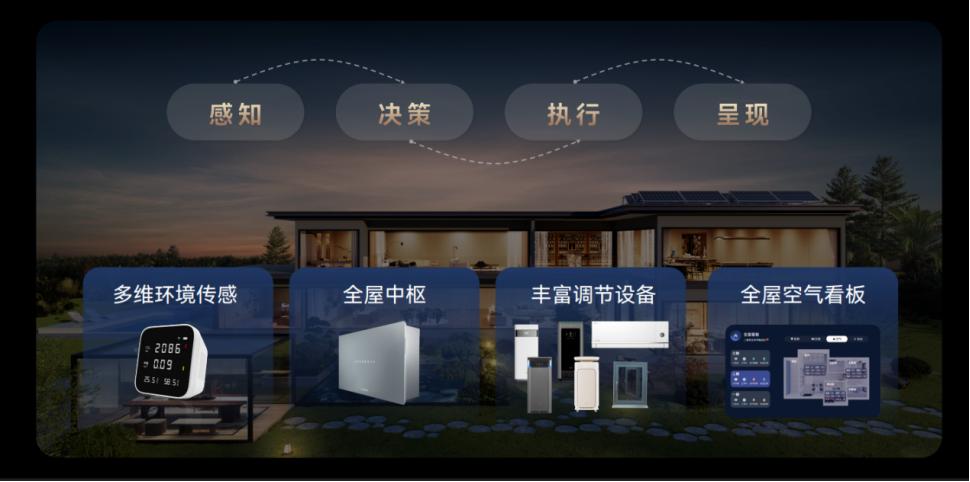
HarmonyOS Smart Selection creates a closed-loop solution through multi-device collaboration
HarmonyOS Smart Selection injects a complete intelligent gene into products, providing full-stack technical support from chips, operating systems to upper-layer applications. On this basis, the R & D team integrates "hardware, system, and scenario" into an integrated solution. The chips ensure computing power and stable connection, the HarmonyOS realizes protocol interoperability between devices, and applications such as the Smart Life app, the Sports & Health app, and Xiaoyi voice form the entrance for users to interact naturally with devices.
Since then, devices no longer passively respond to instructions but have the ability to actively understand scenarios. Through the feature of "full-scenario", the product power is transformed into a perceivable and complete experience.
For example, the "Wind God's Eye" smart air conditioner equipped with millimeter-wave radar can sense the user's position, realizing the function of avoiding blowing directly at people and following people with the wind. The smart bathroom heater can also recognize human movement, avoid direct blowing on the head, provide intelligent heating, and turn on the light when people approach. These are not just parameter stacking but are based on active prediction of behavior. The active healthy air solution uses an air quality detector to monitor the temperature, humidity, and carbon dioxide levels in real-time, and links the smart air conditioner, smart disinfection air purifier, and humidifier to keep the room at a constant temperature and humidity. When the carbon dioxide concentration is too high, it will also link the window opener to automatically open the window for ventilation.
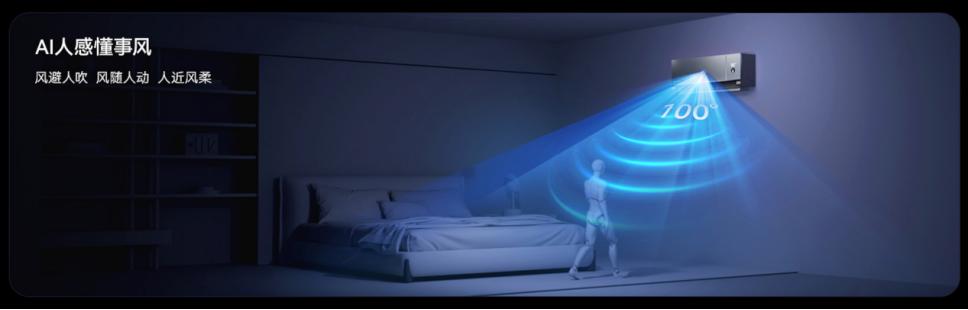
The "Wind God's Eye" smart air conditioner
Relying on the ecological architecture of the HarmonyOS, all devices have a common underlying language, fundamentally breaking the protocol barriers between brands and categories, and realizing smooth dialogue and seamless collaboration across devices.
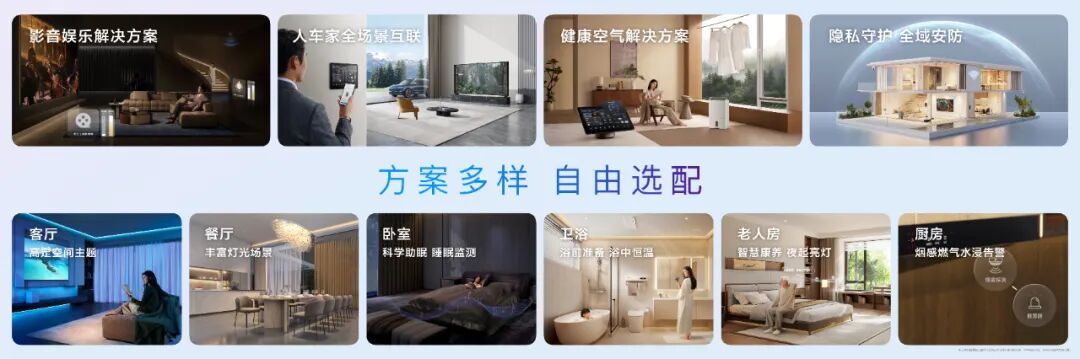
Huawei HarmonyOS Smart Home - Smart Scenarios
Yang Haisong pointed out that the