What's happening at the forefront of the industrial AI transformation? Schneider Electric's Energy and Industry Practices in the "Innov8" Program
The wave of industrial AI is sweeping across, and almost every sector, from energy to industry, is being drawn into the process of digital transformation and intelligent upgrading. However, in the real - world environment of dense production lines, aging equipment, and increasing energy - consumption pressure, many enterprises have gradually realized that simply implementing an AI system and collecting industry data does not mean that the factory has become smarter.
From the initial integration of OT (Operational Technology) and IT (Information Technology) to the current application of large AI models, industrial upgrading is gradually integrating into more detailed and complex aspects of scenarios such as industrial equipment, energy systems, and supply - chain management. Industry concerns have also become more practical and stringent. Beyond the technological advancement, enterprises place more emphasis on how the system can truly operate efficiently and intelligently under high reliability, strong security, and long - term operational pressure.
Against this backdrop, Schneider Electric's platform focused on innovation incubation and result transformation, the "Innovation Win Program", has also sent a clear signal: Global manufacturers across industries are bringing AI from the realm of technological narratives into the system - building process of organizational collaboration and industrial implementation.
The "Innovation Win Program" is jointly hosted by the International Economic and Technological Cooperation Center of the Ministry of Industry and Information Technology and Schneider Electric. By co - creating with small and medium - sized enterprises, developers, industry partners, and customers, it accelerates technological integration and promotes the digital and low - carbon transformation of the industry.
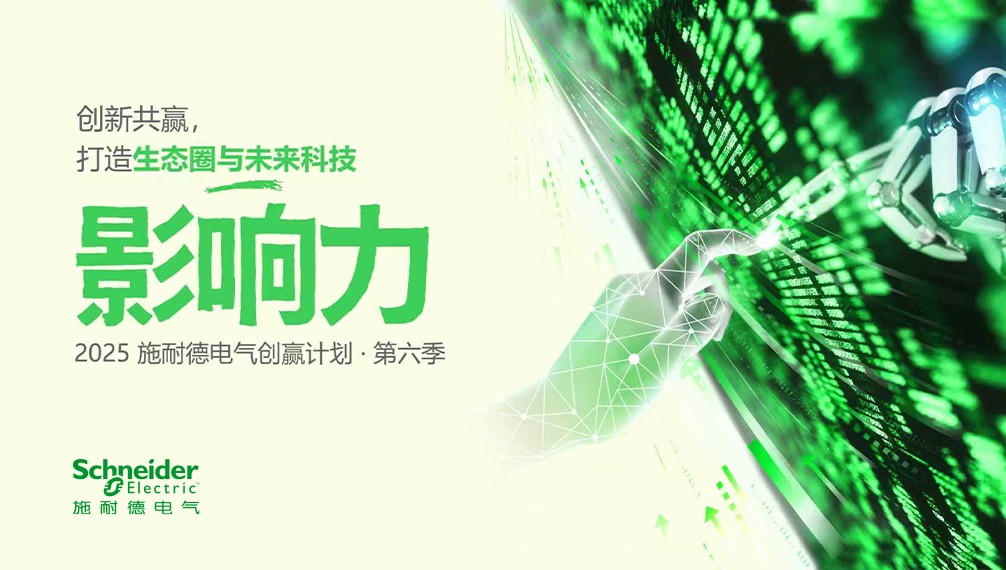
Through exploration and iteration from 2020 to the present, the program has gradually completed the process of scaling up and result transformation from 0 to 1 and then from 1 to N. It has advanced from the initial conceptual design to the verified PoC implementation and the exploration of multi - scenario reuse. Focusing on the two major fields of energy management and intelligent manufacturing, Schneider Electric has attracted more than 1300 small and medium - sized enterprises to participate in the past few years and promoted the incubation of more than 40 joint innovation projects.
From the safety and efficiency of energy systems to the intelligence and reliability of industrial systems, these cases represent many achievements of technological integration and innovation. The project implementations cover multiple industries such as power grids, buildings, chemical engineering, metallurgy, municipalities, and water.
By building a joint innovation platform for small and medium - sized innovative enterprises, Schneider Electric aims to create a more practical industrial - side AI ecosystem, enabling AI not only to define the future at the technological level but also to become a structural capability in manufacturing and energy systems.
From Technology Introduction to Value Co - creation: How the Innovation Win Program "Institutionalizes" Industrial Innovation
Compared with traditional corporate innovation contests or startup camps, Schneider Electric's "Innovation Win Program" is more like a joint innovation mechanism built around the industrial and energy fields: The enterprise provides real - world scenarios, technological platforms, and industrial resources, while the joint innovation team contributes model capabilities, engineering methods, and scenario understanding. Both sides jointly complete the entire process from technological verification to industrial implementation.
During its six - season development, the program has formed a relatively clear operation logic: In the initial stage, there is the "Acceleration Camp" to support projects from 0 to 1 and the "Growth Camp" to promote projects from 1 to N and achieve productization and scaling up. In the later stage, the "AI + Exploration Camp" is set up to specifically explore the combination of AI and various scenarios and promote the verification of cutting - edge concepts (PoC). It now constitutes a complete closed - loop mechanism from experiment to deployment.
Different from short - cycle innovation incubation, the focus of the "Innovation Win Program" is on "depth" rather than "speed". Its core design centers around the complexity, stability, and safety of energy and industrial scenarios. In fields such as energy systems, industrial control systems, and infrastructure networks, any concept - level innovation that cannot pass the test of long - term operation will find it difficult to enter the main industrial process.
In other words, the "Innovation Win Program" places more emphasis on engineering credibility and business sustainability, which is also the reason why the project has gradually gained influence in the industry. Instead of a single explosive product result, it aims to build the infrastructure capabilities for industry - technology collaboration.
From a more macroscopic perspective, another signal sent by Schneider Electric's "Innovation Win Program" is that the competition in China's "AI + Industry" is shifting from model capabilities to system - embedding capabilities. Whoever can integrate into the operation structures of energy systems, manufacturing systems, and urban systems will hold the key to long - term value.
The competitive factors in this field are obviously different from those of C - end products: a longer verification cycle, higher deployment costs, more complex organizational collaboration, and stricter technological compliance requirements. This means that single - point innovation is difficult to form a long - term growth engine, and only platform - level integration capabilities can create a continuously evolving system advantage.
This also explains why Schneider Electric repeatedly emphasizes ecosystem co - construction rather than single - technology breakthroughs in the "Innovation Win Program". In the industrial system, true innovation often occurs at the interfaces, such as the interface between technology and engineering, data and processes, and large enterprises and innovative enterprises.
In this sense, the "Innovation Win Program" constructs not only an innovation incubation project but also a long - term channel for embedding AI into China's industrial system. The five past joint - innovation project cases of the "Innovation Win Program" focused on in this article announce such a possibility: The continuous evolution of this kind of mechanism will directly affect the position of Chinese manufacturing in the next - stage digital competition.
How Can Energy Systems Achieve Intelligent Leapfrog Development?
Against the background of a high proportion of new energy access and the increasing complexity of the power system, the traditional power distribution system in energy infrastructure, which relied on manual inspections and experience - based scheduling, has difficulty coping with high - concurrent loads, uncertain operating conditions, and more stringent requirements for power supply continuity. It needs a more stable and reliable system.
Based on this real - world demand, Schneider Electric's "Innovation Win Program" and its ecosystem partners have been promoting joint - innovation practices in the fields of power distribution, operation and maintenance, and energy management for several years, gradually building an engineering paradigm for the future power system.
In the past projects displayed this year, there are three cases in the energy field: "Digital Twin Power Distribution Room", "Fast - Acting Distribution Network Fault Self - Healing Application Based on Differential + Fiber Optic/5G", and "Comprehensive Renovation Business of Multiple Product Lines in Universities". The partners are TwinNumber Technology, Nanjing Zhihui, and Tuoshen Technology respectively.
All the above joint - innovation solutions have been delivered and implemented to varying degrees, covering industries such as power grids, power supply companies, large industrial parks, subways, commercial buildings, and university buildings.
The "Digital Twin Power Distribution Room" originated from the 2021 Innovation Win Program. It introduced visual decision - making capabilities to the power system. Based on the EcoOS ecological platform, the system constructs a three - dimensional mapping, converging equipment status, operation data, and operation and maintenance processes on a unified interface, making the power distribution system perceptible for the first time from being invisible.
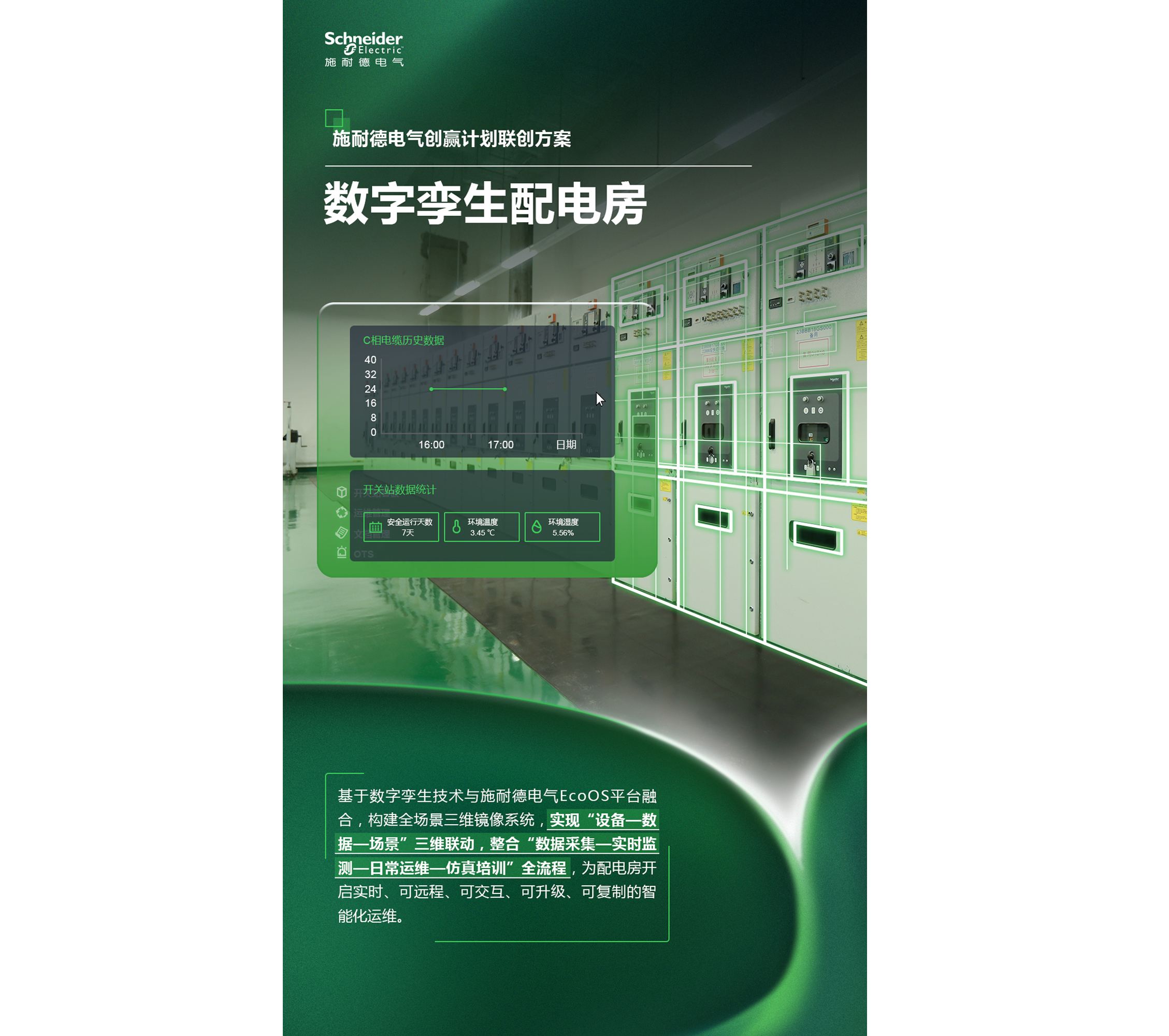
In projects such as the Huairou Science City, this solution has significantly improved long - standing problems such as paper - based account books, information fragmentation, and lagging operation and maintenance, and has been replicated and applied in places like Suzhou. Data shows that the project has reduced the operation and maintenance response time by about 30%, improved the training efficiency by 50%, and the cumulative implementation amount has reached tens of millions of yuan, becoming an early example of the large - scale application of digital twin technology in the power distribution field.
To solve problems such as difficult differential coordination in the distribution network, wide - range power outages, and slow fault recovery, the "Fast - Acting Distribution Network Fault Self - Healing Application Based on Differential + Fiber Optic/5G", as a more engineering - oriented underlying capability, combines differential optical differential technology with fiber optic and 5G to create a differential self - healing device. It enables millisecond - level fault location and automatic isolation, giving the power distribution system self - repair capabilities, breaking through the bottleneck of improving power grid operation reliability, and creating a new defense line for safe and reliable power consumption.
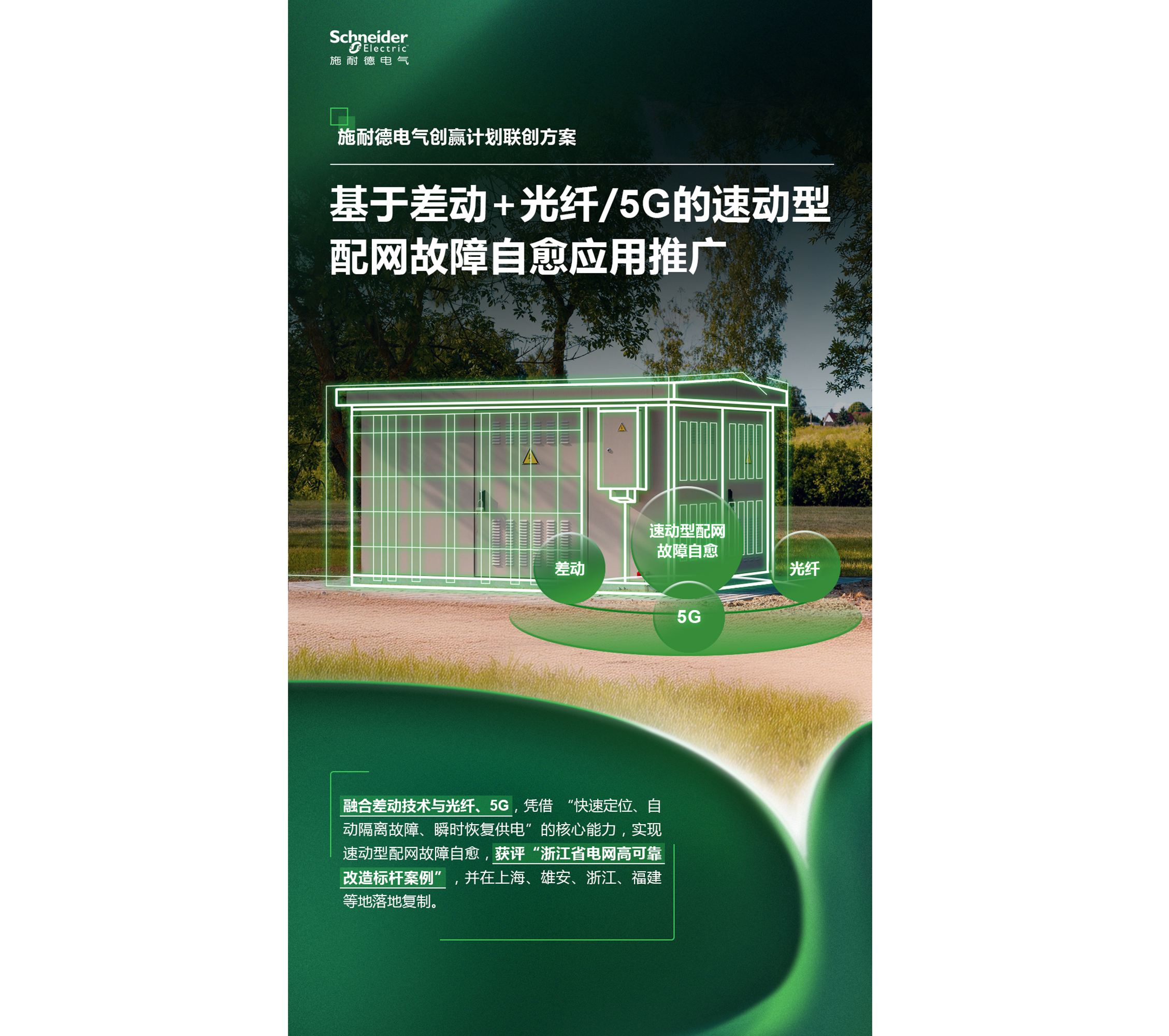
In deployment practices in places like Zhejiang, the system has achieved coordinated control among multiple sites and has been rated as a benchmark case for high - reliability transformation of regional power grids. In the engineering context, this kind of device is evolving from an emergency facility to an infrastructure, providing necessary safety redundancy for power grids with a high proportion of new energy.
In addition, the intelligence of energy systems is further extending to the energy - consumption end. The Campus Power Intelligent Management System uses AI current fingerprints and load recognition algorithms to convert power - consumption behaviors in the complex scenarios of universities into a manageable and predictable parameter system, which can provide a basis for refined management of cities, industrial parks, and public facilities in the long run.

Currently, in the renovation projects of many universities, the system is used to solve long - standing problems such as aging facilities, inefficient manual inspections, and insufficient power supply reliability. It also provides a replicable path for smart industrial parks and complex public facilities. Its significance lies not only in energy - saving management but also in verifying a future path: The energy system may gradually shift from a single - dispatch network to a system composed of a large number of intelligent nodes with perception and decision - making capabilities.
Compared with the results incubated by traditional innovation contest models, the joint - innovation solutions from the "Innovation Win Program" have a more realistic and detailed industrial perspective and are more implementable. From the dispatch center to the load end, they have truly identified the pain points and granularity of enterprises' energy - management needs.
Operable and Low - Disturbance: The Practical Solution for Industrial Intelligence
Similar to the energy system, the challenge in the industrial field is how to complete intelligent upgrading without interrupting production. In reality, factories often have a long operation period and seriously heterogeneous systems, making replacement - style transformation infeasible in most cases.
Under this constraint, the joint - innovation practice of Schneider Electric's "Innovation Win Program" emphasizes embedding intelligent capabilities into the existing system to achieve gradual evolution.
Among them, two solutions focus on deepening the operation and maintenance mode and system collaboration. They are "Industrial Zero - Trust Solution" and "Predictive Maintenance Platform for Transmission Systems (ATV Predict Plus)". The partners are Fangtewang and Huidu Intelligence. These solutions have been implemented in industries such as chemical engineering, metallurgy, and municipal water.
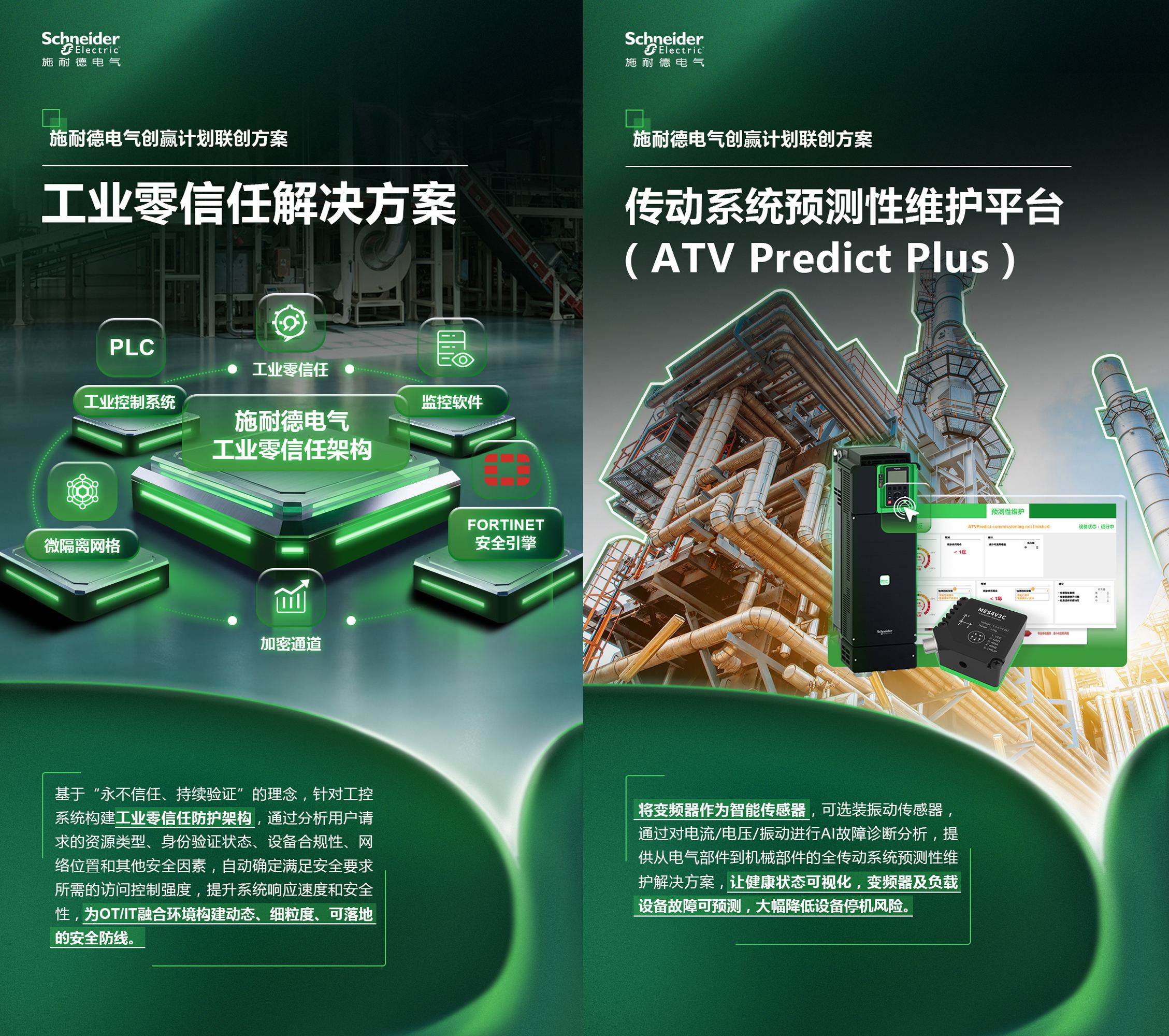
In the process of digital transformation, the boundaries of traditional industrial networks are becoming increasingly blurred. The internal network is no longer trustworthy, simple passwords cannot protect accounts, and key equipment is vulnerable to attacks. The industrial zero - trust security architecture that emerged in 2023 is a response to this real - world environment.
The industrial zero - trust security architecture systematically introduces the "zero - trust" concept of information security into the field of industrial control systems for the first time. Through mechanisms such as identity authentication, micro - segmentation, and software - defined boundaries, it provides refined protection for key assets and improves the system security level without affecting continuous production.
Currently, in project practices in places like Qingdao, Wenzhou, and Jinzhou, the architecture has achieved hierarchical protection of key assets. It can not only respond to protection requirements but also solve pain points such as the difficulty of protecting trusted areas and the vulnerability of traditional authentication methods. It has become an important underlying defense line in the industrial digitalization process. In addition, the system has also won many project contracts in foreign markets.
Beyond security issues, another transformation bottleneck in the industrial scenario lies in the potential impact of equipment operating status. For example, transmission equipment failures can affect product quality, unplanned downtime can affect production efficiency and cost, and abnormal shutdowns may lead to safety accidents.
The ATV Predict Plus Predictive Maintenance Platform for Transmission Systems can specifically address the above - mentioned problem scenarios. Taking the frequency converter as the data entry point, it directly embeds AI capabilities into the equipment layer to achieve health monitoring and failure prediction for core systems such as motors, pumps, and fans. By using embedded algorithms to identify failure trends in advance, it reduces the hidden costs caused by unplanned downtime.
Compared with the traditional operation and maintenance mode, its advantage is not in seeing more but in judging earlier. By using embedded models to identify trending anomalies, it enables operation and maintenance to shift from passive repair to pre - intervention. It can not only predict faults in frequency converters but also in power loads for customers.
The platform has currently completed the design of the delivery solution, and the pilot project is being implemented and was delivered in December. Data from the pilot project shows that the solution can increase equipment utilization by about 17%, reduce maintenance costs by about 25%, and significantly reduce production losses caused by unplanned downtime. This means that for the first time, the reliability in the industrial production environment has a calculable and predictable technical connotation.
These two practices reflect the consensus path for the intelligentization of industrial systems. Instead of pursuing overall reconstruction, they use AI as a supplementary tool at key nodes to embed intelligent mechanisms, enabling complex systems to gradually evolve within a controllable range.
Conclusion:
Whether it is the digital twin of power distribution rooms and the millisecond - level self - healing system in the energy field or the zero - trust architecture and predictive maintenance in the industrial field, these cases all point to a clearer trend: The most relevant factor for the intelligentization of industry and energy is not the model level or computing power but a profound transformation centered on long - term system operation, engineering feasibility, and industrial collaboration capabilities.
This is where the value of Schneider Electric's "Innovation Win Program" lies - Through its joint - innovation mechanism with small and medium - sized innovative teams, it enables capabilities that are truly implementable, sustainable, and compatible with the existing system to gradually take shape. This institutionalized innovation approach enables technology to move from concept to engineering and systemization, creating a more long - term and stable intelligent foundation for the industry.
From a broader perspective, the next - stage competition in traditional industries will revolve around whether AI can integrate into the system structure and be deeply coupled with engineering logic. This is related to whether enterprises' intelligentization levels can be stably accumulated in their respective core industrial scenarios.
As industries enter the deep - water area of AI - driven transformation, how should enterprises position themselves?
The path provided by Schneider Electric's "Innovation Win Program" may serve as an important reference for the future industrial upgrading of more small and medium - sized innovative enterprises. By participating in a joint - innovation path similar to the "Innovation Win Program", they can explore more industry - valuable and era - appropriate AI solutions and become the creators and beneficiaries of technological dividends.