The mysterious embodied AI team that raised 1.7 billion yuan in angel round financing responds to 11 key questions
Text by | Wang Xin
Edited by | Su Jianxun
In the bustling entrepreneurial wave of embodied intelligence in 2025, "TARS Navigation" has an absolutely eye - catching strength.
This is a "dream team" composed of core executives from the domestic intelligent driving "Whampoa Military Academy". Chen Yilun, the CEO of TARS Navigation, once served as the CTO of the autonomous driving system at Huawei's Vehicle BU; Ding Wenchao, the chief scientist, was once a "Genius Youth" at Huawei. Li Zhenyu, the chairman, once served as the former president of Baidu's Intelligent Driving Business Group and built the world's largest Robotaxi travel platform, "Luobo Kuaipao".
In the autonomous driving industry, both Chen Yilun and Li Zhenyu are "famous generals" who have led teams of thousands and won battles. Their joint entrepreneurship has quickly made TARS Navigation the darling of capital. In March this year, TARS Navigation set a record for the largest angel - round financing in China's embodied intelligence industry with a financing amount of $120 million.
Capital values TARS Navigation's technical accumulation and talent reserve. Wang Huai, the founder and CEO of Linear Capital, once evaluated TARS Navigation like this: "They can apply the experience of hardware and software polishing in Huawei's autonomous driving to embodied robots, combined with the thinking and reasoning ability of large models."
Despite breaking the angel - round financing record and having such a luxurious founding team, unlike other embodied intelligence companies that frequently disclose shipment volumes and technological breakthroughs, TARS Navigation rarely announced its progress in 2025.
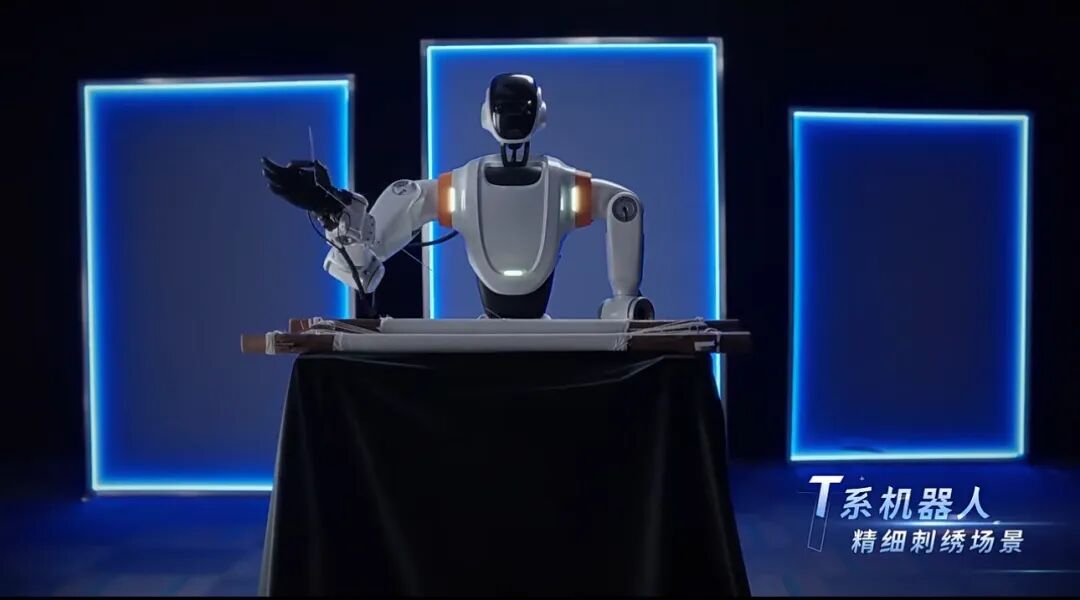
Image source: TARS Navigation
On December 19th, TARS Navigation held an online press conference that lasted only 40 minutes. The achievement displayed was "the world's first robot to complete embroidery".
Why choose this scenario? "This is the spill - over of our current technical capabilities," Chen Yilun, the CEO of TARS Navigation, told "Intelligent Emergence". The technical capabilities he mentioned refer to long - range (including multi - step tasks), fine and complex (similar to embroidery) movement problems, and the operation objects are flexible and difficult - to - model objects.
Currently, the embodied industry commonly uses tasks such as grasping, folding clothes, and pouring coffee to demonstrate technical capabilities. According to TARS Navigation's official disclosure, no enterprise has publicly demonstrated the robot embroidery ability before. This is because for robots, handling flexible objects is much more difficult than handling rigid objects.
The general VLA has difficulty handling this problem. VLA is essentially a vision - guided task, so it naturally has bottlenecks in the perception dimensions of force or touch. Therefore, we can see that the industry's exploration in vision has gradually converged, but there is no consensus in the industry on how to handle force or touch, and there is no unified data collection method.
The world model can solve this problem. This is also one of TARS Navigation's important business segments. TARS has built its embodied basic model - TARS AWE (AI World Engine) 2.0. It migrates the data collected from the real world to the robot body through one - stage whole - body end - to - end learning.
The difficulty in handling flexible objects lies in - not only knowing how to move oneself but also knowing how the environment will evolve after the movement, and needing to make changes in response to the changes. The world model can precisely solve this core contradiction. It can predict two key factors: first, what actions to take after seeing the scene, and second, building a model to simulate how the world will change after the action.
The core challenge of the world model lies in data and spatial perception.
How to address this challenge? Chen Yilun, the CEO of TARS Navigation, and Ding Wenchao, the chief scientist, recalled the technical thinking they had accumulated during their time in the intelligent driving field. They found that many problems in the embodied industry can find answers in the development process of intelligent driving.
At the 2025 RMB Fund Partners' Annual Meeting of BlueRun Ventures, Chen Yilun once mentioned that when he left Huawei's autonomous driving team in 2022, the last product feature he delivered was an end - to - end system. After deploying it in a very complex urban village scene with a mix of people and vehicles, the engineers were amazed by its flexible and intelligent traversing effect. A black - box neural network could achieve amazing results only through end - to - end operation. At that moment, he realized that the era of algorithms replacing complex engineering stacks had arrived.
In this process, he gradually discovered the overlap between intelligent driving and embodiment: "Autonomous driving and robot technology have the same origin. The early autonomous driving technology stack all came from the robot team. When end - to - end showed great power in autonomous driving, I firmly believed that there must be a corresponding all - AI algorithm stack in robot technology itself."
"The current stage of embodiment is equivalent to the year 2019 in intelligent driving," Chen Yilun told "Intelligent Emergence". "When problems come in like snowflakes, we began to seriously think about how to truly scale up intelligent driving so that the ability to solve problems is higher than the ability to discover problems."
Similar to the current embodied industry, the bottleneck at that time was also the lack of data. Chen Yilun observed that to break through the data barrier in intelligent driving, 100,000 hours of carefully selected high - quality data segments were needed. Due to the high complexity of tasks in embodied intelligence, the data requirement is at least an order of magnitude higher, requiring at least 1 million hours of real - world scenario data.
This established TARS Navigation's technical main line: self - developed embodied data collection system SenseHub (including gloves and panoramic cameras) to collect environmental semantic data sets of actions, languages, and tactile sensations in real human scenarios. Based on these real data, further build the embodied basic model TARS AWE 2.0.
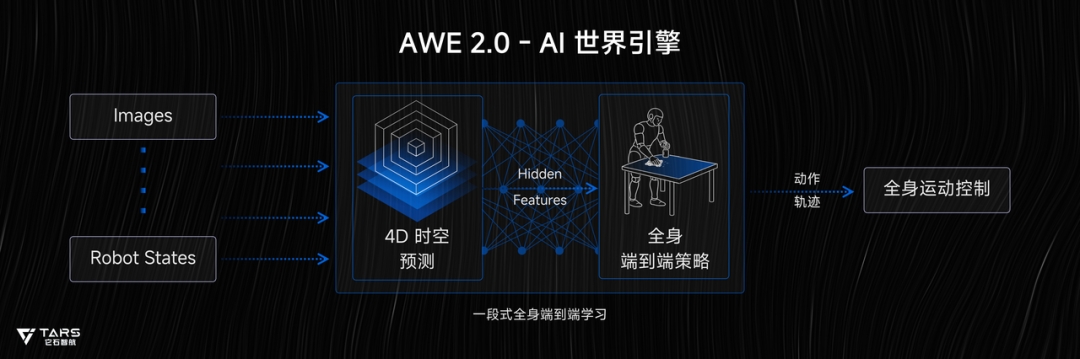
Image source: TARS Navigation
In the eyes of Chen Yilun and Ding Wenchao, this is the shortest path to explore the feasibility of the Scaling Law in embodied intelligence, that is, enabling robots to develop abilities such as embroidery by inputting enough data.
They also see the prospect of this ability: "Only by handling flexible objects well can we truly achieve flexible production - line - level productivity and truly automate every corner of the factory."
The following is a dialogue between "Intelligent Emergence" and Chen Yilun, the CEO of TARS Navigation, and Ding Wenchao, the chief scientist, with the content sorted and edited:
1. Q: Is the embroidery robot displayed at the press conference a demo to showcase the robot's ability, or will this device be mass - produced in the future?
Chen Yilun: Mass production will be for specific industrial scenarios. This embroidery demonstration is an overflow of the robot's ability.
2. Q: What exactly does this overflow of ability refer to?
Chen Yilun: This generation of embodied robots should solve long - range, fine, and complex movement problems, and the operation objects are flexible and difficult - to - model objects. The previous generation of robots has done well in grasping solid and large objects.
3. Q: Which specific factories or work links will you choose as the implementation scenarios?
Chen Yilun: We have three core principles for screening implementation scenarios: real demand, which must come from clear pain points in the market; fine granularity, where the solution can cover a large enough group; high difficulty, where real demand and a large market often mean extremely high technical thresholds, which is our core competitiveness. Take flexible assembly as an example. This is a very clear implementation scenario and has now entered the commercialization stage.
4. Q: Compared with other embodied companies, you are very low - key in the industry. The outside world is also very concerned about your progress. Could you introduce some of the main key progress made in 2025?
Chen Yilun: We are doing three things - super algorithm, super ontology, and super intelligence.
Super algorithm: We believe it is a large - scale AI system more complex than the intelligent driving system, which needs to overcome the data barrier, the algorithm barrier, and the Scaling law at the environmental interaction level.
Super ontology: We insist on self - developing hardware. The goal is to have the ability to "design hardware for AI at will" to ensure that the hardware becomes the best carrier of the algorithm in the physical world, rather than a simple basic assembly.
Super application: What we pursue is to truly achieve industrialization, allowing technology to transmit real commercial value as a production tool or service, rather than just creating a demo.
5. Q: Is there a quantitative threshold for the data barrier?
Chen Yilun: To achieve commercial - grade autonomous driving, 100,000 hours of carefully selected high - quality data segments are required. Due to the high complexity of tasks in embodied intelligence, we judge that the required data volume is at least 10 times that of intelligent driving, that is, starting from 1 million hours.
You can imagine how to obtain these 1 million hours? And it needs to be collected in real scenarios.
The data of large language models comes from the real text data of humans on the Internet, and the data of autonomous driving comes from the real driving data of humans. Therefore, we believe that embodied data should also come from the sensory and behavioral data of humans.
6. Q: Is the data collection device in the demonstration video the glove?
Chen Yilun: Yes. We pioneered the Human Centric (human - centered) new data collection paradigm. We believe that embodied data should come from the real sensory and behavioral data of humans, with the core being the "hands" and "eyes", achieving "seeing what humans see and feeling what humans feel". This self - developed glove and panoramic camera device is more complex than the existing solutions on the market and can restore the position and tactile weight information of the hand with high fidelity. Even if you put the glove inside a quilt, I can still know where it is.
When we were working on autonomous driving lidar before, the measurement accuracy could reach the centimeter level. But for robot operation, the centimeter level is far from enough - it must reach the millimeter level or even higher.
7. Q: Are there any commonalities between the autonomous driving and embodied intelligence fields? Different entrepreneurs have different views on this. What's your opinion?
Chen Yilun: Autonomous driving is a decade - long track. Teams with different backgrounds enter the autonomous driving track at different times, so they see different things.
In my opinion, the problems and challenges encountered in the current AI field are almost the same as those I encountered when I first started working on autonomous driving, and corresponding solutions can be found.
We divide the development of embodied intelligence into three 3 - year stages. The first three years may be mainly for demo demonstrations. We entered during the second three - year period, which is the process of truly implementing fancy technologies into productization. The greatest magic of our team is that we have fully experienced the engineering process of autonomous driving.
We used to receive a snowflake of problems from users. How to solve so many user problems, how to allocate the data? How to train? And how to connect the data to the model and build the entire data closed - loop? In fact, our entire team has gone through the tempering of these problems.
So we are confident in doing a good job in the entire engineering link from data to model in the embodied field.
8. Q: Which year in intelligent driving do you think the current stage is equivalent to?
Chen Yilun: 2019. 2019 was the key point when the entire intelligent driving stack turned to AI, and leading companies began to think about large - scale commercialization. The bottleneck at that time was the lack of enough data and how to match the data with the algorithm ability. In 2022, autonomous driving technology began to spread to the industry, and the prosperity of autonomous driving in the public view started in 2022. The current situation of embodied intelligence is very similar to that of autonomous driving at that time: problems are pouring in like "snowflakes", forcing the industry to improve the problem - solving efficiency in an AI way (such as end - to - end).
9. Q: In the field of embodied intelligence, are the bottlenecks also the cost of data collection and the problem of large - scale implementation?
Chen Yilun: First, how to obtain a large amount of satisfactory data in a limited way. Second, how to obtain a continuous stream of real data in the process.
10. Q: So is the bottleneck we encounter in AI algorithms because the data is not good enough or not enough?
Chen Yilun: The essence of AI is a function that maps X to Y. The emergence of intelligence requires enough real - world data for compression. Without enough data, intelligence cannot be compressed.
11. Q: How do you define TARS Navigation? Is it an AI company, a robot company, a brain company, or an ontology company?
Chen Yilun: We believe that the next - generation super single product may be the robot. We do these three things (hardware/software/AI) together. All hardware serves AI, and the goal is to create a complete product value and build a complete and sustainable evolving system.
Cover source | AI - generated