Andrew Ng's year-end summary: 2025 is the dawn of the AI industrial era.
2025 is coming to an end.
Readers who follow the AI circle know that this year has been a year of intense competition among AI giants, a year of frequent talent wars and organizational restructurings, a year of an extremely fierce arms race in large models, and a year of rapid development in AI infrastructure construction...
At the end of this remarkable year, our old friend, Professor Andrew Ng, a visiting professor of computer science at Stanford University, former head of AI at Baidu, and former head of Google Brain, released his annual tradition: a letter and an annual summary of the artificial intelligence field in 2025.
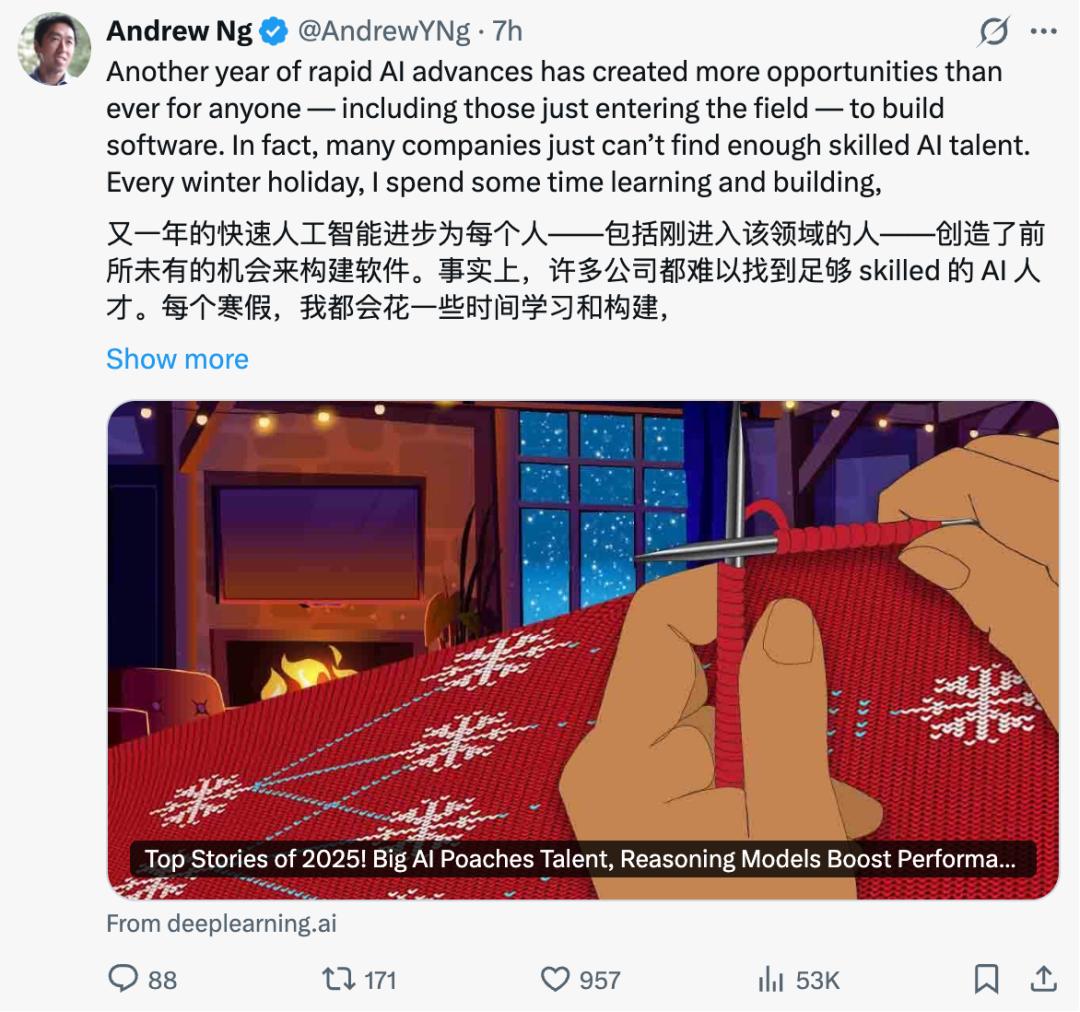
Year-End Message: Three Golden Keys
The New Year's Day holiday is approaching, and so are the wonderful winter vacations for students and the Spring Festival holiday. "Never stop learning" is an old adage before holidays, especially for those who hope to seek development opportunities in the rapidly evolving and highly competitive field of artificial intelligence. Andrew Ng shared his insights on what to do and how to do it in this year's letter.
Here is the full text of the open letter:
Dear friends,
Once again, AI has advanced at an astonishing pace, creating unprecedented software development opportunities for everyone, including newcomers to the field. In fact, one of the biggest challenges many companies face today is finding enough engineers who truly understand AI.
Every winter holiday, I set aside some time to learn and build projects hands-on, and I hope you will do the same. This not only helps me refine my existing skills and acquire new knowledge but also significantly promotes your technical career development.
To truly have the ability to build AI systems, I suggest you do three things:
Systematically study AI courses
Continuously build AI systems hands-on
(Optional) Read research papers
Now, let me explain why these three points are so important.
I often hear some developers advise others, "Don't study; just start doing it." This is very bad advice! Unless you are already in a community of experienced AI developers, starting without understanding the basics of AI can easily lead you to reinvent the wheel or, even worse, make a mess of it.
For example, in interviews, I've seen many candidates reinvent a standard RAG document segmentation strategy, re-implement mature Agentic AI evaluation methods, and write chaotic and hard-to-maintain LLM context management code. If they had taken a few relevant courses in advance, they would have a better understanding of which "building blocks" already exist in the industry. They could still choose to implement these modules from scratch or even invent better methods than the existing ones, but at least they could avoid wasting weeks going down the wrong path.
Therefore, structured learning is crucial.
To be honest, I personally find taking courses very interesting. Instead of watching Netflix, I'd rather open a course by an excellent AI instructor to learn at any time.
At the same time, just taking courses is not enough. There is a lot of important experience that can only be truly learned through hands-on practice. Learning the theory of how an airplane works is, of course, very important for becoming a pilot, but no one has ever learned to fly an airplane just by taking courses. At some point, actually sitting in the cockpit is essential! The good news is that with the emergence of highly intelligent programming assistants, the threshold for hands-on building has never been lower. And when you start learning about the various building blocks of AI, they often inspire new ideas about "what else can be done." If I can't find inspiration for a project for a while, I usually take a few courses or read some research papers. After persevering for some time, I always come up with a lot of new project ideas. And, to be honest, I find "making things" really fun, and I hope you can also experience this joy!
Finally, not everyone has to do this, but I've noticed that the strongest candidates in the job market these days almost always read research papers occasionally. Although in my opinion, papers are much harder to digest than courses, they contain a lot of cutting-edge knowledge that hasn't been translated into a more understandable form. I would prioritize reading papers after courses and practice, but if you have the opportunity to improve your paper-reading ability, I still strongly recommend that you do so. (You can also watch a video I made before about how to read papers.) Taking courses and building hands-on are fun for me, while reading papers is more like a "grind," but the occasional insights from papers are truly rewarding.
I wish you a wonderful winter vacation and a happy new year. Besides learning and creating, I also hope you can spend more time with your family - that's also very important!
Love,
Andrew
Year-End Summary: The Dawn of the AI Industrial Age
2025 has truly been an extraordinary year.
As an annual tradition, Andrew Ng's year-end summary takes us through the most important AI events and development trends of the year.
In 2022, it was a glorious year for AI. Systems capable of generating text, images, videos, music, and code were on the horizon, sparking discussions about the future of creativity.
In 2023, it was a year of innovation and anxiety. The wave of generative AI swept across all industries, and its expanding capabilities raised concerns that intelligent machines might make humans obsolete.
In 2024, it was a year of blizzard-like progress. Artificial intelligence made breakthroughs. Intelligent agent systems improved their ability to reason, use tools, and control desktop applications. Smaller models became widely popular, many of which were more powerful and cheaper than their predecessors.
2025 may be remembered as the dawn of the AI industrial age. Let's follow Andrew Ng's perspective to explore the most representative AI events of 2025.

Article link: https://www.deeplearning.ai/the-batch/issue-333/
Reasoning Models Solve Bigger Problems
At the end of last year, OpenAI launched its first reasoning model, o1, embedding an agentic reasoning workflow. In January this year, DeepSeek - R1 showed the world how to build this ability. The result was an immediate improvement in mathematics and programming performance, more accurate problem answers, stronger robot capabilities, and rapid progress in AI agents.

At the beginning of 2025, models would only execute reasoning strategies when explicitly prompted. Now, most new large language models do this by default, significantly improving performance on a wide range of tasks.
The earliest batch of reasoning models were trained through RL and were specifically designed to solve mathematical problems correctly, answer scientific questions accurately, and generate code that could pass unit tests. For example, o1 - preview scored 43 percentage points higher than its non - reasoning predecessor, GPT - 4o, on the AIME 2024 and 22 percentage points higher on the GPQA Diamond; in Codeforces programming problems, its performance was at the 62nd percentile among human competitive programmers, while GPT - 4o was only at the 11th percentile.
When reasoning models learn to use tools such as calculators, search engines, or bash terminals, their performance further improves. For example, in a high - difficulty test covering 100 fields that examines multimodal understanding and technical expertise, OpenAI o4 - mini with tools achieved an accuracy of 17.7%, more than 3 percentage points higher than without tools.
Robot action models also learned to reason through RL. For example, by rewarding ThinkAct for reaching the target position, its performance on robot tasks improved by about 8% compared to models without thinking ability (such as OpenVLA).
Reasoning models also help agents handle complex problems. For example, AlphaEvolve used Google Gemini to repeatedly generate, evaluate, and modify code, ultimately producing faster algorithms for real - world problems. One of its achievements was proposing a hypothesis for a long - unsolved problem explaining microbial drug resistance; human scientists independently proposed and verified the same hypothesis almost at the same time.
Reasoning ability significantly improves the performance of LLMs, but better output comes with a cost. When running the Artificial Analysis's Intelligence Index benchmark with reasoning enabled, Gemini 3 Flash consumed 160 million tokens (scoring 71), while with reasoning disabled, it only consumed 7.4 million tokens (scoring significantly lower, at 55). Additionally, generating reasoning tokens delays the output, which also puts greater performance pressure on LLM reasoning service providers. However, researchers are working hard to improve efficiency. Claude Opus 4.5 and GPT - 5.1 achieved the same Intelligence Index score under high - reasoning settings, but the former consumed 48 million tokens, while the latter consumed 81 million tokens.
High Salaries Attract Top AI Talent
Leading AI companies have launched a fierce talent war, offering salaries comparable to those of professional sports stars to poach top talent from their competitors.
In July, Meta launched a large - scale recruitment drive to build a team for its newly established Meta Superintelligence Labs, offering packages worth hundreds of millions of dollars to researchers from top AI companies such as OpenAI, Google, and Anthropic. In response, Meta's competitors poached key employees from Meta and each other, driving up the market value of AI talent to unprecedented levels.

According to The Wall Street Journal, after successfully recruiting Alexandr Wang and his core team members, Meta CEO Mark Zuckerberg made a "wish list."
To persuade people to switch jobs, Zuckerberg even visited them in person, sometimes bringing homemade soup. This effort successfully recruited talents including Jason Wei and Hyung Won Chung from OpenAI, both of whom are core researchers of reasoning models.
The Wall Street Journal reported that Andrew Tulloch, who co - founded the Thinking Machines Lab with former OpenAI CTO Mira Murati, initially rejected Meta's offer, which included a bonus worth $1.5 billion. A few months later, he changed his mind and joined Meta.
Meta also hired Ruoming Pang, who previously oversaw Apple's AI models. According to Bloomberg, his compensation package will total hundreds of millions of dollars over several years. Meta's offer exceeded the compensation of Apple's top - level executives except for the CEO, and Apple chose not to match it.
In this talent shuffle, Microsoft AI CEO Mustafa Suleyman took more than 20 researchers and engineers from Google, including Engineering Vice President Amar Subramanya.
Elon Musk's xAI poached more than a dozen AI researchers and engineers from Meta. Musk criticized the "crazy" offers from competitors and emphasized his company's "extremely ability - oriented" culture and the greater growth potential of equity.
As 2026 approaches, the AI recruitment landscape has changed significantly. According to The Wall Street Journal, to resist headhunters, OpenAI offers a higher proportion of stock - based compensation than its competitors, accelerates the vesting of new employees' stock options, and pays retention bonuses of up to $1.5 million.
Despite the discussion about the AI bubble in 2025, for companies planning to invest tens of billions of dollars in building AI data centers, high salaries are a completely rational choice: If you're willing to spend so much on hardware, why not spend a small portion of it on talent compensation?
A Data Center Construction Craze Sweeps the Globe
Leading AI companies have announced huge construction plans, expected to spend trillions of dollars in the next few years and consume gigawatts (GW) of electricity.
Just this year, the capital expenditure in the AI industry exceeded $300 billion, with most of it going towards building new data centers to handle AI tasks. This is just the "appetizer," as companies are planning grand blueprints - building facilities as large as small towns and consuming as much energy as medium - sized cities. According to McKinsey's prediction, to build enough computing power to meet the expected reasoning and training needs, the cost of this race could reach $5.2 trillion by 2030.

OpenAI: In January, OpenAI launched the $500 - billion "Stargate" project in cooperation with Oracle, SoftBank, and UAE investment firm MGX. The company finally announced plans to build 20 GW of data center capacity globally and predicted that the demand would be five times that number. OpenAI CEO Sam Altman said he hopes to ultimately increase the capacity by 1 GW per week.
Meta: In 2025, it invested approximately $72 billion in infrastructure projects, and executives said the figure would increase significantly in 2026. Its Hyperion project includes building a $27 - billion, 5 - GW data center in rural Louisiana.
Microsoft: In 2025, its global data center project expenditure reached $80 billion, including facilities in Wisconsin and Atlanta, which will be connected via a dedicated fiber - optic network and operate as a huge supercomputer. The company also promised to expand its cloud and AI capacity in Europe to 200 data centers.
Amazon: It is expected to spend $125 billion on infrastructure in 2025 and more in 2026. Its $11 - billion "Project Rainier" is a 2.2 - GW data center in Indiana that will run 500,000 Amazon Trainium 2 chips. Additionally, Amazon plans to spend approximately $14 billion to expand its data centers in Australia from 2025 to 2029 and invest approximately $21 billion in Germany.
Alphabet (Google's parent company): It is expected to spend up to $93 billion on infrastructure in 2025, higher than the previously predicted $75 billion. The company announced a $40 - billion plan to add three data centers in Texas by 2027. It also promised to invest $15 billion in India, announced approximately $6 billion in investment in Germany, and launched new construction or expansion projects in Australia, Malaysia, and Uruguay.
Despite concerns about the AI bubble, the infrastructure construction boom is bringing real growth to the otherwise sluggish economy. Harvard economist Jason Furman pointed out that almost all of the US GDP growth in the first half of 2025 came from investments in data centers and the AI field. At this stage, there is evidence to support the view that 2025 marks the beginning of a new industrial era.