Former ByteDance technology leader starts a business to build an enterprise-level Coding Agent platform, has secured tens of millions of yuan in financing | Exclusive interview by 36Kr
Text by | Deng Yongyi
Edited by | Su Jianxun
In just half a year, Yang Ping witnessed how crazy the AI Coding track was.
In 2024, the Vibe Coding track was developing in full swing. Cursor's ARR soared from $1 million in 2023 to $65 million in November 2024, and its valuation more than sextupled in just four months.
At that time, Yang Ping had just launched ByteDance's first Coding product, MarsCode, into the market. As the person in charge of technology R & D, since 2021, she had led a team of hundreds of people at ByteDance to explore the application of AI in the software field. The products she developed had served tens of thousands of R & D personnel within ByteDance, helping the company save hundreds of millions in R & D budgets.
"Even then, we had already discovered that AI had great application potential in the Coding field, and users were more concerned about whether they could directly understand and effectively use it," she told Intelligent Emergence.
However, when the track changed rapidly, Yang Ping felt a strong sense of urgency.
The changes were reflected in two dimensions: First, these consumer - oriented Coding products not only received high valuations from capital but also saw a sharp increase in revenue, proving the real market demand for AI programming tools.
Second, the market structure was being re - configured. Whether in China or overseas, in the consumer - oriented Coding product market, the flags of pioneers were everywhere. However, more and more manufacturers were turning to the business - to - business (B2B) market, and the enterprise - level demand began to explode.
These changes made her realize that the time for entrepreneurship could not wait any longer. In July 2025, Yang Ping and two co - founders officially established a new company, "Ciyuan Infinite," hoping to provide AI Coding Agent services for B2B enterprises.
Recently, Ciyuan Infinite officially completed an angel round of financing worth tens of millions of yuan. The investor was a CVC of a software industry. This round of financing was advised by Navigation Capital as the long - term financial advisor.
Ciyuan Infinite has also recruited senior talents from prestigious institutions such as Tsinghua University's Yao Class and companies like ByteDance. The CTO, Wang Wei, is an alumnus of Tsinghua University's Yao Class and has previously served as a technology partner in well - known domestic embodied robot companies and large - model startup companies. The person in charge of commercialization, Li Ying, has more than a decade of experience in the implementation of AI industries and has led the implementation of projects worth hundreds of millions of yuan in the large - model B2B field.
Although general AI programming tools on the market can generate code quickly and write many small applications rapidly, they often struggle when facing enterprises' complex legacy systems (Legacy Code), technology stacks, and strict business specifications.
For example, in a typical financial scenario, the China Banking and Insurance Regulatory Commission stipulates that the account - opening process must include specific compliance steps, while general AI tools may design several steps on their own based on public data. No matter how fast the code is generated, it is useless code in the eyes of enterprises.
To truly integrate Vibe Coding into enterprise - level production scenarios, Silicon Valley is reviving a classic concept - FDE (Forward Deployed Engineer).
This model was proposed by Palantir in 2010 and has now sparked a recruitment boom in the AI industry. Companies including OpenAI and Anthropic have announced that they will expand the scale of their application AI teams, including FDEs, several times.
Ciyuan Infinite hopes to use AI to create a similar Agent service, allowing high - level engineers to directly enter the customer's site. They are both technical experts and business consultants, helping enterprises apply cutting - edge AI technology to their production environments.
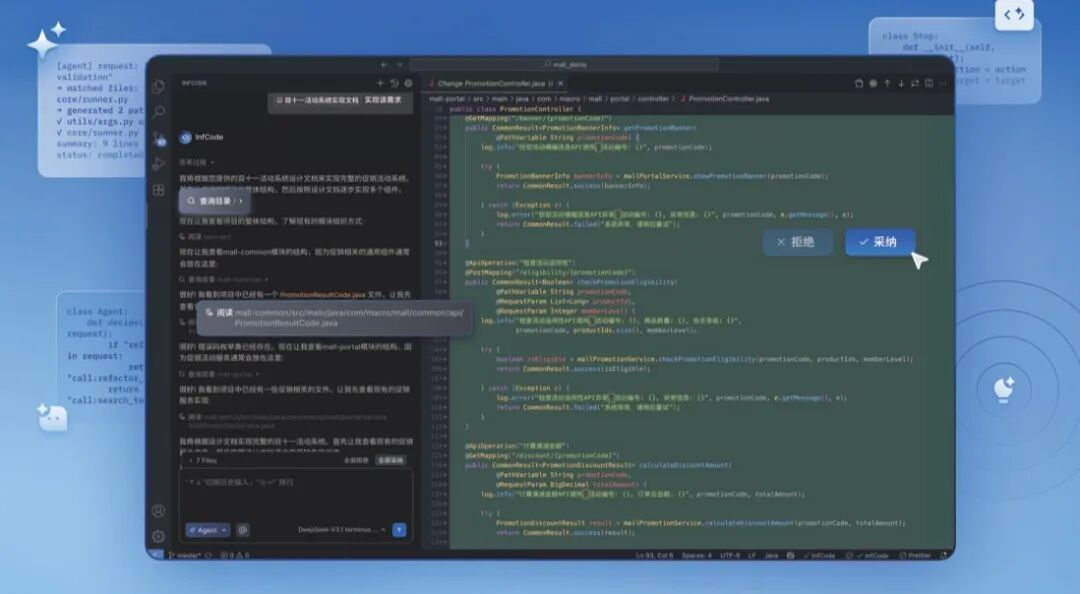
InfCode
At the beginning of December, the first version of Ciyuan's core product, InfCode, was officially launched in the form of a plugin + an enterprise - level AI Coding platform. InfCode helps enterprises complete tasks such as code governance, completion, review, and task planning, equivalent to a mid - level R & D engineer.
InfCode solves this problem through a two - layer mechanism: The first layer is standardized docking. Through the built - in MCP Server connector, it can quickly integrate common office systems such as Feishu and enterprise OA, enabling AI to query enterprise - internal documents and specifications in real - time.
The second layer is personalized adaptation. For each enterprise's unique microservice architecture, internal processes, and legacy systems, it provides an open interface for the enterprise's IT team to perform lightweight adaptation.
In the actual POC verification, in the customer cases that Ciyuan is currently cooperating with, the R & D efficiency has increased by nearly 40%, the availability rate of AI - generated code has reached more than 88%, and the quality has reached the level of a mid - level programmer.
More importantly, Ciyuan Infinite does not focus on the AI accuracy of the intermediate process but directly measures the value of project delivery, such as the improvement of labor efficiency and project time.
Currently, on the globally authoritative agent evaluation benchmark SWE - Bench Verified, InfCode has refreshed the world's best record (SOTA) with a score of 79.4%, exceeding the scores of top models such as GPT - 5 and Claude on the public leaderboard by about 65%.
In China in 2025, it is still not an easy decision to target the B2B market. In the previous AI 1.0 era, the development of many AI companies showed that if they only had single - point technical capabilities, they were likely to get caught up in endless customization and large - scale projects.
However, Yang Ping believes that AI Coding may lead the B2B implementation on a different path.
Behind this, one reason is the rapid development of base models. In 2025, base - model manufacturers are sparing no effort in building Agent capabilities. The newly launched Gemini 3 flash is already several times more powerful than Gemini 2.5 pro a few months ago, bringing immediate business value.
Second, consumer - oriented AI products are rapidly spreading. For example, vertical Coding products such as Cursor and Replit, as well as general AI assistants like ChatGPT, have made enterprise R & D teams more receptive to AI and more willing to pay than expected.
Yang Ping said that ultimately, the business model of Agent will move towards a result - oriented approach (RaaS, Result as a Service), enabling enterprise managers to clearly calculate the return on investment. "The popularization of consumer - oriented products has completed the market education of enterprise R & D personnel. Now the key is to solve the problem of understanding the business in the last mile," Yang Ping said.
When the first round of financing was completed, several co - founders of Ciyuan Infinite also talked with Intelligent Emergence about the pain points and opportunities in B2B AI Coding.
The above is the original text of the interview, edited and organized by Intelligent Emergence:
Enterprise - level scenarios and Vibe Coding are largely incompatible
Intelligent Emergence: Let's start from the origin of your entrepreneurship. You were initially working on Coding products at ByteDance and then started your own business. What were your considerations behind this whole process?
Yang Ping: From 2018 to 2024, I was mainly responsible for work related to intelligentization and software engineering at ByteDance. Before the popularity of large - language models, we had already been researching some deep - learning and generative - learning models, but at that time, we were mainly conducting some exploration in the academic community.
Since 2021, I and the entire team have been continuously observing and applying some reinforcement - learning techniques, including the application of deep learning in code scenarios.
ByteDance's internal AI Coding product started in mid - 2022. We basically went through the whole process from scratch. Later, I chose to leave in August 2024. After a period of study, I founded Ciyuan Infinite in July this year.
Intelligent Emergence: In August 2024, MarsCode had just been launched. Did you hesitate to leave the product you nurtured from the beginning?
Yang Ping: The most crucial factor is the numerous opportunities brought by the wave of large models. One should make choices at the peak of their career, not in a downturn. Otherwise, what reason do you have to convince others to invest real money in you?
Entrepreneurs should come out and take bold actions when they are doing well. This is the time when they have experience and confidence.
Before we founded our company, star companies like Cursor and Replit began to see a sharp increase in market performance and valuation in the second half of 2023.
This really touched me. I realized that in a large company, the competition might not be as fast as outside. The timing of entrepreneurship is very important.
Intelligent Emergence: Previously, the AI Coding products you developed were directly targeted at developers, but your new company, Ciyuan Infinite, has chosen to target the enterprise - level market. Why did you choose to change the direction?
Yang Ping: The difference between B2B and B2C in developer tools is not as significant as that in traditional software products. When we emphasize enterprise - level, we mainly refer to the problem domain we want to address. Enterprise - level scenarios require large - scale Agent capabilities to solve problems throughout the software - delivery process.
For example, many personal Vibe Coding products claim to be able to generate a demo project of tens of thousands of lines of code with just one sentence. However, you might find it hard to believe that Vibe Coding can generate a software project of tens of millions of lines of code that can increase revenue or support core business.
We actually focus more on these serious enterprise - level programming scenarios and challenge these more complex large - scale problems.
Intelligent Emergence: Can you summarize in one sentence what Ciyuan Infinite's product can do?
Yang Ping: We are an AI Coding Agent platform focusing on enterprise - level scenarios.
In terms of the underlying definition, we provide not only a tool but also platform - level capabilities for Agents. These Agents will be involved in every aspect of enterprise - level software development, such as enterprise - level Coding and Debugging. They will deeply integrate AI capabilities into the IDEs (Integrated Development Environments) commonly used by developers.
Intelligent Emergence: In enterprise - level development scenarios, why can't Vibe Coding products meet the needs? What are the pain points for users?
Yang Ping: Enterprise developers often have to switch frequently between multiple platforms such as requirements, development, testing, and operation and maintenance, which creates huge data and process barriers. For example, in key industries such as finance and medicine, every code change must be accountable to the business.
In serious programming scenarios, the results are relatively certain, and there are requirements for service stability. It is necessary to guide users through the entire Coding process according to specific contexts.
So, in essence, this is incompatible with Vibe Coding. Vibe Coding products often rely more on the capabilities of base models, with a relatively thin engineering layer. It is not just a manifestation of personal will. You need to understand business requirements, write business code according to business specifications, and work on projects within certain constraints.
Intelligent Emergence: Can you give an example to illustrate the actual difficulties faced by enterprise customers and how you solve them?
Wang Wei: Enterprise development often involves the collaboration of dozens or even hundreds of people. Therefore, the product must be able to integrate smoothly with the enterprise's existing R & D processes.
For example, when developing the front - end page of an e - commerce system, if only Vibe Coding is used, the page written may not match the logic of the back - end system. However, our AI Coding Agent can connect to multiple back - end projects, refer to the corresponding code interfaces and documents, and ensure that the front - and back - end code logics are consistent and can actually run.
The limited effectiveness of Vibe Coding products in B2B scenarios is precisely because they are not designed for such scenarios.
Take the account risk - control logic in finance as an example. The China Banking and Insurance Regulatory Commission has clear policy - guidance documents, requiring that the account - opening process must include several inspection steps. If a simple Vibe Coding product is used for generation, it may "cleverly" design a very complex inspection process, but the final result does not meet the basic process requirements at all.
Our Coding Agent aims to solve these scenarios with complex dependencies, large amounts of code, and many associations. For example, for the "existing projects" in enterprise systems, with code repositories of hundreds of thousands or even millions of lines, the context space of the model is definitely insufficient.
This requires optimization and design at the Agent level. Our Agent has designed two mechanisms. Internally, it mainly focuses on optimizing the context under the limited context window, including dynamic compression of the context and loading - unloading mechanisms to address the inherent limitations of the model. Externally, it mainly introduces more connections, dynamically bringing various information (including documents, external dependencies, databases, etc.) in the enterprise R & D process into the Agent environment through open protocols such as MCP. This approach of combining internal and external efforts has achieved good results.
Intelligent Emergence: Can you give a specific case to illustrate how your product helps users solve problems?
Wang Wei: We currently have a typical cooperation case with a listed financial company. The implementation is divided into two steps:
The first step is to provide a standardized product, focusing on context engineering to ensure that the design of the agent itself can avoid the problem of insufficient context length.
The second step is to solve the problem of "where the information comes from."
This information connection is divided into two categories: One is standardized. Through the built - in MCP Server connector, it can quickly integrate environments such as git repositories, artifact - management systems, and document systems, enabling the Agent to accurately read external information.
The other part is non - standard personalized systems. We provide open interfaces and adapters, and the customer's team has quickly integrated their internal OA system.
After these two steps of implementation, the final result is fast and good. The customer's actual test shows that the product's ability is basically on par with that of a mid - level developer, ultimately helping the customer improve labor efficiency by nearly 40%.
Intelligent Emergence: How is this 40% calculated? How is a task considered solved?
Wang Wei: We only look at the final result, that is, directly compare the human - resource input, such as the R & D cycle (person - days).
These indicators must be directly related to the business goals. During the entire development process, we do not break down the different types of situations in the middle, nor do we care how much human effort is needed to repair or adjust after AI generation. We only look at how much human - resource cost is saved when the team completes a task of the same value.
From the perspective of enterprise managers, they are most concerned about the final delivery value, rather than other process indicators.
Intelligent Emergence: What is your charging model?
Li Ying: Currently, we are in the process of signing agreements and exploring cooperation with several leading ISVs (Independent Software Vendors) and large - scale end - customers.
For tool - type products, we will charge License fees and Agent subscription fees. For platform - type products, in addition to charging some standard fees, we are also considering a profit - sharing model.
From plugins to IDEs, the product form is not the most core issue
Intelligent Emergence: You just mentioned that Ciyuan Infinite aims to solve the problems in "serious programming scenarios." What are the main differences between these problems and those solved by Vibe Coding?
Li Ying: The Coding products in the consumer - market on the market actually solve the problem of delivering lightweight software. However, they struggle to perform well in complex enterprise - level business scenarios.
However, this is precisely what we see as a huge market opportunity. Although it may seem like difficult work, it becomes an opportunity for startup companies.
Wang Wei: