Sharge Technology Completes Nearly 100 Million Yuan Series A+ Round of Financing, Plans to Ship Over 100,000 Units of New AI Glasses within One Year | Exclusive Report from Yingke
Hard Krypton has exclusively learned that one year after the release of its first AI glasses, Shanjikeji (Shenzhen) Co., Ltd. (hereinafter referred to as "Shanji") recently completed a nearly 100 million yuan Series A+ financing round. We have summarized the information of this financing round and several highlights of the company:
Financing Amount and Investment Institutions
Financing Round: Series A+
Financing Scale: Nearly 100 million yuan
New Investors: Planck Venture Capital, Sky Workshop Venture Capital Fund, and Wuhan Lingkonggang Economic and Technological Development Zone jointly invested. Several other institutions are in the process of closing the deal.
Use of Funds: The funds will be mainly used for the implementation of the personalized flexible production line for the new - generation AI glasses, the development of the computing - in - memory server cluster related to active AI memory, and the expansion of the global market.
Basic Company Information
Founding Time: February 2020
Registered Address: Longhua District, Shenzhen
Corporate Positioning: Shanji Technology focuses on innovation in forward - looking consumer electronics, charging, and storage fields. It focuses on the R & D of AI glasses, charging and storage products, and data storage products. Its core technologies cover the R & D of electronics and software for AI hardware, appearance and structural design, and relevant technologies of the active AI memory model. With a dual - business parallel model, it provides more comprehensive consumer - grade AI glasses, mobile power, and data solutions. Its new - generation AI glasses will be officially released on December 29, 2025.
Product Roadmap: Shanji's new - generation AI glasses have been iteratively upgraded in terms of active AI capabilities, optical display, and underlying hardware structure.
In terms of AI technology capabilities, Shanji has cooperated with the Silicon Valley star technology company memories.ai to apply its multimodal AI memory engine for the first time in the form of a wearable device - smart glasses.

Multimodal AI memory engine (Source/Enterprise)
This engine can convert the real - time audio and video information collected by the device into structured memory content that can be retrieved, analyzed, and edited, providing users with more efficient information retrieval and understanding capabilities. Combined with Shanji's self - developed Loom OS 2.0 system, it supports multi - terminal data synchronization and the collaborative invocation of more than a dozen mainstream large models in China, enhancing the practicality and flexibility of AI interaction.
To solve the core pain points of high weight and high power consumption of some AI display glasses, Shanji has cooperated with Fengmang Technology, a leading enterprise in laser display technology, and introduced Fengmang's exclusive "Dragonfly Optic Engine" technology.
This technology is of the same origin as the Meta Display, a ten - thousand - yuan - level AI display glasses in the industry. It can reduce the power consumption of full - screen display and solve the problem of compatibility between the flexible front frame and the binocular 3D display structure.
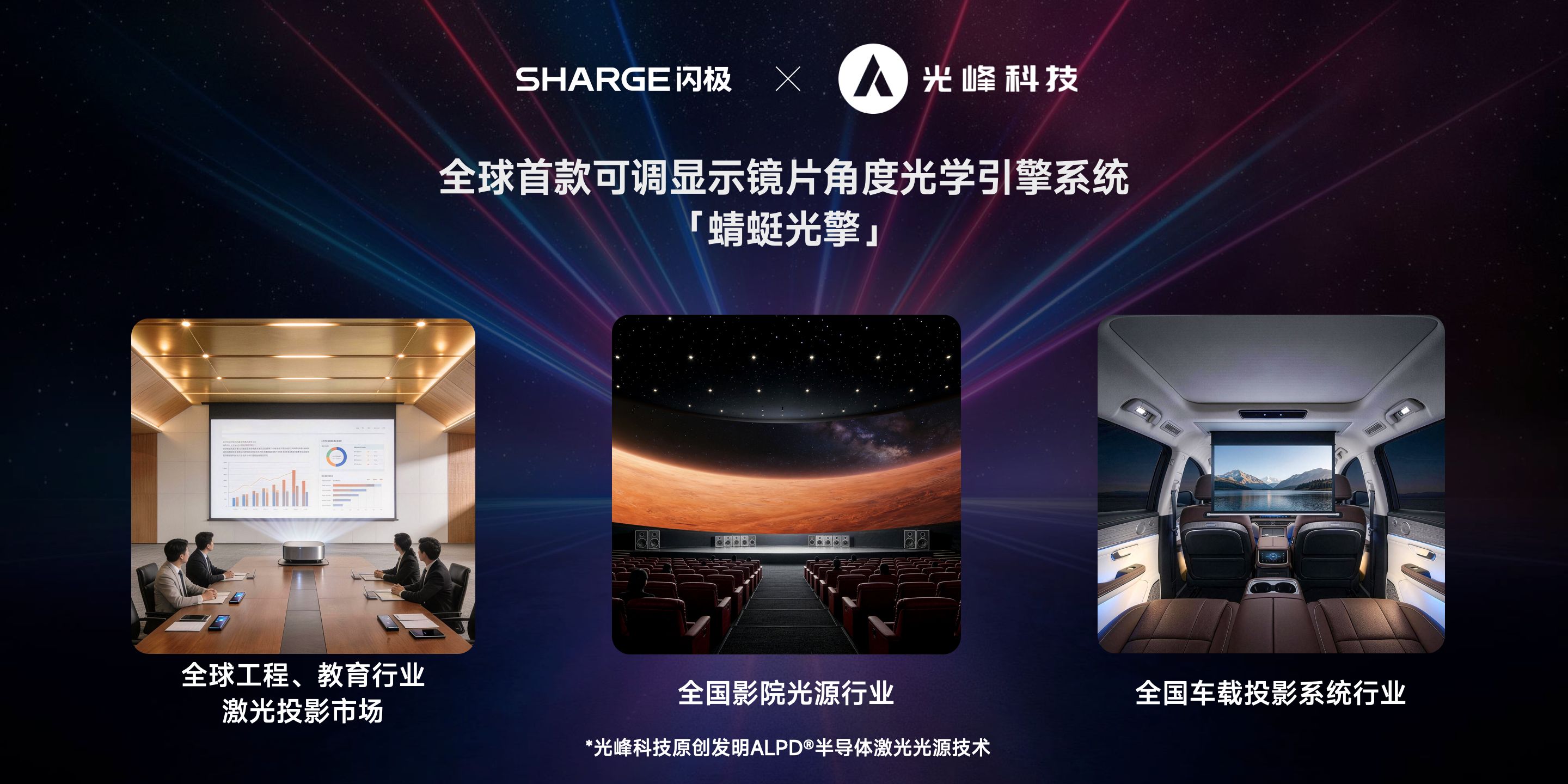
Introduction of Fengmang's exclusive "Dragonfly Optic Engine" technology (Source/Enterprise)
On the hardware architecture side, the new AI glasses are equipped with a 4 - nanometer - level main control chip and a flagship - level Bluetooth chip. Through the collaborative optimization of software and hardware, the visual performance and battery life efficiency of the device can be systematically improved. In terms of weight, a new configuration design is adopted. It is made by fusing a polymerized low - density material processed by five - axis CNC high - precision machining with titanium alloy. On the basis of about 50g of the first - generation product, further optimization is carried out to ensure the balance between the overall structural strength and light weight, so as to achieve the comfort and adaptability of all - day and all - scenario wearing.
Market Size
According to the "Quarterly Tracking Report on the Global Smart Glasses Market" by IDC, in the first half of 2025, the global smart glasses market shipped 4.065 million units, a year - on - year increase of 64.2%. China's shipments exceeded 1 million units, accounting for 26.6%.
The report predicts that the shipments in the Chinese market will reach about 2.907 million units in 2025, a year - on - year increase of 121.1%. By 2029, the global shipments are expected to exceed 40 million units. At that time, the compound annual growth rate of the Chinese market is expected to be 55.6%, ranking first in the world.
Business Progress
Since this year, as giants such as Alibaba, Baidu, ByteDance, and Xiaomi have all entered the AI glasses track, the competition has fully heated up. Based on the new technical solution and product definition, Shanji expects that the shipments of the new - generation AI glasses will exceed 100,000 units within one year after the release.
In addition, Shanji maintains stable profitability in mature 3C energy storage categories such as mobile power supplies and storage devices. Its core business continues to generate cash flow, contributing hundreds of millions of yuan in revenue and tens of millions of yuan in net profit each year. At present, the company still has hundreds of millions of yuan in available funds on its books, providing sufficient resources for technology R & D and market expansion.
Founder's Thoughts
Hard Krypton: Compared with the first - generation product, what key iterative improvements have been made in the functions and experience of the upcoming new AI glasses?
Zhang Bo: The iterative upgrade of Shanji's new - generation AI glasses is still based on the long - term strategy of "external brain, digital immortality", focusing on two key directions: all - day active AI memory capabilities and optimization of the hardware experience.
On the software level, the transformation from "passive recording" to "active perception" lies in reconstructing the operation mode of AI memory. It is equipped with Shanji's self - developed active voice recognition AI and VAD algorithm, with the function of automatically triggering recording of effective voices. It can capture environmental conversations, call voices, and even record network audio such as Bluetooth music and videos, comprehensively taking over the voice information that users contact daily. Through all - day and all - scenario voice recording, a user - specific "life memory library" is built.
More importantly, we make this data "come alive". Based on the full - volume memory data, the product also extends features such as automatic diary and weekly report generation and personal biography compilation, supporting users to query past important events and to - do reminders, making the AI memory function closer to practical scenarios and thus cultivating user stickiness.
On the hardware structure side, through the optimized dual - chip architecture and the replaceable battery solution, while achieving all - day battery life, we will make the AI shooting glasses the lightest to wear. It ensures that users can maintain a comfortable experience even after continuous wearing for 15 hours.
In addition, we have found that when users choose glasses, they usually need to try on 5 - 10 pairs of glasses to find the frame they like. Therefore, through the personalized customized flexible production line, Shanji will launch at least 10 different frame types in the next year. The five - axis CNC high - precision machining of polymerized low - density materials is combined with titanium alloy technology to replace traditional injection molding, improving the product texture and color richness. Each frame type offers three size options to solve the pain point of users in selecting suitable frames and better meet the aesthetic needs of segmented groups such as female users.
Hard Krypton: Has the user growth and penetration rate of AI glasses in 2025 met the expectations?
Zhang Bo: The whole industry is talking about the "hundred - glasses war", but in fact, the sales volume in China is lower than expected.
In 2025, less than 100 brands and products were launched in the Chinese market throughout the year, and only more than ten were mainstream brands. The overall industry shipments were about one million units. Meta shipped 2 million pairs last year and is expected to exceed 4 million pairs this year. From this data, China's development is significantly lagging behind the global level.
I think there are two main reasons. First, the product form does not match the user scenarios. Most of the AI glasses on the current market borrow from the sunglasses design of Meta (Ray - Ban). The products are designed for outdoor shooting scenarios, and users usually wear them for 2 - 3 hours a day. However, the domestic users' demand for optical glasses is mainly for myopia, presbyopia, astigmatism, etc. The design requirements of these glasses are completely different from those of sunglasses and require long - term and all - day wearing.
If the sunglasses product form is directly applied, the user's wearing comfort will become the primary obstacle. This is also the core problem that Shanji has focused on solving in the past year, how to design AI glasses to be more suitable for all - day daily wearing.
Second, the software functions lack user value. In the domestic market, when the product form changes from sunglasses to myopia glasses, the software functions fail to provide core value that cannot be replaced by mobile phones. For example, the accuracy and reaction speed of navigation are inferior to those of mobile phones, the experience of AI Q&A is not as mature as that on the mobile phone, and functions such as teleprompters belong to niche and low - frequency scenarios. This results in the functions of AI glasses not being effectively converted into users' long - term use needs, and the market is still mainly composed of trial - using users, failing to achieve large - scale popularization.
Currently, most products are in the first - generation stage. Previously, due to the lack of real - user feedback and software data support, manufacturers failed to fully recognize the core problems in product design and experience. With the market verification of the first - generation products and the gradual solution of software and hardware problems, the experience of next year's products will definitely be improved.
Hard Krypton: Returning to the AI glasses category, how to balance product innovation and iteration with users' core needs?
Zhang Bo: The key lies in finding the balance point between functions and user needs.
Essentially, AI glasses are first and foremost a pair of glasses. Therefore, the core goal of hardware design is always the wearing experience. At the functional level, we have added intelligent modules such as photo - taking, video - recording, AI Q&A, and music playback. However, at the form level, through the ultimate optimization of appearance, weight, and aesthetics, it must be made to be infinitely close to the wearing feeling of traditional glasses. This is the basis for the product to be accepted by a wider range of users.
After AI glasses become more like daily glasses, we can then discuss what their value is and what indispensable functions they must have. These functions are either things that mobile phones cannot do or things that mobile phones can do but with poor experience. This is also the direction that Shanji is trying to break through.