Robots Race Against Time: A Battle for the Spring Festival Gala, Commercialization, and the IPO Window
Editor's Note:
As the end of the year approaches, looking back from the vantage point of 2025, the surging wave of technology, the changing consumer demands, and the iterative business models have painted a brand - new business landscape. Lianxian Insight has launched a year - end review special series, attempting to capture how different enterprises have coped with challenges and seized opportunities in this changing landscape. This is the second installment, focusing on the embodied intelligence industry.
The times have changed, and robots are now vying for a spot on the Spring Festival Gala.
Recently, a piece of news has shaken the embodied intelligence industry: Zeyuan Robotics and Unitree Technology are competing for the title of the biggest sponsor of the 2026 Spring Festival Gala of China Media Group, with both offering bids in the tens of millions of yuan range.
Coincidentally, this was the day when China Media Group released the theme and main logo of the "2026 Spring Festival Gala". According to 36Kr, people familiar with the matter said that the Spring Festival Gala has become a high - ground that the embodied intelligence industry needs to seize, and many robot companies have participated in the bidding. Among them, Zeyuan Robotics was the first to bid 60 million yuan, and Unitree Technology directly raised the offer to 100 million yuan.
As of the time of publication, Zeyuan Robotics has responded that "it's not true", while Unitree Technology has not responded.
Currently, the specific list of sponsors for the Spring Festival Gala has not been announced. Only "LatePost" reported that Volcengine will become the exclusive AI cloud partner of the 2026 Spring Festival Gala of China Media Group, and Doubao, the intelligent assistant under ByteDance, will also launch various interactive features.
The discussion continues on how robot enterprises will appear on the stage of the Spring Festival Gala.
After all, the robots under Unitree Technology made an appearance on the Spring Festival Gala stage in 2025 and successfully attracted extensive social attention.
We can see that people may seem to be watching a brand - marketing bidding war, but in fact, they are concerned about the future of the entire robot industry: the concept verification stage is coming to an end, and the industry is entering a new phase of commercialization.
When the "Spring Festival Gala" becomes one of the topics for robot enterprises, the nature of the competition has changed. Years of gentle technological iteration have ended, and market competition has taken center stage. From then on, exposure, orders, financing, and listing have all become high - grounds that robot enterprises must strive for.
Competing for the Spring Festival Gala: Robot Enterprises Need More Attention This Year
Is it worth spending hundreds of millions of yuan to sponsor a gala? How to calculate this?
Sponsoring the Spring Festival Gala has never been cheap. In addition to the sponsorship fee, there are also hidden costs such as the on - site presence of the technical team, preparation of backup plans, coordination of the operation team, repeated rehearsals, and supporting publicity plans, which often double the actual investment of the enterprise based on the bid price.
However, for today's robot enterprises, spending money on the Spring Festival Gala is indeed necessary. Even if they don't win the sponsorship, it's still worthwhile to get a chance to perform on the show.
At the 2025 Spring Festival Gala, 16 H1 humanoid robots from Unitree Technology and 16 dancers jointly performed the dance "YangBOT". The robots, dressed in Northeast - style cotton - padded jackets, danced nimbly with handkerchiefs, coordinating perfectly with the dancers. This performance catapulted Unitree from a star enterprise in the tech circle to a representative of national scientific and technological strength recognized by the public.
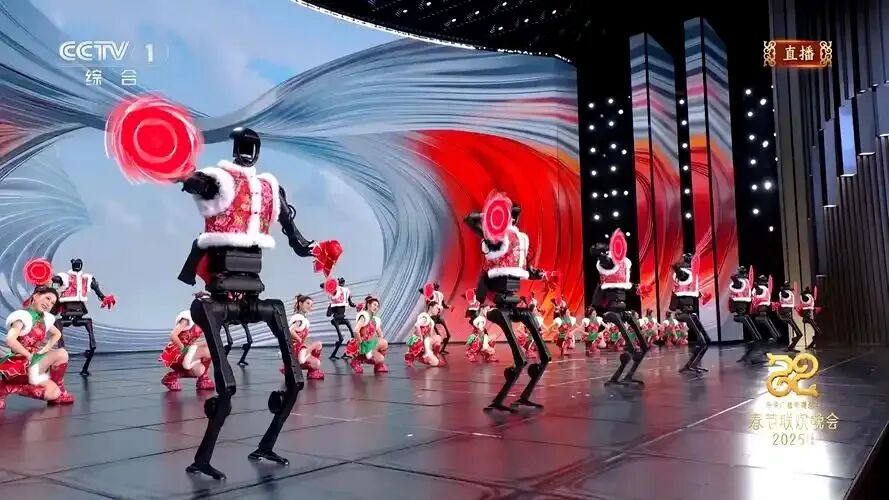
Unitree Technology's robots at the 2025 Spring Festival Gala, source: CCTV live broadcast
According to data from CCTV.com, the 2025 Spring Festival Gala reached a cumulative audience of 16.8 billion across all media platforms, with a total live - viewing share of 78.88%, setting a new high in viewership in the past 12 years.
Beyond the traffic effect, "appearing on the Spring Festival Gala" itself is a strong endorsement for the brand. The official endorsement and quality certification have given Unitree an edge in negotiating cooperation with local governments, obtaining orders from large state - owned enterprises, and getting policy support.
The benefits brought by the Spring Festival Gala are first felt by the downstream.
Some media reported that after Unitree's appearance on the Spring Festival Gala, government agencies and enterprises in need of renting robots all preferred Unitree. A boss of a downstream robot rental company earned more than 100,000 yuan in just over a month by renting out robots.
The connection between robots and the Spring Festival Gala in 2025 was no accident.
Firstly, there is policy support. During the Two Sessions in March 2025, embodied intelligence was included in the government work report for the first time, marking clear support at the national strategic level.
Secondly, the technology has gradually matured. According to a report by iResearch, the autonomy level of embodied intelligence has reached a transitional stage similar to L2 - L3 in autonomous driving, and the tipping point of qualitative change is just around the corner. In the next 2 - 3 years, the model capabilities are likely to achieve a leap - forward breakthrough.
Behind the attention of robot enterprises to the Spring Festival Gala lies an urgent practical logic: in the process of commercialization, if enterprises cannot establish an absolute technological gap, the one that seizes the users' minds first will gain an advantage in financing, recruitment, and cooperation ecosystems.
Undoubtedly, at this special time, the exposure provided by the Spring Festival Gala is not only a signal of confidence to the capital market but also a clarion call to potential users.
How are Embodied Intelligence Enterprises Progressing in Mass Production and Commercialization?
The competition for the Spring Festival Gala is just a microcosm. In 2025, the real battleground for the robot industry is mass production and commercialization. In this battle, the progress of leading enterprises is the most representative. Their mass - production capabilities and commercialization paths largely determine the direction of the entire industry.
Wang Xingxing, the founder of Unitree Technology, publicly stated that Unitree's revenue exceeded 1 billion yuan in 2024 and has achieved continuous profitability for five years. According to data from the GGII, in 2024, Unitree sold 23,700 robotic dogs annually, accounting for approximately 69.75% of the global market share, and the delivery volume of humanoid robots exceeded 1,500 units.
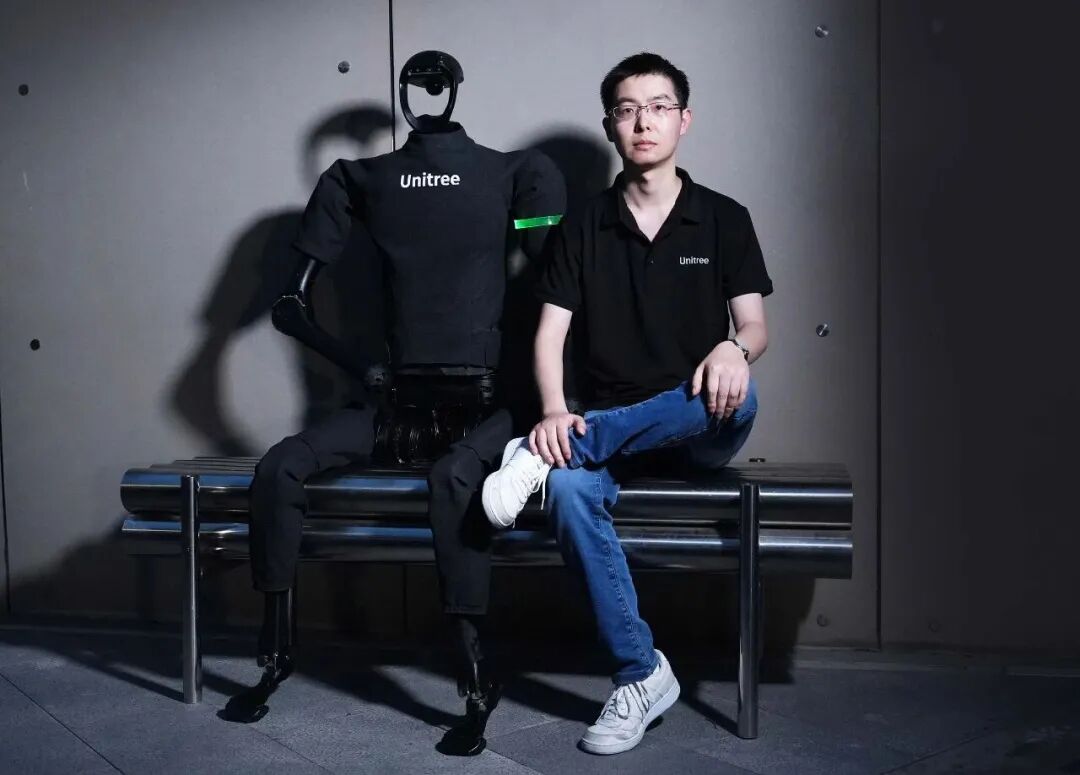
Wang Xingxing, the founder of Unitree Technology, source: Unitree Technology's official WeChat account
According to the disclosure of Zeyuan Robotics, as of early December 2025, a total of 5,000 general - purpose embodied robots from Zeyuan's three major product lines had rolled off the production line, including 1,846 units of the Lingxi X1/X2 series, 1,742 units of the Yuanzheng A1/A2 series, and 1,412 units of the Jingling G1/G2 series.
In terms of production capacity and development speed, the two leading enterprises each have their own strengths.
Unitree, founded in 2016, is a relatively "established" robot company with profound hardware capabilities. Industry insiders believe that the core reason for Unitree's profitability lies in its mature hardware control capabilities. The commercialized robots of Unitree are not built by simply piling up components but by optimizing each link to achieve the most suitable configuration and the lowest cost.
As an example, the new humanoid robot R1 of Unitree Technology has an AIR version starting at only 29,900 yuan. Although Unitree's main revenue still comes from the quadruped robot field, the reduction in the cost of humanoid robots has undoubtedly opened up imagination space in terms of application scenarios and scale - up.
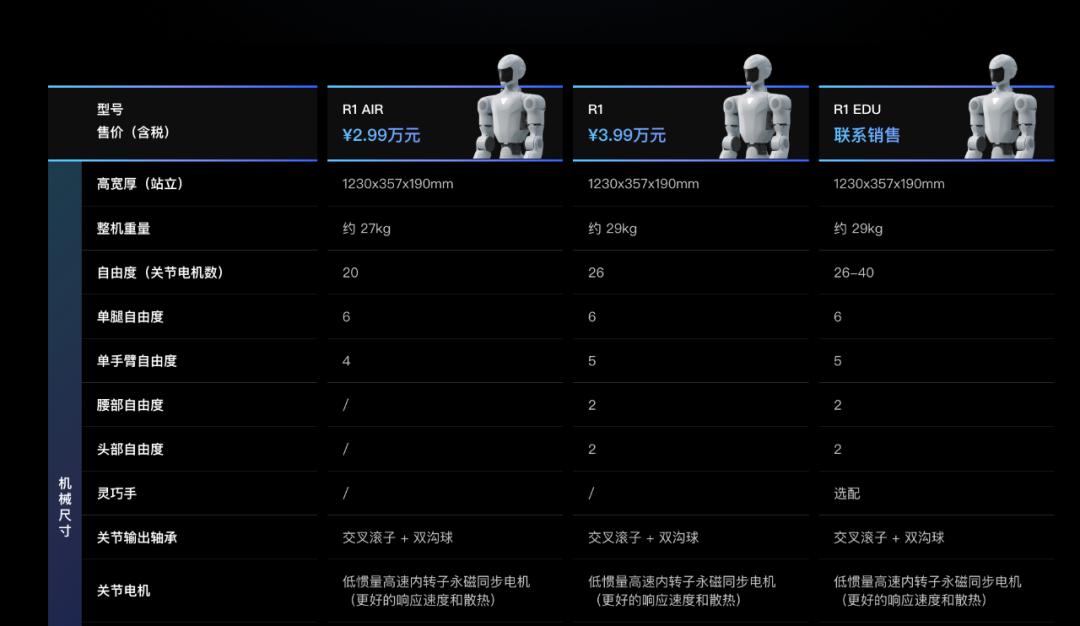
Prices and configurations of different versions of Unitree Technology's R1, source: Unitree Technology's official website
Zeyuan Robotics, founded in 2023, has a short development time but strong product - launch speed and capital background. Its founder, Peng Zhihui, is the well - known "Genius Youth from Huawei", also known as Zhihui Jun. According to public information, in just two years, Zeyuan has completed 11 rounds of financing, with a cumulative amount exceeding 5 billion yuan, and its valuation has reached 15 billion yuan.
According to "Caixin", Zeyuan is rapidly shifting its focus from R & D to commercialization. Many core employees have left, and the R & D department has been split into independent business units. A research and development team has been set up for each product line, and internal competition is used to drive rapid iteration. The core goal is to achieve mass production quickly and seize the market.

Peng Zhihui, co - founder and CTO of Zeyuan Robotics, source: Zeyuan Robotics' official WeChat account
In 2025, the trend of robots being deployed in various application scenarios was obvious, and many industrial and commercial orders poured in towards domestic leading manufacturers. In July, Zeyuan and Unitree jointly won the bid for the procurement project of humanoid biped robot OEM services from China Mobile (Hangzhou), with a total bid amount of 124 million yuan. In September, Ubtech announced that it had obtained a procurement contract worth 250 million yuan for humanoid robot products and solutions.
According to public information, the total amount of public orders from domestic enterprises has exceeded 4.6 billion yuan, with the quantity exceeding 20,000 units.
From the amount and quantity, it's not hard to see that the market has high expectations for the robot track. However, there are also skeptical voices in the industry regarding many of the current "hundred - million - yuan orders".
A report from Morgan Stanley pointed out that a significant portion of the "large - scale orders" publicly announced by many manufacturers are framework agreements or intention orders, with relatively low implementation certainty.
A survey by Goldman Sachs of nine Chinese humanoid robot supply - chain enterprises in November this year showed that although the planned annual production capacity of suppliers ranges from 100,000 to 1 million units, no company has confirmed receiving large - scale orders or a clear production schedule.
Perhaps the real bottleneck in the commercialization of robots lies in the application scenarios.
According to the "2025 Commercial Embodied Intelligence White Paper" by iResearch, the breakthrough point for the commercialization of embodied intelligence requires crossing the usability threshold in five dimensions: battery life, latency, execution, reliability, and economic benefits. Currently, only industrial manufacturing and logistics warehousing scenarios are the closest to meeting this standard.
Although wheeled robots can meet the needs of most factory scenarios in terms of battery life, stability, and navigation accuracy, it is still difficult for them to penetrate into more complex scenarios.
Compared with industrial scenarios, scenarios such as households and elderly care are less structured, with lower task repeatability and more difficult - to - calculate ROI. There are still many problems to be solved for humanoid robots in these scenarios.
Wang Xingxing, the founder of Unitree Technology, once admitted that actions such as opening doors and mopping the floor are still very complex for humanoid robots, and it's not realistic to let robots directly do housework at home.
The technological bottleneck of humanoid robots is still obvious. For example, the "hands" of robots, as core components, need to be compact in structure while ensuring agility and reliability, which leads to a "triple - dilemma". Without a breakthrough in this regard, fine - grained operations in household scenarios cannot be achieved.
The deeper problem lies in economic viability. The industry estimates that the price of a sufficiently mature humanoid robot is about 300,000 to 500,000 yuan. Only when it can undertake more than about ten types of tasks in the same scenario can the investment be considered "worthwhile" in terms of input - output ratio.
Currently, the main application directions of humanoid robots are still performance and scientific research. According to statistics from the Humanoid Robot Application Scenario Alliance, as of the first half of 2025, educational and scientific research institutions accounted for 75% of the total orders for humanoid robots.
Taking Advantage of the "Concept Heat", Rushing to IPO is Inevitable
Although the commercialization path has not been fully established, the enthusiasm of the capital market has boiled over.
According to Huaxin Capital, in the first seven months of 2025, the total financing amount in the primary market of the embodied intelligence industry exceeded 30 billion yuan, while this figure was only 7.5 billion yuan in the first half of 2024.
According to IT Juzi data, in the first 11 months of 2025, there were 557 investment and financing events related to the Chinese robot industry chain, with a total financing amount exceeding 83.9 billion yuan.
Among the top 20 AI - related startups with the highest financing amounts this year, nine are in the field of embodied intelligence.
The secondary market is also booming. According to statistics from "Securities Times" at the end of September, the average increase of 110 humanoid robot concept stocks in the A - share market this year was 67.63%, and 18 stocks doubled in price compared with the end of last year.
While hot money is pouring in, robot enterprises have set off an IPO boom.
The adjustment of the Hong Kong Stock Exchange's Rule 18C has opened up the listing channel for robot enterprises. With the market - value threshold lowered to HK$4 billion, more early - stage enterprises see the possibility. According to public information, in addition to Yuejiang Technology, which has already been listed, companies such as Seer Industry, Standard Robots, Yunji Technology, and YouiBot have submitted their listing applications.
Unitree Technology completed its domestic listing counseling in November 2025 and is expected to submit its listing application on the A - share main board this year. According to public information, Unitree's valuation after the Series C financing was 12 billion yuan. After completing the share - reform in September this year, Leju Robotics received nearly 1.5 billion yuan in Pre - IPO financing in October.
In contrast, Zeyuan's path is more circuitous.
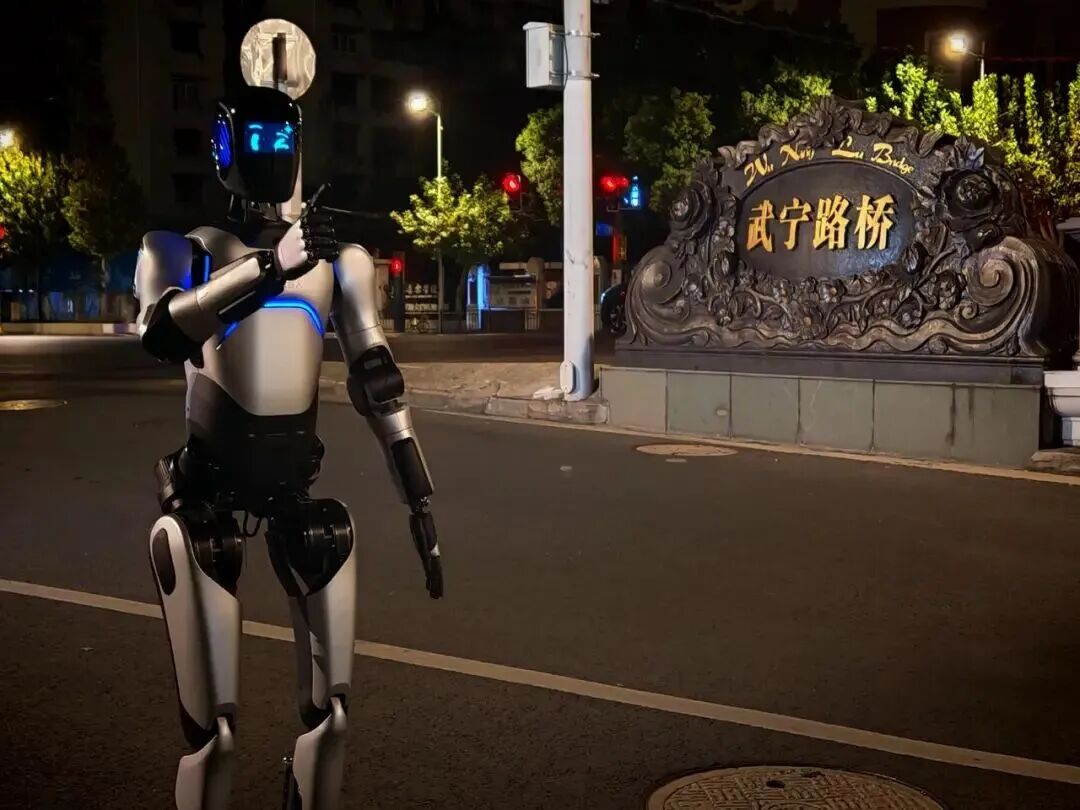
Zeyuan's Yuanzheng A2 robot on Wuning Road Bridge in Shanghai