Industry giants like Baidu and A-share companies are all getting involved. Unveiling the full picture of CVC investment in embodied intelligence in 2025.
As artificial intelligence transitions from "perceptual intelligence" to "embodied intelligence," robotics technology is accelerating the breakthrough from virtual interaction to physical execution. Embodied intelligence has not only become the key path to general intelligence but is also regarded as the core engine of a new round of industrial transformation.
Against this backdrop, the capital market's attention to the embodied intelligence track has been continuously soaring.
According to IT Juzi data, as of December 21, 2025, there have been over 305 financing events in China's embodied intelligence track this year, nearly tripling compared to last year; the total financing amount is estimated to exceed 38 billion yuan.
Behind the data, more than 600 investors have increased their investment with real money. Among them, the CVC forces composed of large enterprises such as Baidu, Alibaba, and Meituan, as well as various industrial capitals, have become the core driving force for the development of the track, thanks to their dual advantages in capital and scenarios.
How intense is the investment of industrial capital in embodied intelligence startups this year? Which CVC industrial parties are more active?
1. Core Force: Investment Layout and Strategic Interpretation of Internet/Tech/AI Giants
Internet, tech, and AI giants have demonstrated a high degree of strategic awareness in the field of embodied intelligence investment, thanks to their technological accumulation, scenario resources, and capital strength. Their layout is not a blind scattergun approach but is closely centered around their core business ecosystems, forming a differentiated and precise investment logic. The specific investment data is shown in the following table:
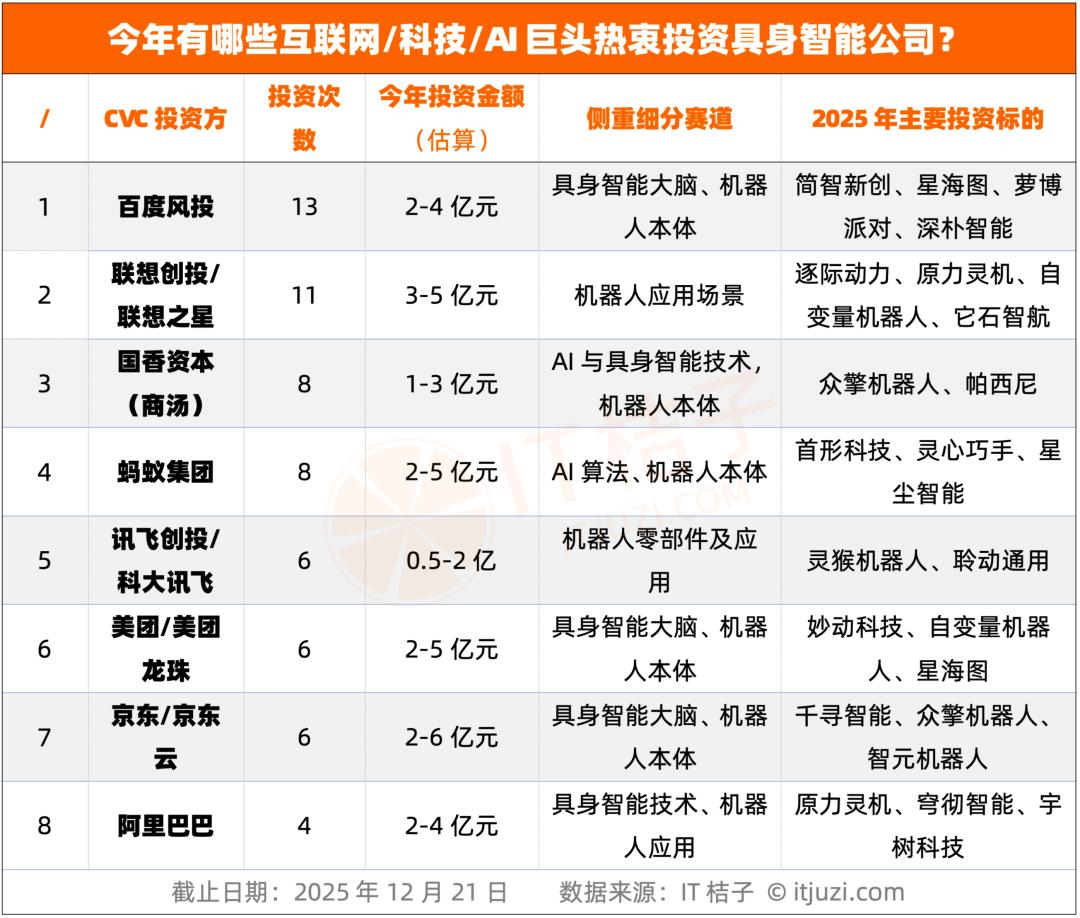
According to IT Juzi data, the investment of large enterprises in the embodied intelligence track shows the characteristics of "high frequency and strong focus": The total number of investments made by 8 core large enterprises throughout the year reached 62 times. Among them, Baidu Ventures led with 13 investments, followed closely by Lenovo Capital and Incubator Group/Lenovo Star with 11 investments. Guoxiang Capital (SenseTime) and Ant Group tied for third place with 8 investments each, forming the first investment echelon.
In terms of investment intensity, the estimated total investment amount of the 8 large enterprises throughout the year ranged from 1.45 billion to 3.4 billion yuan. Except for iFlytek, whose single - investment amount may be less than 100 million yuan, Baidu Ventures, Lenovo Capital and Incubator Group/Lenovo Star, Ant Group, Meituan/Meituan Longzhu, and JD.com all made large - scale investments of 200 million to 500 million yuan, demonstrating the large enterprises' firm confidence in the track.
Based on the above investment data, the strategic logic of large enterprises can be summarized into three core directions:
Firstly, seizing the technological foundation.
Represented by Baidu Ventures, it focuses on the core technological field of the embodied intelligence brain. By investing in enterprises such as Xinghaitu, it strengthens the layout of the integration technology of large models and robots, and constructs a technological closed - loop of "cloud training + edge computing + terminal execution."
Alibaba, relying on the advantages of Tongyi Qianwen large model, invests in enterprises such as Yuanli Lingji to promote the implementation of multimodal models in embodied intelligence hardware and consolidate the technological foundation.
Secondly, scenario - based collaborative empowerment.
Meituan's investment is closely centered around the "tech + retail" strategy, and it layouts the embodied intelligence brain and robot bodies. The aim is to reduce service costs and increase service density through the application of robots in unmanned delivery and intelligent fulfillment, and form in - depth synergy with its local life service ecosystem.
JD.com focuses on the e - commerce retail scenario. By investing in enterprises such as Zhipu Robotics, it promotes the application of embodied intelligence robots in scenarios such as warehousing, logistics, and home services, and constructs an ecological closed - loop of "hardware + software + service."
Thirdly, ecological circle construction.
Large enterprises generally abandon extensive investment and instead pursue complementary business ecosystems and technological synergy. By investing in key links such as robot bodies, algorithms, and components, they form a complete industrial ecological chain. For example, Lenovo Capital and Incubator Group focuses on robot application scenarios, Ant Group focuses on AI algorithms, and iFlytek Capital focused on investing in robot components and application fields this year. All of them are key pieces to improve their own ecosystems through precise investment.
For more information, please refer to: Meituan's investment layout in robots, JD.com's investment layout in robots
2. Ecological Complementation: Cross - border Layout of CVCs of Traditional Enterprises
In addition to tech giants, CVCs under traditional enterprises, especially A - share listed companies, have become an important supplementary force in the investment in embodied intelligence in 2025. Relying on their industrial resource advantages, they enter the track through cross - border investment, seeking industrial upgrading and new growth curves. The specific investment situation is shown in the following table:
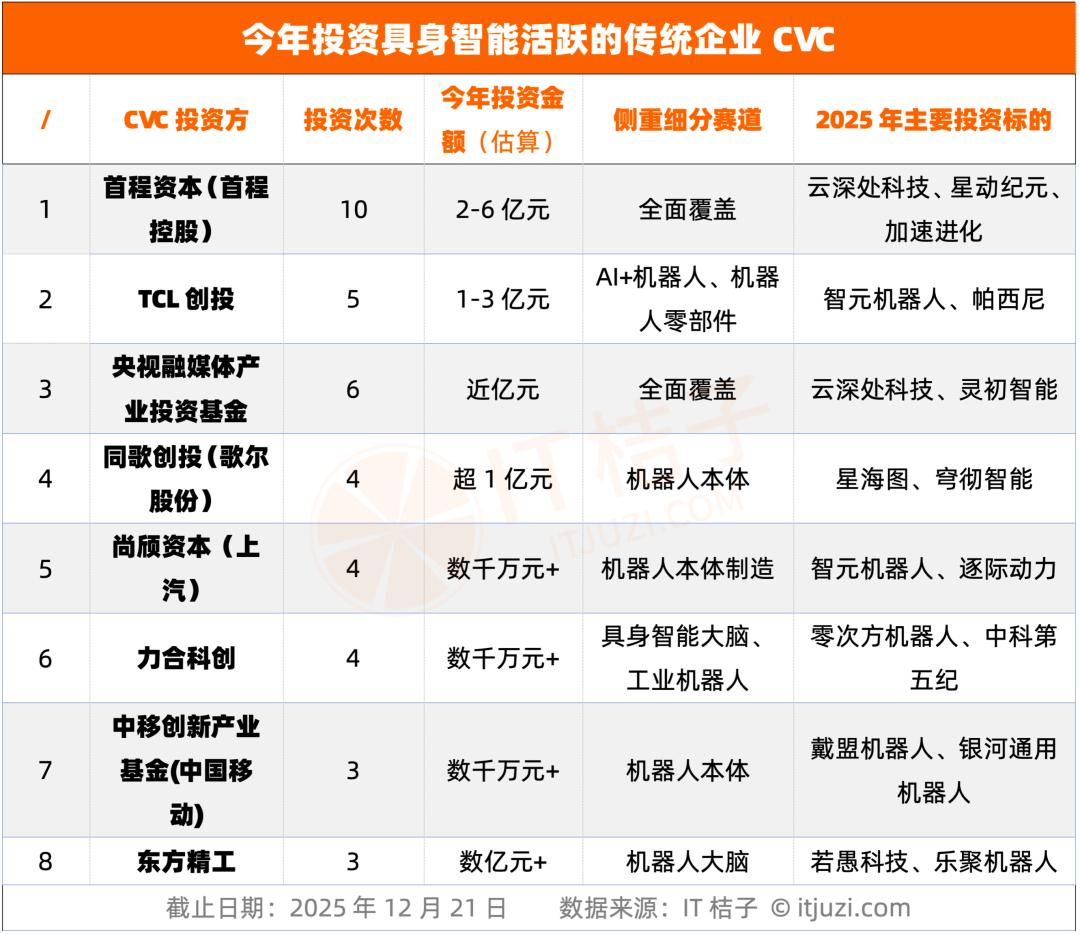
According to statistics from IT Juzi, the total number of investments made by 8 core traditional enterprise CVCs in embodied intelligence startups throughout the year reached 43 times, and the estimated total investment intensity exceeded 500 million yuan.
Among them, Shoucheng Capital became the champion in terms of investment frequency among traditional enterprise CVCs with 10 investments. Its investment amount may reach 200 million to 600 million yuan, comparable to the large - scale layouts of tech giants. The GP CCTV Media Convergence Industry Investment Fund, invested by multiple media listed companies, ranked second with 6 investments. Although Dongfang Seiko only made 3 investments, it showed a strong determination to layout with an investment of hundreds of millions of yuan.
Data shows that the investments of CVCs of some new - energy vehicle manufacturers and manufacturing enterprises show distinct industrial synergy attributes:
Typical CVCs such as SAIC (Shangqi Capital), Goertek (Tongge Venture Capital), and Longcheer Technology focus on robot body manufacturing and hardware links, which complement their own manufacturing advantages.
Among them, Shangqi Capital, as a private equity investment platform under SAIC Group, invested in Zhujidongli and promoted in - depth cooperation between it and SAIC Group in the field of embodied intelligence. The core of the cooperation is the joint research and development of industrial embodied robots suitable for automobile production lines by both parties.
It is reported that in July 2025, SAIC Group and Zhujidongli LimX Dynamics officially signed a strategic cooperation memorandum in Beijing, announcing the establishment of a long - term strategic partnership and the establishment of an embodied intelligence joint laboratory to jointly promote technological innovation, R & D cooperation, and talent cultivation of embodied intelligence in the automobile industry chain.
In addition, Longcheer Technology, an A - share listed company, participated in the Series B financing of Zhipu Robotics worth hundreds of millions of yuan in March this year, and facilitated the implementation of relevant strategic cooperation half a year later.
In October, Zhipu Robotics and Longcheer Technology signed a strategic cooperation agreement. Longcheer Technology placed a framework order worth hundreds of millions of yuan to purchase Zhipu Elf G2 robots, with an estimated deployment of nearly a thousand units. This is an important order in the field of domestic industrial embodied intelligence.
This cooperation plan starts from consumer electronics manufacturing, focuses on verifying the value of embodied intelligence in flexible production and quality control, provides a replicable model for vertical scenarios such as industrial inspection, and promotes the improvement of manufacturing operation efficiency.
Some other CVCs present different investment paths. For example, platform - type enterprises such as China Mobile (China Mobile Innovation Industry Fund) explore the integration scenarios of intelligent hardware and communication services by investing in robot body enterprises. Shoucheng Capital, CCTV Media Convergence Industry Investment Fund, etc. adopt a comprehensive coverage strategy, widely layout key links of the track, and seize the opportunity of future industrial transformation.
3. New Forces: Investment Entry of Emerging Robot Companies
It is worth noting that, in addition to traditional large enterprises and traditional enterprises, as emerging robot startups, they raise funds from listed companies, giants, and large enterprises on the one hand, and actively participate in the construction of the embodied intelligence ecosystem through investment on the other hand. The specific investment data is shown in the following table:
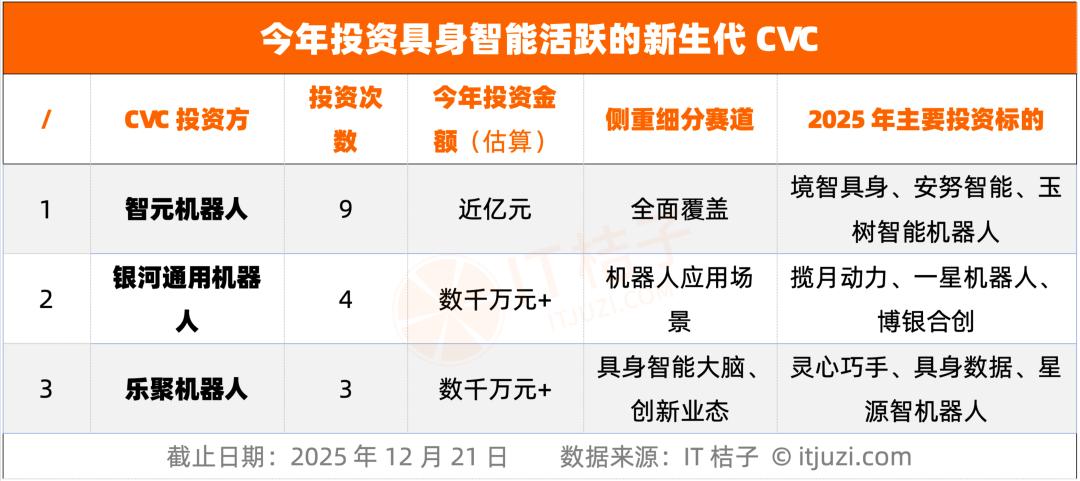
According to IT Juzi data, the total number of investments made by 3 emerging robot companies in embodied intelligence enterprises throughout the year reached 16 times.
Among them, Zhipu Robotics became the core force in this camp with 9 investments, with a very high investment frequency. However, as a unicorn company, its investment amount is much less than that of listed companies and tech giants. Single - investment amounts are mainly in the range of millions to tens of millions of yuan, and rarely exceed 100 million yuan.
Galaxy Universal Robotics followed closely with 4 investments, and Leju Robotics completed the initial layout with 3 investments, showing the investment characteristics of "high frequency and precision."
The investment logic of such emerging enterprises is mainly based on technological synergy and ecological complementarity, jointly promoting the technological iteration and ecological improvement of the embodied intelligence industry.
For example, in August this year, Zhipu Robotics officially took a stake in Shenzhen Yushu Intelligent Robot. Yushu Intelligent is a subsidiary of Yuhetian Group, backed by an A - share environmental sanitation listed company.
As early as June, the two parties announced the signing of a strategic cooperation agreement and the establishment of the "Shenzhen Yushu Embodied Robot Intelligence Innovation Center", which focuses on data collection and technological innovation of embodied robots, and lays the foundation for the general intelligent application of robots, aiming to solve the long - standing limitation of the industry's heavy reliance on simulation data.
On the one hand, Zhipu Robotics cooperates with listed companies to obtain orders and promote commercialization; on the other hand, through ecological investment, it not only strengthens its ecological voice in the track but also cultivates more technological innovation forces for the industry.
In summary, in 2025, the CVC investment in the embodied intelligence track presents a diversified pattern of "led by tech giants, complemented by traditional enterprises, and coordinated by emerging enterprises." The capital flow and investment layout are all centered around technological breakthroughs and scenario implementation, highlighting the transformation trend of the track from concept hype to value realization.
This article is from the WeChat official account "IT Juzi" (ID: itjuzi521), author: Wu Meimei, published by 36Kr with authorization.