Computing power drives a new paradigm for universities: Shanghai gives birth to a national model for university intelligent computing.
The new wave of intelligentization sparked by AI is sweeping across the globe. The scenarios familiar to the public include using agents to assist in work tasks, traveling in self - driving vehicles, or watching robot performances. Beneath the surface, AI is actively participating in and driving academic and scientific research, with the path of its impetus becoming increasingly clear.
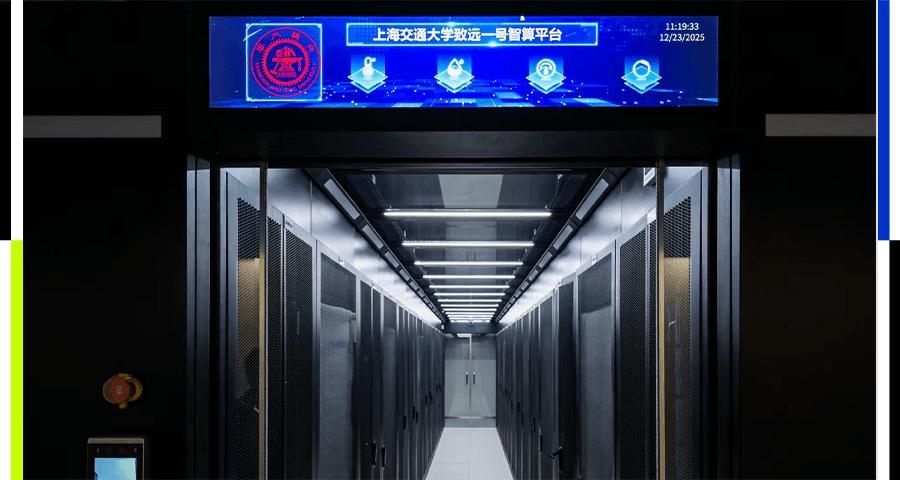
On December 23, a "special member" officially made its debut at Shanghai Jiao Tong University, a century - old institution renowned for nurturing outstanding talents - the "Zhiyuan No.1" Intelligent Computing Platform jointly developed by Shanghai Jiao Tong University and Huawei. This marks a solid step for the university towards the "AI for Science" research paradigm.
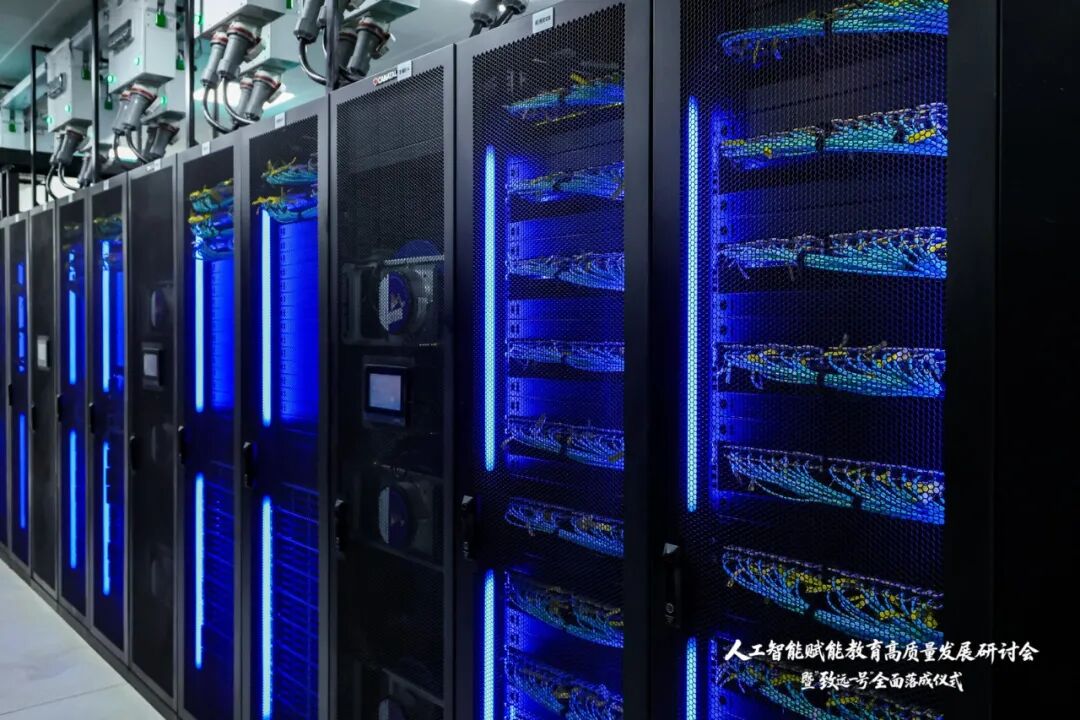
Positioned as the largest domestic intelligent computing infrastructure among national universities, since its launch in December 2024, it took less than a year to complete the local deployment of a thousand - card Ascend cluster and large - scale cloud application of a thousand - card cluster. With a peak computing power of 633 PFLOPS and a storage capacity of 13P, it has made the in - school training of large models with hundreds of billions of parameters a reality.
It provides teachers and students with ready - to - use AI application services, offering a solid computing power foundation for scientific research training, teaching practice, and course experiments.
Standing at the new starting point of the "Big Science Era" empowered by AI, as the research paradigm is being reshaped, what kind of intelligent computing platform does a university need to speed up its teaching, research, and management? This time, the top forces from the industrial and academic circles have presented a Chinese model that holds significant weight globally.

Adapting to the Evolution of the Fifth Paradigm
The emergence of Zhiyuan No.1 is timely.
Globally, AI4Science, or "AI - driven scientific research," is rapidly taking the lead and becoming the "fifth paradigm" of modern scientific activities after empirical science, theoretical science, computational science, and data science.
Two insights are worth noting:
Firstly, more and more scientific researchers and academics are actively embracing and efficiently using AI.
For example, Stanford University held an unprecedented "Open Conference on Scientific AI Agents" in October this year, requiring AI to serve as the first author and reviewer.
According to a report from Google DeepMind, the global usage of AI in laboratories is growing exponentially. One in every three post - doctoral researchers is using large language models (LLMs) to assist in scientific research.
Secondly, AI directly participates in and even redefines the boundaries and methods of scientific discovery, generating key value.
It usually plays a disruptive role in scientific research directions that are data - intensive, involve complex experiments or high costs, and where laws are difficult to observe directly.
A typical example is that both the 2024 Nobel Prize in Physics and the Nobel Prize in Chemistry were awarded to fields related to AI.
In particular, AlphaFold 3 winning the Nobel Prize in Chemistry gives the scientific community confidence that more models like AlphaFold will play a key role in scientific breakthroughs in the next at least 10 years.
The essence of AI4Science lies in combining the computing power of AI with the wisdom of scientists. The goal is not to replace humans but to make scientific research faster, more accurate, and smarter.
On the one hand, major countries and top technology companies around the world are competing to layout in AI4Science to consolidate their global leadership in scientific research. On the other hand, AI4Science has typical characteristics driven by data and intelligent technologies. An intelligent computing platform based on ultra - large - scale heterogeneous computing power will become a solid foundation for supporting teaching and scientific research.
To cope with the fierce global AI competition, China has been intensively implementing relevant policies and measures, emphasizing the in - depth integration and innovation of AI in the education field.
In 2023, the National Development and Reform Commission (NDRC) and other departments launched a specific implementation plan to implement the "In - depth Implementation of the 'Artificial Intelligence +' Action," the "Special Project for the Integration of Industry and Education in Artificial Intelligence." It proposed to build 12 national - level AI platform universities to break the barriers between industry and education, and Shanghai Jiao Tong University was listed as the key leading unit.
In this context, the co - construction of Zhiyuan No.1 by Shanghai Jiao Tong University and Huawei is a natural result. It not only meets the actual needs of scientific research and teaching but also involves national strategies and long - term development. The new platform will provide strong underlying computing power support for talent cultivation, technology R & D, and the integration of industry, academia, and research in the AI4Science era.
At the Huawei Connect 2025 conference, Professor Xi Lifeng, the Executive Vice - President of Shanghai Jiao Tong University, mentioned that "the cultivation of AI literacy requires original research and exploration, practical teaching environments, and experimental platforms for practical training. Therefore, it is inevitable to vigorously promote the construction of computing power infrastructure to support relevant transformation and upgrading."
Shanghai Jiao Tong University has launched the "Ten AI Strategies" at the university level. Currently, scientific research computing covers 100% of all major disciplines, and more than 500 teaching courses have undergone AI - based transformation. Therefore, Shanghai Jiao Tong University, which has been proactively promoting the diversified layout of centralized computing power infrastructure at the university level, made a decisive decision to cooperate with Huawei and other ecological partners to start the construction of the Zhiyuan No.1 Intelligent Computing Platform.
Regarding the integration of industry and education, the two parties have had previous interactions. As early as 2020, they signed an agreement to establish the "Intelligent Base" Industry - Education Integration Collaborative Education Base, and their cooperation has entered a stage of institutionalization and normalization.
Undoubtedly, Zhiyuan No.1 will push the new journey of cooperation between Shanghai Jiao Tong University and Huawei to a new level.
Xi Lifeng said that Zhiyuan No.1 will inject strong impetus into the continuous scientific research innovation of Shanghai Jiao Tong University.

Unfolding the "SJTU Model" with Computing - Assisted Research
When observing the construction and implementation of Zhiyuan No.1, an important reason why this "multiplier" for teaching and research can become a new benchmark is that its planning and scheduling are unified and centralized at the university level.
How to avoid redundant construction and improve resource utilization efficiency is an important issue in the construction of intelligent computing centers in universities in the AI era.
Zhiyuan No.1 adopts a university - level coordinated construction model, giving full play to the advantages of top - level design of the platform and the integration of teaching and research resources, and truly driving the platform by the actual needs of the university.
Through intensive construction and professional operation, the planning, deployment, and evolution of computing power resources can be directly aligned with the university's disciplinary organizational structure, research priorities, and teaching needs, rather than being led by a single college, a single project, or a short - term project.
Thus, from the previously scattered "chimney systems" to the current efficient "unified scheduling," common problems such as "redundant investment and fragmented management" are avoided, and the optimal allocation of computing resources is truly achieved.
Under the university - level coordinated model, Huawei provides a series of hardware and software resources, such as Kunpeng CPU servers and AI acceleration training cards, which are equivalent to building the key "engine" for the operation of the entire system. In addition, for multiple system modules in platform construction, including heterogeneous computing power scheduling, platform operation and maintenance, user access, file and database systems, etc., Huawei complements these modular capabilities through ecological forces.
In this way, the school not only achieves a systematic reshaping of the computing power operation model but also obtains support for the full - life - cycle and one - stop service of digital construction.
Currently, "JiaoWoSuan" serves as a unified entrance, providing the entire school's teachers and students with a full set of services such as computing power application, task management, and account access.
Behind the significant improvement in the convenience and systematicness of scientific research computing is that Zhiyuan No.1 has a super - strong hardware composition, computing power configuration, and scheduling ability.
With a peak intelligent computing power of 633 PFLOPS, Zhiyuan No.1's large - scale parallel computing ability can support the training tasks of large models with hundreds of billions of parameters to be efficiently completed on campus.
Relying on this veritable "computing power factory," intelligent scientific research has now built a "high - speed highway." It not only significantly reduces the procurement and use costs of intelligent computing resources but also can be used in the entire scenario of "research - education - management," and the computing power can be called more independently.
It should be noted that computing power is an important productive force in AI4Science. Scientific research is a data - intensive field. Whether it is training complex deep - learning models, processing large - scale data sets, or dealing with complex model structures, it requires huge high - performance computing resources to support.
So, how does Zhiyuan No.1 specifically support the AI training of teachers and students?
In April this year, Shanghai Jiao Tong University announced the progress of the first - phase construction on its official WeChat account. On the basis of configuring 304 Ascend 910B acceleration cards, it launched the first full - fledged local version of DeepSeek in domestic universities and opened it to all teachers and students on campus.
Even in the first - phase construction stage, all work was done meticulously. The "JiaoWoSuan" team specifically recruited a student team to study a more targeted service model.
They not only sorted out professional prompt words and hundreds of cases for multiple disciplines, covering science, engineering, humanities, and social sciences, but also considering that DeepSeek focuses on text reading and writing but cannot "describe pictures," and that the full - fledged DeepSeek 671B has a large number of parameters, making model fine - tuning time - consuming and labor - intensive. They deployed and tested several lightweight multi - modal models to help students and teachers choose the most suitable model according to their own needs.
It is reported that in addition to providing advanced computing resources, the "JiaoWoSuan" platform also relies on a university - level computing service team composed of more than 30 members to safeguard the school's scientific research, teaching, and management.
For Shanghai Jiao Tong University, the successful completion of Zhiyuan No.1 has extremely profound value and significance.
This university presented an impressive report card of intelligent achievements last year. Nature, Science, and Cell are the three world - recognized top academic journals, commonly referred to as "NSC" for short. In 2024, scholars from Shanghai Jiao Tong University published a total of 58 papers in NSC, and 10 of these 58 papers were selected as highly cited papers in the ESI in 2024.
Seizing the opportunity to speed up the construction of a globally influential scientific and technological innovation center, for Shanghai Jiao Tong University, Zhiyuan No.1 can significantly lower the threshold for teachers and students on campus to use computing power, truly improve students' practical abilities and competitiveness in further studies/employment, and help cultivate compound leading talents with a global perspective. At the same time, it has created a new scientific research business card, which will surely attract high - quality students and high - level teaching staff in the future.
Xi Lifeng said that in the future, Shanghai Jiao Tong University and Huawei will continue to deepen their strategic cooperation, build a sustainable, self - evolving, and world - class AI application ecosystem, and jointly explore collaborative innovation in scenarios such as "AI + teaching, research, and management."

Unveiling a New Picture of Scientific Productivity with AI
Thanks to the support of Zhiyuan No.1, many scientific research achievements have been successfully born.
For example, the "Mingyuan Project" of the Xiao Xiang team. Based on nearly 2,000 deep - sea samples collected from the Mariana Trench, the team built the world's only large - scale deep - sea biological database, identified 7,564 species of deep - sea prokaryotic microorganisms through research, of which 89.4% are previously unreported new species.
Facing the complex decoding task of ultra - high - throughput multi - omics data, the "JiaoWoSuan" platform provides full - process support from storage and computing power resources, software stack adaptation to data analysis and code optimization, helping to increase the algorithm operation efficiency by more than nine times, thus significantly shortening the scientific research cycle.
In the future, the team plans to take a further step and build a multi - modal general large model of deep - sea microorganisms based on the data set to systematically analyze species diversity, community structure, and their adaptation mechanisms to extreme environments.
The GBCseeker early - screening project for gallbladder cancer of the Liu Yingbin team has also benefited from this.
Gallbladder cancer is a silent "invisible killer," with an average 5 - year survival rate of about 5% and a traditional pre - operative diagnosis rate of less than 30%. However, the 5 - year survival rate can be significantly increased to 75% after early screening.
The Liu Yingbin team integrated liquid biopsy and AI radiomics to build a large - scale early - diagnosis model for gallbladder cancer, GBC seeker. Relying on a multi - modal AI system, it can achieve non - invasive and accurate differentiation between gallbladder cancer (GBC) and benign lesions, increasing the pre - operative diagnosis accuracy to 93.3% and reducing the misdiagnosis rate by more than 56%.
Considering that the team needs to integrate genetic, imaging, and clinical information, the project highly depends on strong computing power and high - reliable storage. "JiaoWoSuan" not only provides a resource foundation but also participates in the construction and optimization of various mutation detection algorithms, promoting the breakthrough of key technical links.
Relying on the efficient operation of the "JiaoWoSuan" platform, the supported training models have been applied in fields such as brain science, synthetic biology, and new energy, supporting the release of multiple national - level scientific research achievements, and truly making scientific research outputs "visible, reusable, and convertible."
Since Zhiyuan No.1 has completed the adaptation of the next - generation 910C architecture, it means that as an evolvable platform, it will be smoothly upgraded in the future without the need for a complete reconstruction, significantly saving the upgrade cost.
As the largest intelligent computing platform in domestic universities, the steady progress of Zhiyuan No.1 has a greater significance in exploring a replicable and referable path for the digital transformation of national universities.
The trend of bringing computing power into universities is gradually becoming popular. Many universities, including Tsinghua University and Peking University, have built their own computing power centers. However, with the continuous expansion of computing power