2025 AI Review: Top 10 "Bold Statements"
(1)
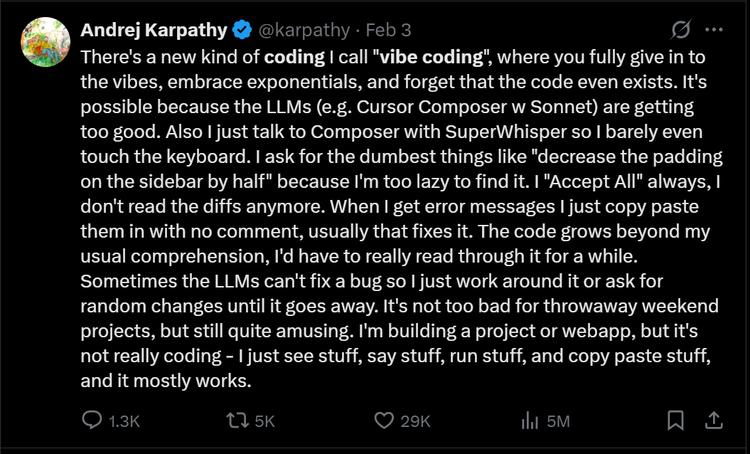
“There's a new way of programming, and I call it vibe coding.
You surrender yourself completely to your senses, embrace exponential growth, and forget about the existence of code itself.”
——Andrej Karpahy
At the beginning of the year, this tweet from Andrej Karpahy, the spiritual mentor of Silicon Valley, triggered an ongoing AGI neologism movement. Initially, people thought he was just talking about coding, but soon, "vibe" took over every corner of AGI. From vibe coding to vibe design, vibe marketing, and finally, it became vibe everything...
Some people like it, believing that "vibe" represents a refreshing product concept, showcases a future - oriented AI ability, and presents a beautiful vision of harmonious coexistence between humans and AI. However, others dislike it, arguing that "vibe" represents a flood of ambiguous language that blurs what's truly important in AI products and creates an "affected" niche culture.
The concept of "vibe" was overly ideal from the start. It overestimated the current capabilities of AI and underestimated the professional thresholds accumulated by humans. This has made people gradually forget about it in terms of capabilities, but they still can't bear to abandon it in the narrative. Anyway, the "vibe" argument has had strong vitality since its birth, with a sub - text of radical remarks full of subversive qualities, catering to people's impulse to tell stories about the great era's changes. Presumably, the word "vibe" will continue to accompany us next year.
May you have just had a "vibe" year.
(2)
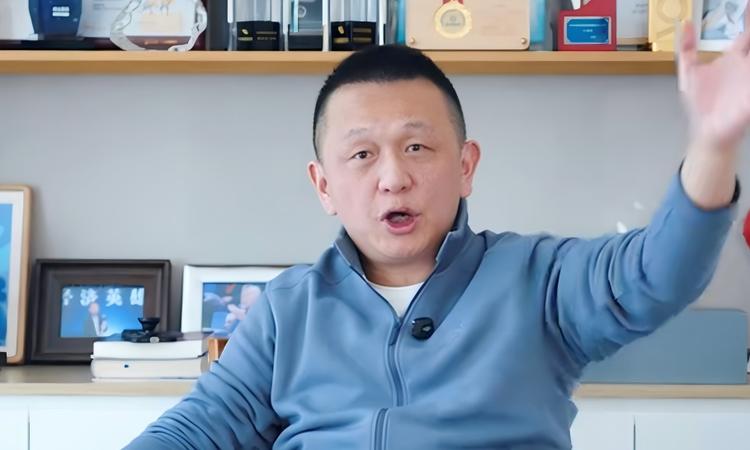
“We are exiting humanoid robot projects in batches.”
——Zhu Xiaohu
In March, Zhu Xiaohu's statement "exiting humanoid robot projects in batches" kicked off a long - lasting discussion about the humanoid robot bubble.
However, the development of humanoid robots won't stop because of Zhu Xiaohu's words. Looking back at 2025, it was still a year when the valuations of humanoid robots soared. Zhu Xiaohu sold his shares right before the main up - wave. As more and more capital flowed in, Zhu Xiaohu was more lenient in his past judgments and instead used "we don't understand" to respond modestly.
But the shadow of the "bubble theory" has never really dissipated. Even the founders of some well - known humanoid robot companies have privately admitted the current capital bubble several times and have adopted more conservative capital consumption strategies, choosing to compete on the "body" side and follow on the "brain" side. Moreover, humanoid robot companies' obsession with "scenarios" this year far exceeded that of last year. "Order PR" has even become a more important voice competition than "financing PR".
However, despite the large number of orders, the commercialization scenario structure of robots in December was not fundamentally different from that in March. The most accessible scenarios in the embodied track are still education and dance performances. The only area showing a trend of breaking through the niche is AI companionship, but the main products in this track are still not humanoid.
Looking back at the beginning of the year from the end, commercialization may not necessarily be the primary goal in the field of humanoid robots. Excessive focus on commercialization may actually slow down the commercialization schedule.
(3)
“Prompt Engineering is Dead.
Long Live Context Engineering”
The statement "Prompt Engineering is Dead" is not a new one. Between 2023 and 2024, scholars and institutions including OpenAI and DeepMind put forward similar views. In particular, in 2024, IEEE Spectrum published an article titled "AI Prompt Engineering is Dead", bringing this assertion to many people's attention.
However, that article had a very interesting subtitle, "Long live AI prompt engineering". When these two sentences are put together, it borrows from the famous "The King is dead. Long live the King". In fact, what the whole article means is that the task of prompt engineering should also be handed over to AI.
Today, prompt engineering seems like something from the last century. But somehow, people have always been trying to find the second half of this statement. It wasn't until the emergence of context engineering that this statement was truly completed, and context engineering quickly became a popular term in the industry.
Compared with prompt, context is broader and more systematic. It not only includes prompt words but also encompasses all the background information, tool capabilities, and even the format and structure of data required for a task. Many agents and infrastructure projects were able to secure funding this year, probably thanks to this statement. Because its successful narrative objectively allowed many investors to see the potential moat between startups and tech giants, and also promoted the development of many tool - based products including memory.
Prompt isn't really dead. It has been reborn in a larger form, and some of its stories will continue - outside the intelligence of super - models, how much living space can be left for others?
(4)
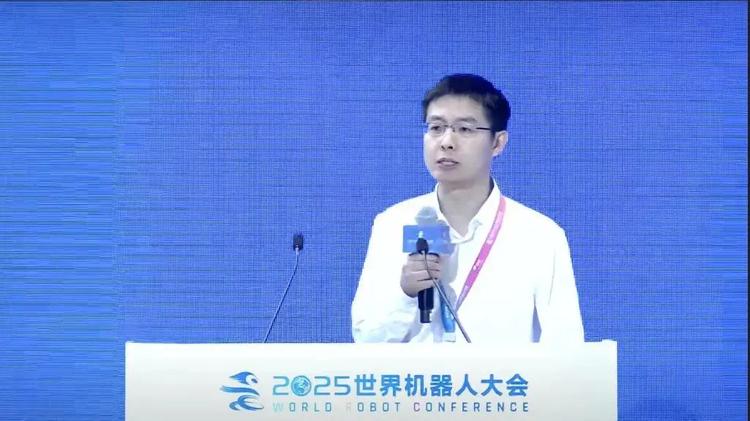
“VLA is a relatively simplistic architecture.
The biggest problem with robots is the model, not the data.”
——Wang Xingxing
At the World Robot Conference in August 2025, because of this statement, Wang Xingxing almost went from being an "industry hero" to an "embodied public enemy".
Because this statement was too harsh. If VLA isn't an LLM and can't achieve the Scaling Law, then the underlying logic of many investments in the industry would be completely overturned. Some even criticized Unitree for "kicking away the ladder" after crossing the river, not only not doing it themselves but also preventing others from doing it.
Today, the great debate about the relationship between data and models is still in full swing, spreading from the embodied field to LLM, and even showing some characteristics of "mixed - doubles" competition. In the embodied track, the world model and the "big and small brains" have emerged strongly in recent months. They are intertwined with the VLA model, serving as patches and extensions of the latter while also having a certain competitive relationship. At the data level, more and more data collection factories and dataset explorations have emerged in the hope of solving the problem of data shortage.
In contrast, when looking back at this news today, my biggest feeling may be that at least half a year ago, the disputes over the embodied brain were still within the domestic embodied industry, but now people seem to be shifting their focus from them to the more radical overseas embodied companies and world model entrepreneurs from the LLM industry.
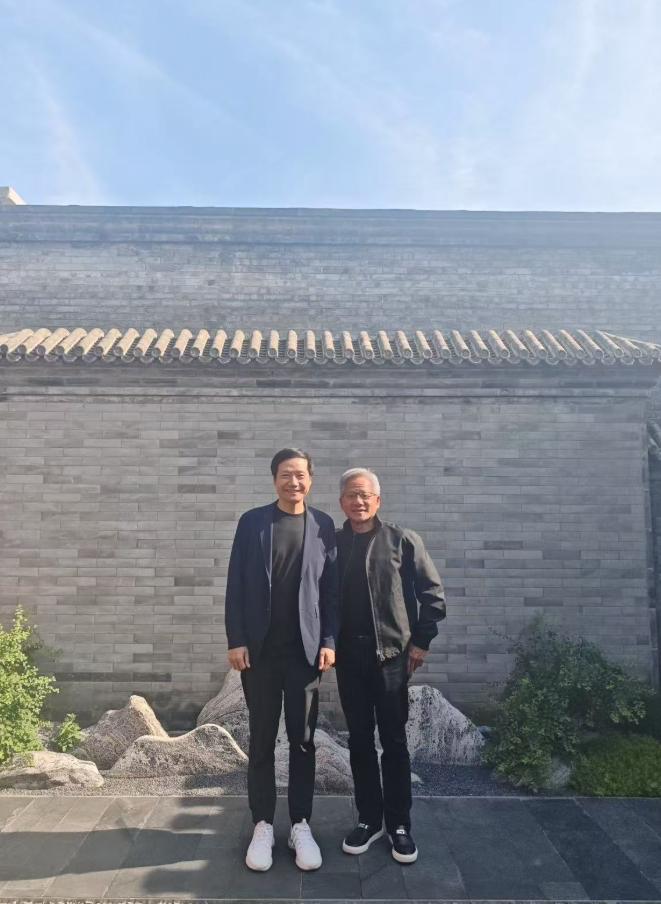
(5) “China will win the artificial intelligence competition”
——Jensen Huang
In November, Jensen Huang made the above statement at the Financial Times Summit.
In the past year, he may have been the most China - concerned entrepreneur in Silicon Valley. He has traveled between China and the United States many times and frequently expressed his views on China's AI issues in the media. In the past few years, due to the US government's sanctions against China, NVIDIA may have indirectly lost tens of billions of dollars in revenue and will lose more in the future. As the world's largest AI infrastructure company with a market value of five trillion dollars, NVIDIA's statement deserves everyone's attention.
Some people think this is Jensen Huang's sincere words, a kind of "warning in prosperous times" in the American version. China has the largest developer community, the largest Internet consumer market, the best power infrastructure, and a moderately positive policy environment. China's achievements in the open - source ecosystem are sufficient to prove everything, and these achievements were made under sanctions, which shows that sanctions cannot stop China's AI progress.
Of course, some people believe that Jensen Huang's main purpose is still to put pressure on the US government. On the one hand, "China anxiety" can make NVIDIA receive more policy attention. On the other hand, strengthening China's image can also make Washington give up the illusion of "encirclement", so that NVIDIA's top - tier products can re - enter the Chinese market. After all, if Chinese and American large - models are destined to divide the market equally, it's better for NVIDIA to maintain its global leadership position.
Regardless of Jensen Huang's true views, this speech reflects the real global AI competition situation:
China and the United States are becoming the dominant players in the systematic AI competition, and the United States cares very much about the outcome of this competition.
(6) “In the next five to six years, traditional mobile phones and apps will disappear”
——Elon Musk
This isn't just Musk's unique view. Microsoft CEO Satya Nadella also said something similar. He said in an earlier interview that "the application layer of traditional software is going to collapse and be replaced by agents."
Less than a month after Musk said this, the Doubao phone was released. Looking back, it even seems like a footnote to the Doubao phone assistant.
Maybe neither Musk nor Nadella expected that the trend of agents replacing traditional applications would come so early and that the confrontation between the two would be so fierce.
On the one hand, the agents imagined by Musk and Nadella may be mainly LUI - based with GUI as a supplement, and data flows within the agents. In contrast, Doubao chooses to fight by taking the high - ground of system authority with a GUI - based approach. On the other hand, the interests of traditional software are firmly established and won't easily yield to the new rules of the game. Instead, they hope to firmly hold the power of agents in their own hands.
Maybe traditional mobile phones and apps will indeed disappear eventually, but the time and manner of their disappearance may both be unknown. Maybe we really need a more powerful and user - friendly native AI hardware that can directly replace mobile phones.
Oh, by the way, OpenAI's first - generation hardware may appear next year.
(7)
“Welcome to short - sell (OpenAI).
If you want to sell your shares, I can help you find a buyer. There are plenty of people who want to buy.”
——Sam Altman
This was Altman's response in November when OpenAI started to face a lot of doubts. The last Silicon Valley tycoon who responded so aggressively to short - sellers was probably Musk a decade ago. This isn't a typical catchphrase, but it's hard to find a similar statement to describe the current divide in attitudes towards the AI bubble.
Before this fierce response, Altman had just painted a huge picture, announcing a cumulative investment of $1.4 trillion in computing power. In the same period, OpenAI's annual revenue was only $13 billion, and its valuation was between $500 billion and $700 billion. OpenAI's revenue guidance is to reach $200 billion in revenue by 2030. But before that, the market may need to see a steeper growth curve from OpenAI.
Today, people have reached a full consensus on the long - term prospects of AI, but there are obvious differences in the current asset prices and input - output ratios.
The picture painted by OpenAI is so big that some people are already worried whether the economy can bear so much revenue and profit to provide a proper exit for the capital crowded in the AI track. And whether the potential large - scale unemployment will lead to deflation and an economic recession. If not, will the decline in asset prices caused by the bursting of the AI bubble destroy the pension accounts of the "golden generation", which will also have far - reaching economic consequences and lead to deflation and an economic recession?
OpenAI's commercialization and monetization ability may become an important indicator of whether the current AI bubble will burst. It represents the revenue potential of the entire industry. If a company with top - tier models, top - tier scientists, top - tier computing power, and the largest user base can't deliver satisfactory revenue to the market, the confidence in AI valuations will definitely be severely hit.
Altman can't prove through natural language that AI can bring prosperity to humanity. He can only let those who believe in it continue to believe, raise enough funds to get through the difficult period before the explosive growth of revenue, and then lead the company's revenue to ultimate victory.
Fortunately, there are enough believers, so he can carry this story intact into 2026.
(8)
“There is no shortage of chips, but there isn't enough electricity and data centers.”
——Satya Nadella
AI is not only a giant in terms of computing power but also a black hole for electricity. The United States has the world's top - tier chips, but the difficulties they are about to face may not be easier to solve than the chip problem - a shortage of electricity.
The bad news is that the electricity shortage may be a structural problem for large companies:
On the one hand, different from China's unified large - scale power grid system, the US power grid is relatively decentralized and highly privatized, making coordination more difficult. If the power demand of data centers is high, there may be local power shortages, resulting in computing power being unable to operate due to lack of electricity. And since the construction cycle of the power grid is significantly longer than that of data centers and chips, this will in turn exacerbate the power shortage problem in data centers.
Morgan Stanley reported this year that if the power supply can't keep up with the growth rate of AI, the US power grid may face a power shortage of up to 20% by 2028, with a total power shortage of 44GW, equivalent to the electricity consumption of more than 33 million US households.
On the other hand, almost all large companies have carbon - reduction goals, and the large - scale power consumption is eroding their public commitments.
For Silicon Valley giants, investing in nuclear energy is becoming a trend. Microsoft, Meta, and Amazon have started signing nuclear power procurement contracts. In addition, a large amount of capital is flowing into the "nuclear fusion" field in the hope of solving the problem once and for all. Elon Musk has criticized "nuclear fusion as stupid" and instead chosen to focus on space solar power stations and is considering deploying AI computing satellites.
In the years of the explosive growth of AI computing power, AI may no longer be just a triangular problem of computing power, data, and models. It will be a real infrastructure - level governance problem deeply embedded in society. And this game between electricity and computing power has just begun.
