ZHU Yie of Kingsoft Office: "Knowledge-Enhanced Generation" Enables AI to Manage Knowledge Like Data, and WPS 365 Creates an Exclusive "Brain" for Enterprises
On December 20th, at the "Alpha Summit" jointly hosted by Wall Street Insights and China Europe International Business School, Zhu Yie, the assistant president and senior technical expert of Kingsoft Office, delivered a keynote speech. AI applications are shifting from being "model - centered" to "data - centered". Kingsoft Office uses "Knowledge - Augmented Generation" as the technical support to help large models truly "master" the enterprise's knowledge assets. Finally, through WPS 365, it completes knowledge modeling, knowledge governance, and multimodal integration to build an exclusive "enterprise brain" for the enterprise.

The picture shows Zhu Yie delivering a speech
Zhu Yie pointed out that current AI applications are shifting from being "model - centered" to "data - centered". Although large - model technology continues to develop and the comprehensive intelligence of cutting - edge models is higher than that of ordinary enterprise employees, AI still faces problems in practical applications such as limitations in the retrieval system architecture, insufficient enterprise - owned data volume, and improper knowledge retrieval and governance. Therefore, the accurate mining and efficient utilization of private - domain data have become the core challenges for enterprises.
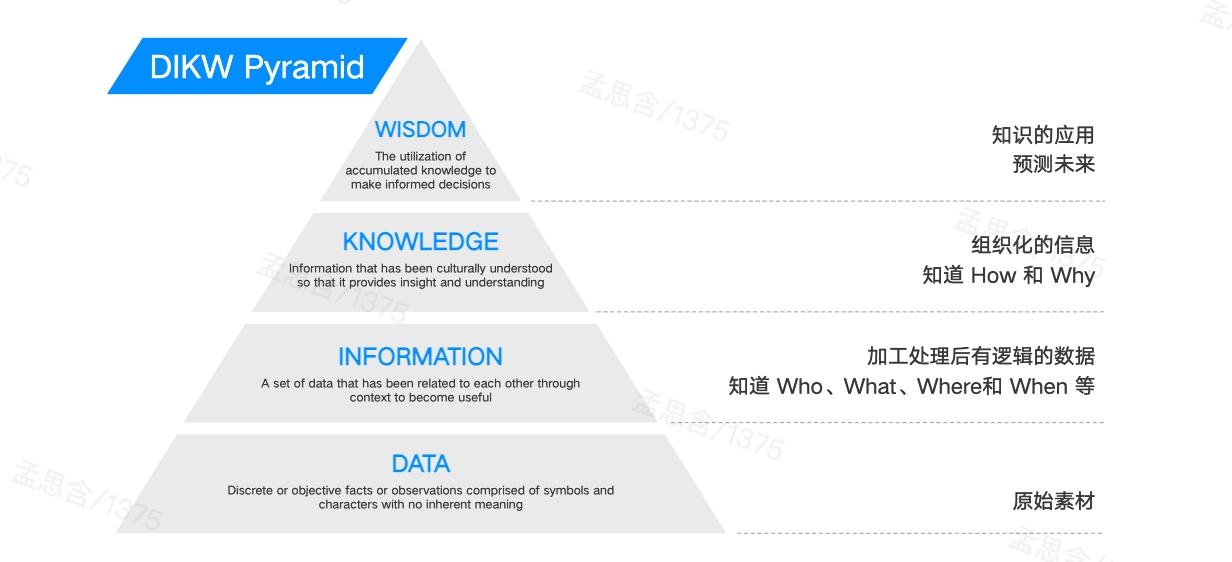
The pyramid model from data to wisdom
In response to these pain points, Kingsoft Office proposed a solution of Knowledge - Augmented Generation (KAG). Compared with traditional Retrieval - Augmented Generation (RAG), KAG not only enables large models to "see" documents but also achieves in - depth "mastery" of the enterprise's knowledge assets through knowledge governance and multi - source knowledge integration. The KAG architecture is divided into a knowledge governance layer and a knowledge application layer. The former is responsible for tasks such as document parsing, knowledge extraction, and graph construction, while the latter empowers professional scenarios through core components such as a multi - source fusion retrieval engine.
Based on the KAG architecture, the AI Docs intelligent document library created by WPS 365 covers four major modules: knowledge governance, intelligent Q&A, intelligent extraction, and intelligent writing, and has been implemented in professional fields such as medicine and law. For example, in pharmaceutical regulations Q&A, the system can accurately identify constraints such as time and region; in clinical report writing, through intelligent extraction templates and precise data transfer, the report - writing efficiency is increased by more than 60%, significantly suppressing AI "hallucinations".
Zhu Yie emphasized that the transition from RAG to KAG is an upgrade in knowledge utilization. Data and knowledge becoming assets available to AI are the cornerstone for enterprises to move from digitalization to intelligence. In the DATA 2.0 era, enterprises need to manage knowledge in the same way as they manage data, forming a dual - lake drive of data lake and knowledge lake, so that AI can truly help enterprises and employees improve efficiency in professional fields.
The full text of the speech is as follows:
Dear guests, good afternoon. I'm Zhu Yie from Kingsoft Office. The topic I'm sharing today is: WPS AI, Moving towards Higher - Quality Knowledge - Augmented Generation.
Since the birth of WPS 1.0 37 years ago when Qiu Bojun wrote more than 100,000 lines of code, Kingsoft Office's product matrix has been continuously iterating and upgrading. WPS 365 is a new - quality productivity platform for organizations and enterprises, including WPS Office, the newly released WPS AI Enterprise Edition, and WPS Collaboration. It integrates the three major capabilities of documents, AI, and collaboration, covering the office needs of an organization, from document creation to instant messaging (IM), meetings, emails, and then to AI applications, and has been officially upgraded to a one - stop AI collaborative office platform. With the development of large - model technology, Kingsoft Office released WPS AI in 2023.
When it comes to large models, they have high intelligence. Regarding how to define intelligence or wisdom, we can analyze it from the "pyramid from data to wisdom".
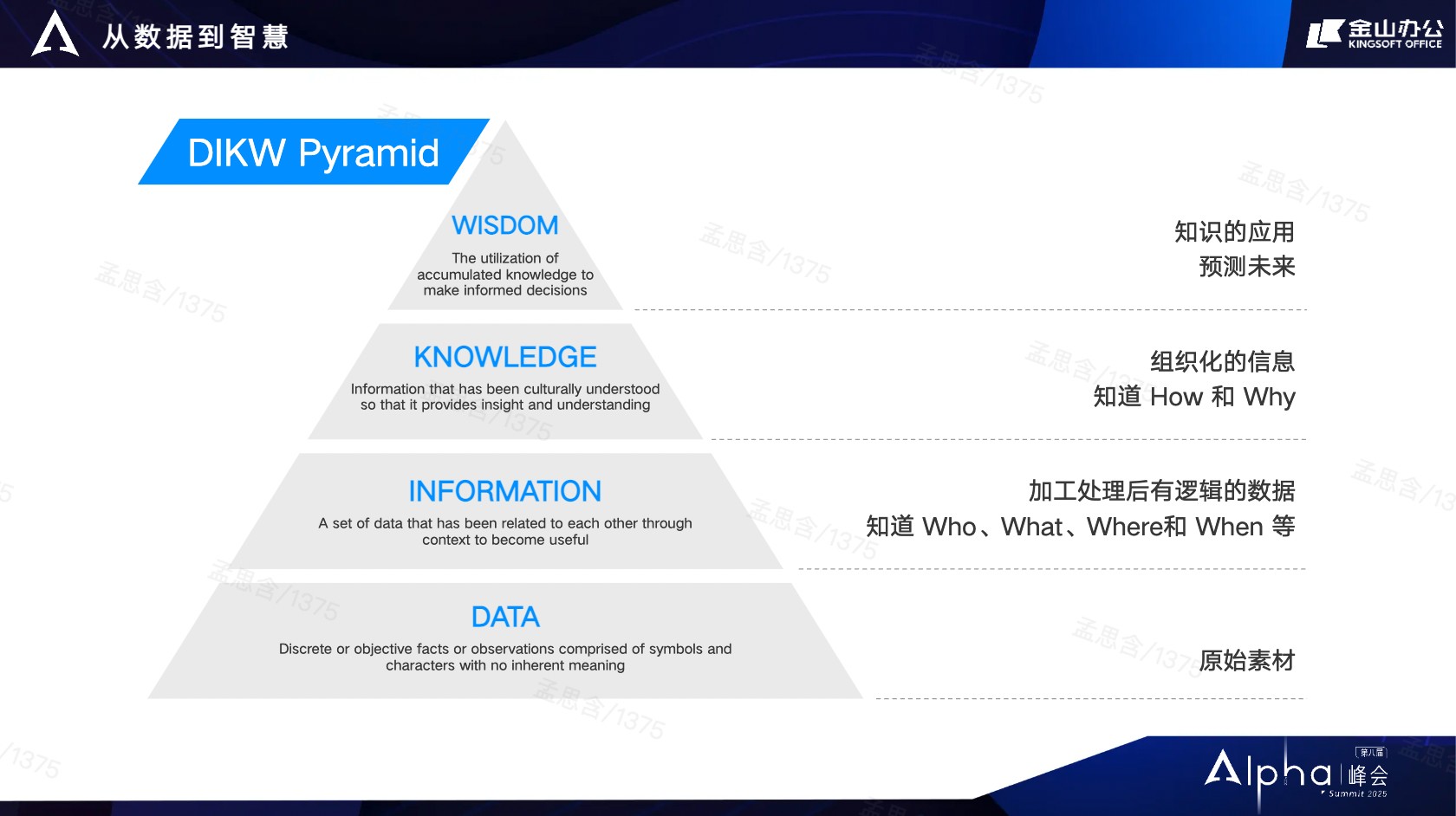
At the bottom of the pyramid is raw data (DATA). Data with logic after processing is usually called information (INFORMATION). Organized information that can explain How and Why is called knowledge (KNOWLEDGE). Finally, the ability to apply knowledge to solve problems and predict the future is called wisdom (WISDOM).
There is a very key question: What is included in today's large models? After 4 - bit quantization, the model parameter weight file of a 7B large model is about a 4 - GB file on the disk. Obviously, it cannot contain all the raw data of public - domain knowledge on the Internet but stores knowledge sorted out based on high - frequency events according to statistical laws. This knowledge must be combined with real data to play its value in practical applications.
The three core elements of AI applications are algorithms, computing power, and data. Generally, we consider today's algorithms or "brains" to be more intelligent large models, such as Deepseek V3.2, Qwen3, Kimi K2, GLM4.6, etc. The technology of large models is still continuously developing. Computing power means faster and cheaper inference. There may be two different business models in China and the United States, but we can see that domestic computing power has made significant breakthroughs. From the data dimension, large models themselves already contain very rich public - domain data and knowledge. The core challenge is the better mining and utilization of private - domain data. However, we believe that the difficulty of practical application in this aspect far exceeds expectations.
Therefore, we believe that AI applications will shift from being "model - centered" to "data - centered" in the future.
The capabilities of large models are continuously developing. The comprehensive intelligence of cutting - edge models in knowledge reserve, logical understanding, etc., is higher than that of ordinary enterprise employees, and the differences in the capabilities of various models are not significant. Therefore, it is not easy to form a monopoly in this type of technology.
Second, the previous practice of pre - training large models for industries and enterprises based on massive data is likely to be a false proposition. The reason is that the volume of enterprise - owned data is just a drop in the ocean compared to the data volume required for the complete training of the base model; at the same time, the iteration speed of the base model is extremely fast, resulting in the training of industry - specific models always being in a passive state of following the version upgrade of the base model.
Third, the root cause of the poor performance of most AI applications is related to external data connection. For example, data errors are caused by parsing problems, too little data is due to improper knowledge retrieval and governance, and when facing too much data, how to better select suitable data with the help of the context engineering of large models.
From the perspective of data connection, RAG (Retrieval Augmented Generation) has become the standard architecture for large models to combine external and private - domain data. It effectively solves four major problems: knowledge combination, knowledge update, permission control, and fact - checking, and is widely used in many fields. RAG itself is also continuously evolving: from the initial Naive RAG to Advanced RAG, and then to modular and Agent - based RAG.
However, in the process of enterprises applying RAG, we still found many challenges. The first problem is that a large amount of enterprise data exists in the form of "documents", such as text, spreadsheets, and PDF documents. Due to the complex format, chaotic organization, missing content, or mutual contradictions of these unstructured data, the documents themselves are not equivalent to available knowledge, which directly affects the retrieval and generation effects of RAG.
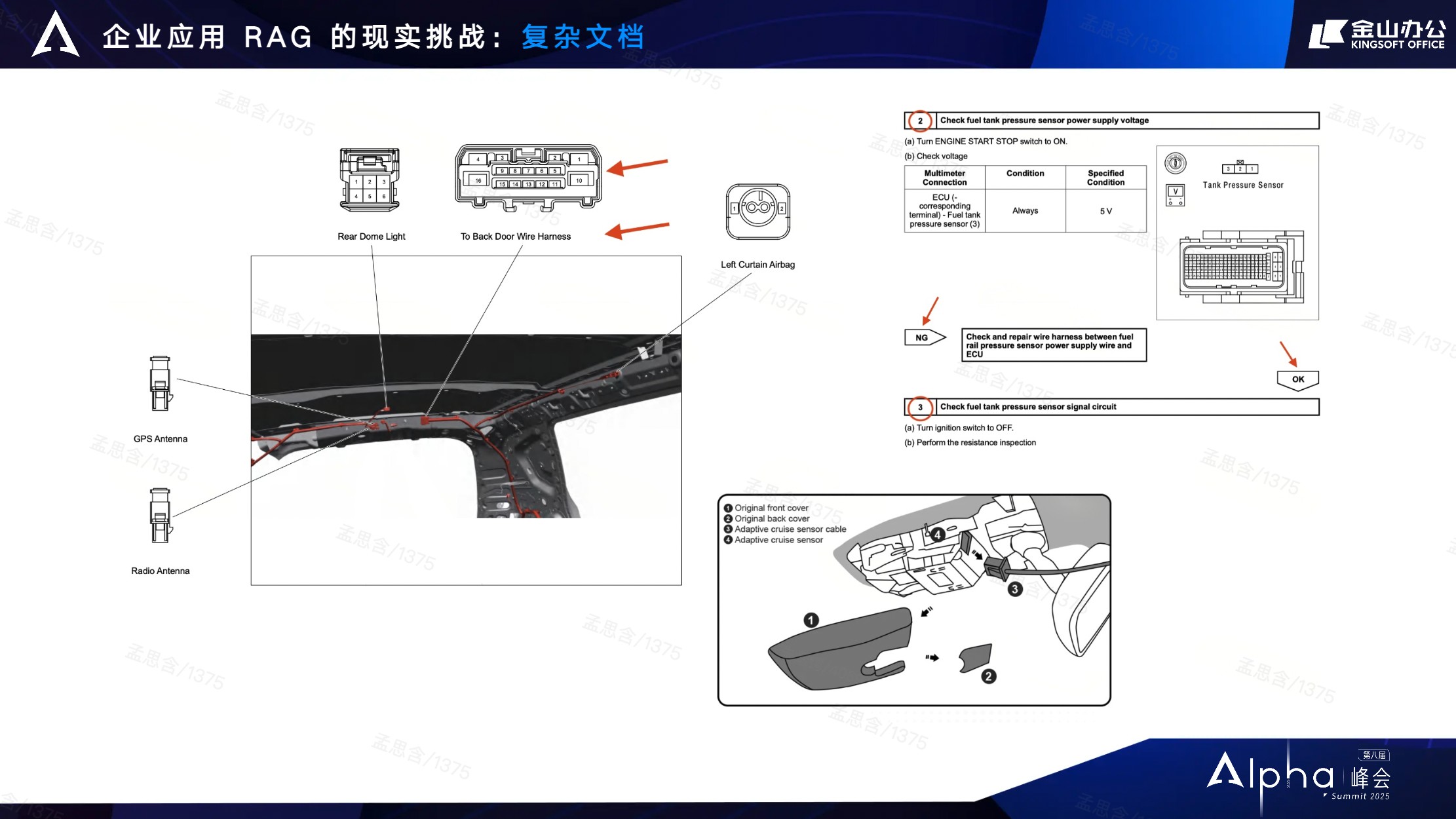
The second problem is that the traditional RAG solution has semantic limitations - it conducts retrieval based on vector similarity (embedding), and semantic similarity does not equal logical relevance. This not only leads to the recall of many fragmented information that cannot be effectively integrated but also is insensitive to logical relationships such as numerical values and time, and cannot effectively handle implicit relationships in the text.
These two types of problems are common in real - world scenarios: when facing complex documents, tasks such as mixed text and image layout, reading order derivation, sub - tables in spreadsheets, table header detection, and effective parsing and expression of graphic documents, such as the correspondence between sub - figures and text in industry customer maintenance manuals and the logical links of flowcharts; there are also widespread knowledge conflict problems in the document library, including explicit conflicts in dimensions such as facts, numerical values, time, and processes, as well as implicit conflicts where the contained knowledge contradicts each other. These will seriously reduce the output effect of AI applications; in addition, industry jargon and enterprise - specific terms often exceed the understanding scope of the model, and the personalized needs in the enterprise context, such as providing suitable answers based on the user's position, rank, and location, cannot be well met by traditional RAG.
As a result, many current AI applications are in the dilemma of "producing a demo in a week but failing to go live in half a year".
In the application of the enterprise's existing knowledge assets, the GraphRAG framework provides a new idea: it builds a logical system based on document content and improves the generation quality through generating knowledge graphs and conducting path reasoning based on the graph structure. However, it still has two major problems: one is that it heavily depends on the quality of the original documents, and the other is that there are still many technical challenges to be overcome in the engineering implementation. In addition, the high - quality structured knowledge accumulated in many professional fields, such as professional knowledge graphs, standardized structured labels, and SOP process specifications, also has great application potential. If the effective integration of multi - source knowledge can be achieved, the generation quality and professional level of AI applications will be greatly improved.
In response to the above - mentioned series of pain points, we believe that a better solution is: to evolve AI capabilities to the KAG (Knowledge Augmented Generation) stage. It has two core ideas: first, knowledge must be governed, and high - quality input can support high - quality output; second, break the limitations of "document retrieval" and systematically integrate multi - modal and multi - structured knowledge assets to provide high - quality input for AI generation.
Analyzed from the architectural level, KAG can be divided into two core modules: the knowledge governance layer and the knowledge application layer. The knowledge governance layer covers tasks related to document parsing, knowledge extraction, graph construction, label systems, and quality monitoring to obtain high - quality underlying knowledge; on this basis, the knowledge application layer uses the multi - source fusion retrieval engine, dynamic sorting module, and context engineering system as core components to build a knowledge base that can empower various professional scenarios.
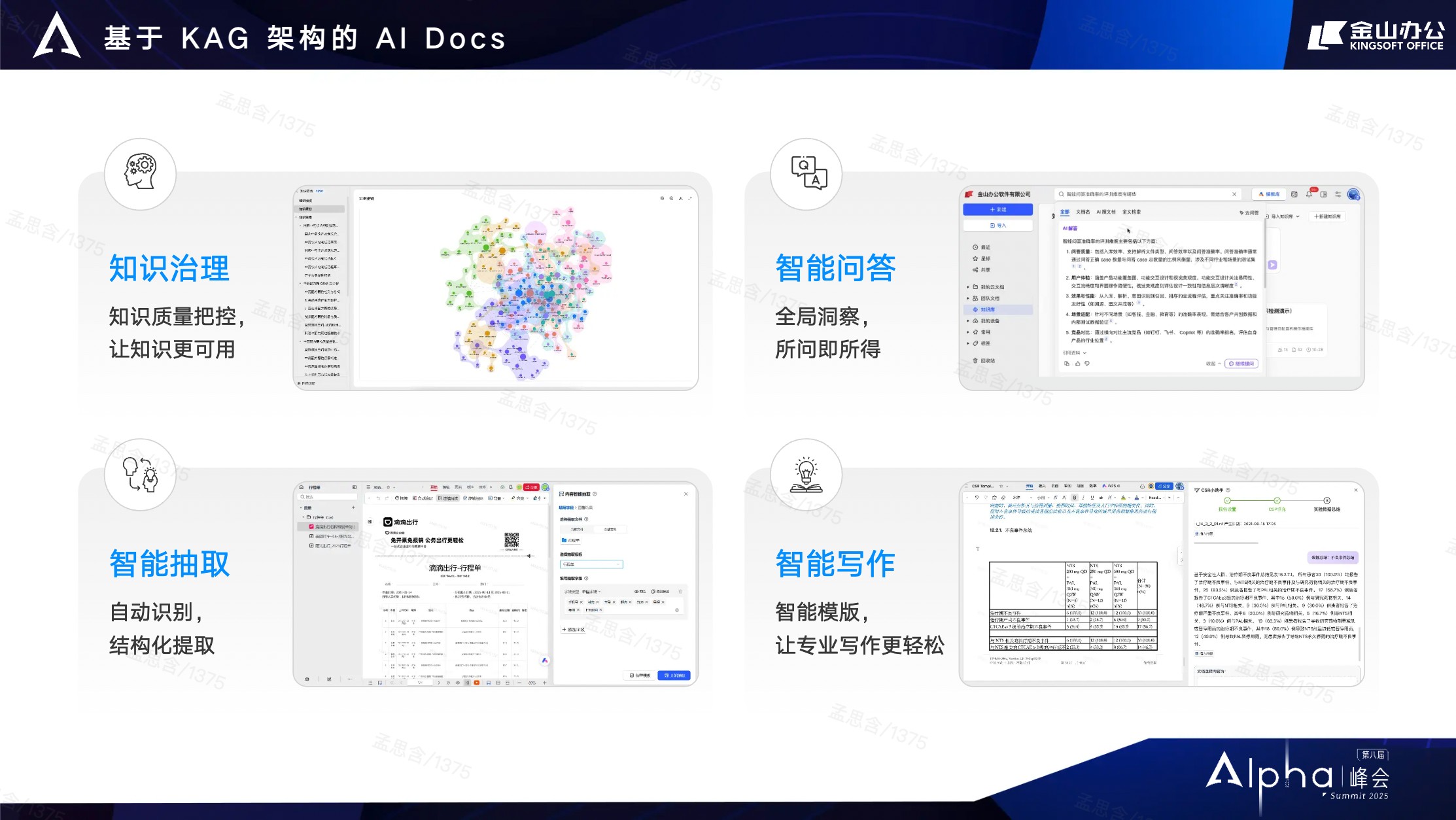
The AI Docs intelligent document library created based on the KAG architecture has core capabilities in four major modules: knowledge governance, intelligent Q&A, intelligent extraction, and intelligent writing, providing enterprises with full - link intelligent knowledge management and application services.
Relying on the knowledge governance module, AI can improve the knowledge quality of the enterprise's original assets. This module uses the method of knowledge graph modeling to continuously extract logical triples from documents, finds possible contradictory attributes or relationships between entities through the process of grouping and filtering; then combines large models to clean up duplicate content, extract conflicting content, and detect missing knowledge, and finally hands it over to the knowledge administrator for manual judgment and processing. For example, when building an enterprise knowledge base, ordinary employees often do not have the ability to make a global judgment on knowledge materials. At this time, the large model can detect content missing points with its comprehensive understanding of public - domain knowledge and assist employees in supplementing and optimizing the knowledge system.
The intelligent Q&A module is committed to providing higher - quality knowledge Q&A services in professional fields. We conduct fine - grained parsing of enterprise private - domain documents, build document graphs, and at the same time complete the ontology modeling and knowledge structuring of professional field knowledge, and deeply integrate the two to form core knowledge with logic, completeness, and professionalism. Taking the professional knowledge base of pharmaceutical regulations as an example, after the system receives the Query input by the user, it first conducts element parsing, refines the constraints and the query subject, and then conducts retrieval and subsequent processing based on the core knowledge. In this process, the system can accurately identify constraints such as "after June 2025" and "Zhejiang Province" and output the correct answer, effectively avoiding the interference of regulations from other regions.
The core value of the intelligent extraction module lies in accurately extracting key fields from unstructured data and converting them into structured content. We have carefully optimized special document elements and formats such as checkboxes, multi - level complex tables, scanned documents, and handwritten text in enterprise production process documents, and greatly improved the processing efficiency through complex recognition and batch extraction functions. The module uses a template - driven approach that supports the addition of custom fields and can be flexibly adapted to various scenarios for extraction work; in terms of result application, it supports both manual configuration of fields and real - time acquisition of extraction results and automatic aggregation to a specified folder or system, suitable for the construction of multiple scenarios such as contract libraries and resume libraries.
A pharmaceutical customer built a "Drug Vigilance SAE Individual Case Report Information Extraction System" based on this set of capabilities: Various adverse event reports generated during the clinical stage are sent to the pharmaceutical company in the form of email attachments. The pharmaceutical company calls the API through the WPS 365 automation platform to automatically extract the email attachments, perform parsing and intelligent extraction, output structured data in JSON format, and then call back the customer's drug management system for automatic entry, greatly improving work efficiency.
Finally, the intelligent writing module relies on the creative ability of large models to efficiently complete the generation tasks of various documents such as professional industry reports, aiming to build a compliant and controllable general report - writing platform. Most reports are different from daily leave notes and speeches. They have clear format requirements and require precise transfer and summarization of a large amount of data or content. Manual writing is not only time - consuming and labor - intensive but also prone to omissions; and it is generally believed that there is a "hallucination" problem in general AI during this process.
To achieve accurate transfer of a large amount of data, AI Docs first ensures the accuracy of raw data search. It uses a data retrieval Agent driven by the writing goal and ensures information accuracy through multi - round verification. For text content, it supports lossless citation of the original material report; for table data, it can completely retain the original format during the transfer process. In the report - writing stage, the system strictly follows industry and enterprise specifications and outputs content that meets professional standards; in terms of chapter configuration, it can intelligently and standardly generate the report outline.
In terms of technical architecture, we have constructed two Agents to work together: the first Agent can construct an intelligent template system that can define the writing outline, workflow, sub - task list, and required data according to the report writing template, examples, and the regulations/SOP requirements of the corresponding field. The second Agent integrates various experimental data, table data, and planning data during the report - making process based on the intelligent template to complete the final report writing. Taking the writing of a clinical research report (CSR) in the pharmaceutical industry as an example, WPS AI can achieve "lossless transfer" of experimental data through this whole set of mechanisms, imitate the thinking logic of pharmaceutical professionals to summarize data, effectively suppress content "hallucinations", and turn the originally complex academic report writing from an "essay question" into a "fill - in - the - blank question", saving more than