In the industrial large model field, an "underwater unicorn" has emerged.
Recently, a new "meme" has emerged on the Internet - "Woke up one day, and we've become an 'Industrial Cthulhu'?"
Yes, when we talk about "a major industrial country" or "a major manufacturing country", not many people have an intuitive feeling.
Let's first look at a set of data:
According to data from the Bureau of Economic Analysis of the US Department of Commerce, in 2024, after several years of a vigorous "manufacturing reshoring" plan, the US industrial added - value reached a record high of $374 million, among which the manufacturing added - value was $291 million, also hitting a new high.
According to data from the Federal Statistical Office of Germany, the Cabinet Office of Japan, and the Bank of Japan, in 2024, Germany and Japan - second only to the US - had annual industrial added - values of $98 million and $93 million respectively; the manufacturing added - values were $83 million and $82 million respectively, both less than 30% of that of the US.
So, what about China?
According to data from the Ministry of Industry and Information Technology of China, in 2024, China's total industrial added - value reached 40.5 trillion RMB (approximately $569 million), ranking first globally for 15 consecutive years and accounting for over 30% of the global total, which is more than the sum of the US, Germany, and Japan.
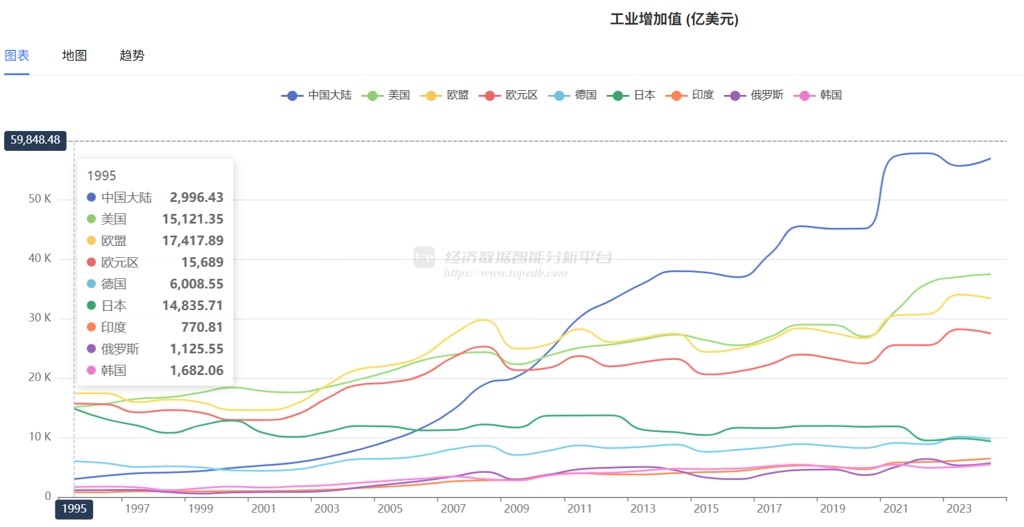
Changes in industrial added - values of China, the US, Europe, Germany, Japan, India, Russia, and South Korea from 1995 to 2024; Image source: Economic data intelligent analysis platform
Especially in heavy - industry fields such as energy, materials, metallurgy, machinery manufacturing, and chemicals. For example, in 2024, the cement output of enterprises above designated size in China was 1.825 billion tons, accounting for nearly 50% of the global total output and ranking first in the world for 39 consecutive years.
As a globally leading non - metallic materials manufacturer, China National Building Materials Group not only comprehensively promotes the "cement +" strategy but also continuously makes efforts in strategic emerging industries around "inorganic non - metallic materials, organic polymer materials, and composite materials". It has built a number of major demonstration projects such as the world's first zero - carbon intelligent manufacturing base for glass fiber.
- What is "Industrial Cthulhu"? This is "Industrial Cthulhu".
However, challenges still exist.
In 2024, the per - capita manufacturing added - value in the US was approximately $8,670, while that in China was only $3,345, less than half of that in the US.
Although the US has the problem of "hollowing out" in its manufacturing industry, its advantages in high - end and intelligent fields are also significant. Especially in recent years, as the global situation has been continuously adjusted in the process of escalation, turmoil, and change, the US has vigorously implemented the manufacturing reshoring plan and continuously increased innovation in emerging industries such as artificial intelligence, large models, and high - performance computing. In 2024, the National Institute of Standards and Technology (NIST) of the US even established a special fund to promote the integrated R & D of AI and manufacturing.
China has also made top - level design and strategic plans for the development of artificial intelligence.
This year, the State Council officially issued the "Opinions on Deeply Implementing the 'Artificial Intelligence +' Initiative". As the first guiding document in the field of artificial intelligence in China, it clarifies the development plan and goals in the domestic artificial intelligence field for the next decade. Recently, the Ministry of Industry and Information Technology launched the work of "Innovation Challenge and Recruitment in the Artificial Intelligence Industry and Enabling New - type Industrialization", aiming to accelerate the process of using artificial intelligence to empower new - type industrialization.
Currently, there are numerous attempts in the industry to apply AI "across boundaries" to industrial scenarios, ranging from Internet giants to AI startup stars. In many cases and scenarios, they are only one step away from completing the value - closed loop and bringing real economic benefits to industrial enterprises.
However, it is precisely this "last mile" that has trapped countless people.
At the "Strategic Symposium on Collaborative Innovation and Development of 'Artificial Intelligence + Manufacturing'" during the Great Wall Engineering and Technology Conference in July, Anhui Digital and Intelligent Building Materials Research Institute Co., Ltd. (hereinafter referred to as "Digital and Intelligent Institute"), an industrial large - model company incubated by China National Building Materials Group, presented a clear practical result of industrial AI. Its independently developed "Xiaomiao" industrial large model has successfully achieved real - time closed - loop control of production and manufacturing in dozens of factories and end - to - end optimization of business decisions by integrating data models, mechanism models, business models, and domain knowledge bases. It has reduced the average cost per ton of cement by $2 in each factory and decreased the energy consumption and power consumption per unit product, creating hundreds of millions of dollars in benefits for enterprises.
Yes, in addition to language dialogue and image creation, the industrial large model has achieved closed - loop management of real - time collaborative models in key scenarios such as the supply chain, production, and marketing. It has also achieved end - to - end real - time automatic closed - loop control on the production side, bringing a benefits - closed loop of "real money" to the front line of industry.
I. The Low - key "Underwater Unicorn"
The Digital and Intelligent Institute is a To B enterprise that provides industrial enterprises with a value - closed loop of data, models, and implementation based on technologies such as agent - based artificial intelligence and industrial large models. It was jointly funded and established in December 2022 by the New Materials Fund, a member of China National Building Materials Group, Southern Cement, Aolin Technology, and Shangfeng Building Materials, with a registered capital of 500 million RMB.
Compared with the high - profile general - language large - model enterprises, the Digital and Intelligent Institute with central - state - owned - enterprise background is extremely low - key.
As early as 2023, with the industrial large model as the core engine, the Digital and Intelligent Institute took the lead in completing more than a dozen high - value AI application pilots in the entire "supply - production - sales" chain of basic materials and end - to - end production scenarios, creating significant economic benefits. Subsequently, it quickly replicated the mature model on a large scale: in 2024, it was promoted to 66 factories, and in 2025, with the in - depth application of the end - to - end industrial large model, the cumulative number of serviced factories exceeded 100, forming a set of standardized implementation plans that are "replicable, lightweight, and effective".
Its technical strength and industrial value have been recognized by both domestic and international authorities: at the national level, the consortium composed of the Digital and Intelligent Institute and Tianshan Materials successfully won the bid for the major scientific and technological research project in the building materials industry with the "R & D and Innovation Project of the Full - process Control and Optimization Model for Cement Production"; at the international level, China National Building Materials Group won the runner - up in the advanced manufacturing track of the Gartner 2025 "Eye of Innovation" selection with the "Cement Industrial Large Model" innovatively developed by the Digital and Intelligent Institute, setting a new benchmark for the innovative development of China's manufacturing industry.
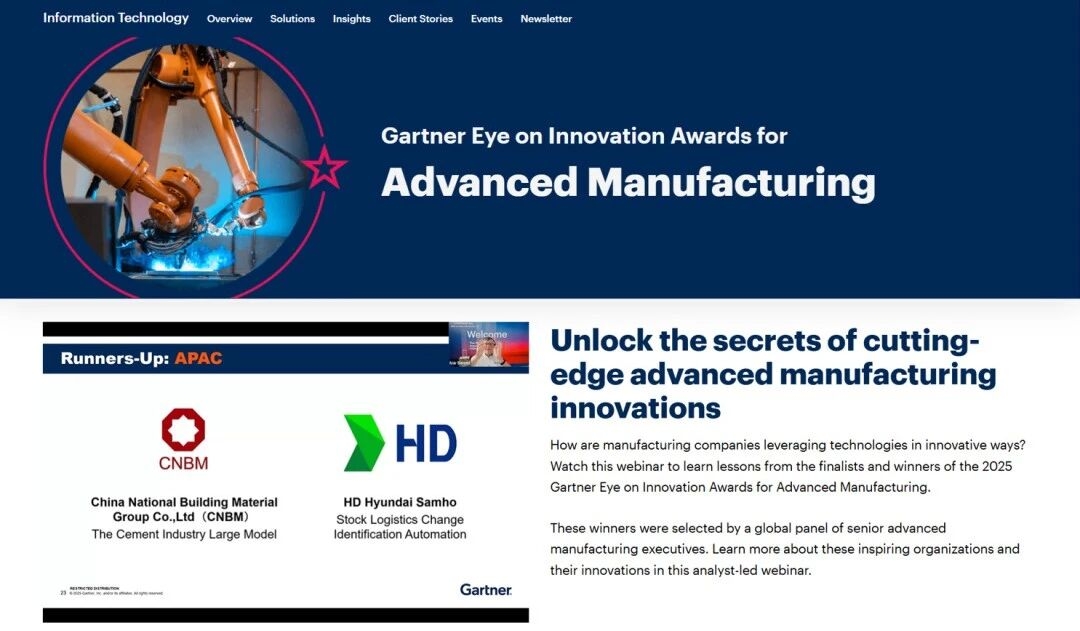
China National Building Materials Group won the runner - up in the advanced manufacturing track of the Gartner 2025 "Eye of Innovation" selection
More importantly, currently, the Digital and Intelligent Institute has cumulatively managed and trained more than 2 trillion valuable production data and built nearly 200 scenario models of various sizes. Recently, the Digital and Intelligent Institute further launched the "AI + R & D Platform" of the "Xiaomiao" industrial large model, marking a systematic extension of its capabilities from production optimization to the source of R & D innovation. This platform aims to build an intelligent closed loop from laboratory exploration to industrialization, achieving a leap in R & D efficiency driven by AI. Thus, the Digital and Intelligent Institute has established an intelligent empowerment system covering the core scenarios of the entire industrial chain, including R & D, procurement, production, sales, logistics, and services, continuously creating quantifiable direct economic benefits for each link of the industry.
It can be said that in the three years since its establishment, the Digital and Intelligent Institute has quietly become a benchmark enterprise in the field of industrial large models.
How did it achieve this?
Before answering this question, we may first need to understand: how difficult is it to develop a good industrial large model?
II. Three Challenges of Industrial Large Models
In the current business narrative, for the vast majority of enterprise managers, AI has evolved from a mere "technological hot spot" to a "strategic imperative" that must be faced. However, beyond curiosity, practical considerations regarding benefit quantification and pain - point solution have become the focus of current decision - making.
Although large AI models have shown amazing penetration in general fields such as document processing, knowledge Q & A, and content creation, there are few successful cases in industrial scenarios that can verify their significant positive value.
The reason lies in the fact that the technical essence of large models is generative AI, and its core is "Next Token Prediction". It is good at searching, summarizing, handling long texts, and generating creative content. At the same time, the "hallucination" problem and the "black - box" problem are still rooted in the underlying technology of the model itself, which makes it often perform poorly in production scenarios with low fault tolerance and strong time - sequence requirements (such as industrial assembly lines).
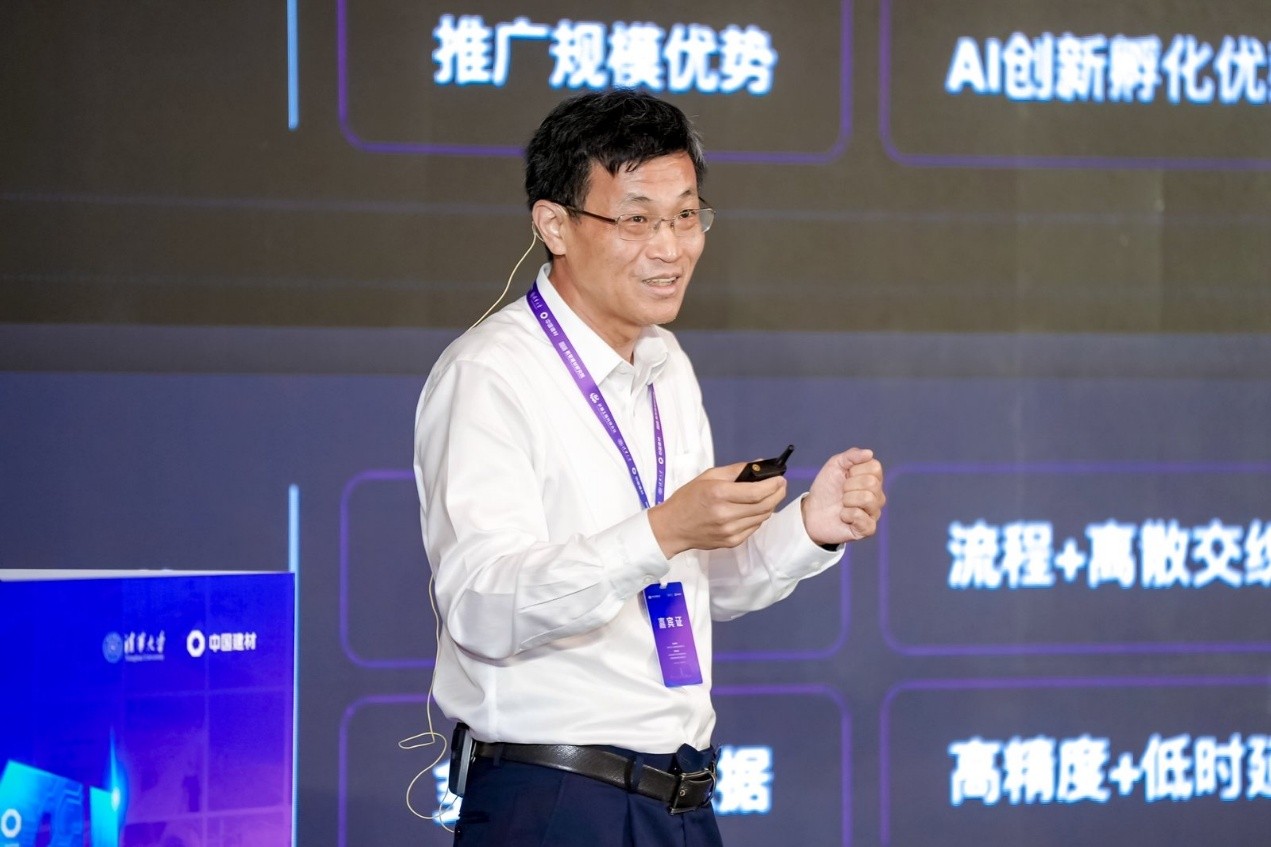
Xue Zhongmin, Executive Director of the Science and Technology Committee of China National Building Materials Group and Chairman of the Digital and Intelligent Building Materials Research Institute
Also at the Great Wall Engineering and Technology Conference, Xue Zhongmin, the chairman of the Digital and Intelligent Institute, summarized the difficulties of applying AI in the industrial manufacturing field into three challenges:
1. Data: Industrial scenarios have a large amount of time - series data, and the way to process it is different from natural language. The model must understand the business logic hidden in the numbers and eliminate the hallucination phenomenon of large models.
2. Scenarios and business: The industrial mechanism and business logic are very complex. The construction of the model must have an in - depth understanding of the scenarios and comply with real - world business rules to ensure the accuracy, real - time nature, and executability of the output decisions.
3. Stability and fault tolerance: In industrial manufacturing, especially in process industries such as cement, the fault tolerance for decision - making instructions is almost zero. The model must be able to independently handle abnormal situations to ensure safe and stable production.
At the same time, there is also the most important point - the Return on Investment (ROI) is difficult to evaluate.
Therefore, many industrial digital twin and simulation laboratory projects cannot achieve a value - closed loop. The models exist independently of the production line, only providing prediction parameters for producers, unable to provide real - time business decisions, and it is even more difficult to calculate the investment return efficiency.
"Model construction is not an IT system. After deployment, there are clear goals for evaluation and measurement. There is no standard to recognize the value of large models. How can we determine it? So, in combination with industrial scenarios, there is only one 'clumsy way' - to be benefit - oriented." At the Great Wall Conference, Xue Zhongmin also presented the solution of the Digital and Intelligent Institute.
Currently, whether in the cement, building materials, or the entire industrial manufacturing field, enterprises have an extremely strong demand for cost reduction, efficiency improvement, and intelligent transformation and upgrading. In 2024, the total profit of cement enterprises above designated size in China was approximately 25 billion RMB, a 20% year - on - year decrease. The business pressure, financial pressure, as well as the requirements for environmental protection, energy conservation, and carbon reduction have all brought urgent needs for industrial transformation and upgrading to enterprises.
According to Xue Zhongmin, the Digital and Intelligent Institute will rely on the industrial large model to develop more Agentic AI applications. In the next step, it is expected to help enterprises reduce the cost per ton of cement by $3 - 5, and in principle, the average pay - back period can be shortened to less than one year, greatly meeting the needs of enterprises for intelligent transformation and upgrading.
III. AI "Grown" from the Factory
"We have been emphasizing the three elements of (artificial intelligence), which are data, algorithms, and computing power. Here, I especially emphasize that many people forget about 'knowledge'." At the Great Wall Science and Technology Conference, Zhang Bo, an academician of the Chinese Academy of Sciences and a professor at the Department of Computer Science and Technology of Tsinghua University, said so.
Yes, in the field of large models - especially in the field of industrial large models - the importance of industrial knowledge, industrial data, and industrial know - how is beyond doubt.
Twenty kinds of clinker ratios can lead to 200 kinds of quality fluctuations. One hundred batching scales can have 1,000 kinds of drift patterns. From the recording habits of engineers to the thermal system of the firing system, there are hundreds of scenarios in the cement category alone. Combined with the complex differences among factories of all sizes scattered across the country, it has set a very high threshold for entering the industrial large - model field.
To some extent, the AI industrial model of the Digital and Intelligent Institute is "grown" from inside the factory.
In terms of data, the Digital and Intelligent Institute has deeply cooperated with Tianshan Materials to promote cross - domain collaboration among business experts, data experts, and algorithm experts. They jointly built an industrial - level data standard and established the path for building an industrial large model of "defining the model by the scenario and defining the data by the model", systematically creating an integrated solution from data collection, mining to management. This mechanism effectively ensures the high quality and high availability of data, promoting the transformation of industrial data from static assets to continuously driving dynamic productivity.
In terms of business, the rapid implementation and application of the industrial large model in the field of basic materials cannot be separated from China National Building Materials Group's high - level attention to digital transformation. By establishing a top - down AI - integrated innovation system, it has gradually promoted the in - depth application of AI technology to empower the entire process of building materials production. At the same time, industrial application parties such as Tianshan Materials have carried out multi - role collaborative co - creation through industry - university - research - application cooperation, enabling the Digital and Intelligent Institute to have in - depth access to a large number of enterprise decision - makers, factory directors, and even senior engineers on the production line who have real - world scenarios and real pain points. They are the people who understand technology and scenarios best, and they also have the most urgent pain points and needs, with a profound understanding of business scenarios and logic.
Relying on this unique industrial know - how ability of "industrial data + business logic + industrial mechanism" in the industrial field, the Digital and Intelligent Institute has created a systematic "1 + 1+N architecture", which consists of a digital and intelligent base, an industrial large - model platform, and N