EVE Energy to Build AI Robots, Enter Production Lines in 2026 and Create Industrial Intelligent Scene Manufacturing Solutions | The Frontline
Author | Huang Nan
Editor | Yuan Silai
Recently, the groundbreaking ceremony for the "EVE Sodium Energy Headquarters and Jinyuan Robot AI Center" project was officially held in Area D of EVE Energy's Huizhou headquarters.
In the sodium battery segment, the project has a total investment of approximately 1 billion yuan and a planned total construction area of about 90,000 square meters. It will build an innovation platform integrating "R & D - pilot - mass production". In the AI and robot segment, the Jinyuan Robot AI Center with a planned construction area of about 50,000 square meters will cover the entire R & D and mass - production process of robots, including "R & D - trial production - pilot - final assembly - skills training".
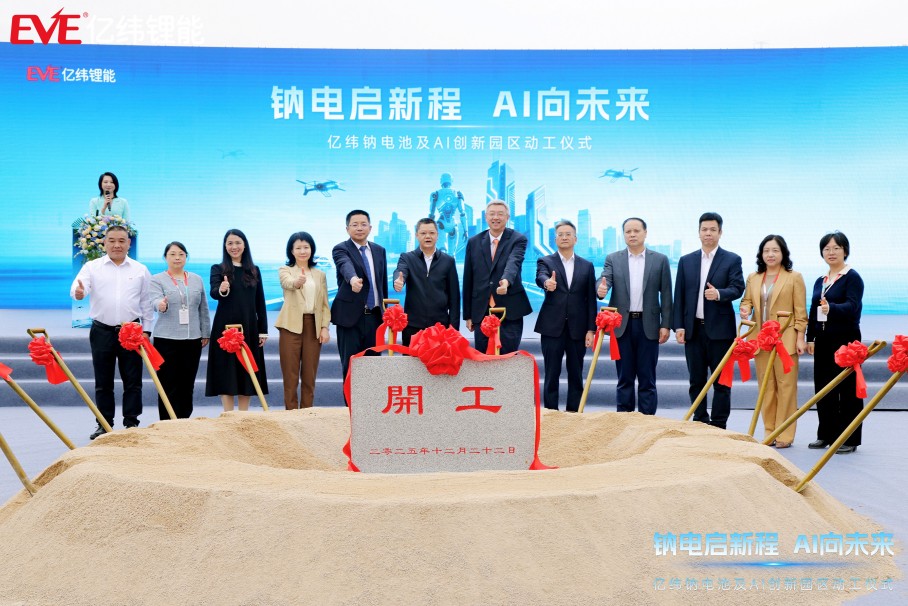
The scene of the project groundbreaking ceremony
As the development of the lithium - battery industry enters a more challenging stage, the competition due to product homogenization intensifies, and the traditional manufacturing model faces triple challenges in terms of efficiency, cost, and flexibility. In a market environment with fierce stock competition, leading enterprises urgently need to find new growth curves. Embodied robots that integrate AI technology with industrial scenarios have become a key path for enterprises to explore the second growth curve.
EVE Energy has three major advantages: manufacturing scenarios, process data, and full - industry chain integration. The company has built a dual - track system of "robot R & D + energy support", forming an industrial closed - loop with software - hardware synergy.
In the robot business, EVE Energy has made a systematic layout, covering the entire chain from underlying technology to scenario implementation.
In terms of core components, the company has completed laboratory - level technical verification from mechanical structures to AI models and achieved a relatively high localization rate in key links, gradually building an independently controllable supply - chain system. In terms of the overall machine form, seven major series of products, including bipedal, wheeled, and heavy - load robots, have been developed, covering different loads and operating scenarios to meet diverse needs from high - precision detection to heavy - material handling.
During this period, EVE Energy has built systematic technical support. At the algorithm level, it trains large industrial AI models based on its own production - line data to improve the robot's ability to understand and make decisions in complex scenarios; at the computing - power level, it provides differentiated computing - power configurations according to different industrial - scenario needs to break through the bottleneck of edge - side inference; at the scenario - adaptation level, through a modular design concept, it combines standardized technical modules with customized modifications to achieve rapid adaptation from lithium - battery production lines to other manufacturing fields.
Dr. Xiao Gang, the director of the Jinyuan Robot Research Institute, said in an interview with 36Kr and other media, "We don't first develop robots and then look for scenarios. Instead, we define robots based on the real pain points of production lines. The company has established a 'three - step - jump' strategic positioning, starting from being a core - component R & D provider, then becoming an overall - machine integrator, and finally becoming a 'provider of intelligent solutions for all industrial scenarios'."
At the energy - support end, EVE Energy deeply links its battery - technology advantages with the needs of robots. To address the pain points of limited space and high - endurance requirements for robots, it is researching and developing "intelligent energy" technology. Through material innovation and structural optimization, it plans to increase the energy density within the limited space of robots and boost the endurance capacity by 50%.
At the same time, sodium batteries, with their advantages of high - power output, high - temperature stability, and safety, will be used as an emergency power - backup solution in scenarios such as data centers, complementing lithium batteries and building a complete energy - guarantee system.
In addition, to precisely meet industrial needs, EVE Energy is building a robot skills - training center that replicates real - world scenarios on a 1:1 scale to optimize robot performance by accumulating a large amount of process data.
The first batch of implementation scenarios will focus on three core directions: replacing humans in high - load and harsh - environment operations to solve safety pain points in industrial production; taking over repetitive and boring standardized processes to improve production consistency and stability; and tackling high - precision detection tasks, such as X - ray detection and high - rhythm visual detection, to avoid errors caused by human fatigue.
For basic production - line tasks such as screwing and material handling, the operating efficiency of its robots is basically on par with that of humans. In the future, continuous optimization will lead to a decrease in the total cost of ownership (TCO).
Xiao Gang revealed that the company plans to launch its first robot product in 2026 and first apply it in its own factories to participate in equipment maintenance, inspection, loading and unloading, etc., further improving the flexibility of its existing lighthouse factories. At the same time, it will also start to expand into overseas markets.