Ordinary people also have flying dreams.
"Dive" - where a drone pilot controls a racing drone to vertically plunge down from the top of a tall building, cliff, or waterfall - is one of the most iconic, thrilling, and visually impactful maneuvers in racing drone flight. It's also the favorite move of Liu Jingkang, the founder of Insta360, after he learned to fly racing drones.
During his first "dive," Liu Jingkang was shaking so much that his colleagues beside him had to hold him steady. To operate this kind of drone, one has to wear VR-like goggles, which provide the same perspective as the drone, making it feel as if one is right there in the action. Just like a bird, experiencing a flight, a fall, and a sense of weightlessness, the fear triggers the release of endorphins, and with a surge of adrenaline, he completed an extreme sport.
Is it possible for ordinary people to fly like birds? This thought popped into Liu Jingkang's mind during a "dive."
Insta360 is a company that explores the limits of vision. When panoramic action cameras can already cover all ground and even underwater sports scenarios, taking to the sky is the next logical step.
In fact, Insta360 tried to explore the sky scene in 2022 in the form of an accessory - the Sphere. It's a "hamburger"-style panoramic camera accessory with a lens on the top and bottom, which can be clipped onto a DJI drone. The success of the Sphere lies in its ability to use panoramic stitching algorithms to remove the drone's body from the frame, allowing users to capture 360° footage without the plane blocking the view.
The drawback of the Sphere is that its weight, when attached to the drone, can affect the drone's battery life. In complex flight environments, it may also interfere with the video transmission signal, leading to "drone crashes."
In the comment section of a Bilibili video about the Sphere, a netizen said, "It's recommended to directly launch a drone capable of shooting panoramas."
This is an appealing but difficult-to-achieve suggestion. Insta360's work on drone accessories is within its comfort zone of R & D. If it were to make drones, the technical accumulation would be in a different direction, and the R & D difficulty would be on a completely different level.
Moreover, to create a brand - new consumer - grade drone, one needs to prepare at least hundreds of millions of yuan in funds to have a chance in the industry. Not to mention, there are already established giants in the drone industry. The top talents in China's consumer - grade drone field have already gathered in Sky City in Xili, Shenzhen.
In the past decade, there have been many fallen competitors in the drone industry trenches.
3D Robotics (3DR), once the largest drone company in North America, was overwhelmed by inventory. Its flagship product, the Solo, failed due to its own performance and external price wars. GoPro, which rushed into the market, saw its drone as the beginning of the decline of this pioneer in action cameras. A defect in the battery clip design during flight caused the drone to accidentally fall, and safety concerns forced it to leave the market. In the Chinese startup market, there was also a wave of drone - making startups. For example, Zero Zero Robotics, which bet on "miniaturization" and launched the popular Dobby, couldn't compete with DJI's Mavic Pro. Like the Solo, it faced financial pressure due to inventory backlogs.
If Insta360 wants to make a panoramic drone, how can it break through in a mature market dominated by giants?
It needs to offer consumers a brand - new experience.
Five years ago, the Yingling project began to take shape.
"If it weren't for us, the giants might not do it," Liu Jingkang said later. "Many companies will eventually disappear, but the meaning of their existence in history is that they invented and changed something, created new markets... Solving problems that others haven't solved is Insta360's core value."
The answer lies in the racing drones that Liu Jingkang is so fond of playing with - allowing people to "fly to the sky with the drone."
1. The Hard Road of Entrepreneurship: Crossing the Technical Black Box
When the top drone pilot Johnny flies a racing drone equipped with a movie camera, chasing a Porsche on an ice field in Finland at - 30°C, he can take you through the wheels of the car, make your heart race as you dive down from a hundreds - meter - tall skyscraper, and then suddenly pull back up to the sky... He demonstrates the limits of human control over drone flight, which is the muscle memory gained from countless days and nights of practice and is a privilege reserved for a very small number of geniuses.
Racing drones are also known in the industry as "F1 in the air."
"F1 in the air" is not a game for ordinary people.
It offers extreme shooting effects. In manual mode, a racing drone can perform 360 - degree flips, providing extreme anti - gravity camera movements. It is also the only photographic equipment whose speed can keep up with drifting cars, downhill skiing, and even wingsuit flying.
It has a strict learning process for operation. The learning cycle can be as short as half a year or as long as over a year. Getting a racing drone into the air is just the beginning. Crashes are inevitable, and repairs are a daily occurrence. Drone pilots need to know how to weld, understand aerodynamics, and be able to adjust software parameters to fine - tune the "feel" of the plane.
It comes with a high financial cost. Before becoming an excellent racing drone pilot, losing hundreds of thousands of yuan worth of drones and cameras is just the start. Even someone as skilled as Johnny experienced several crashes while shooting a Porsche advertisement.
Nick, the product manager of Yingling, prides himself on being a good aerial photographer and thinks he is good at flying drones. But when he first flew a racing drone, he felt that "this is not something for humans." The second time, when he went to pick up the racing drone, he accidentally touched the joystick, and the drone suddenly took off. The powerful propellers cut his fingers badly.
Fortunately, Nick is Liu Jingkang's teacher for FPV (First - Person View) drones. The cost of learning materials for FPV drones and assembling equipment such as FPV drones, video transmission modules, and cameras is around five or six thousand yuan. When crashes were frequent, Nick spent up to eight or nine thousand yuan in a year. The cost was so high that Nick's department leader was reluctant to approve it, asking him to get a special approval from Liu Jingkang, who always approved it immediately.
When Nick and his colleagues were addicted to flying racing drones, they had a new idea about how to make drones: break away from the mainstream definition of drones in the market and offer a racing - drone - like experience.
But with the high difficulty and cost of operating racing drones, what about ordinary people?
The Yingling team already had an "out - of - the - box" innovative solution in mind: instead of relying on the speed and maneuverability of the racing drone itself to achieve shooting effects, they would rely on the panoramic camera. The content shot by the panoramic camera can be post - processed to achieve visual effects such as passing through objects, changing perspectives, and even continuous flips.
For Insta360, which has years of experience in panoramic cameras and post - editing, this "out - of - the - box" innovative solution became the first pillar for its drone products.
Even so, venturing into the drone field across product categories is still a huge challenge for Insta360. Insta360's years of technical accumulation are mainly in the imaging system, while the technical difficulties of drones lie in the flight system and the image transmission system, which respectively challenge the stability limit of physics and the Shannon limit of communication theory.
"It was like starting with a disaster," Nick, who was attracted by drones and voluntarily transferred to the "Yingling" project, recalled later.
The high technical difficulty of drones requires a large amount of capital on one hand and a high - density of talent on the other. Yingling wanted to take the path of full - stack self - research. Initially, their advantage was capital, but in terms of talent, Insta360 didn't dare to publicly recruit for the Yingling team. They first searched within the company for people with relevant background and experience to form a small team of only a few dozen people - to "develop stealthily" first.
Making drones is a highly difficult task. For this secret small team, the first technical hurdle was "flight control."
This small team quickly built a drone, but problems arose: this drone had four propellers, four motors, and four flight controllers. While other drones could hover steadily in the air like a nail, their drone flew very "unsteadily."
And this was just a small difficulty on Yingling's road to developing drones.
One of the most memorable experiences for Nick was adjusting the cooperation between the drone's image transmission and visual positioning. During the R & D process, the image on the screen would always shake and freeze. The video transmission was unclear, and the drone flew unstably. The two systems always seemed to be at odds.
The software and hardware of action cameras are relatively independent, while the software and hardware of drones need to be highly integrated. The software must be based on an in - depth understanding of the hardware, and the hardware must match the algorithm boundaries of the software. A change in one part will affect the whole.
"The scariest thing is that you don't even know what you don't know," Nick recalled. The team initially had to grope in the dark.
Nick remembered that when the team went to Liu Jingkang in extreme distress, Liu Jingkang's response was "far - sighted": Someone has already achieved this, so why can't we? Nick admitted that there was some truth to this, and the team had to continue groping "with this belief."
On the day when the core management of Yingling was to accept the image transmission function, the eleven people in charge of video transmission started the test flight at the originally planned 4 p.m. and kept adjusting until dawn. The management leaders stayed in the office waiting for them.
Finally, as dawn broke, the drone finally hovered steadily in the air, sending back clear images. The perfect renderings of the designer finally came to life in reality. The game entered the real world for the first time.
Nick had an incredible feeling. He never thought that the product that had seemed like a wild idea would actually be realized.
2. Product Method: The Optimal Solution for Ordinary People
To enable ordinary people to "fly into the sky" like racing - drone pilots, the first key to the product is to be equipped with a panoramic lens.
But why has there never been a real panoramic drone in the market before?
The principle of a panoramic camera is to use two back - to - back fisheye lenses to shoot and then stitch the images together through algorithms. To achieve the "invisible" effect, the main body of the drone must be hidden in the "blind spots" of the two lenses. This was the initial structural constraint faced by panoramic drones.
To achieve an "invisible body," a panoramic drone cannot use a mechanical gimbal for image stabilization, as it would affect the panoramic view. During the structural design process, a physical shock - absorption structure needs to be considered. The fisheye lenses on the top and bottom may also have different sensitivities in the air. The upper lens is closer to sunlight, while the lower one is farther away, which also poses new problems for image uniformity...
The Yingling team designed a panoramic drone in the shape of a "thermos flask" to make the drone look cooler and more novel. However, after adopting the "thermos flask" shape, the components that were originally on one PC board were split into multiple parts and had to be inserted into the body in a scattered way. The internal structure of the drone became quite fragmented. Whenever a part needed to be modified, other parts also had to be changed accordingly.
Moreover, the exploration of the "thermos flask" shape failed because of a constant limiting condition: the weight of the drone cannot exceed 250 grams. In most countries around the world (such as China, the United States, and the European Union), 250 grams is the dividing line between "toys/micro - drones" and "aircraft/light drones." Once it exceeds this weight, it may be subject to flight regulations.
Yingling wants to make drones not just for a particular market but for as many ordinary people around the world as possible. It aims to allow all ordinary people to experience what only top - level drone pilots could do before.
Nina, the person in charge of the drone's body structure design at Yingling, said that the design philosophy of this drone is to find the optimal solution under the two given limiting conditions.
During the most stressful period, Nina would even think about the drone's configuration in her sleep. Whenever she had a little inspiration in the middle of the night, she would immediately get up, pick up her iPad, draw it, and go to the company to test it the next day. She said that she lost about one - third of her hair during that time.
When Yingling was trying every means to push the weight limit, every 0.01 - gram change required the team members responsible for structural analysis and vibration analysis to first analyze the impact on the drone's performance after weight reduction through simulation algorithms and then conduct actual tests.
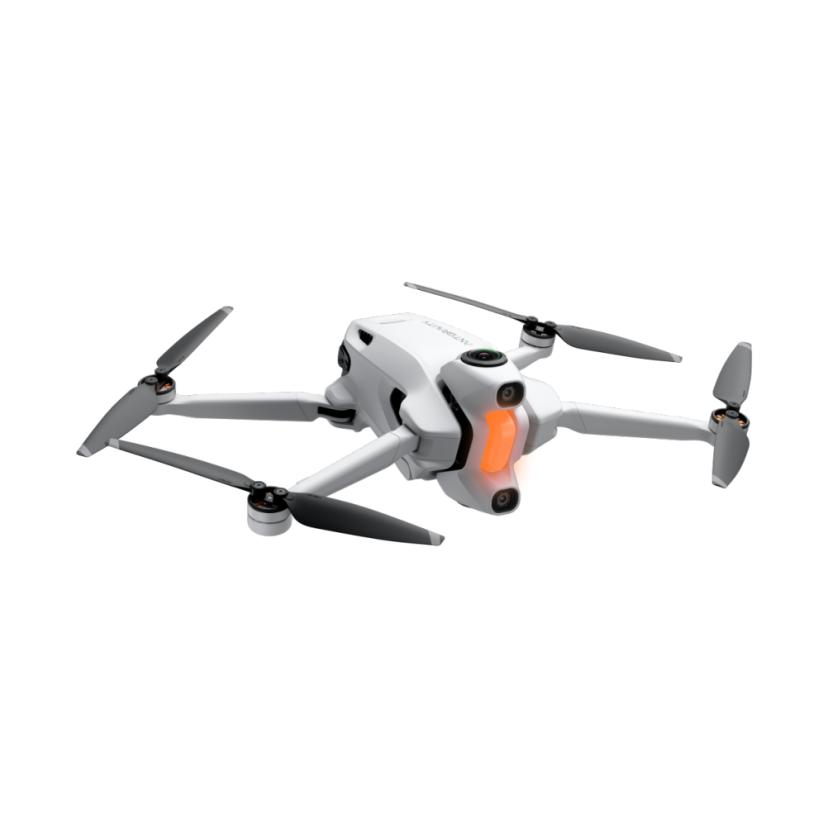
Drone
When "targeting ordinary people" became the core concept of this product, Yingling also broke the convention in terms of operation: instead of following the joystick - based operation that the drone market is accustomed to, it adopted motion - sensing operation.
After years of development, the traditional joystick - based operation mode has become relatively easy to learn. However, pilots still need to establish a coordinate system in their minds: the left hand controls ascent, descent, and rotation, while the right hand controls forward, backward, left, and right movements. This requires a lot of practice to coordinate the two hands. There are also different types of joystick configurations, such as the American style, Japanese style, and even Chinese style, with completely different operation modes.
Yingling wants to eliminate the time it takes for users to learn joystick - based operation.
People who have played the "Sports" game on the Switch will remember that even if you have never played fencing, tennis, or golf in real life, you can easily handle all these sports in the game just by waving the controller.
The motion - sensing remote control of the Yingling A1 aims to achieve the same effect. With the drone in the sky, the motion - sensing remote control in your hand is like a "laser pointer," and the drone will fly wherever you point, without the need to establish a coordinate system in your mind or design a flight route.
However, the risk of changing the joystick to motion - sensing operation is that long - time drone users are already accustomed to traditional joystick - based operation, and motion - sensing operation may cause discomfort to core users.
After careful consideration, Yingling hopes to serve the widest range of ordinary users, many of whom have never operated a drone before. Just as experienced drivers may prefer manual - transmission cars, most users are more willing to accept automatic - transmission cars.
Although it sounds simple, in actual design, Yingling, which aims to provide an innovative operating experience, has to solve many "firsts." There were numerous internal discussions about how many operation buttons the motion - sensing remote control should retain or remove at the beginning so that users wearing glasses can quickly get the hang of it without pressing the wrong buttons.
Even the button pressure was carefully considered. "The pressure required for each button on the remote control, including the pressing stroke, is different. You'll notice that each button has a different feel when you touch it with your eyes closed," said Colin, the product manager. "The A1 aims to provide an intuitive experience."

Remote control
To enable ordinary people to "fly to the sky with the drone," the quality of the experience depends on the flight goggles. In the team's vision, the eyes are the most natural viewfinders. Wearing flight goggles allows users to see a 360 - degree view, and they can fly wherever they look. This is the ultimate experience.
However, achieving the "fly - where - you - look" experience is not that easy: The motion - sensing remote control relies on a gyroscope to detect hand movements. Due to the cumulative error of the gyroscope, a drift phenomenon