There are no more "trending waves" to ride. The electric vehicle competition has entered a "cooling-off period".
The development of electric vehicle technology is bidding farewell to the stage of "rushing forward recklessly."
Fifteen years ago, BYD launched its first mass - produced new energy vehicle, the BYD E6, equipped with lithium iron phosphate batteries. The energy density of the battery cells was 90Wh/kg. With technological advancements, BYD increased the battery energy density to 125Wh/kg in 2015 and then to 135Wh/kg.
Five years ago, BYD introduced the first - generation blade - shaped lithium iron phosphate batteries, with the energy density of the battery cells reaching 170Wh/kg. With an energy density comparable to that of ternary lithium batteries and the unique safety features of lithium iron phosphate batteries, the "first - generation blade battery" was truly unrivaled.
This shift in the technical path also triggered a wave of innovation in the industry, and many automakers quickly followed suit with blade - shaped batteries.
Judging from the data, from 2010 to 2020, BYD almost doubled the energy density of lithium iron phosphate batteries.
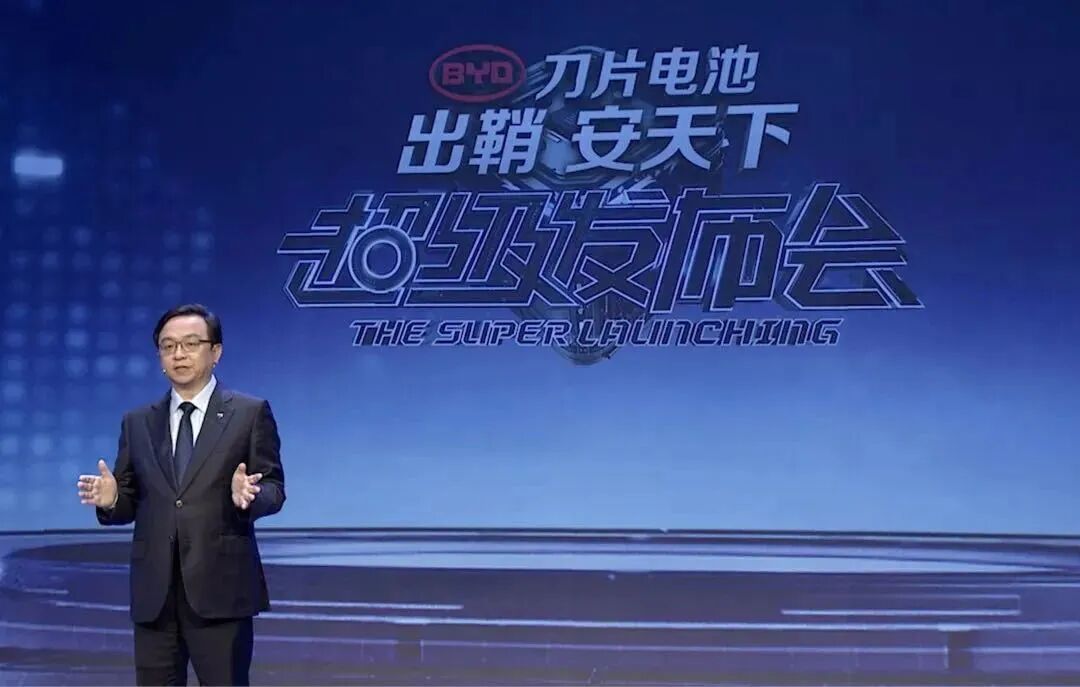
BYD launched the first - generation blade battery in 2020
In 2025, BYD's "second - generation blade battery" finally made its debut, with the single - cell energy density reaching 190Wh/kg. That is to say, there was an increase of less than 12% in the past five years.
Comparatively, the iteration of battery energy density across the entire industry follows a similar evolutionary pace.
On December 5th this year, Wang Chuanfu, the chairman of BYD, "reflected" at the interim general meeting of shareholders in Shenzhen, admitting that BYD's technological leadership and market - stunning effect were not as remarkable as in previous years. In fact, this is not a problem unique to BYD.
In recent years, there has been an obvious trend: The pace of technological iteration in the entire new energy industry has slowed down, which has also led to increasingly obvious homogenization of industry products and technologies.
According to a report by Sanford C. Bernstein in August this year, the average technological iteration cycle of global new energy vehicles has been extended from 1.8 years in 2021 to 3.2 years, and the annual growth rate of power battery energy density has dropped from 15% to 7%.
A similar situation is also playing out in the intelligent driving industry. Su Qing of Horizon complained at the HSD press conference that many new concepts in intelligent driving, such as VLA, are just "self - indulgent," and only end - to - end is the paradigm shift that can represent the fundamental change in the industry. Moreover, it is unlikely that there will be such a major breakthrough in the short term.
At a recent communication meeting of the Electric Vehicle 100 Forum, a phased summary of the development of new energy technologies in the past decade was made: from 2015 to 2021 was the initial and development stage of technological innovation in the automotive industry; from 2022 to 2025 was the explosive stage and also the most active stage of innovation; after next year, it will shift to in - depth integration of technologies and external empowerment.
Early on, Lei Jun said that when standing at the forefront of the trend, even a pig can fly. In the past few years, structural changes in lithium - ion batteries, 5C ultra - fast charging, 800V platforms, end - to - end, and large models have successively promoted the progress of the automotive industry. Now, there are fewer trends to follow. Perhaps, as Su Qing said, everyone has to endure "tough times."
The so - called tough times mean that when the pace of technological iteration slows down, when technological routes become more unified, and when product parameters become similar, the competition logic changes from "who is more advanced" to "who is more solid." This requires automakers to shift from blindly chasing trends to calmly strengthening their internal capabilities.
NO.1
[ You can no longer achieve the same results with the same amount of money. ]
There are still some trends to follow in the current automotive market. Solid - state batteries and L3 autonomous driving are the "hopes of the whole village" in the future. However, it will take at least three to five years for them to be commercially viable.
Moreover, there are still some new stories to tell in the current automotive market. For example, XPeng's humanoid robots and Li Auto's AI glasses... However, these stories outside of car - making are just for the capital market to manage the company's market value in the short term.
Besides, the innovation points of most new energy - related technologies at present are rather lackluster.
In terms of the three - electric technology, the energy density of lithium batteries is now approaching the ceiling. In the case of hybrid vehicles, the competition for longer range this year has mainly been about increasing the battery capacity, but there is a limit to this.
In the field of motors, the maximum speed of the most powerful single motor in the industry has exceeded 25,000 rpm, and the maximum power of a single motor is approaching 600 horsepower. It is also very difficult to make further progress. What remains is mainly to improve the on - vehicle adaptability. The large - scale promotion and popularization of in - wheel motors and wheel - side motors are also unlikely in the short term.
For another example, the essence of the intelligent cockpit is to improve the driving experience rather than to make substantial technological innovations. After the widespread application of large - model technologies in vehicles, there are no more trends to follow in the intelligent cockpit. Even the so - called "cockpit - driving integration" promoted by some manufacturers this year is a balanced product of cost and experience.
What is particularly difficult for automakers is that they not only have to face the current problem of technological homogenization but also need to make long - term investments in the research and development of next - generation technologies to have a chance of winning in the next round of competition.
However, the efficiency of such R & D investments will become lower and lower. Put simply, you can no longer achieve the same results with the same amount of money as before.
Because as technology gradually approaches the theoretical limit, the R & D investment required to improve performance by 1% increases exponentially. For example, it is relatively easy to increase the battery energy density from 200Wh/kg to 250Wh/kg, but it will require several times more effort and cost to increase it from 300Wh/kg to 350Wh/kg.
BYD's annual R & D investment has been increasing linearly in the past 15 years, soaring from 2.8 billion in 2011 to over 40 billion in 2024. However, this year, there is no positive correlation between investment and output.
NO.2
[ With policy "oversight," safety is more important than innovation. ]
To make matters worse, the update and iteration of existing technologies are increasingly facing "resistance" at the policy level.
This year, the penetration rate of new energy vehicles has approached 60%. Electric vehicle accidents and battery safety have received more attention and have even influenced consumers' choices. In this context, the public and the government will put forward higher requirements for the safety of new energy vehicles, especially the battery system. Any technological change needs to go through strict verification and certification, which requires a longer iteration cycle than before.
For example, the new national standard "Safety Requirements for Power Batteries of Electric Vehicles," which will be implemented on July 1st next year, is known as the "strictest power battery safety order in history." The core requirement of this standard is that power batteries must not catch fire or explode when thermal runaway occurs, which is a qualitative leap compared with previous standards that only required providing alarm signals.
In addition to the battery order, national regulatory authorities have also put forward more specific requirements for intelligent electric vehicles. For example, the design of fully hidden car door handles is clearly prohibited, and it is recommended that the 0 - 100km/h acceleration time after vehicle startup be more than 5 seconds.
Professor Wang Zhanguo, a battery expert from Beijing Jiaotong University, pointed out that after years of rapid development, the new energy industry in China has accumulated too many "technological debts," which have also brought a huge impact on the entire industrial chain and the after - market. It needs some time to catch its breath.
For example, in order to seize the market opportunity, automakers may prefer to adopt the most mature and popular but not necessarily the optimal technological route, such as the "extended - range large - battery" strategy that has been very popular this year. Another example is that in order to quickly launch new technologies to catch the trend, the R & D cycle is shortened, resulting in defects in the underlying architecture and safety problems...

This year, electric vehicle collision and fire accidents have frequently "gone viral," causing public anxiety.
In other words, the "cooling - off period" of technological iteration is actually an opportunity for the industry to mature.
It is also worth noting that the increase in penetration rate means that the new energy supply chain is gradually maturing. Therefore, overly rapid technological iteration may lead to instability in the supply chain, increasing management costs and quality risks.
In today's new energy vehicle market, the importance of electric vehicle safety and supply chain stability has exceeded that of innovation. Automakers that are used to rapid development in the past may need to learn to slow down and do better in the future.
NO.3
[ How can automakers endure tough times in the "post - innovation era"? ]
In short, the slowdown of technological innovation is not a "monster." A battery department head of an automaker told AutoReport that this is a sign of the industry's maturity, shifting from "single - point breakthroughs" in technology to "system integration + cost optimization."
However, this trend poses multiple challenges to automakers:
For example, the era of intelligent electric vehicles is far from coming. Technological innovation remains the core competitiveness. How should automakers evaluate the risks and returns of technological investments? How can they balance the present and the future?
Another example is that when there are not many new stories to tell in the market, investors will pay more attention to fundamental factors such as a company's profitability, market share, and position in the industrial chain. Coupled with the expected downturn in the first half of next year, how should automakers choose between price wars and profitability?
These seemingly contradictory problems actually point in one direction: automakers need to calm down and build their systematic capabilities during the "cooling - off period" of industry development.
During the Guangzhou Auto Show this year, many senior executives of automakers talked about "systematic competitiveness."
For example, He Liyang, a former Huawei employee and now the president of SERES, said that in the future, SERES will evolve into a high - end new energy brand in the AI era. The core of this evolution is to "internalize Huawei's capabilities" and improve and upgrade its own systematic capabilities.
Zhang Liang, the deputy general manager of SAIC Passenger Vehicle, emphasized that future competition will shift from "scale and volume" in the first half to "brand, lean management, and development" in the second half.
However, it has always been easier to chase trends than to strengthen internal capabilities. In the next five years, many companies that are unwilling or unable to endure hardships will probably be eliminated.
This article is from the WeChat official account "AutoReport," written by Yu Jie and edited by Gan Meng. It is published by 36Kr with permission.