A post-1992 alumnus of Peking University has raised 2.1 billion yuan in financing at once.
While Unitree Technology and Zhipu Robotics were vying for a spot at the Spring Festival Gala, someone was quietly breaking the industry's financing record.
Galaxy Universal announced the completion of a Series C financing round exceeding $300 million (approximately RMB 2.1 billion).
The $300 million financing has set a new record for single - round financing in the field of general intelligent robots. So far, Galaxy Universal has accumulated a total financing of nearly $800 million, and its latest valuation has risen to $3 billion, making it the highest - valued general intelligent robot startup in China.
Galaxy Universal has been established for just over two years and has only released one product to date - the wheeled dual - arm robot Galbot G1. Galbot G1 doesn't have bipedal legs, doesn't aim for full - scenario coverage, and doesn't tell the story of "human - like intelligence." It performs very specific tasks: picking drugs in smart pharmacies and repeatedly transporting materials in the factories of CATL and Toyota.
Galaxy Universal has chosen a path that is not very glamorous but can generate immediate revenue - using robots to replace repetitive labor in B - end scenarios.
01
Galaxy Universal was founded by Wang He, an assistant professor and doctoral supervisor at Peking University's Frontier Computing Research Center, and Yao Tengzhou, another co - founder.
Wang He was born in 1992 and spent six years in Beijing No.11 School. He was admitted to Tsinghua University through the physics competition in high school. "During his undergraduate years, he mainly studied semiconductor physical devices" and obtained a bachelor's degree in engineering from the Department of Micro - Nano Electronics in 2014.
After graduating from Tsinghua, Wang He went to Stanford University in the United States for further studies. He studied under Professor Leonidas J. Guibas, a famous algorithm expert and the director of the Geometric Computing Group in the Department of Computer Science at Stanford. Guibas has extremely high attainments in fields such as computational geometry, geometric modeling, computer graphics, computer vision, sensor networks, robotics, and discrete algorithms.
During his doctoral studies, Wang He set "physical interaction" as his research direction, focusing on object perception for physical interaction. "He spent more time and energy on three - dimensional vision research, aiming to enable robots to have generalized object perception capabilities, so that they can accurately identify the pose and perform operations such as grasping even for unfamiliar (un - data - labeled) objects." The intelligence of physical interaction is today's popular embodied intelligence.
In 2021, Wang He obtained a doctorate from the Department of Electrical Engineering at Stanford University and returned to Peking University to teach as an assistant professor and doctoral supervisor at the Frontier Computing Research Center. He also serves as the director of the Embodied Intelligence Research Center at the Beijing Zhiyuan Artificial Intelligence Research Institute.
Yao Tengzhou graduated from Beihang University and studied under Professor Wang Tianmiao, a famous robotics expert. Before starting a business with Wang He, Yao Tengzhou held important positions at ABB Group's Shanghai Robot R & D Center and ROOBO's Robot R & D Department, being responsible for the R & D of multiple series of robot products such as Pudding and Jelly.
In 2023, Google released the PaLM - E model. It integrates language, vision, and robot operation into the same model system, enabling robots not only to "be programmed to perform actions" but also to understand the environment and then decide how to act. This means that large models have truly entered the field of robotics.
Wang He noticed this change. Previously, the boundaries in the robotics industry were clear: industrial robotic arms were responsible for fixed processes, and service robots only completed a few preset functions. However, in real - world scenarios, there is no such clear division of labor. Warehouses, stores, and factories need robots that can follow instructions, perceive the environment, and complete tasks, rather than more "single - task" devices.
In his view, once large models supplement the understanding ability, the feasibility of general robots is no longer just a technical discussion but a matter of time. In 2023, Wang He and Yao Tengzhou founded Galaxy Universal.
In June 2024, Galaxy Universal completed a $700 million angel - round financing, setting a record for angel - round financing in the industry that year. The wheeled dual - arm robot Galbot G1 was officially unveiled. Galaxy Universal cooperated with Meituan, and Galbot G1 was tested in Meituan's 24 - hour smart pharmacy, capable of tasks such as drug shelving, picking, and delivery.
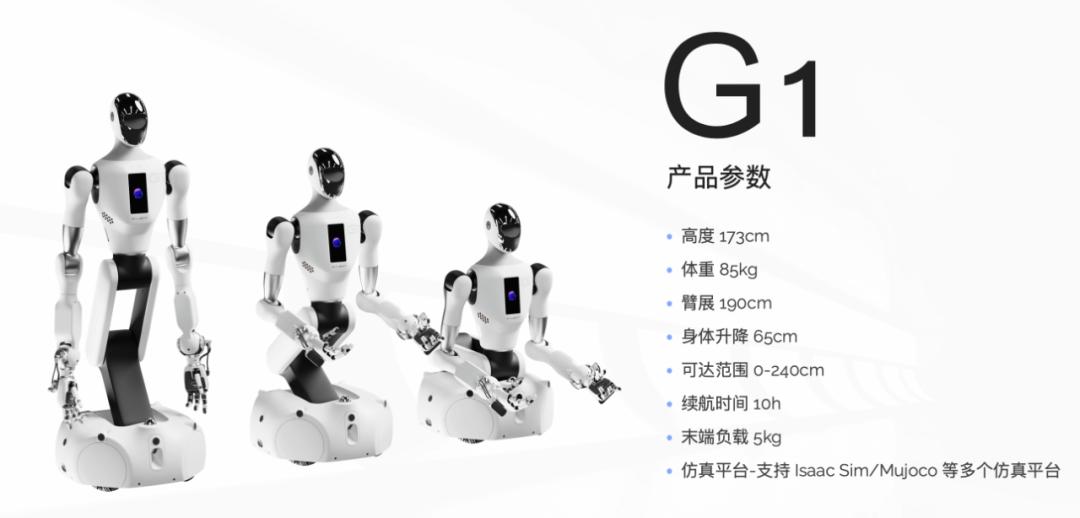
Wheeled dual - arm robot Galbot G1
Today, Galaxy Universal has established R & D centers in Beijing, Shenzhen, Suzhou, and Hong Kong and has set up joint laboratories with institutions such as Peking University.
02
The scale of the robot market is already quite large.
It is estimated that by 2025, the market size of general intelligent robots in China will reach $32 billion. The overall market share of domestic brands is approximately 30%, and the leading shares are mainly concentrated in enterprises such as Estun and Siasun. The "Big Four" international robot companies still occupy more than half of the market.
Globally, the potential is even greater. McKinsey predicted in "Global Robotics Industry Outlook 2050" that by 2050, the global market size of general intelligent robots is expected to exceed $1 trillion, approximately one - third of the current global automotive market size.
However, there are still many obstacles between the reality and the expectations. On the one hand, the integration of general artificial intelligence and mechanical structures is not sufficient, and the operation accuracy of robots in complex environments is limited. On the other hand, the core components rely on imports, making it difficult to reduce costs. In addition, the demand differences among different industries and scenarios are relatively large, which also increases the difficulty of a "one - size - fits - all" solution.
Against this background, the differentiation among leading companies has begun to emerge. Among the first - tier domestic embodied intelligence companies, Galaxy Universal Robotics, Unitree Technology, and Zhipu Robotics are all in the leading camp, but the three companies have different understandings of the "core capabilities of general robots" and have taken different technical paths.
Galaxy Universal chooses to be driven by an embodied large model. Its product form is a wheeled dual - arm robot, and it focuses on B - end scenarios such as smart pharmacies and industrial manufacturing, emphasizing replicable and scalable industry solutions.
Unitree Technology excels in self - developed hardware and motion control, mainly offering bipedal humanoid robots and robot dogs. It expands the market through cost - effectiveness and mass - production capabilities, and its main customers are concentrated in universities, research institutions, and industrial inspection scenarios.
Zhipu Robotics takes another path: full - stack self - development and full - scenario coverage. Its products span the industrial, commercial service, and consumer - grade markets. It builds both hardware and an ecosystem, hoping to form a synergistic effect through multi - scenario adaptation.
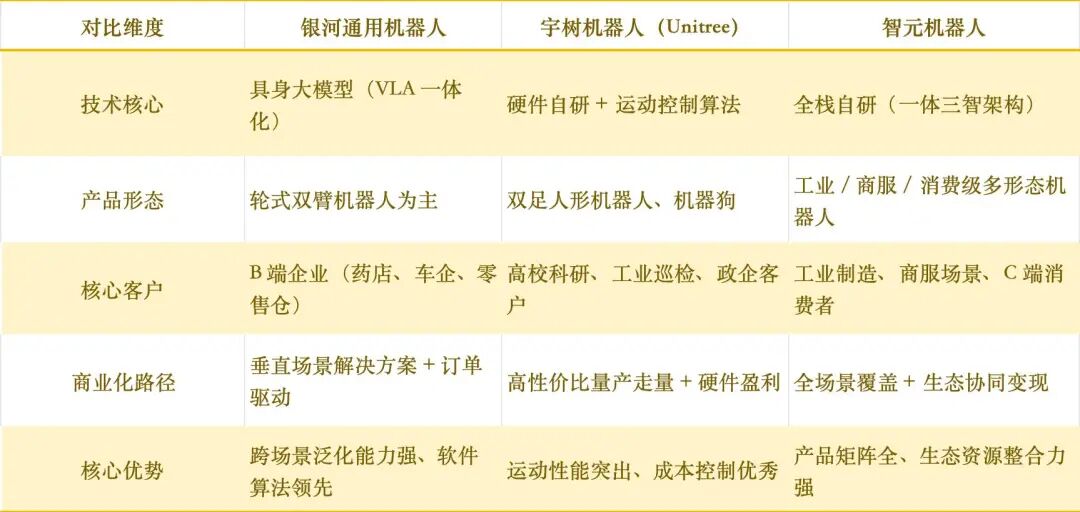
A simple table of the core differences among Galaxy Universal, Unitree Robotics, and Zhipu Robotics
An easily overlooked detail is that although Unitree and Zhipu Robotics have higher public recognition, Galaxy Universal is progressing faster in terms of capital.
Just one and a half years after its establishment, Galaxy Universal has completed financing of over RMB 4 billion, and its latest valuation has reached $3 billion, exceeding the valuations of Unitree (approximately RMB 12 billion) and Zhipu (approximately RMB 15 billion), becoming the highest - valued embodied intelligence company in China at present. During this period, Galaxy Universal has only released one body product - Galbot.
The work of this robot is also very single: either picking drugs in unmanned pharmacies or doing handling work in the factories of CATL and Toyota. It has not expanded to more forms and has not covered multiple scenarios simultaneously.
This comparison raises a question worthy of discussion: In the early stage of general intelligent robots, is focusing on a few vertical scenarios with feasible implementation more likely to lead to a successful commercialization path?
03
Galaxy Universal has not rushed into the home or consumer scenarios. It has put all its energy into pharmacies, warehouses, and factories. At the same time, the company has only developed one body product so far, which is due to several considerations.
The home scenario is too difficult for robots at this stage.
Every family is different. The house layouts, furniture sizes, and placement methods vary. Human behavior is very random, and instructions are not standardized. More importantly, ordinary users can hardly accept failures. One freeze or one misjudgment may lead to the robot being labeled as "useless." This means that the home scenario actually has higher requirements for general capabilities than the industrial environment.
In contrast, pharmacies, warehouses, and factories are more "rule - abiding."
There are many actions and complex processes in these places. However, the spatial structure is stable, the rules are clear, and the goals are definite. For robots, this is a more friendly starting point. Galaxy Universal can continuously obtain real and reusable data in these scenarios and establish unified task standards. The more robots are deployed, the faster the model can be corrected; the more customers there are, the more stable the system will perform in similar environments. This positive feedback is difficult to form in the home scenario.
The business logic also drives the company to make the same choice.
Enterprise customers are not concerned about "being human - like" but about whether the robot can replace human labor and save costs. In factories or warehouses, robots can be embedded in the process for long - term operation. Even if there is a problem, human intervention can take over. This gives Galaxy Universal the space to use engineering and system design to make up for the lack of model capabilities, rather than betting the success or failure entirely on the algorithm itself.
Developing only one product puts less pressure on costs. In the very early stage of embodied intelligence, developing multiple products often means more troubles. Different hardware structures and control logics will result in completely different data distributions, which are difficult for the general model to handle.
Galaxy Universal chooses to use the same "body" to repeatedly perform the same type of tasks. The only purpose is to make the data cleaner and the model learn faster. For example, in CATL's factory, the robot performs the same skylight transfer task every day. Each action becomes training data. Within three months, the success rate of this task has increased from 85% to 98%.
Only when the system runs smoothly in the real world repeatedly can the general capabilities be extended to more complex scenarios.
This article does not constitute any investment advice.
This article is from the WeChat official account "Pencil News" (ID: pencilnews), written by Song Ge and published by 36Kr with authorization.