Huami, OPPO, VIVO are in a race for AI. No one wants to become the next "Nokia".
The mobile phone market presents a stark contrast.
On one hand, there is a saturation in hardware parameter competition and an increasingly long replacement cycle. According to TechInsights data, the average annual replacement rate of smartphones has dropped to 23.7% globally, corresponding to a replacement cycle of about 51 months.
On the other hand, AI mobile phones continue to be popular. Huo Jinjie, President of IDC China, said that the global shipment of new - generation AI mobile phones will reach 170 million units in 2024, accounting for 15% of the total smartphone shipments.
The share of AI mobile phones in the Chinese market will also grow rapidly, accounting for more than 50% by 2027. The industry expects that the global penetration rate of AI mobile phones will exceed 35% in 2026.
A new era of "defining products, ecosystems, and user experiences with AI at the core" has begun.
How have the sales of Huawei, Xiaomi, OPPO, and vivo been in the past 3 years of AI development?
At the end of 2022, ChatGPT emerged suddenly, setting off a wave of generative AI. "Intelligent terminals" became a necessity. In the following three years, mobile phone manufacturers have all entered an AI - driven mode. Not only are the new product releases highly AI - inclusive, but organizational adjustments have also been actively made to adapt to the AI layout.
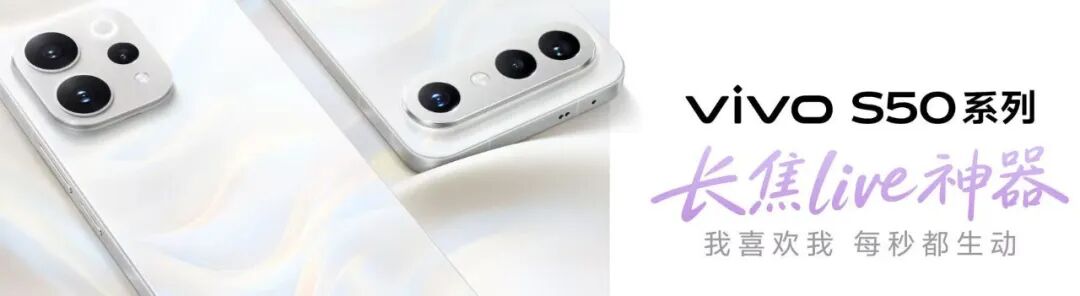
On December 11th, OPPO adjusted the organizational structure of its AI center, integrating Xiaobu Memory, Xiaobu Assistant, and Xiaobu Suggestion into the "Super Xiaobu" project to deepen system - level AI. Four days later, vivo officially launched the S50 series. The new product, a "long - focal Live masterpiece", was quite impressive.
This year can be regarded as the year of explosion for edge - side AI. The government work report listed "developing a new generation of intelligent terminals" as a national strategy, clearly proposing to accelerate the implementation of products such as AI mobile phones, AIPC, and intelligent connected vehicles.
Frost & Sullivan, a third - party data company, predicts that from 2025 to 2029, the global edge - side AI market will achieve leap - forward growth. The scale is expected to jump from 321.9 billion yuan to 1.22 trillion yuan, with a compound annual growth rate of 40%.
However, the situation at the sales end does not quite match the industry forecasts and public opinion hype.
According to IDC data, as of the third quarter of 2025, vivo ranked first with a 17.2% share, a year - on - year decline of 7.8%, the most significant drop among the TOP 5. Xiaomi and OPPO hovered around 14%, with one dropping 1.7% and the other slightly increasing by 0.4%. Honor tied with OPPO in fifth place. Honor's share was 14.4% but dropped by 1.5%.
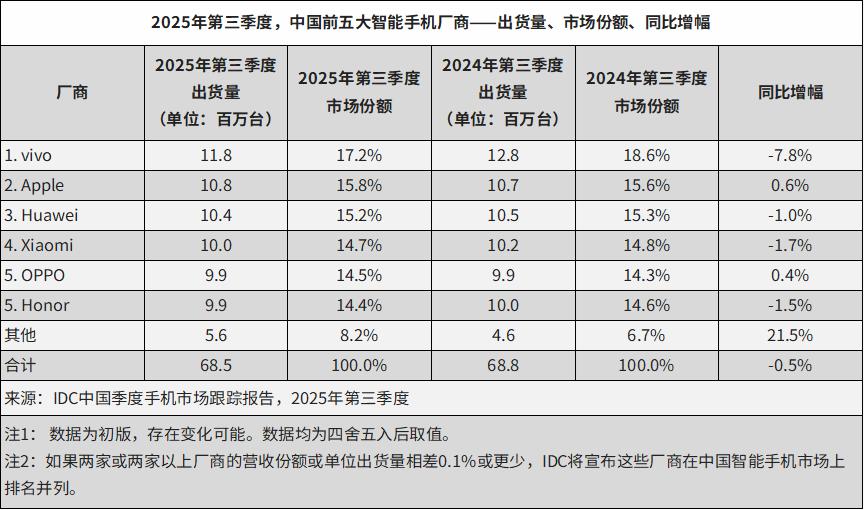
It can be seen that after the suspension of national subsidies, the year - on - year growth rates of mobile phone manufacturers are not ideal. Although in terms of product sales, people are not strongly motivated to replace their phones and pay for AI mobile phones, it has not affected manufacturers' heavy promotion of AI at product launches.
In January last year, OPPO launched the flagship Find X7 series and announced the implementation of the Andes large - model with 7 billion parameters on mobile phones. Immediately afterwards, Honor launched the flagship smartphone Honor Magic 6 series, which was the first to be equipped with the self - developed edge - side platform - level AI large - model "Magic Large - model" with 7 billion parameters. The Xiaomi 14 Ultra is equipped with the "Xiaomi AISP" imaging large - model, and the vivo X100 series features the self - developed "Blue Heart Large - model".
Mobile phone manufacturers always mention "large - models", and there is a feeling of "no AI, no flagship" in new product launches.
Betting heavily on AI to seize the tickets for the new era
For Huawei, Xiaomi, OPPO, and vivo, although AI mobile phones have not boosted the overall brand sales in the short term, when looking at the high - end market, the driving effect begins to appear.
According to data from the Telecommunications Industry Report (2025), in the high - end market segment of 4,000 - 6,000 yuan, vivo increased its market share from 8.8% to 14% through breakthroughs in imaging technology. Xiaomi's global sales of high - end mobile phones exceeded 10 million units in 2024, a year - on - year increase of 43%.
There are mainly two reasons for this phenomenon. The high - frequency and high - density nature of AI tasks places higher requirements on components such as mobile phone heat dissipation, batteries, cameras, and PCBs. Limited by costs, manufacturers can mostly only equip flagship phones with relevant AI capabilities.
This also matches the needs of end - users. Consumers of flagship phones are often geeks who have higher requirements for performance and experience. Consumers of mid - and low - end models are more concerned about cost - effectiveness and have less demand for AI functions. Naturally, manufacturers will allocate more and better resources to flagship phones.
Moreover, the poor overall sales are not entirely due to AI. The domestic mobile phone market is highly concentrated at the top. The six major brands such as Huawei, Xiaomi, OPPO, and vivo account for a total market share of 91.8%. It can be said that their performance represents the current situation of the domestic smartphone market. According to data from the China Academy of Information and Communications Technology, from January to October 2025, the domestic smartphone shipments were about 233 million units, a slight year - on - year decrease of 0.3%.
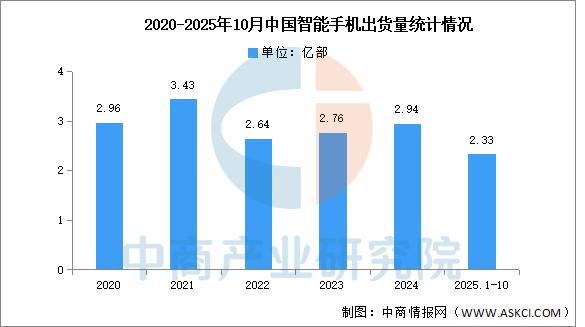
In other words, the overall replacement market in China has almost zero growth. Even with the implementation of national subsidies in 2025, the annual shipments have not changed significantly. Against such a sluggish background, the overall shipments of leading manufacturers are naturally not impressive.
AI is an opportunity of the era and a life - and - death battle of "join or be eliminated". Huawei, Xiaomi, OPPO, and vivo must participate. This can be seen from the manufacturers' "unlimited" investment in AI R & D.
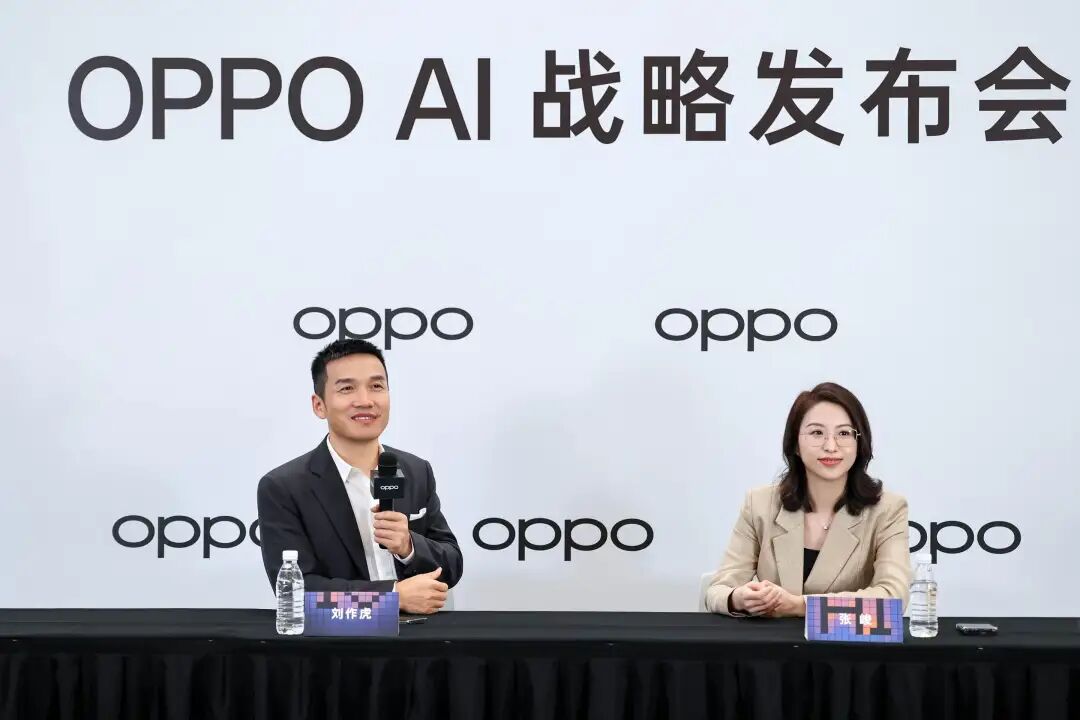
As of October 2024, vivo had invested more than 23 billion yuan in the AI field. OPPO's R & D investment also exceeded 10 billion yuan. Liu Zuohu, OPPO's Chief Product Officer, even said bluntly, "For mobile phone companies, if they don't layout large - models, they have no chance."
Honor launched the "Alpha Strategy" and plans to invest 10 billion US dollars in AI terminal technology, ecosystems, and partnerships in the next five years. Xiaomi announced that it will invest more than 200 billion yuan in AI R & D in the next five years, with AI, chips, and operating systems as the three core investment directions. It also recruited Luo Fuli, a key developer of DeepSeek - V2.
Whether it is capital, resources, or talent reserves, manufacturers' investment in AI is continuous and long - term, but the focus of their bets has changed.
In the past, the application of mobile phone AI was mainly concentrated on text processing, such as multi - round dialogue, summary generation, and copywriting continuation, and mostly relied on cloud - side large - models. Now, the deep integration of "edge - side large - models" gives mobile phones the ability to "think independently", such as "understanding scenarios, predicting needs, and providing proactive services". This is the core breakthrough of the new generation of AI mobile phones.
It can also be seen from the manufacturers' actions in the past two years that they have devoted more energy to edge - side multi - modal large - models.
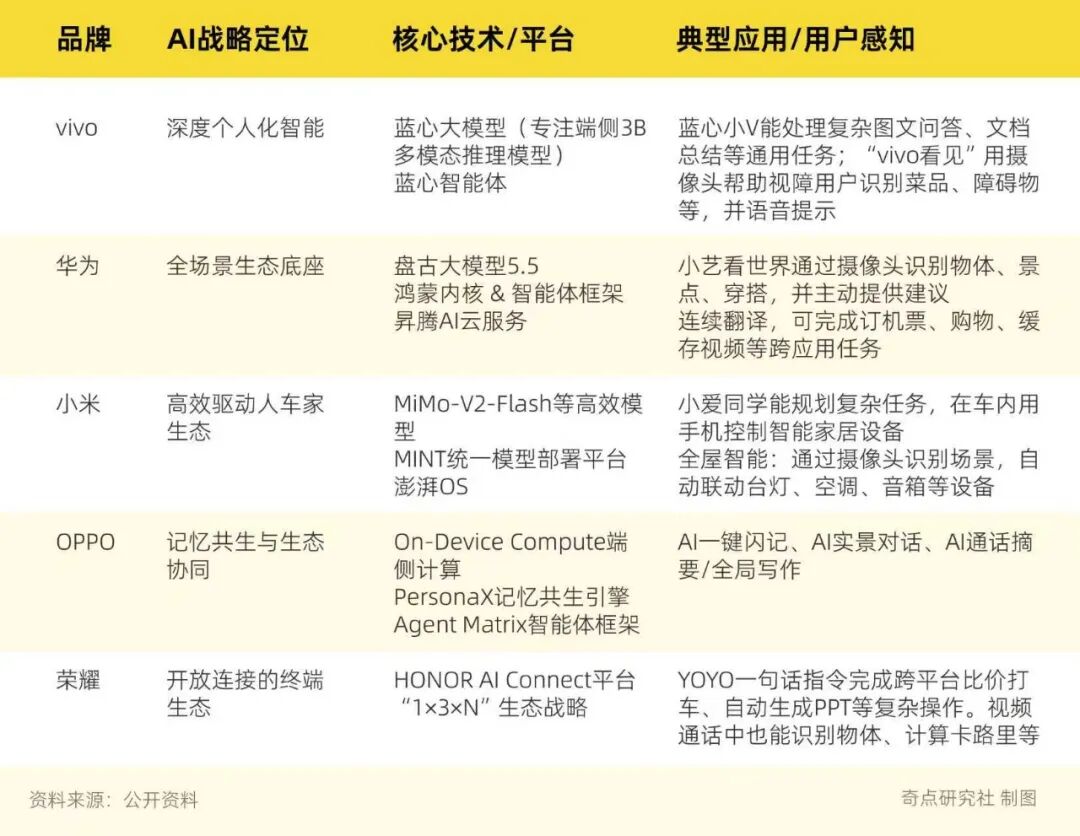
vivo focuses on the in - depth optimization of edge - side inference. It was the first to launch an industry - leading edge - side multi - modal inference large - model with 3 billion parameters and built a proactive service system centered around the "Blue Heart Intelligent Agent", aiming to make the mobile phone a personalized intelligent assistant that understands you best.
Huawei aims to build an operating system and ecosystem foundation for the AI era. Through the "Pangu Large - model" as a unified AI capability foundation, the "Harmony Kernel" for seamless cross - device transfer, and the "Ascend/Kirin Chips" to provide heterogeneous computing power across cloud, edge, and terminal, it achieves full - stack in - depth optimization, thereby providing full - scenario AI basic ecological capabilities from mobile phones to robots, covering cloud, edge, and terminal.
Honor actively embraces open protocols such as MCP to access third - party services. It builds a "1×3×N" ecosystem based on the "HONOR AI Connect" platform and drives service transfer across devices through the "YOYO Intelligent Agent", aiming to become an ecological organizer connecting ubiquitous AI services.
Xiaomi uses AI as the intelligent center to drive the "full ecosystem of vehicles, homes, and mobile phones". It provides an Agent base through efficient cloud - based models (such as MiMo - V2 - Flash) and implements relevant capabilities on the edge - side through "Surge OS" and "Super Xiaoai". The ultimate goal is to make AI the efficiency core to activate its large - scale hardware ecosystem network.
OPPO is committed to creating a personalized AIOS that can learn throughout life and co - exist with users. It builds system capabilities through three technical foundations such as "On - Device Compute" and launches closed - loop functions such as the "PersonaX" memory co - existence engine and "AI One - Key Flash Memory", aiming to make AI a daily partner that understands users best and provides exclusive experiences.
If vivo and Huawei take the "in - depth" route, and Honor and Xiaomi take the "breadth" route, OPPO has taken a unique path centered around the individual user.
The prosperity of the ecosystem requires multi - party co - construction. The key breakthroughs made by SoC manufacturers in computing power also allow mobile phone manufacturers to take bold actions. Counterpoint data shows that since 2017, the AI computing power of flagship phones has increased by 20 times. In 2025, the AI computing limit of their SoCs is expected to exceed 60 TOPS.
The performance of the Qualcomm Snapdragon 8 Gen5 Ultra's Hexagon NPU has been improved by 37%, supporting a generation speed of 220 tokens per second for edge - side large - models.
The MediaTek Dimensity 9500 uses a dual - NPU design of super - performance and super - energy - efficiency. The peak computing power of the super - performance NPU has been increased by 111% compared with the previous generation, and it is the first in the industry to achieve edge - side 4K high - definition text - to - image generation.
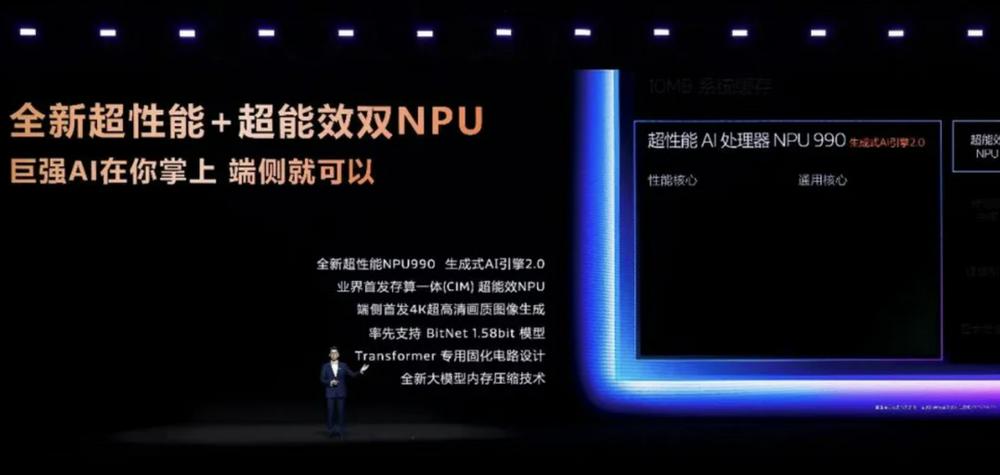
Currently, it has provided core computing power support for many flagship mobile phone AI functions, including the "AI Real - Scene Dialogue" of the OPPO Find X9 series and the "Personalized Beauty" of the vivo X300 series.
Morgan Stanley predicts that the self - sufficiency rate of Chinese AI chips will reach 82% in 2027.
In addition to SoC chip manufacturers, the support of application manufacturers such as ByteDance, Tencent, and Alibaba is also essential. Zhou Wei, Vice President of vivo and Dean of the Global AI Research Institute, once mentioned in an interview that mobile phone companies need to solve three problems in AI development: edge - side implementation, the combination of AI and OS, and the construction of upper - layer applications.
"Users use mobile phones. Mobile phone manufacturers only account for 15% of the usage time, and the remaining 85% is provided by application companies. Currently, application developers are in the process of discussing security authorization standards with terminal manufacturers, which requires cooperation between the two parties."
On the timeline of "cloud - side large - model → edge - side inference → system - level intelligent agent", each mobile phone manufacturer is betting on one thing: Once a killer application (App or Agent) emerges, the one who can integrate it into its own devices the fastest will seize the distribution right.
This is why vivo, OPPO, etc. privately rush to access Doubao but seem hesitant in public. After all, hardware is the foundation, and applications are the soul.
Finally, in the current situation of a sluggish consumer market and saturated hardware parameter competition, AI is one of the few topics that can make the audience at product launches applaud. If well - presented, it can support price premiums, as there are still many consumers willing to pay for a good story. If poorly presented, at least the company won't fall behind.
Huawei, Xiaomi, OPPO, and vivo don't want to become the next "Nokia"
The prospects of AI are broad and irresistible, but manufacturers also face many challenges.
The challenge of rising costs squeezing profit margins is the most severe. Executives of mobile phone companies such as Lei Jun and Lu Weibing have "complained" on Weibo that the cost increase of smartphones in 2025 will be very significant.
