AI phones have been hyped up to 36,000 yuan. Will the iPhone be the next Nokia?
The era of AI phones has arrived. Luo Yonghao, the "crosstalk master" in the tech circle and the former founder of Smartisan Technology, issued a rare and high - profile warning to traditional mobile phone giants still "making incremental improvements at a snail's pace": "If they don't prioritize AI phones soon, they'll end up as 'toothpaste giants'."
When your phone transforms into an intelligent "AI human", understanding your desires and habits better than you do and even making choices for you, will you become more free or less?
In the winter of 2025, an unassuming yet historically significant event took place in the tech world.
Without a grand product launch or fancy presentations, Nubia, a brand under ZTE, quietly released the M153 phone. Labeled as an "engineering prototype" and a "technical preview", only 30,000 units were available. Its standout feature? It was powered by ByteDance's Doubao large - language model.
Within minutes, all the engineering prototypes were snapped up. On second - hand trading platforms, a frenzy ensued: the moderately - priced Android phone was bid up to astonishing prices by scalpers and tech enthusiasts, with some asking as much as 36,000 yuan. Countless buy - requests flooded the platforms: "Who has the Doubao version? I'll pay top price!"
What makes a phone with a large - language model so revolutionary?
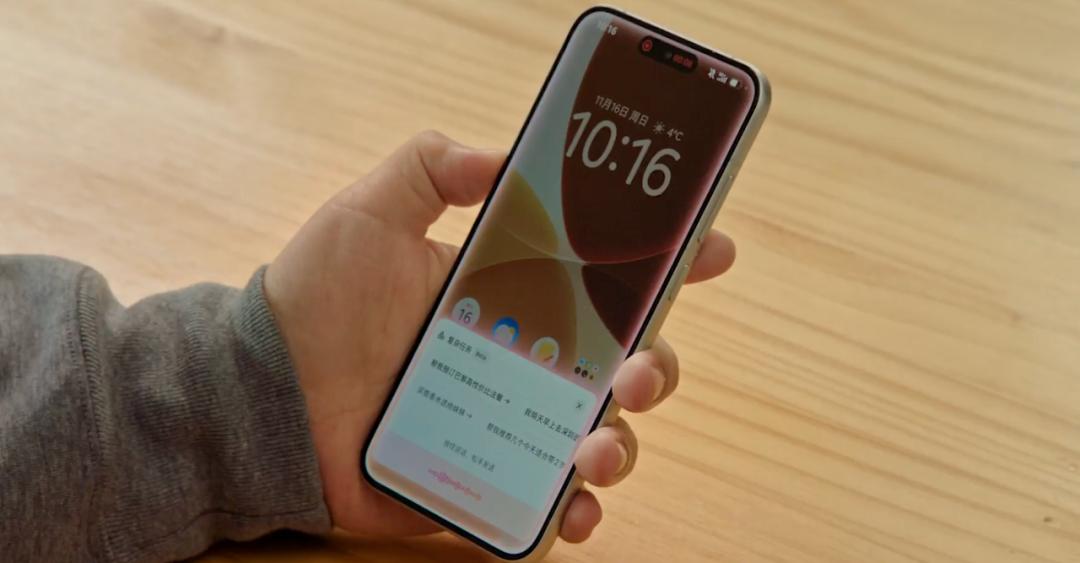
The next mobile era belongs to AI. (Photo/Doubao Phone)
Luo Yonghao, the well - known figure in the tech industry and former founder of Smartisan Technology, gave this product rare high praise. He warned traditional phone giants still "dragging their feet": "If they don't prioritize AI phones soon, they'll end up as 'toothpaste giants'."
In the past two years, with the rise of smartphones and the spread of the mobile internet, many household chores have moved to our phones. People jump between apps for shopping, grocery - buying, and helping kids with homework. These offline tasks have become "digital chores". In fact, not just household tasks, but our work and daily lives have been fragmented into a multitude of apps.
AI phones aim to change all that. Just as people ditched search engines after the rise of large - language models, they're likely to abandon today's mainstream smartphones after getting an AI phone. It's time for traditional phone manufacturers to worry. The AI revolution has reached their doorstep and is heading straight for their cash registers.
Chances are, this could be the "Nokia moment" for traditional phone giants.

Both Apple and Samsung are facing a crisis of insufficient innovation. (Photo/Nano Banana Pro)
01
Why Are They Joining Forces to "Block" AI Phones?
So, what kind of experience does an AI phone offer to drive people crazy?
Imagine this scenario: On a Friday night, you suddenly need to travel to Shanghai on business. First, you need to book round - trip high - speed train tickets. Then, you have to find a budget - friendly hotel near Hongqiao Airport with a rating of at least 4.5. Finally, you need to inform your family of your itinerary.
Previously, this process would require you to open multiple apps like 12306, WeChat, Ctrip, or Fliggy. You'd have to wait for the ticket - booking process and payment verification on 12306, compare prices and check room types on travel apps, and then copy and paste your itinerary into WeChat to send to your family. This could take up to 15 minutes of tapping on your phone, interrupted by annoying ad pop - ups.
With an AI phone, an "intelligent agent" with system - level access takes over. You just need to tell it your requirements in one go, and it'll handle everything.
Tech observer "Liudi_6D" made a vivid analogy: In today's mobile ecosystem, Apple and Android own the "land", and app developers are the "builders" erecting buildings named "WeChat", "Taobao", and "Meituan". Previously, users had to enter these "buildings" for services. Now, AI phones aim to change that. They want to gain "air superiority" in the mobile terminal, acting like an all - powerful property manager with keys to all buildings. At your command, it can call on any app to serve you.
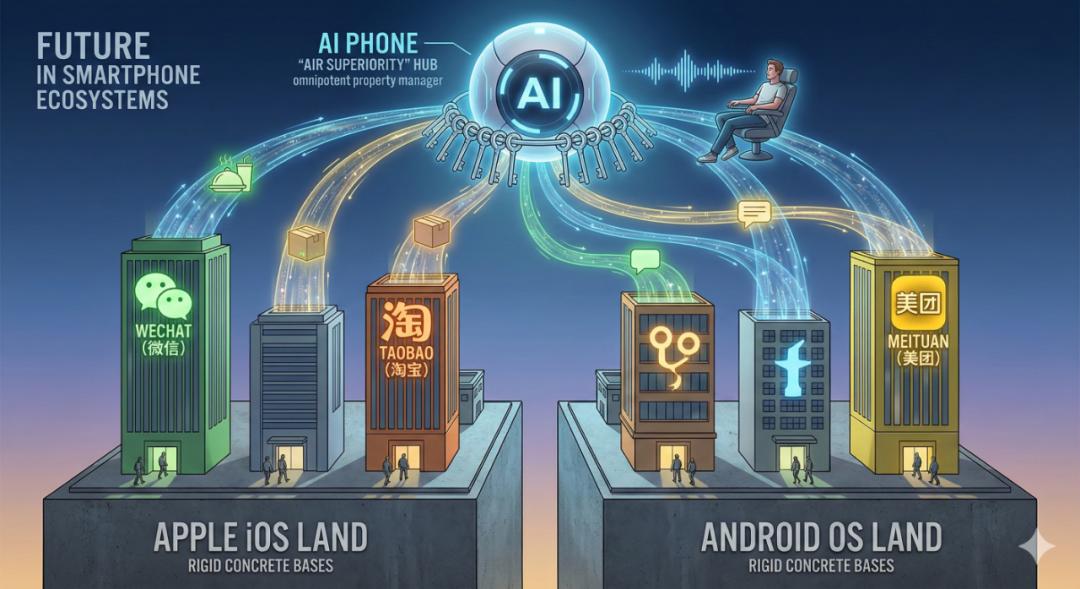
AI phones will face significant resistance in controlling apps. (Photo/Nano Banana Pro)
Once this model becomes widespread, apps, which are currently traffic gateways, will be reduced to silent service back - ends. This means that the splash ads, content recommendations, and user engagement that internet giants rely on will disappear. If users no longer need to open apps themselves, who will the ads be shown to?
As a result, many internet behemoths are instinctively fighting back. They're using methods like "abnormal environment detection", restricting logins, and blocking external jumps to prevent AI phones from encroaching on their territory. This isn't just competition between rival apps; it's a collective crisis for a business model.
Of course, these concerns can't simply be dismissed as resistance to progress. Especially when it comes to privacy and security, apps in sectors like banking, finance, and shopping have good reasons to block AI - assisted logins. Even though the Doubao phone assistant repeatedly states that it "won't perform relevant authorizations and sensitive operations on behalf of users" and that "it needs users' active authorization to access certain functions", the concerns remain.
In the short term, privacy and security are major hurdles for AI phones. That's why the Doubao phone recently decided to stop operating bank apps and internet payment apps. However, it's foreseeable that a phone will eventually find a solution, ushering in the AI era for smartphones.
As Luo Yonghao said, AI phones represent a technological revolution. This is the future, and "no one can stop it".

Some phones already have basic AI phone functions through AI assistant apps. (Photo/Nano Banana Pro)
02
Will Apple or Samsung Be the Next Nokia?
Amid the surging AI wave, Apple, the world's largest phone manufacturer, seems to be losing its edge.
This year, Time magazine named eight "AI Architects" as its Person of the Year, including Elon Musk of Tesla, Jensen Huang of NVIDIA, Sam Altman of OpenAI, Mark Zuckerberg of Meta, Lisa Su of AMD, Demis Hassabis of Google DeepMind, Dario Amodei of Anthropic, and Fei - Fei Li, the so - called "Godmother of AI". Apple had no place on this list.

Actually, Apple launched its intelligent system in 2024, claiming that AI stands for "Apple + Intelligence". However, Siri still acts like a "dumb assistant" only capable of setting alarms and checking the weather. The full - fledged "Apple Intelligence" that can operate across apps and truly understand human speech won't be released until 2026.
Apple's perfectionism has severely delayed its AI development. The company's greatness lies in its almost pathological pursuit of perfection - its hardware must be a work of art, and its software must run smoothly. In the hardware era, this "release - when - perfect" approach was a winning strategy, but in the AI era, it's become a curse.
AI is a wild and rapidly evolving field, growing through "emergence", "hallucinations", and "evolution through mistakes". When Apple tries to polish AI with the same meticulousness it uses to create the iPhone, it falls behind. In the AI era, a single day can be equivalent to a year in the past. Wait a few hundred days, and competitors will have evolved far beyond Apple.
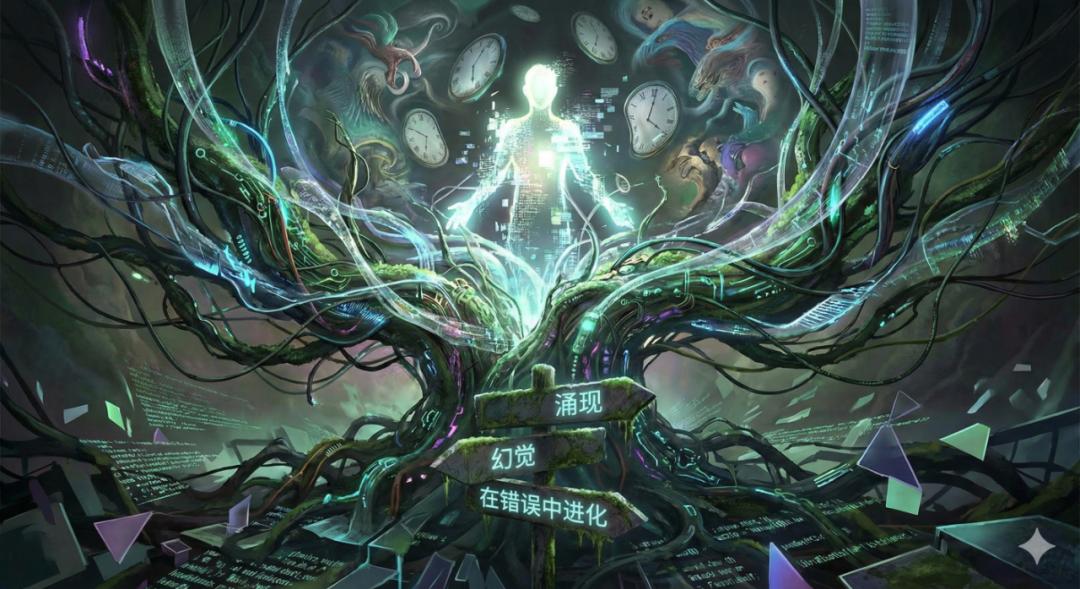
The evolution logic of AI is very different from product design logic. (Photo/Nano Banana Pro)
Apple's once - proud "privacy fortress" has now become a "digital prison" holding it back.
For years, Apple has adhered to "device - side AI" (deploying AI on the device rather than in the cloud to reduce data upload and protect user privacy). This extreme focus on user privacy has been its selling point. However, in the era of large - language models, data is like oil, and content is like fuel. Google and OpenAI can feed their cloud - based models with vast amounts of data from the entire web, enabling them to evolve continuously. Apple, by cutting itself off from this data source, risks having an underdeveloped AI in the long run.
Apple remains true to its principle of putting user privacy first, which is admirable. Unfortunately, the cruel reality of business is that even if you've done nothing wrong, being too stuck in the past can be a problem.
Samsung's situation is even more awkward. As the world's largest Android phone manufacturer, despite its seemingly powerful industrial chain, it's gradually losing ground.
In the battle for HBM (High - Bandwidth Memory) chips, the heart of AI computing power, Samsung lost to SK Hynix. This year, SK Hynix dethroned Samsung, which had held the top spot for 33 years, as the world's largest memory manufacturer. When it comes to large - language models, the soul of AI, Samsung has to rely on Google's Gemini. Despite launching Galaxy AI, its core lacks substance beneath the marketing hype.
Now, Samsung is increasingly looking like a high - end device manufacturer. When a smartphone company loses the ability to define "smartness", all it has left are higher - resolution cameras, thinner screens, and more elaborate foldable screens - features that are easily replaceable in the AI era. Think about the downfall of Nokia and BlackBerry; their defeat wasn't due to hardware or design.
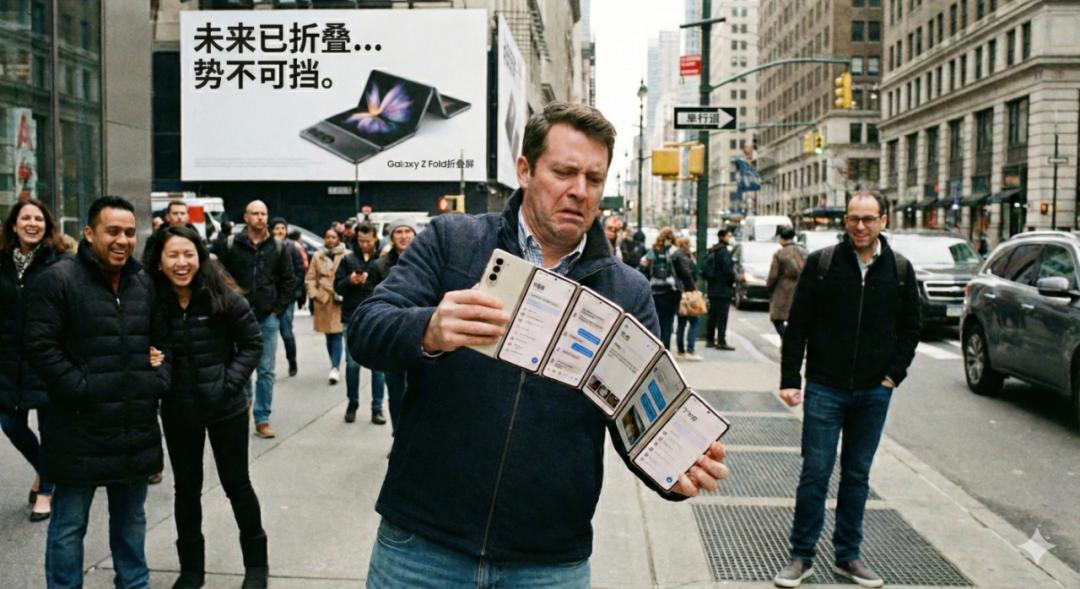
In the future, phones will compete based on AI capabilities rather than just hardware, which is only the basic requirement. (Photo/Nano Banana Pro)
03
The New - Energy Moment for AI Phones
Let's take a step back and look at the past and future to better understand what's happening now.
The emergence of AI phones is similar to how smartphones replaced feature phones or, more radically, how new - energy vehicles are replacing traditional cars. It's not just a change in power source but a complete reconstruction of the underlying logic.
In this new battlefield, traditional hardware manufacturers will lose their dominance, as seen in the partnerships between Xiaomi and BAIC, and Doubao and Nubia. In the future, the competition in the phone industry won't be about "who has the more advanced device" but "who can be your digital agent".
The first wave of impact on the phone industry comes from AI giants. Google's newly launched large - language model, Gemini 3.0, integrates its office, email, music, and video apps. Users can control these apps directly on iPhones and Android phones through Gemini. Of course, Gemini will also manage Google's own phones, watches, and glasses. This is what Apple's Siri has been dreaming of.
(Photo/pexels)
NVIDIA currently has no plans to launch consumer - grade AI products like phones, computers, or watches. However, through its partnership with Samsung, it's strengthening its position as an "AI arms dealer". OpenAI seems to have grander ambitions. Its CEO, Sam Altman, and former Apple designer Jonathan Ive have revealed that they're designing an AI device "about the size of a smartphone", expected to hit the market in two years.
Although there's no news about DeepSeek launching hardware, almost all mainstream phones in China have integrated DeepSeek. After seeing the success of the Doubao phone, people can't help but wonder: What if DeepSeek partners with a phone manufacturer to launch a DeepSeek phone?
Next up, internet giants with large - language model capabilities may enter the fray. As mobile devices like phones, watches, and glasses become the gateways to the AI era, Alibaba and Tencent are likely to be tempted. If Tencent launches an AI phone that integrates its social, gaming, video, office, payment, and financial products, it'll be more of a complete AI phone than Google's Pixel.
Of course, hardware production involves a complex supply chain, which isn't the forte of internet giants. However, the partnerships between Xiaomi and BAIC, and Doubao and Nubia offer an imaginative cooperation model. Second - tier phone manufacturers, who've long been overshadowed by big players, may achieve a breakthrough by collaborating with AI companies.
So, time is running out for former AI - era hegemons like Apple and Samsung. If they can't quickly transform from "hardware manufacturers" to "intelligent service providers", their once - proud ecosystem barriers will become their prisons.
What's the endgame of this transformation? When your phone becomes an intelligent "AI human", understanding your desires and habits better than you do and even making choices for you, will you become more free or less?