Zero-magnetic medicine reaches an inflection point
When emergency department doctors encounter a patient with chest pain of unknown cause, or when neurologists need to assess an autistic child who cannot stay still, there is a common underlying clinical need: Is there a technology that can non - invasively, quickly, and intuitively “see” the functional activities of human organs, rather than merely observing their static anatomical structures?
Zero - magnetic medicine (officially known as “extremely weak magnetic functional information medicine”) is a cutting - edge technology that emerged in response to this need. By creating a measurement environment close to zero magnetic field and using highly sensitive quantum sensors such as atomic magnetometers, it captures the extremely weak biomagnetic signals spontaneously generated by organs like the heart and brain, which are only one - hundred - millionth to one - billionth the intensity of the Earth's magnetic field. This enables the detection of “functional changes” in the early stages of disease.
In the past, this technology mostly remained in the laboratory. Now, however, it has reached a real turning point for industrialization: The room - temperature magnetocardiogram (MCG) system CardioFlux in the United States was the first to obtain FDA approval; China's first domestic magnetoencephalogram (MEG) system was successfully approved; domestic and overseas teams such as Cerca, FieldLine, and Hangzhou Zero - Magnetic Medical are simultaneously promoting the clinical implementation of wearable MEG, room - temperature MCG, and lightweight magnetic shielding devices.
This article will start from this turning point, deeply analyze the core forces driving the industrialization of zero - magnetic medicine, sort out the strategic layouts and technical routes of representative global enterprises, explore how this cutting - edge technology can take the crucial step from the laboratory to the clinic, and move towards a broader future industrial landscape.
01
Technical Foundation: Why Can a Zero - Magnetic Environment Transform Medicine?
Zero - magnetic medicine did not emerge out of thin air. It is the result of a long - term evolution of medicine, electromagnetism, and engineering technology, culminating in a concentrated breakthrough at a critical juncture. To understand its rationale, we need to trace back to the history of human observation of bioelectrical activities.
For a long time, clinical understanding of bioelectrical activities has mainly relied on electrode - contact technologies such as electrocardiogram (ECG) and electroencephalogram (EEG). These technologies are mature and convenient, but their physical nature imposes fundamental limitations: Electrical signals are attenuated and distorted to varying degrees by tissues as they propagate in the body, resulting in low spatial resolution and vague localization of deep - seated current sources.
In the second half of the 20th century, to bypass the physical constraints of “contact measurement,” scientists began to explore the path of magnetic signals. Unlike electrical signals, the magnetic fields generated by bioelectric currents in the body are hardly affected by tissue conductivity and can more truly reflect the location and propagation direction of current sources. This realization gave rise to the early research on magnetocardiogram (MCG) and magnetoencephalogram (MEG).
However, for decades, magnetic measurement technology was restricted by two extremely high barriers: extremely weak signals and extremely demanding sensors. The intensity of human biomagnetic signals is extremely low. The cardiac magnetic signal is about one - millionth of the Earth's magnetic field, and the brain magnetic signal is even as low as one - billionth. Meanwhile, the only feasible high - sensitivity sensor in the early days, the superconducting quantum interference device (SQUID), had to operate in an environment close to absolute zero with the help of liquid helium. This made the system large, expensive, and complex, confining the technology firmly to top - level laboratories.
The real transformation stems from the synchronous maturity of multiple enabling technologies in the past decade or so at the intersection of “cost reduction, lightweight design, and clinical friendliness.” The core of zero - magnetic medicine is not to pursue an absolute “zero magnetic field,” but to reconstruct the way of capturing and interpreting biomagnetic signals through a three - layer progressive system engineering.
The first layer is “environmental shielding.” Any untreated geomagnetic field, magnetic noise from equipment, or urban electromagnetic interference may mask the body's magnetic field signals. Therefore, creating a silent environment close to “zero magnetic field” through technologies such as high - performance magnetic shielding chambers and active magnetic compensation is an indispensable prerequisite for capturing real signals.
The second layer is “signal sensing.” In a noise - free environment, sensors are the key. The shackles of liquid helium for SQUID have been broken, and the maturity of the optical pumping magnetometer (OPM) is a decisive breakthrough. This miniature quantum sensor that operates at room temperature has comparable sensitivity to SQUID and supports array integration and wearability. A new generation of atomic magnetometers represented by SERF (spin - exchange - relaxation - free) has pushed the sensitivity to a new height, fundamentally solving the feasibility problem of clinical deployment.
The third layer is “magnetic field reconstruction and regulation.” After obtaining high - quality magnetic field signals, algorithms such as electromagnetic source localization are needed to reconstruct them into dynamic maps of cardiac current propagation or brain neural activities, achieving a perfect combination of “millisecond - level temporal resolution and millimeter - level spatial resolution.” More forward - looking is the research on magnetic regulation, which uses specific extremely weak time - varying magnetic fields to non - invasively intervene in neuronal activities, opening up a new physical treatment path for diseases such as epilepsy and depression.
As can be seen, zero - magnetic medicine is a complex engineering medicine that spans materials science, quantum sensing, algorithm modeling, and clinical engineering. It is this “shielding - sensing - decoding” system that endows it with the fundamental ability to transform the clinical paradigm: for the first time, it directly “visualizes” the electromagnetic physiological activities of the human body in a completely non - invasive and high - spatiotemporal - resolution manner. This brings about two paradigm shifts:
● Early diagnosis: Capture early functional signals of abnormal electrical activities before structural lesions occur in organs. For example, identify minor current abnormalities caused by myocardial ischemia before the coronary arteries are significantly stenosed, achieving true “early screening.”
● Functional assessment: Provide dynamic information that traditional imaging cannot reveal. For example, accurately locate the origin and propagation path of epileptic foci or map the millisecond - level collaboration network of different brain regions during cognitive tasks.
Therefore, the zero - magnetic environment itself is not the goal but a necessary condition for high - fidelity capture of biomagnetic signals. It is like an extremely sensitive “magnetic microscope,” allowing us to glimpse the most fundamental electrophysiological activities of life, thus pushing medical diagnosis and intervention into an earlier, more precise, and more dynamic era of functional information.
02
From Laboratory to Clinic: The Industrialization Path of Zero - Magnetic Medicine
In recent years, driven by the national strategy of “independent and controllable high - end medical equipment” and the urgent clinical need for precise diagnosis and treatment of cardiovascular and cerebrovascular diseases and brain - related diseases, zero - magnetic medicine has reached a critical turning point. This field is no longer just the research object of physicists and neuroscientists but has gradually come into the view of clinicians, hospital administrators, and industrial capital.
On the one hand, cardiovascular and cerebrovascular diseases have long been among the leading causes of death and disability in China and globally, but existing imaging and electrophysiological tools still have obvious gaps in identifying ultra - early functional abnormalities. On the other hand, in fields such as brain science research, precise localization of epilepsy, and assessment of developmental disorders, the demand for high - temporal - resolution and non - invasive functional imaging has been accumulating but has long been limited by the complexity and high usage threshold of equipment. These unmet clinical needs are providing real and urgent reasons for the implementation of zero - magnetic medicine.
As MCG and MEG related equipment have successively passed regulatory approvals, this technology is accelerating from the laboratory into the real clinical system. This change not only means the approval and listing of individual products but also marks that a class of cutting - edge technologies that have long remained in the research stage are starting to be tested in the real medical system.
Globally, zero - magnetic medicine is still in a clear early stage. The market has not yet achieved large - scale volume growth, and its commercialization progress mainly relies on regulatory approvals and the verification of specific application scenarios one by one. The number of installed devices is not the core indicator at this stage. What really determines the industry's direction is which clinical needs are established first.
Different from traditional large - scale imaging equipment such as MRI and CT, zero - magnetic medicine has not followed a linear expansion path of “research maturity - large - scale deployment” but shows a more cautious development rhythm: the high price of a single device and the need to gradually verify its clinical value through real - world scenarios.
This non - linear development characteristic has given rise to differentiated verification and promotion strategies globally. In Europe and the United States, verification often starts in specialized clinics or in - depth research collaborations. In China, it is combined with the large - scale tertiary - level hospital system earlier. Relying on national - level industrial policies and special support, systematic clinical research and engineering verification are carried out to promote the technology to quickly enter application pilots in the form of complete machines.
According to the technological maturity and clinical verification stage, the industry has differentiated into two main lines:
● Magnetocardiogram (MCG): Compared with traditional electrocardiograms, MCG is more sensitive to early myocardial ischemia, microvascular diseases, etc., and has the characteristics of non - invasiveness and rapidity. It naturally fits the scenarios of emergency chest pain triage and early screening. Its clinical value is relatively direct, and the business logic focuses on optimizing the diagnosis and treatment process and reducing unnecessary invasive examinations. Therefore, its commercialization path is clearer, and it has entered the scope of discussion on regulatory and payment systems earlier.
● Magnetoencephalogram (MEG): It is currently in the stage of technological innovation and pilot applications, focusing on specialized fields with urgent needs for brain function information, such as the localization of epileptic foci, neurodevelopmental disorders, and mental diseases. Although it has great long - term potential, due to its higher technological complexity and long clinical verification cycle, it needs to accumulate more solid clinical trial and real - world evidence to prove its added value. Therefore, its commercialization path is expected to be longer.
As industrialization progresses, a global industrial chain with clear hierarchies and well - defined divisions of labor is taking shape at an accelerating pace:
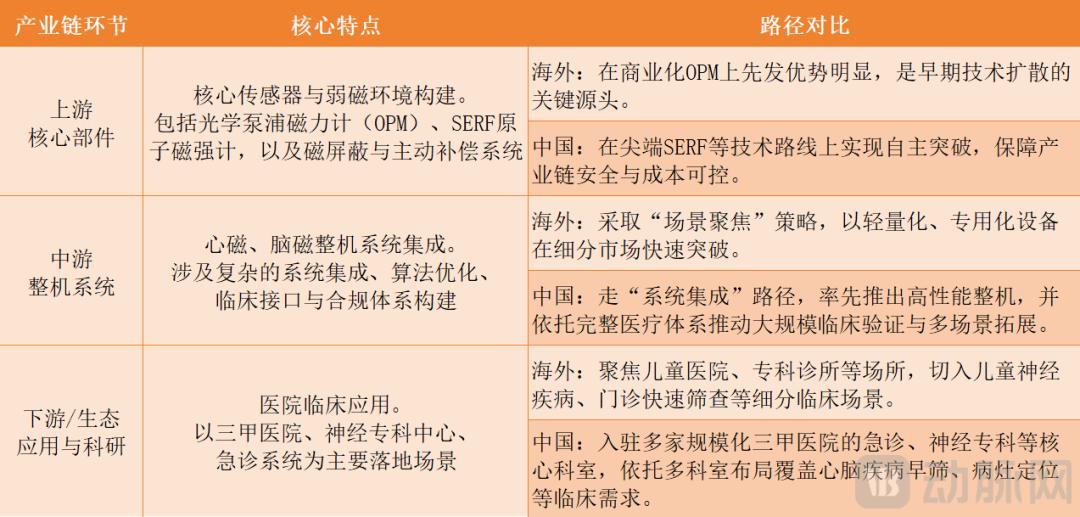
Comparison chart of the core characteristics and paths of the zero - magnetic medicine industrial chain
From the core sensors and weak - magnetic environment in the upstream, to the extremely challenging complete - machine system integration in the mid - stream, and then to the hospital clinical applications in the downstream, the specialized ecological collaboration marks that the technology development has entered a new stage driven by both system efficiency and clinical value.
On this basis, with the future decline in manufacturing costs and the improvement of the certification system, zero - magnetic medicine is expected to be deeply integrated with technologies such as artificial intelligence and big data, evolving into a more intelligent diagnosis and intervention platform. For example, CardioFlux has used AI algorithms for signal processing; emerging integration directions such as multimodal imaging and “zero - magnetic + brain - computer interface” will also expand its application boundaries.
03
Research - Driven and Policy - Guided: An Overview of Representative Zero - Magnetic Medicine Enterprises
Against the backdrop of the above - mentioned market stage and path differentiation, since 2018, enterprises related to zero - magnetic medicine have gradually shown a clear trend of division of labor and agglomeration globally.
Notably, this emerging field has attracted a considerable amount of capital attention. The financing progress of representative domestic and overseas enterprises reveals the market's valuation logic and expectations for zero - magnetic medicine.
Currently, the representative global enterprises in the zero - magnetic medicine field are as follows:
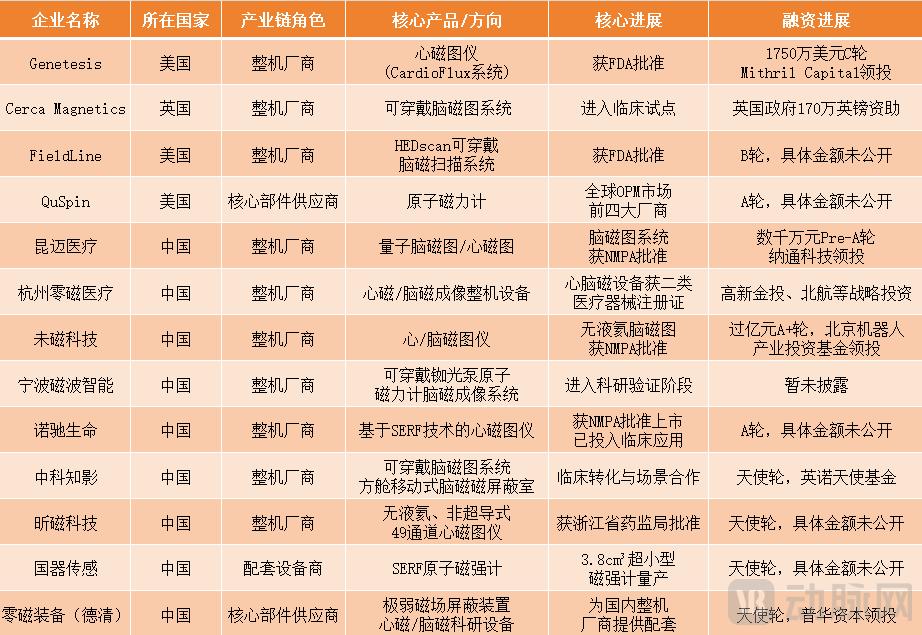
Overview of domestic and overseas zero - magnetic medicine enterprises
■ Overseas market: Early commercialization oriented by scenarios
European and American enterprises tend to adopt a “lightweight and scenario - based” technical route. Mainly relying on optical pumping magnetometer (OPM) technology, they are committed to developing wearable and adaptable MCG or MEG detection systems. The core goal is to lower the usage threshold and promote the shift of examinations from professional shielding rooms to dynamic environments such as outpatient clinics and homes.
In the MCG field, the American company Genetesis is one of the most representative examples. Its MCG system CardioFlux was the first to pass regulatory approval, clearly targeting the high - frequency scenario of emergency chest pain triage. Its goal is not to replace existing examinations but to assist doctors in quickly determining whether further invasive diagnosis and treatment are needed. This strategy has proven the value of MCG in real medical processes.
In the MEG direction, the British enterprise Cerca Magnetics represents a research - driven path. Its wearable MEG system based on OPM emphasizes flexible deployment and wearability, which is more in line with the needs of neuroscience research and specialized clinical practice; the HEDscan system of the American company FieldLine further demonstrates the feasibility of application in a mildly shielded environment. Although the commercialization rhythm of this path is slow, it can establish extremely high technical barriers and expert consensus in the neurological specialty field.
QuSpin occupies a key position at the core component level. Its OPM/SERF atomic magnetometer module has become an important underlying component for many overseas complete - machine manufacturers, greatly lowering the threshold for industry innovation and spurring diverse application explorations.
Overall, the current industrialization momentum of global zero - magnetic medicine shows regional differentiation. Overseas enterprises' innovation and capital are more focused on the in - depth optimization of traditional SQUID technology and the consolidation of existing scenarios, and are relatively cautious about the systematic expansion of new - generation technology routes such as OPM. In contrast, China is advancing more rapidly in the integration of OPM and SERF technologies and the engineering of complete - machine systems.
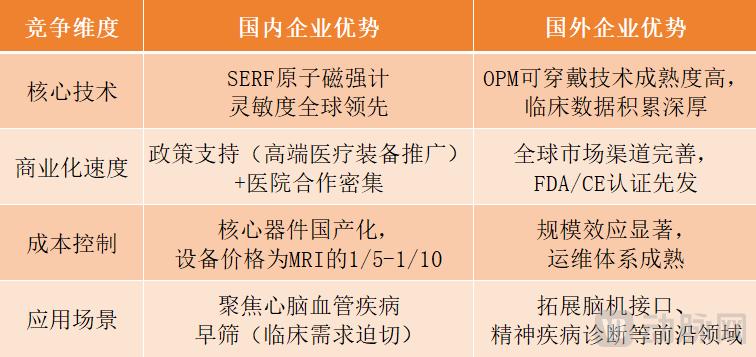
Comparison of the core competitiveness of domestic and overseas zero - magnetic medicine enterprises
■ Chinese market: Industrialization promotion centered on system engineering
For China, the exploration path of zero - magnetic medicine does not aim for short - term leadership in a single technology point but is committed to building a complete system engineering from source innovation to clinical implementation. This path is chosen based on the deep integration of China's unique industrial foundation, medical system, and national strategy.
Top - level design: Support from national strategy and systematic resources
China's development of zero - magnetic medicine has been placed under the grand narrative of national scientific and technological innovation and the independent and controllable high - end medical equipment from the very beginning.
At the policy level, it not only enjoys the fast - track review channel for innovative medical devices but is also included in the “14th Five - Year Plan for Major National Science and Technology Infrastructure,” receiving strong support from special funds at both the central and local levels. This top - level design has solved the “valley of death” problem faced by cutting - edge technologies in the early stage, making China one of the few markets in the world that can simultaneously promote basic research, engineering development, and clinical verification.
This support is specifically manifested in a unique collaborative model of “large - scale scientific device - clinical research - industrial transformation.” For example, the national “Ultra - high - sensitivity extremely weak magnetic field large - scale scientific device” being built in Hangzhou provides a world - class platform for source innovation of the technology. Meanwhile, the dense cooperation network among industry, academia, research institutions, and medical institutions ensures that laboratory breakthroughs can be quickly verified and iterated in clinical scenarios.
Implementation path: Complete - machine traction and full - chain breakthrough
Under the national systematic layout, China has formed a well - structured and collaboratively developed enterprise ecosystem, jointly supporting the “system integration” path.
Represented by Hangzhou Zero - Magnetic Medical, its MCG and MEG complete - machine systems have both obtained regulatory approval, and the equipment has been put into verification in many hospitals across the country. It has not only achieved a technological closed - loop from core components to complete machines but also led the construction of the world's first “zero - magnetic interventional medicine laboratory,” expanding the