Capital is eyeing 3D printing again.
"Let me share a new hobby I've recently gotten into - 3D printing!"
"Since I got a 3D printer, I've achieved the freedom to make figurines."
On a certain social platform, similar content is going viral. There are already over 2 million notes related to "3D printing". From anime figurines to home renovations, this once niche technology belonging to the geek circle is rapidly entering the daily lives of ordinary people.
The trends in capital also reflect the popularity of the industry from the side. In just two months at the end of 2025, there were a series of major investment and financing news in the 3D printing sector:
In November, DJI, the drone giant, made its first cross - border move by strategically investing hundreds of millions of yuan in SmartPie Technology, a 3D printing company, officially announcing its entry into this field.
In December, Snapmaker followed suit and announced the completion of a Series B financing of hundreds of millions of yuan, co - led by Hillhouse Capital and Meituan, with participation from Shunwei Capital, Meituan Longzhu, and Nanshan Strategic Emerging Investment.
Meanwhile, Creality, a leading company in the industry, has submitted its prospectus to the Hong Kong Stock Exchange, aiming to enter the secondary market. Another hidden giant, Tiertime, although it has not initiated an IPO, has an annual shipment volume of over one million units...
The once quiet 3D printing sector is experiencing an unexpected collective recovery in 2025. Is this wave of enthusiasm just a short - term return of capital, or is it the inflection point for the large - scale implementation of 3D printing in China?
Hot Capital Flows into 3D Printing
This upsurge in the sector is not without reason. The most notable event is the cross - border investment by DJI, which has triggered a stir in the industry.
Last month, SmartPie Technology, a 3D printing company, completed a Series B financing of hundreds of millions of yuan, with the investor being DJI. This low - key industrial investment was pushed into the center of public opinion due to a WeChat Moments post by Tao Ye, the founder of Tiertime.
Tao Ye wrote that when DJI invested in SmartPie Technology recently, "the agreement specifically included clauses targeting Tiertime", implying that Tiertime might face a "siege" from DJI.
This statement quickly caught the industry's attention. Before founding Tiertime, Tao Ye had worked at DJI for eight years and had served as the head of DJI's consumer drone department, leading the R & D of star products such as the Mavic Pro.
In response to external speculation, DJI stated that this investment was purely based on its optimism about the prospects of consumer - grade 3D printing technology and the growth potential of the industry, which is in line with its consistent forward - looking layout in cutting - edge hard technologies. It did not specifically respond to the "targeted clauses".
Behind this internal feud within the "DJI ecosystem" is a more thought - provoking signal: even the drone giant is getting involved, indicating that the 3D printing sector, once regarded as a "niche geek toy", is back in the sight of mainstream technological forces.
In fact, DJI's cross - border layout is just the tip of the iceberg. The intensive investment from market - oriented VCs further highlights the popularity of the sector.
In December, Snapmaker announced the completion of a Series B financing of hundreds of millions of yuan. This round of financing was co - led by Hillhouse Capital and Meituan, with participation from Shunwei Capital, Meituan Longzhu, and Nanshan Strategic Emerging Investment. Existing shareholders Tongchuang Weiye and Orient Securities Capital continued to increase their investment.
In the same month, Cybertron Technology, an electron - beam metal 3D printing company, announced the completion of a Pre - A round of financing, jointly invested by Liandong Fengye and Tuotan Xinwei.
Looking back further, in September this year, RAYSHAPE, a digital dental 3D printing enterprise, announced the completion of a Pre - B round of financing of tens of millions of yuan, co - led by Xingqi Fund under Falcon Investment and Xieli Investment, with participation from Orient Securities Capital.
In the same month, Atom Reconstruction announced the completion of a Series A financing, with the investors being Junke Danmu and Cornerstone Capital, injecting impetus for its entry into the consumer - grade 3D printing sector.
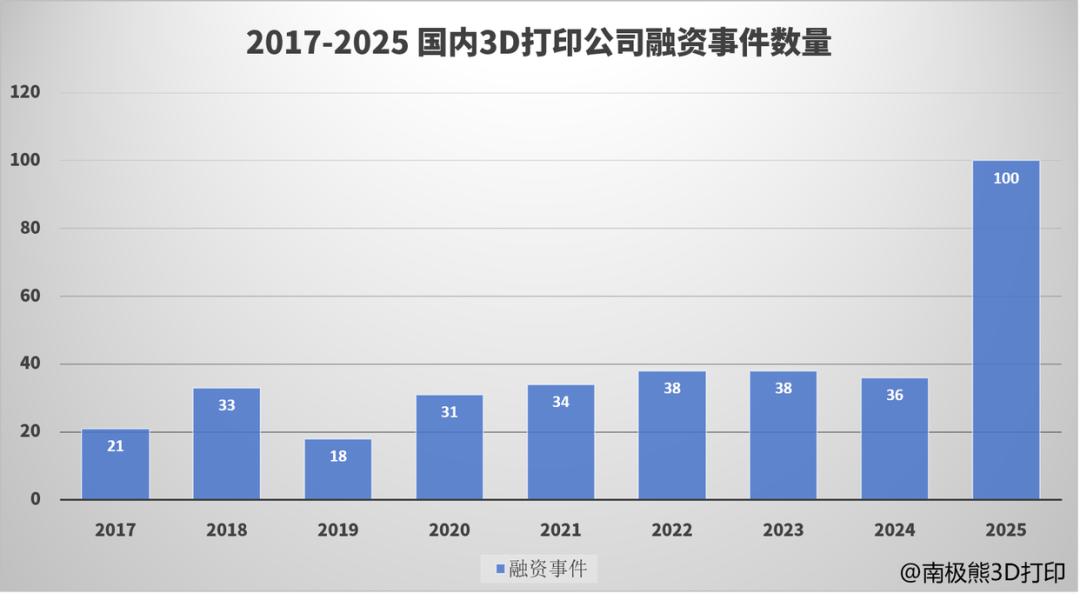
Beyond these scattered financing cases, a set of core data further confirms the soaring popularity of the sector. According to data from Nanji Xiong 3D Printing, in the past few years, the number of investment and financing events in the domestic 3D printing industry has basically remained between 30 and 40. In 2025, the number of financing events reached 100 (involving 81 companies, with some companies having 2 - 3 rounds of financing), almost tripling.
Source: Nanji Xiong 3D Printing
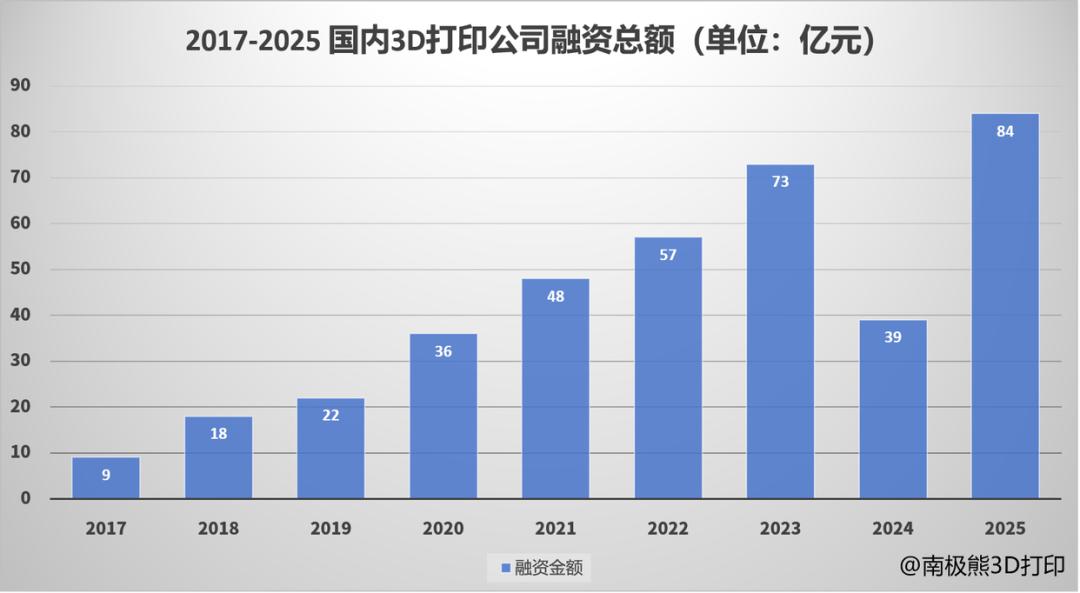
The dimension of financing amount also confirms the capital enthusiasm in the sector. According to the same data source, the total investment and financing in the domestic 3D printing industry in 2025 was approximately 8.4 billion yuan, reaching a record high and reversing the downward trend in 2024. However, the industry's financing did not show continuous high - growth. In 2023 - 2024, it was under pressure due to the overall environment of the capital market.
It is worth noting that in 2023, the total investment and financing in the industry still increased to 7.3 billion yuan, mainly due to two large - scale financings: Blitec's private placement of over 3 billion yuan and Huashu High - tech's IPO financing of 1.105 billion yuan on the Science and Technology Innovation Board. In 2024, due to the lack of such large - scale financings and a sluggish market, the financing amount declined. The explosive growth in 2025 may mean that the industry's financing has returned to a normal growth track.
Source: Nanji Xiong 3D Printing
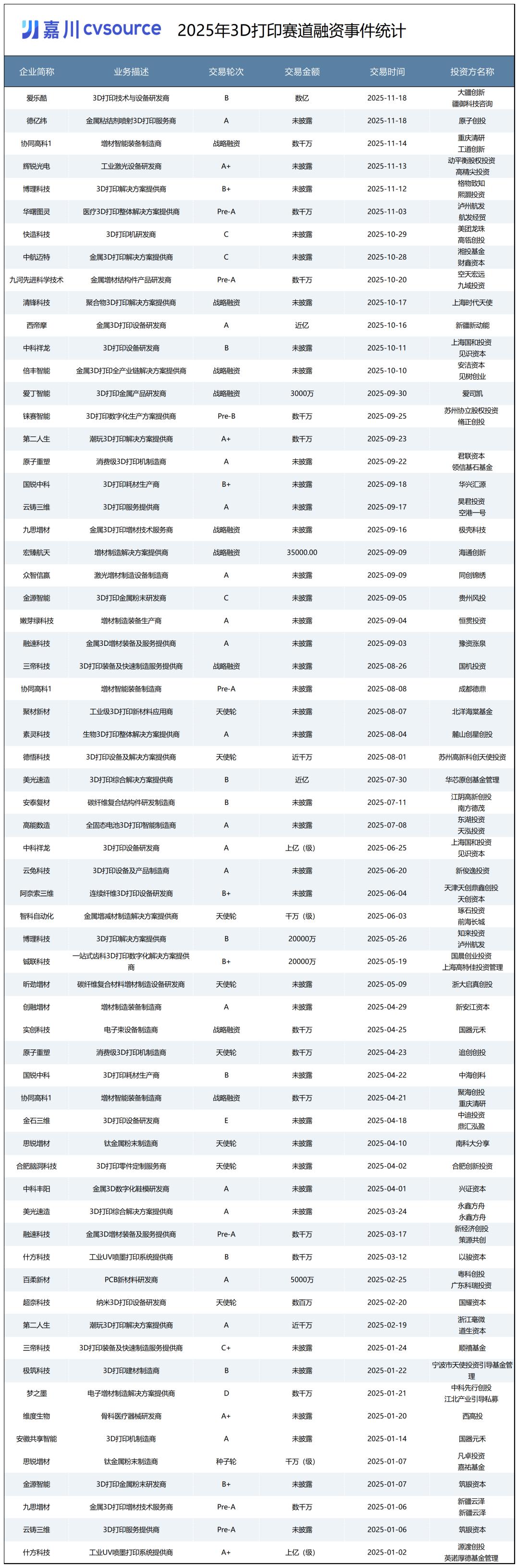
According to data from CVSource, from the perspective of investment targets, the companies invested in this year can be roughly divided into two categories: one is 3D printing companies targeting the C - end consumer market, and the other is providers of new materials or overall technical solutions for the industrial field.
Source: CVSource
A deeper - level trend is that not only market - oriented funds but also industrial capital from local governments are driving this wave of enthusiasm. Capital is no longer chasing concepts but betting on real demand and voting for technologies that can effectively improve efficiency.
Market - oriented VCs, such as Meituan Longzhu, Hillhouse Capital, Tongchuang Weiye, and Legend Capital, have all made investments this year. In addition, early - stage investment institutions established by local state - owned assets have also been quite prominent. For example, the Industrial Mother Machine Industry Fund managed by Guoqi Yuanhe has invested in two related industrial companies, Anhui Sharing Intelligent Equipment and Guilin Shichuang Technology, this year, demonstrating the recognition of the long - term value of the sector by industrial capital.
Why 3D Printing?
In fact, the resurgence of the 3D printing industry is not the result of blind capital speculation but the inevitable outcome of technological breakthroughs.
3D printing technology itself is not new. This technological trend emerged more than a decade ago. However, the pain points of "high cost, slow speed, and difficulty in mass production" have long restricted the large - scale development of the industry.
In recent years, a series of key technological breakthroughs have given a boost to the industry's development. With the domestic substitution of core components such as lasers and galvanometers, the manufacturing cost of equipment has been significantly reduced. Taking the mainstream FDM (Fused Deposition Modeling) technology equipment as an example, the average price of entry - level products was still over 3,000 yuan in 2019, and now some have dropped to the range of 1,000 to 3,000 yuan.
In addition, the in - depth integration of AI technology and 3D printing is becoming the mainstream. AI tools allow users to generate 3D models through simple text descriptions or image inputs without professional modeling skills, greatly simplifying the creative process.
The significant reduction in consumable costs and the enrichment of material systems have further broadened the application scenarios of 3D printing. Taking PLA plastic, a commonly used material in consumer - grade 3D printing, as an example, its price has dropped to about 40 yuan per kilogram, a decrease of more than 50% compared to a few years ago. In addition to traditional plastic materials, new consumables such as carbon fiber composites, environmentally friendly resins, and metal powders are also emerging.
The maturity of technology and the reduction in costs have also made investors who have been deeply involved in the sector more clear about their value judgment. Tongchuang Weiye has been tracking 3D printing - related targets for many years, covering 3D printing materials, equipment, services, and even platforms. It has invested in Hengpu Laser, which focuses on 3D printing technology for metal - ceramic composites, and Zhongzhixin Ying, which specializes in metal 3D printing for high - end molds and aerospace and other high - tech markets.
According to Wang Jing of Tongchuang Weiye, 3D printing will ultimately return to the essence of material forming, especially in industrial scenarios, where it will be one of many processes and finally be applied to specific products. In the view of this investor, the investment logic in the current 3D printing sector has shifted from "technological novelty - seeking" to "value implementation".
Liu Huaping, an investment manager of an industrial fund in Beijing, said, "As the trend of domestic substitution in 3D printing becomes more prominent, while being optimistic about the future of the industry, we also need to remain rational and help those enterprises with real technological strength move towards high - end and international markets. We should not invest blindly but make value investments rather than price - based investments."
Both investors emphasized that the real opportunity in the 3D printing sector lies not in short - term concept speculation but in whether the technology can be effectively transformed into scalable industrial value. This consensus may become the core logic for current capital layout in the sector.
The continuous strengthening of policies has further injected a boost into the industry's development. In 2024, the "Opinions on Accelerating the Construction of a Waste Recycling System" encouraged the application of 3D printing recycled materials. In 2025, eight departments including the Ministry of Commerce jointly issued the "Guiding Opinions on Vigorously Developing Digital Consumption and Jointly Creating a Better Life in the Digital Age", clearly including desktop 3D printing equipment as a key direction in "digital product consumption".
With multiple favorable factors combined, the industry echelon has clearly taken shape. According to Qianzhan Industry Research Institute, in terms of revenue scale, the first - tier enterprises in China's 3D printing industry include Creality and Anycubic, which focus on consumer - grade 3D printers and have an annual operating income of over 1 billion yuan.
The second - tier enterprises include Blitec, Shining 3D, and Guangyunda, with an average annual revenue between 100 million and 1 billion yuan. Among them, Blitec is one of the leading enterprises in industrial - grade 3D printing equipment, with significant technological advantages and market share in the field of metal 3D printing. Shining 3D is mainly involved in 3D scanning and 3D printing equipment.
The Huajing Industry Research Institute predicts that the global 3D printing market will reach 29.8 billion US dollars in 2025 and is expected to climb to 85.3 billion US dollars by 2030, with the Chinese market's share increasing to 35%.
The Consumer - Grade Sector is Ready to Take Off
For a long time, the 3D printing industry has shown a clear - cut pattern: industrial - grade equipment is mainly targeted at high - end fields such as aerospace, automobile manufacturing, and medical care, with strong performance but high prices, often reaching hundreds of thousands or even millions of yuan. Consumer - grade products, due to limited precision and complex operation, are mainly targeted at niche groups such as individual enthusiasts and makers.
However, this pattern is being broken. Guojin Securities pointed out that the penetration of consumer - grade 3D printing in the industry is timely, and it will enter a period of rapid popularization.
Currently, the consumer - grade 3D printing sector has gradually produced a group of leading enterprises from the early stage of fierce competition. Among them, Creality, Anycubic, SmartPie, and Tiertime are known as the "Four Little Dragons of Shenzhen". Relevant data shows that these four Shenzhen enterprises together control 90% of the global market share of entry - level 3D printers.
The prospectus submitted by Creality also reveals a clear industry competition pattern: in 2024, Creality's annual shipment volume was 720,000 units, ranking second in the world. Tiertime ranked first with a shipment volume of 1.2 million units. In addition, SmartPie and Anycubic had shipment volumes of approximately 550,000 and 500,000 units respectively in 2024.
They have different development paths: Creality promotes the popularization of technology with high - cost - performance products and has submitted its prospectus to the Hong Kong Stock Exchange. Tiertime focuses on developers and builds the MakerWorld community ecosystem, with a monthly active user base of over 10 million and more than one million models. SmartPie has transformed from educational kits and has rapidly increased its volume with light - curing technology. Anycubic has opened up the overseas market with its Photon series.
However, the development of consumer - grade 3D printing still faces many challenges, and there are hidden concerns behind the industry's explosive growth.
Firstly, there is the problem of low - price involution. As a large number of enterprises enter the sector, the overall profit of the industry is under pressure, and the product quality is uneven, accelerating the reshuffle process of the industry.
Secondly, there is the problem of user retention. Although the threshold for equipment has been significantly reduced, some users, after purchasing, find that the equipment "collects dust" due to the lack of continuous use scenarios and a high printing failure rate, which not only affects the user experience but also restricts the long - term development of the industry.
However, it cannot be denied that these challenges have not changed the long - term development trend of the industry. Behind consumer - grade 3D printing lies a huge imagination space for future industries such as personalized manufacturing and digital consumption. When the ecological closed - loop of "hardware + software + content" is gradually formed, 3D printers are expected to be upgraded from optional consumer goods to a household standard.
Chen Bo, the co - founder of SmartPie Technology, said bluntly, "Consumer - grade 3D printing has reached the iPhone moment", which implies that the industry has reached an inflection point. "In recent years, consumer - grade 3D printers have passed the early - adopter stage in the theory of innovation diffusion and entered the early - majority stage. The annual revenue of the four leading enterprises in the industry has also crossed the threshold of 1 billion yuan."
For capital, this round of layout is not only a pursuit of short - term market heat but also an optimism about long - term industrial value. For the industry, the injection of capital will accelerate technological iteration and ecological improvement. For ordinary consumers, this change is redefining the boundaries of "creation" and enabling everyone to become a "maker".