Is Zhejiang in a hurry after missing out on the top 20 list nationwide?
According to Daxiang News, the newly released "China Statistical Yearbook 2025" shows that among cities with over 1 million undergraduate and junior college students, Zhengzhou ranks second with more than 1.432 million students, right behind Guangzhou. Wuhan, Chengdu, and Chongqing also have over one million undergraduate and junior college students, ranking third to fifth.
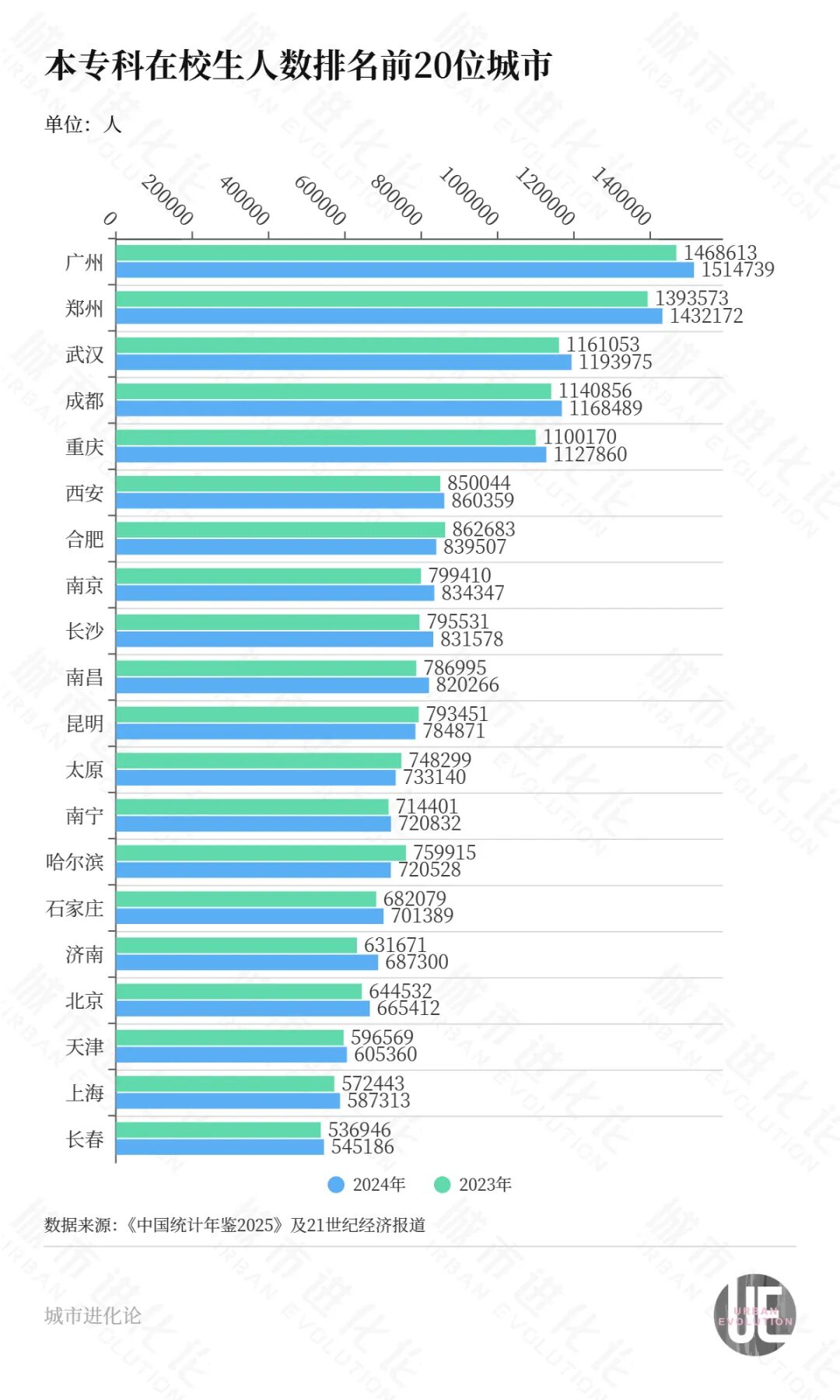
Data shows that among the top 20 cities in terms of the number of undergraduate and junior college students, the total number continues to increase, rising from 17.0392 million in 2023 to 17.3746 million in 2024, a growth of 1.97%. The total number of students in these cities accounts for 44.65% of the total number of undergraduate and junior college students in China.
Compared with the top 20 cities on the list, the cities not on the list have attracted more attention. According to Zhejiang's "Chao News", many cities in Zhejiang have shown mediocre performance in this regard. Even Hangzhou, the city with the largest number of undergraduate and junior college students in the province, has failed to make it into the national top 20 list for two consecutive years. Changchun, which ranked 20th in 2024, already has over 540,000 undergraduate and junior college students.
Talents gather because of industries, and industries thrive because of talents. On the surface, the "talent war" is a competition of talent policies, but in fact, it is a competition of innovation ecosystems and a competition for future development competitiveness. A comparative data is often mentioned: the entrepreneurship rate of graduates from world - famous universities reaches 30%, while in China, this ratio is only about 1% to 2%.
From the public's perspective this year, such a dilemma may not be difficult to solve for Zhejiang, especially Hangzhou. The reason lies in the "Six Little Dragons of Hangzhou" that became popular at the beginning of this year. As one of the earliest universities in China to study AI, Zhejiang University has provided a large number of talents for Hangzhou's AI ecosystem. Three of the "Six Little Dragons of Hangzhou" are from Zhejiang University.
However, even with an established prestigious university like Zhejiang University, Hangzhou still has relatively few high - quality educational resources compared with cities such as Nanjing, Wuhan, and Xi'an. To address this, Hangzhou previously established Westlake University and is now planning to build Qiantang University. In June this year, the Hangzhou Municipal Government signed a framework agreement for cooperative education with the Hangzhou Qiantang Education Foundation. Hangzhou Mayor Yao Gaoyuan and Zhong Shanshan, the initiator of the Qiantang Education Foundation, signed the agreement on behalf of both parties.
According to the agreement, both parties will adhere to the school - running concept of "high - starting - point planning, research - driven, international expansion, and small - scale excellence", focus on fields such as science, engineering, and interdisciplinary disciplines, and are committed to cultivating strategic scientists, leading talents, and outstanding engineers required for the country's scientific and technological self - reliance, providing talent support for promoting the in - depth integration of scientific and technological innovation and industrial innovation.
It's not just Hangzhou. As the second - largest city in the province, local officials in Ningbo have also bluntly stated that the weak scientific and technological innovation strength and the insufficient number of high - level universities have always been bottlenecks restricting Ningbo's high - quality development. Especially at present, as scientific and technological innovation has become a key variable in urban development, the weak scientific and educational resources and the lack of major innovation platforms have increasingly become prominent short - boards hindering Ningbo's development.
Looking at the whole of Zhejiang, on the one hand, there is an obvious gap in high - level universities except for Zhejiang University. On the other hand, there are still "blank areas" of universities in many cities in the southern part of the province. As early as two years ago, Zhejiang proposed to implement the "Double First - Class 196 Project", sounding the clarion call for building a strong province in higher education, and clearly stating that it would actively explore the construction model of "at least one high - level university in each city".
According to the newly released "14th Five - Year Plan" suggestions for Zhejiang, Zhejiang will improve the coordination mechanism for promoting the integration of a strong education province, a strong science and technology province, and a strong talent province. It will deeply implement the "Double First - Class 196 Project" and the project to improve the infrastructure of universities, support Zhejiang University to move forward to the forefront of world - class universities, support Westlake University to build a world - class new research - oriented university, encourage more universities to strive for the national "Double First - Class" status, support social forces to run new research - oriented universities well, and support a number of universities to become high - level applied universities.
This article is from the WeChat public account "Urban Evolution Theory", author: Yang Huan. Republished by 36Kr with permission.