Humanoid robots are being deployed in large numbers at CATL.
Recently, the world's first new energy power battery PACK production line that has achieved large-scale implementation of humanoid embodied intelligent robots was officially put into operation at CATL's Zhongzhou Base. The humanoid robot "Xiaomo" can now accurately complete complex tasks such as plugging in battery connectors, marking the application of embodied intelligence in the field of intelligent manufacturing.
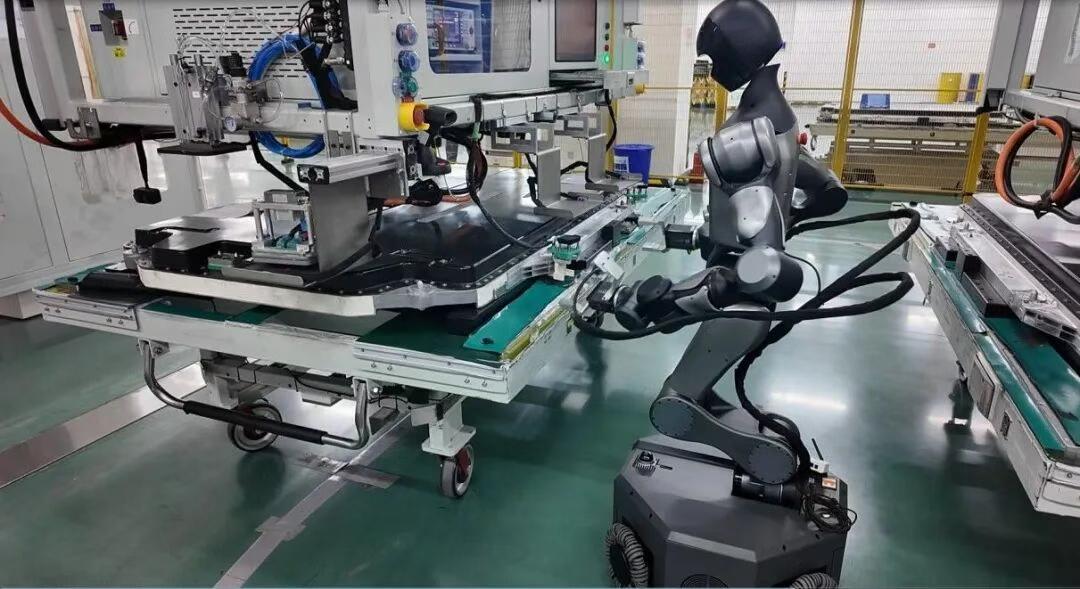
"Xiaomo" was developed by Qianxun Intelligent Robot Co., Ltd., an ecological enterprise of CATL, and is equipped with a self-developed battery by CATL. According to Qianxun Intelligent, in the face of continuous production tasks for multiple battery models, its daily workload has tripled, and it shows excellent consistency and stability.
Specifically, the EOL and DCR processes replaced by "Xiaomo" are the final functional tests before the battery pack leaves the production line. This link has the characteristics of "multiple varieties, small batches, and high flexibility" and has long relied on manual operation. Workers need to accurately plug test plugs with hundreds of volts of high voltage into the specified positions of the battery pack, which not only poses a risk of high-voltage arcing but also has problems such as unstable efficiency and quality.
The introduction of "Xiaomo" has completely changed this situation. It is equipped with an advanced end-to-end vision-language-action (VLA) model and has strong environmental perception and task generalization capabilities:
Precise adaptation: It can independently handle uncertainties such as deviations in the incoming material position and changes in plug-in points and adjust its operating posture in real-time.
Flexible operation: When plugging and unplugging flexible wiring harnesses, it can dynamically adjust the force to ensure a reliable connection without damaging components.
Efficient and reliable: In actual operation, its plugging success rate is stably above 99%, and its operation cycle has reached the level of skilled workers.
This implementation not only solves the problem of flexible production in the power battery PACK line but also verifies the core value of embodied intelligence in the industrial field. That is, embodied intelligent robots, with their "human-like" perception and decision-making abilities, make up for the shortcomings of traditional automation in uncertain scenarios.
For the new energy industry, this means higher consistency, lower safety risks, and stronger production capacity flexibility; for the artificial intelligence industry, this is a crucial step for the large embodied intelligence models to move from "laboratory demonstrations" to "industrial necessities."
Qianxun Intelligent was founded by Han Fengtao, the former CTO of Luoshi Robotics, in February 2024. In less than a year, Qianxun Intelligent completed three rounds of financing in succession. Tianyancha shows that in November 2024, Bairui Capital, jointly founded by a co-founder of CATL, made an angel round investment in "Qianxun Intelligent," a company researching and developing embodied intelligent robots. This year, Qianxun Intelligent disclosed two more rounds of financing, with a total financing amount of over 1.1 billion.
According to reports, Qianxun Intelligent revealed that the company started commercialization in the fourth quarter of this year, and the current orders are in the tens of millions. It is expected that the revenue next year will exceed 100 million, and the shipment volume will reach several hundred units.
Next year, Qianxun Intelligent will invest heavily in data collection, planning to collect or purchase high-quality data from real machines for 1 million hours to promote the model to reach the first in China and the third in the world.
Currently, robots are accelerating their penetration into manufacturing factories and becoming the core force driving industrial upgrading. Figure's second-generation robot has participated in the production of 30,000 BMW X3 cars at the Spartanburg plant in 6 months, loading more than 90,000 parts in total, with an operating time of over 1,250 hours; in Midea's washing machine plant in Jingzhou, the first-generation humanoid robot "Meiluo" has been on the job for more than half a year. Under the scheduling of the "factory brain," it can carry washing machine rear drums weighing up to 9 kilograms and complete tasks such as 3D quality inspection and equipment inspection; 20 industrial humanoid robots Walker S1 of Ubtech have been deployed in the automobile factory of Dongfeng Liuzhou Motor for more than a dozen tasks such as safety belt detection, body quality inspection, refueling, and handling...
IDC pointed out that in 2025, the shipment growth rate of collaborative robots will reach 28%, making it the fastest-growing sub-category. Its lightweight and easy-to-program features match the production trend of "small batches, multiple varieties" of small and medium-sized enterprises.
With technological iteration and scenario deepening, robots are evolving into "production line partners." In 2025, with the integration of large models and robot control systems, their autonomous decision-making ability may see a leapfrog improvement, injecting stronger impetus into the intelligent transformation of the manufacturing industry.
This article is from the WeChat official account "Kechuang Daily", author: Kechuangban Daily. 36Kr is authorized to publish it.