In 2025, is there no competitive smart glasses?
In 2025, how many companies released AI smart glasses?
Some people say around 30 - 40, while some institutions' statistics show there are over a hundred. Looking at the hardware industry, smart glasses were the hottest digital product of the year:

Li Shufu of Geely often wears his company's smart glasses to attend formal occasions.
Internet giants like Baidu and Alibaba regard smart glasses as the physical traffic entrance in the AI era. Automobile - related enterprises such as Li Auto, Xiaomi, and Meizu (a Geely - owned enterprise) attempt to build a new ecosystem from cars to people with them. Smart glasses startups like Rokid and Yingmu also introduce large models under the AI wave and launch new products.
Moreover, many brands try to take advantage of the situation. Taking advantage of the lack of unified industry standards, they claim to sell AI smart glasses but actually offer "plain glasses + earphones", selling products with a cost of just a few dozen yuan for one or two thousand yuan.
Currently, the product functions of smart glasses vary greatly. The starting points and target audiences of different companies' smart glasses are also different. The total sales volume of all smart glasses is still less than that of a mainstream smartphone, but the growth rate is quite high: During the Double Eleven shopping festival in 2025, the turnover of smart glasses increased by 2500% year - on - year, making it one of the fastest - growing categories in the 3C digital industry. The atmosphere of the "Battle of a Hundred Glasses" has been set off.
However, despite the big players "rushing into the market", this battle of AI smart glasses won't start in the short term.
It's time to define smart glasses
Surprisingly, without defining AI smart glasses at present, it's even difficult to count how many products are in this category. Ciguangongshe (ID: ciweigongshe) believes that, like intelligent driving, smart glasses should be classified from primary to advanced according to their intelligence levels. Smart glasses of different levels are not even the same type of product in essence.
Level L1: It has no interaction ability but can play audio and video. It's just a wearable display. Usually, such devices are large in size and heavy in weight and need to be connected to a power source.
Level L2: It only has the ability to interact through voice via the earphone and cannot recognize objects. Strictly speaking, it's just an AI earphone in the shape of glasses.
Level L3: The smart glasses can take pictures and record videos through the camera. With the help of AI, it can recognize objects in front of it and interact and translate through voice. It's an earphone with a camera.
Level L4: On the basis of Level L3, the lenses integrate AR functions. The lenses can be used as a display screen, with functions such as navigation, teleprompter, and glance - to - pay. It can translate subtitles in real - time on the lenses. Finally, it can display in front of the eyes, but it's like a "black - and - white TV", with images and text only displayed in monochromatic lines:
Level L5: On the basis of Level L4, the lenses can display in full color. It's an intelligent assistant right in front of the eyes that can interact with the real world, or even a personal portable computing center.
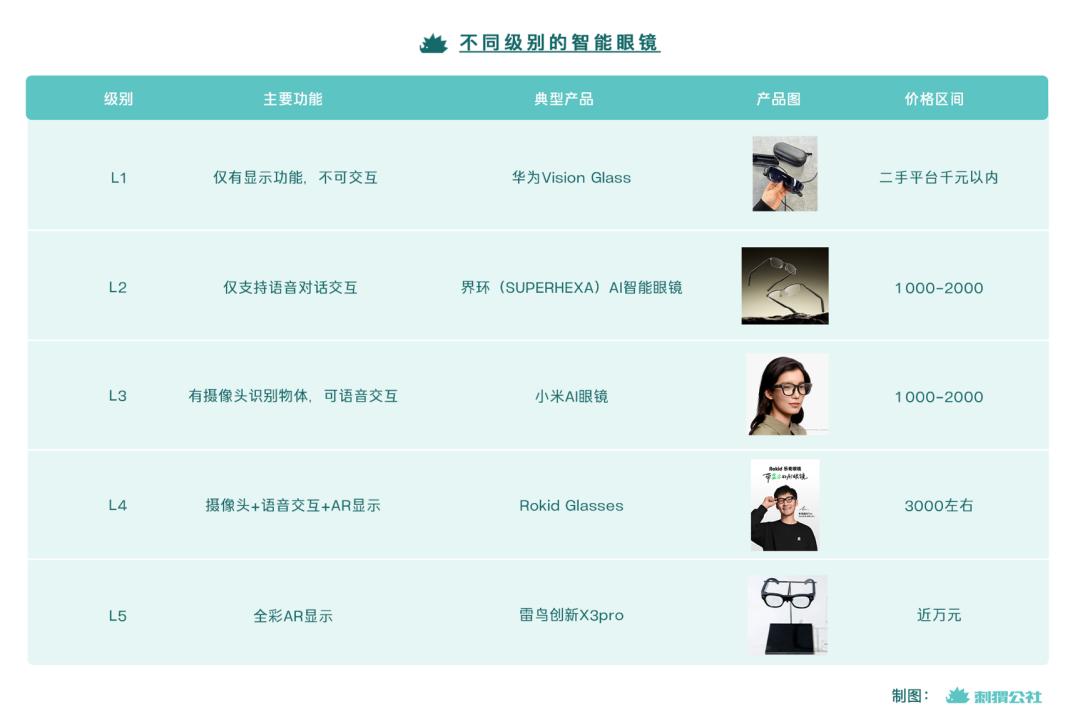
According to this standard, Ciguangongshe observed that nearly half of the smart glasses launched by mainstream manufacturers are at Levels L2 and L3. From the perspective of interaction functions, they are more like smart earphones in the shape of glasses, and the price is generally within 2000 yuan.
In this price range, smart glasses without AR display functions are essentially variants of smart earphones. In the sales rankings of AI glasses on major e - commerce platforms, L2 and L3 smart glasses are popular among users because of their relatively low prices.
However, in the price range below 2000 yuan, the well - selling smart glasses are not necessarily products of large manufacturers with high technological content and good cost - performance. Some unknown small manufacturers' "smart earphones in the shape of glasses" are sold at a similar price to the smart glasses of big brands like Xiaomi and Li Auto, but they don't have the high - definition cameras and AI recognition capabilities of the latter.
Due to the imperfect industry standards, users don't have a fixed concept of "what is a smart glass". Some "pure - audio smart glasses" can also take advantage of information asymmetry and often rank high on the sales rankings of some e - commerce platforms.
The L4 smart glasses with a price of over 3000 yuan usually target technology geeks who have a certain understanding and demand for smart glasses. The combination of AR and AI requires a certain technological threshold, and the design and manufacturing difficulty is much higher than the previous levels.
Therefore, although the products in this "mid - range" price category can only display lines, symbols, and text in front of the eyes, they are actually the safest to buy in the current smart glasses category, and the prices are relatively stable and transparent.
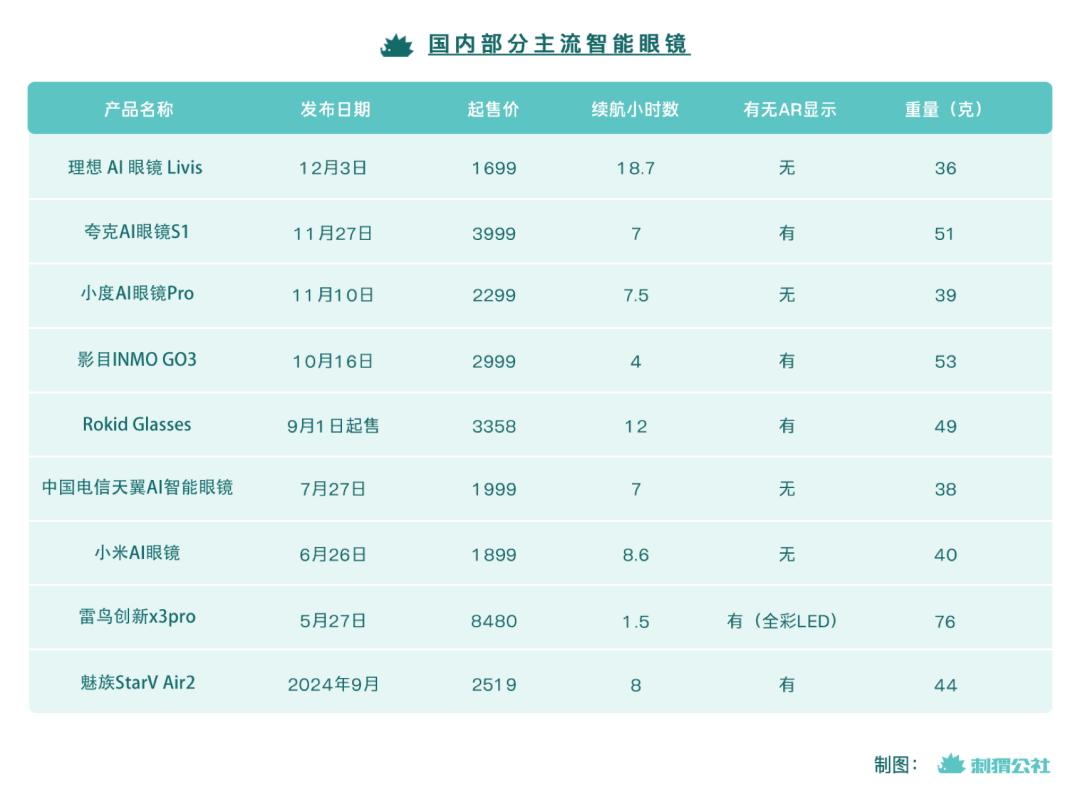
As for the higher Level L5, Ciguangongshe found that among the products launched by mainstream manufacturers, only the Thunderbird Innovation X3pro smart glasses have limited full - color display functions, barely meeting the criteria. However, this product still has a long way to go to reach the ultimate goal of a personal computing center and a portable intelligent assistant. Apart from the price being close to 10,000 yuan, this pair of glasses has much lower battery life than other smart glasses, weighs almost 1.5 - 2 times as much as other smart glasses, and the content that can be displayed in full color is relatively limited.
With the current technology, smart glasses have to make trade - offs among functions, battery life, and weight, and the more functions, the higher the price. Strictly speaking, most smart glasses at this stage are digital "semi - finished products".
The cheaper, the better - selling?
Since the scope of the category is not clear, the shipment volume of smart glasses has become a muddled account, resulting in the strange phenomenon of "everyone being the sales champion". Everyone claims to be the top - selling, and it's even more exaggerated than in the new energy vehicle industry, with no qualifiers in the claim of being the "sales champion".
The Uquark S1 quickly topped the Double Eleven hot - selling list of XR devices on Tmall during the pre - sale period;
Rokid ranked high in the overall sales volume of the whole network category during Double Eleven. Its sales volume on the JD.com channel increased by 1000% year - on - year, the overall growth on all platforms was 800%, and the sales amount exceeded 50 million yuan;
Over 30,000 Xiaomi smart glasses were activated in less than a week, "creating a new sales speed record for Chinese AI glasses".
Thunderbird Innovation retained the first place in the global AR smart glasses market for two consecutive quarters with a 24% market share...
So, is the shipment volume of smart glasses really a muddled account?
IDC data shows that in the third quarter of 2025, the shipment volume of the Chinese smart glasses market was 623,000 units, a year - on - year increase of 62.3%. The shipment volume of audio - video shooting glasses was 454,000 units, a year - on - year increase of 79.2%. The shipment volume of the AR/VR market was 169,000 units, a year - on - year increase of 29.4%.
This data can be verified by the data from the research institution CINNO Research. In the third quarter of 2025, the sales volume of the Chinese consumer - grade AR/VR glasses market reached 169,000 units. However, CINNO Research reported a month - on - month increase of 17% and a year - on - year increase of 57%.
In the statistics of these data institutions, smart glasses without AR functions are often included in audio - video shooting glasses, and glasses with AR functions are calculated together with VR devices.
Since AR and VR devices are calculated together, we have no idea how many smart glasses with AR display functions have been sold. If we calculate based on a 1:1 ratio of AR and VR devices, then in the just - passed third quarter of 2025, the shipment volume of smart glasses with AR functions was less than 100,000 units. Based on the growth rate, it can be further estimated that the annual sales volume of "true smart glasses" above Level L4 as defined by Ciguangongshe is only 250,000 - 350,000 units.
The "complete form" of AR + AI smart glasses is still a minority in the large category of smart glasses in China. In contrast, overseas, Meta's similar product, the Meta Ray - Ban Display with AR display function, which is priced at $799, was widely sought after as soon as it was launched at the end of the third quarter of 2025.
Meta's supplier and partner, the EssilorLuxottica Group, then set a grand goal of "producing 10 million units annually by the end of 2026".
Buy smart glasses two years later?
An optimistic sentiment similar to Meta's pervades the entire smart glasses industry.
For example, IDC predicts that the shipment volume of Chinese smart glasses will exceed 2.9 million units in 2025, a year - on - year increase of over 121%. It seems that smart glasses are on the verge of a big explosion, just waiting for a "Jobs" in the smart glasses industry to bring an "iPhone moment" that will change the entire industry.
However, the recent intensive release of smart glasses by many brands does not mean that this category is mature. Moreover, the real usage demand has far from been established. At this stage, not only will there be no price war like the food - delivery war in the smart glasses industry, but the product strength and usability of each brand determine that most products in this category are still expensive toys to show the user's personality rather than essential devices.

First, catch up with the hardware level of Conan's "suspect - tracking glasses".
First of all, a smart glass that can meet the daily - use standard should have a weight and volume close to that of ordinary glasses. Data shows that due to the bulky appearance, over 70% of current smart glasses are worn less than 3 times a week.
On the one hand, the nose bridge and ears are quite sensitive to weight. If the weight exceeds that of ordinary glasses too much, it will seriously affect the user experience. On the other hand, glasses are an important part of "appearance", and glasses with a lack of design sense are also unacceptable.
Secondly, there is the battery - life problem. In order to pursue the ultimate weight and volume, smart glasses have to reduce the battery capacity. To support continuous one - day use through fast charging, brands like Rokid have launched a capsule battery solution that allows for manual and quick battery replacement. Brands like Li Auto have launched a rechargeable glasses case, similar to a rechargeable wireless earphone case, to be used with smart glasses.
However, these stopgap measures cannot solve the fundamental problem. Imagine, in the busy commuting and working scenarios of office workers, how many people can calmly pick up a capsule battery to replace the one in their glasses?
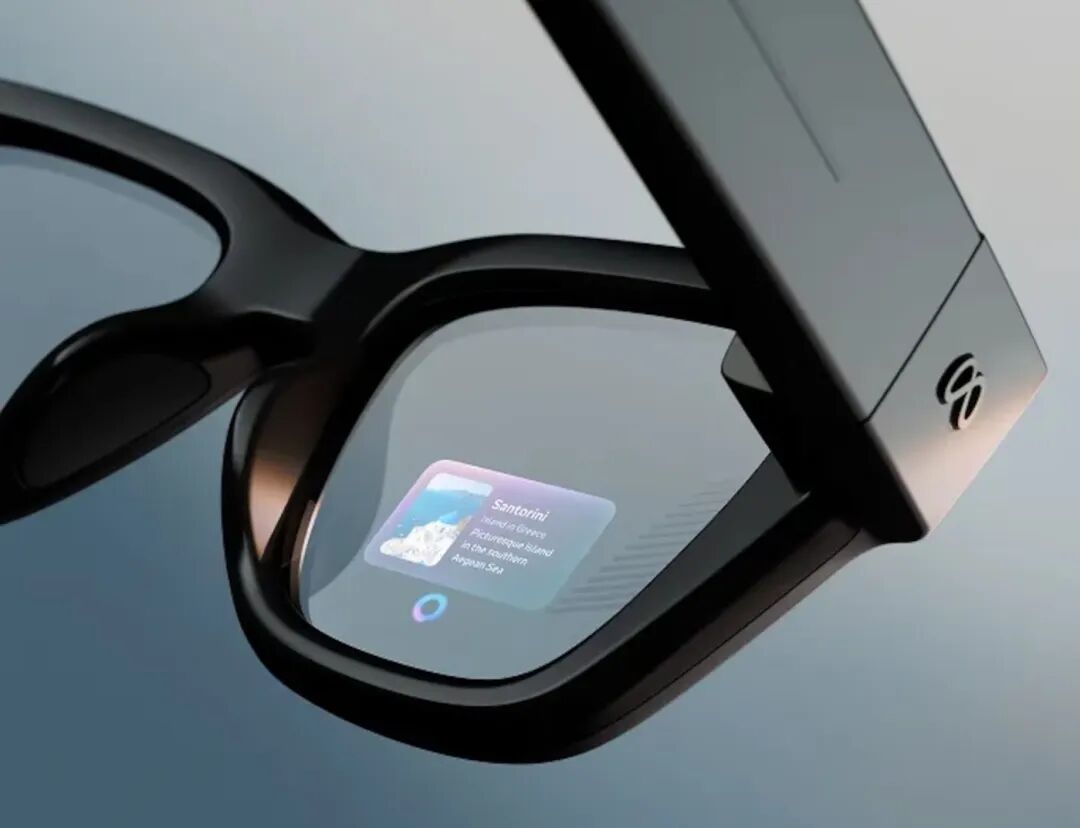
The battery life of the Meta Ray - Ban Display is also average.
Only by overcoming these more fundamental hardware difficulties than AR display and AI dialogue can smart glasses talk about their own "iPhone moment". As for the image - quality problem widely complained about by users on platforms like Xiaohongshu, it's actually easier to solve by increasing hardware specifications. Industry insiders expect that it will take another two years for smart glasses with display functions to truly mature.
For smart glasses brands, serving specific groups, such as car owners or content creators, may be a better choice at this stage.
Li Auto has targeted the 1.5 million users of Li Auto cars for its smart glasses Livis. Instead of trying to break through different circles and become a mass - market product like other brands, Li Auto prefers to have more interactions with its own car owners. The popular Meta Ray - Ban can directly post the taken pictures and videos to Facebook and Instagram and supports live - streaming through the first - person camera on the smart glasses. It has become an essential tool for content creators and can be regarded as exclusive hardware for social platforms.
Developing new products based on existing products and using smart glasses as portable wearable "accessories" for existing products can find more definite usage scenarios for smart glasses and make full use of the existing user base.
From car brands to hardware startups, whether they are Internet giants or network operators, the time point of this "collective entrepreneurship" in smart glasses coincides with the peak of the AI wave. Apart from some startups that have long been deeply involved in AR and smart glasses, most participants want to find a new outlet for their AI capabilities. And wearable hardware is the most intuitive mobile billboard for these outlets.
As long as the AI wave continues, the smart glasses and even the entire smart hardware industry will continue to be dynamic.
References
1. "The Glasses Giant Behind Ray - Ban Meta Thinks It Can Sell Ten Million Units Next Year", GeekPark
2. "Li Xiang's Creation of AI Glasses: A Project That Has Never Been Halted and an Unrevealed Ambition", 21st Century Business Herald
3. "The 'Battle of a Hundred Glasses' Is All Talk and No Action", Yicai Global
This article is from the WeChat official account "Ciguangongshe" (ID: ciweigongshe), author: Yuanzhang, editor: Chen Meixi. Republished by 36Kr with permission.