A report outlines the path for AI towards 2049
In 1765, the UK was in the early stage of the Industrial Revolution. In Birmingham, the center of the revolution, a mysterious organization named the "Lunar Society" was established.
The organization was composed of 14 scientists, inventors, and industrialists, including Watt, who later improved the steam engine, Watt's partner Boulton, and Priestley, who discovered oxygen. It was named the "Lunar Society" because they were used to gathering on Sundays around the full - moon night.

The gathering of the "Lunar Society"
The purpose of the gathering was to build a cross - border communication platform. Before that, scientists were buried in theoretical research, and engineers relied on experience to guide production. There was a lack of effective communication between the two sides.
The emergence of the "Lunar Society" not only provided a platform for ideological exchange but also formed a closed - loop of "production, learning, and research", which directly promoted Watt's improvement of the steam engine and its subsequent commercial implementation. Its influence proves that for scientific discoveries to be transformed into industrial applications, all parties in the academic and industrial circles need to have open communication and close cooperation.
Today, we are also in the early stage of the AI technology explosion. Model iterations are accelerating, and various applications are growing wildly. Behind the bustling scene, the anxiety about monetization and the commercialization dilemma are as thorny as overgrown thorns. All parties are urgently needed to work together to outline the development path.
Technological Visions and Future Scenarios
On December 6th, at the Tengchong Scientists Forum, Yang Yuliang, an academician of the Chinese Academy of Sciences, the former president of Fudan University, and the chairman of the Technological Vision Forum, released the report "Technological Forecast and Future Vision 2049", which is China's first systematic prediction of the future technological prospects.
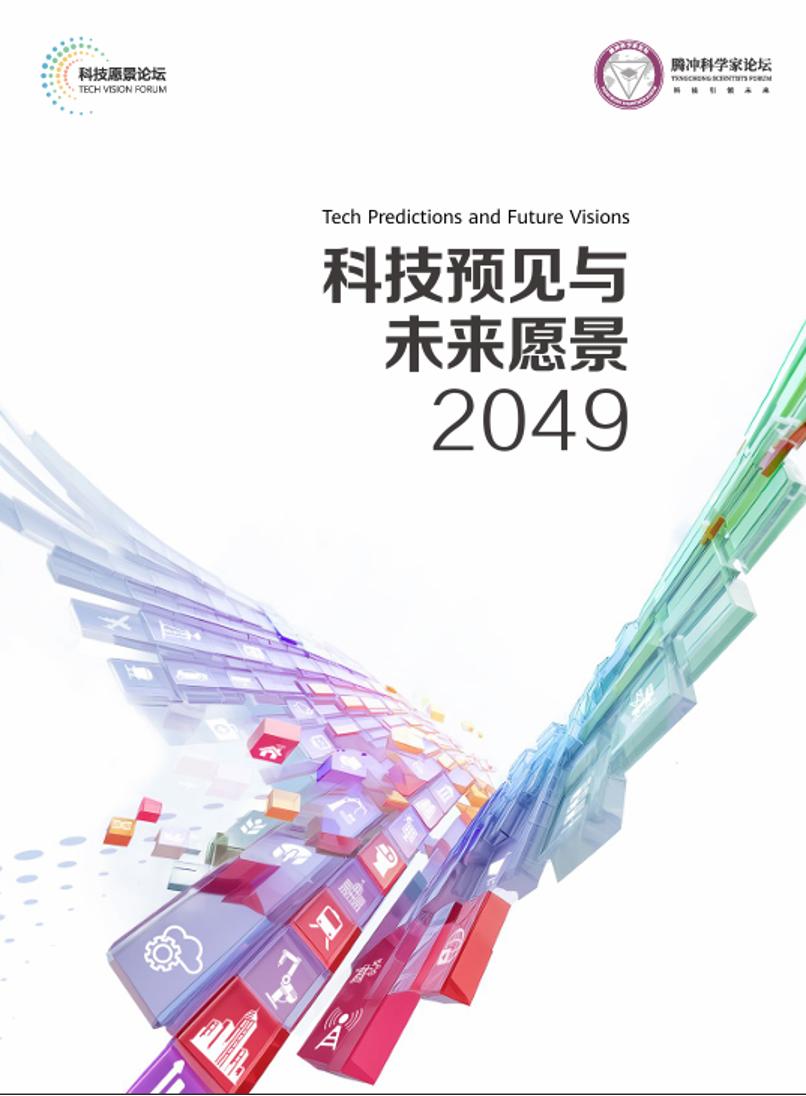
The report "Technological Forecast and Future Vision 2049"
The editorial board is composed of top scientists and industry experts from the Tengchong Scientists Forum Center, Huawei Strategic Research Institute, China Mobile Research Institute, Shanghai Artificial Intelligence Research Institute, Tencent Research Institute, State Power Investment Corporation Innovation Center, etc. Through more than a year of discussions and seminars, they put forward the "Ten Technological Visions" and the "Ten Future Scenarios".
Among them, the "Ten Technological Visions" include human - machine symbiosis, general robots, flying cars, virtual - real symbiosis, quantum computing, intelligent agent internet, room - temperature superconductivity, commercial implementation of controlled nuclear fusion, AI + molecular medicine, and space travel.
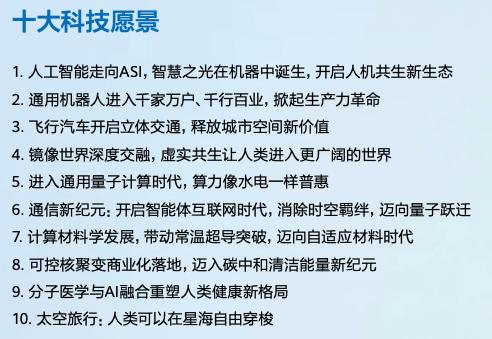
Among these, the intelligent agent internet is one of the visions that is currently happening and is also highly expected by the industry.
The essence of an intelligent agent is to enable AI to actively think, plan, and solve problems based on knowledge by embedding a persistent memory and an iterative learning system. In the future, people don't have to perform every task in their work personally. Instead, they can manage intelligent agents with different "job types" through the intelligent agent network to complete work more efficiently. One person can be like an army of thousands.
The report points out that by 2030, the global number of intelligent agents will exceed 200 billion, and by 2049, the global intelligent agent network nodes will exceed trillions. A single intelligent agent can even distribute multiple capabilities in different places and achieve "seamless" cooperation through network protocols, becoming the "nervous system" for the accelerated integration of the digital world and the physical world.
General robots are currently one of the hottest tracks at home and abroad.
The report points out that for general robots to truly enter people's production and life, they still face five core challenges: lack of data, immature tactile perception, imperfect design of dexterous hands, insufficient motor torque and heat dissipation, and high cost.
The report disassembles these challenges one by one and predicts that problems such as tactile perception, software and hardware design of dexterous hands, motor torque and heat dissipation will be gradually solved before 2030. After 2030, the data flywheel will gradually mature, the hand - operating ability will be greatly improved, and the cost will drop rapidly. Finally, around 2049, general robots will enter thousands of households.
The "Ten Future Scenarios" include life and health, talent education, scientific research, basic livelihood, future transportation, industrial manufacturing, economic and finance, advanced energy, cities and the environment, and space exploration, all of which will undergo great changes under the transformation of AI.
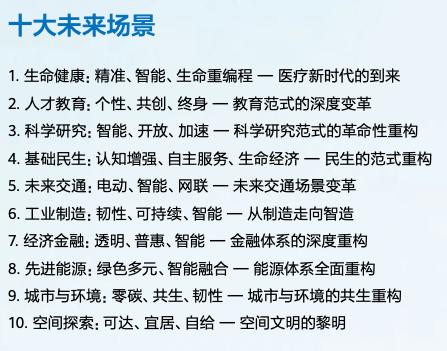
For example, in future transportation, on the one hand, the trend of full - scale autonomous driving is irresistible. It is expected that the trial commercialization of L4 will start by the end of 2027, large - scale application of L4 will be achieved in some scenarios in 2030, L4+ will be achieved in most scenarios in 2035, and L5+ will be fully popularized in 2049.
On the other hand, by equipping with sensors, edge computing nodes, and dynamic signal systems, transportation infrastructure will evolve into an intelligent neural network with self - perception and adjustment capabilities. By 2049, the time loss caused by traffic congestion will be reduced by more than 70%.
At the same time, the travel mode will shift to "mobility as a service". People don't need to own a car. They can call on autonomous taxis, air taxis (eVTOL), high - speed maglev trains, and other three - dimensional transportation tools through a unified platform, thus releasing urban space.
Yang Yuliang described this report as "the first knock on the door of the future". By "giving a very detailed prediction of the future for each specific technological field", it contributes Chinese thinking to the progress of human civilization.
The release of the report clears the current fog for the AI industry and unites the scientific community and the industrial community. They are working together to sail towards the next target of the AI technology wave: application.
Crossing the Gap between Technology and Application
At the beginning of this month, Ren Zhengfei participated in the post - competition symposium of the International Collegiate Programming Contest (ICPC). In the exchange, he said that the ultimate value of AI lies not in invention but in application. "An AI invention can at most make an IT company successful, but application can make a country powerful [1]."
This statement points out the root cause of the current confusion in the industrial circle: the rapid iteration of technology, but the lack of follow - up in application innovation, resulting in a value dilemma.
Currently, the "battle of thousands of models" is still in full swing. Whether it was the release of Deepseek at the beginning of the year or Gemini - 3 a few months ago, they have further increased the speed and intensity of the involution of large models. The iteration frequency has changed from "yearly updates" to "monthly updates" or even "weekly updates". Several new models optimized for specific tasks can be born within a week.
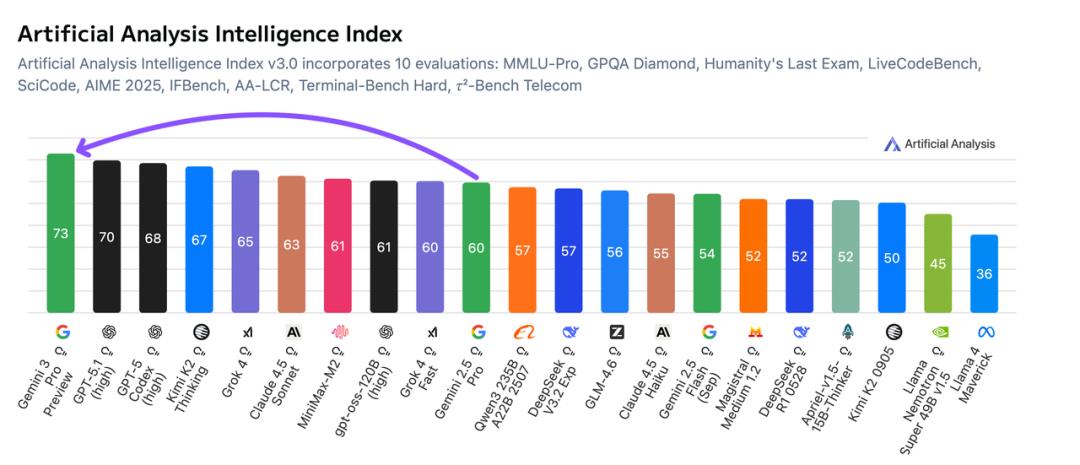
Scores of major models on the ArtificialAnalysis.ai website as of November 18th
At the same time, technological paradigms are constantly making breakthroughs. The context window of large models is expanding from tens of thousands to 200K (about 300,000 Chinese characters), from understanding conversations to being able to process a whole novel or a hundred - page report. In this process, the form of AI has also rapidly evolved from a simple dialogue model to an intelligent agent capable of planning, using tools, and performing multi - modal tasks.
However, compared with the competition on the technology side around "bigger, faster, and stronger", the excitement on the application side is mostly superficial.
According to the latest "2025 AI Report" ("The state of AI in 2025") released by McKinsey, among the nearly 2,000 enterprises and organizations in different industries around the world surveyed, 88% have started using AI technology, but only 36% said it has improved their profitability, and 33% said it has brought substantial revenue growth [2].
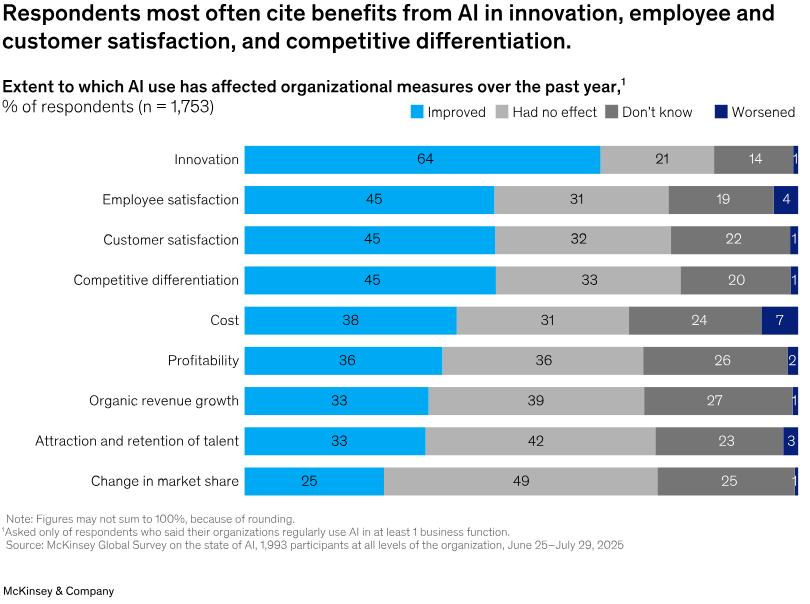
Feedback from surveyed enterprises on the improvement degree of AI at various levels of company business; Source: McKinsey
John Chambers, the former CEO of Cisco, experienced the process of the Internet era from prosperity to decline. In an interview with the media in October, he said that the development speed of AI is five times that of the Internet era. A startup company can develop a product in a month or even a week and then launch it into the market within one or two quarters.
So, how can companies that cannot transform technology into sustainable competitive advantages make profits after investing huge amounts of money? Chambers believes that "given the current speed of market change, you must be able to innovate yourself. However, most CEOs and business leaders don't know how to do this, especially in the field of AI [3]."
The core problem here is that the technology side and the application side operate independently, and there is no effective communication mechanism and cooperation model. As a result, technology iteration and application innovation are out of sync, and the technology path is mismatched with market demand.
A similar embarrassment also occurred in the early development of electric vehicles. They were invented earlier than fuel - powered vehicles and once occupied 38% of the US automobile market share (in 1990) due to advantages such as quietness and easy start - up [4].
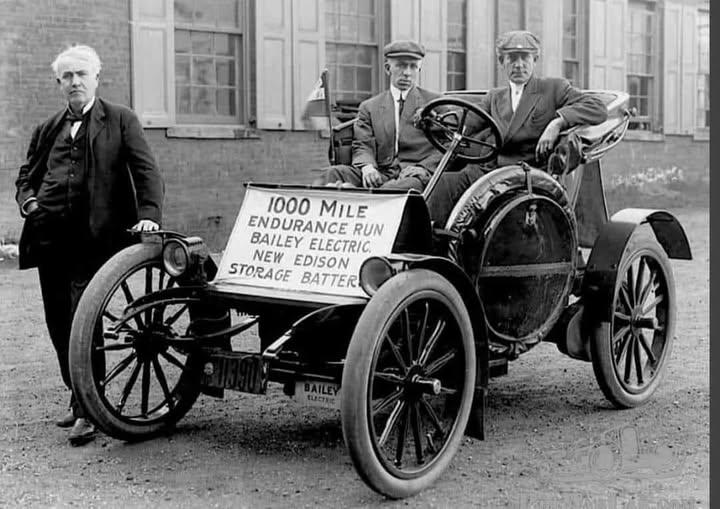
Thomas Edison (left) posing with a 1910 "Bailey Electric" electric vehicle
However, in the 20th century, American society had a greater demand for long - distance and low - cost travel. When Ford's Model T reduced the price of fuel - powered vehicles to $600 through the assembly line (only one - third of the price of electric vehicles at that time) and with the popularization of the gas station network, electric vehicles were quickly eliminated due to their fatal shortcomings in battery life, cost, and charging network.
This shows that if technological advantages are not adapted to the mainstream market demand and infrastructure, they will eventually be abandoned by the market.
The revival of electric vehicles in the past two decades is essentially the result of the systematic adaptation of technology iteration, industrial application, and public demand.
For example, in response to the requirement of long - distance travel, electric vehicle manufacturers represented by Tesla joined hands with battery factories to develop long - range batteries and build charging networks. At the same time, the global battery industry chain has pushed the battery cost down by 90% in ten years. The super - factories that have sprung up everywhere have made electric vehicles accessible to ordinary people.
From scientific principles to industrial scale - up, it has never been a linear process. Confusion is an inevitable stage in the transformation of technological paradigms. Looking back at past technological revolutions, most of them end up the same way.
For any revolutionary technology to go from the laboratory to thousands of households, all parties in the industrial chain need to build bridges around a common goal in multiple dimensions such as technology, products, cost, and infrastructure. These bridges are never formed naturally but are a systematic project that requires active design and difficult construction.
For AI, the perspective should now be expanded from technology iteration to overlooking the entire industrial landscape. A strong collaborative bond and communication channel should be established between technology and application. Only by working together can the benefits of technology effectively improve human well - being.
Epilogue
In 1813, amidst the sounds of war breaking out across Europe, the "Lunar Society" ended its historical mission. From its formation to dissolution, the "Lunar Society" only existed for less than half a century, but its influence on the course of human history continues to this day.
In addition to Watt's successful improvement of the steam engine, among the members of the organization, Priestley discovered oxygen and invented soda water, and Wedgwood promoted the industrialization of pottery manufacturing and triggered the "ceramic revolution". One view is that "it is difficult to find a scientific or technological activity in the 18th century that did not involve members of the Lunar Society."
From the ideological collisions under the moonlight in Birmingham to today's collaborative creation in AI, the force driving historical progress has never changed: only when the top - notch wisdom crosses the barriers and jointly embraces practice can a new - era industrial revolution truly arrive.
References
[1] Ren Zhengfei, the founder of Huawei: The focus of AI is on application, NetEase
[2] The State of AI in 2025, McKinsey
[3] Silicon Valley leader who navigated the internet’s boom and bust sees another wild ride with AI, AP
[4] After more than a hundred years of ups and downs, it can only play a supporting role in the end, Old Car Database
[5] Curiosity Changes the World: The Lunar Society and the British Industrial Revolution, translated by Yang Xiao, written by Jenny Uglow
This article is from the WeChat public account "Yuanchuan Research Institute" (ID: caijingyanjiu), author: He Lüheng, reprinted by 36Kr with authorization.