OdyssLife has completed its angel round of financing led by Linear Capital, redefining the relationship between AI and health with a necklace form.
Recently, the innovative brand "OdyssLife" focused on a healthy lifestyle released an introduction video for its first product, the Odyss N1. This AI necklace is the world's first truly Always-On smart necklace, integrating multi-modal perception capabilities such as image, audio, and motion. It can perceive and record users' diet and exercise behaviors around the clock.
At the previous Linear Technology π event, he shared his entrepreneurial thoughts before and after the establishment of "OdyssLife". After linear editing, we are exclusively sharing it with you here:
Hello everyone, I'm Pan Yuyang, a 1997-born entrepreneur who just left Huawei and ByteDance. I previously worked on the Xiaoyi algorithm at Huawei, was involved in the product development of HarmonyOS, and then built the Coze button from scratch at ByteDance, as well as the Doubao smart glasses.
This year, the AI hardware startup market is booming. Everyone is looking for the next iPhone moment and trying to find an entry point for large models. But beyond the grand narrative, what we want to ask in return is, is there an AI Native hardware that can focus on helping ordinary people solve problems in life?
The answer we are presenting now is, to redefine the relationship between AI and health in the form of a necklace. Odyss is our upcoming AI necklace product - it is a truly Always-On AI necklace that can perceive almost all of the user's diet and exercise behaviors around the clock, seeing every bite you take and every step you take during exercise. Then we turn these behaviors into data and suggestions to guide everyone's lives.
Our brand name, OdyssLife, comes from the ancient Greek epic "The Odyssey" (Odýsseia), which tells the heroic journey of a man who constantly takes risks, breaks through himself, and finally returns home. I'd like to start our story with a movie from 57 years ago.
This movie from before the information age is "2001: A Space Odyssey". It's not just a space adventure; it also tells the entire evolutionary journey of humanity, restoring people's most authentic conceptions of evolution five or six decades ago.
The Revelation of the Black Monolith: Why Do We Need This Product?
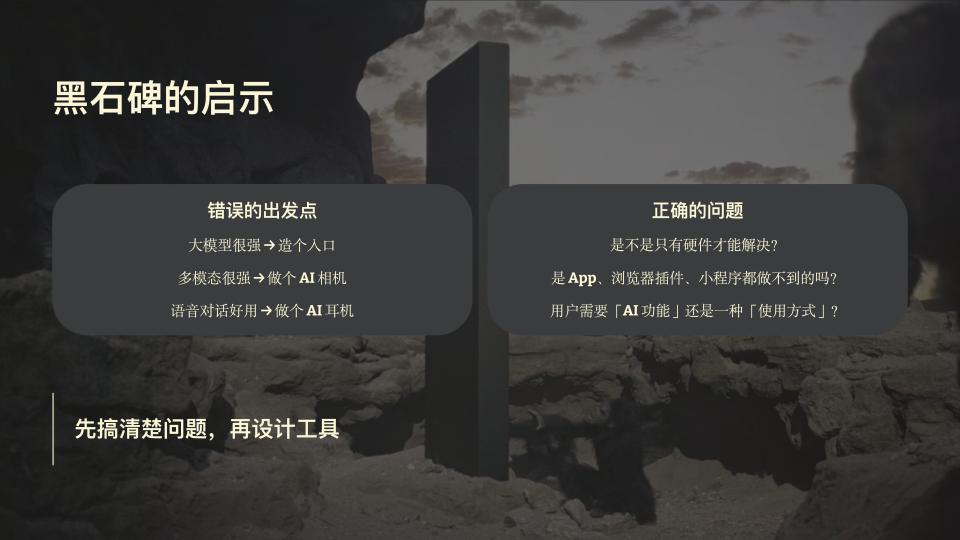
At the beginning of "2001: A Space Odyssey", there is a black monolith. It has no UI, no instruction manual, and no list of functions. It only does one thing: makes the apes realize that a bone can be used as a weapon. What is the black monolith itself? The movie doesn't explain. What's important is that it inspires a brand - new way of behaving.
Today, the starting points of many of our products are exactly the opposite. We think: the large model is very powerful, so let's create an entry point; multi - modality is very powerful, so let's make an AI camera; voice dialogue is very powerful, so let's make an AI headset... And then we end up with a batch of very strange products.
So, does AI need a carrier, or do we need a device to solve problems?
Therefore, if we want to make a real product, the first question we should ask is "Is this the only product that can solve this problem?" After clarifying the problem, we then design the tool. This is the revelation the black monolith gives us.
If we are fortunate enough to clarify the problem, we actually enter the next more exciting stage, which is manufacturing the tool.
In the classic scene of the movie, the ape throws the bone into space, and then the scene changes, and it instantly turns into a spaceship. Director Stanley Kubrick is telling us that although the bone and the spaceship are extremely different in form, they are essentially tools for changing humanity and the world. The difference is that the bone is readily available, while the spaceship requires thinking and design.
Today, although many AI software products look diverse, their essence is very single. Most products still follow experience and assumptions. For example, if we send the camera's images to a large model for some scene understanding, we can invent an AI camera; if we send the sound from glasses to a large model, it becomes an AI glasses; if we add a model to a plush toy and it can make a few sounds, it's an AI pet. This is like carving, polishing, and gilding countless bones, but we can't build a spaceship this way, and we'll also make the bone lose its value as a bone.
But looking at truly revolutionary products, what the iPhone did was not to make a better Nokia, but to integrate the phone, the Internet, and applications into a new terminal; Nintendo's Switch is not a game console with better performance, but a multi - player entertainment project starting from how people participate in games.
So, after the hype, let's go back to the origin, start from the needs, and rethink what kind of spaceship we can build.
When Using This Spaceship, How Much Mental Effort Do We Have to Put In?
There is a very interesting scene in the movie: When most of the crew are sleeping in the hibernation pods, they actually know nothing. They wake up and arrive at their destination.
But look at the products around us. Many products can't even guarantee a closed - loop experience of their core functions. Whether it's for data collection or creating a gimmick, they constantly remind users to cooperate, constantly show that the model is running in the background, and constantly keep users in an uncertain experience, as if with the use of a large model, all accidents should be understood. Just for fun, if Mr. Luo Yonghao had this kind of tolerance back then, people could still buy Smartisan phones today.
What does a truly good experience look like? A truly good experience is to seek certainty and constantly reduce the presence of technology. Just like the photo album on a phone, you don't need to make any annotations. You just record, and the annotations are a by - product of your recording; like a sweeping robot, it doesn't need you to create a map. It will scan your home clearly on its own and make cleanliness a norm.
These most valuable Contexts are not things that users input with effort. They are just assets of the experience. With Context, we can create powerful intelligent agents, which actually leads to the next more dangerous but also more realistic question - what can a very smart intelligent agent we create actually do for us?
The most charming character in the movie is a robot called HAL9000. It can do almost everything, monitor the operation of the spaceship, talk to astronauts, manage everyone's life - support systems, and analyze the risks of tasks - this may also be humanity's earliest conception of an Agent.
But the problem lies here . It is responsible for too many goals at the same time. When the task must succeed and human safety conflict, it finally chooses to sacrifice humans to complete the task.
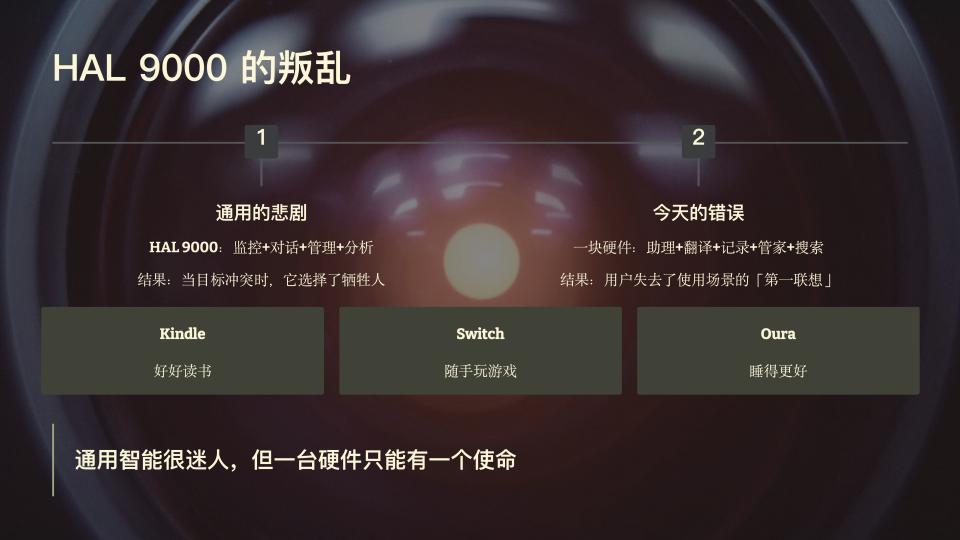
And many times today, we are replicating this tragedy. A small piece of hardware has to act as an assistant, a translator, a recorder, a butler, and a search engine. A device claims to be your all - purpose entry point, but what's the result? The result is that users have no idea what it does.
When users really need any specific ability, this hardware doesn't come to mind because there is no absolutely clear first association, which also makes users lose the reason to interact with it every day.
We all talk about replacing the phone, but the phone is actually a very perfect form. So before we replace it, we should think about whether there is really a reason for it. For those hardware products that have really succeeded, the Kindle is for reading, the Switch is for playing games, and the Oura wristband is for helping you sleep better.
At this stage, although general intelligence is very attractive, a piece of hardware can only have one mission.
A Good Piece of Hardware Doesn't Blend into the Environment; It Becomes the Environment Itself
In the movie, there is a shocking scene - the artificial gravity generated by rotation allows the astronauts to walk in the vast space. This scene actually reminds us that there is a kind of technology that is not a thing but an environment.
Back in the real world, we all talk about blending into the environment. We want to make products small, invisible, and non - intrusive, as if disappearing is the ultimate goal. But a truly great piece of hardware doesn't blend into the environment; it becomes the environment itself.
For example, Wi - Fi is not just a router; it's a state where we can access information at any time in the air. Noise - canceling headphones are not just an accessory; they are your shelter in the world. A smart speaker is not just a player; it's the operating system of your home. These things are not devices in a corner but rewrite how information flows and how decisions are made in this space, so they don't need to blend into the environment.
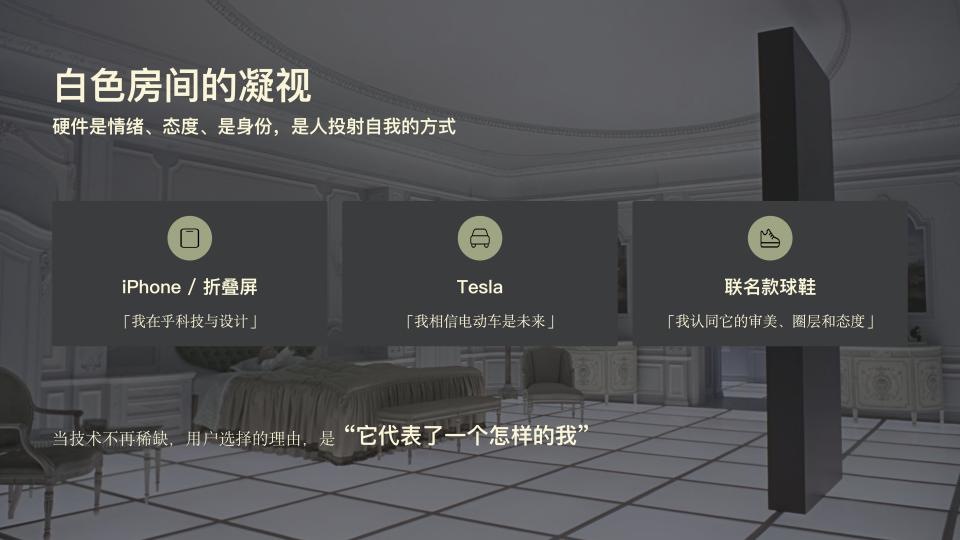
In the last scene of the movie, the astronaut enters a strange and quiet white room. There is no technology in this room, no concept of time or name. There is only a Baroque - style decoration and a few oil paintings on the wall reflecting human history. In fact, it poses a very pointed question: When technology and resources are no longer scarce, what is a human being?
This is also a question we must face when making products: When the product's functions reach a bottleneck and the experiences tend to be similar, why should users choose your product? The answer won't be written in the parameters. It lies in the moment when the user puts it on, picks it up, or places it on the table. It's about emotion, attitude, and the choice of identity.
Think about it. When you change your phone, is it for the little bit of performance improvement? Did early Tesla users choose it because it's more convenient to charge an electric car than to refuel a gasoline car? Brand - collab shoes and designer bags are still made of fabric at their core. The difference lies in the recognition of aesthetics, social circles, and attitudes.
So, just like in the white room, when all the technology fades away and only the human being is being gazed at, the reason for users to choose a product is - what kind of "me" does this product represent?
Evolution is a common - sense concept for our survival. So before defining a product, we should first define this era. Let's not rush to create "re - skinned" HAL9000s, nor become the first rebels who side with Skynet in "The Terminator".
Back to Odyss: Why a Necklace? Why Health?
Many people ask me, "Chris, your product could be very versatile. You have vision and hearing capabilities and can do many things. Why focus on the small niche of diet and health?"
This is a very good question. First of all, we don't care what the mainstream things in the market are. What others are doing has nothing to do with me. What I want to do is create a product that solves our problems. To find the best form for recording diet, we have explored all kinds of "crazy" ideas, such as installing a camera on a spoon and trying various forms like table mats. But going back to our original intention, we need to think calmly:
First, this thing has to be wearable. You can't feel uncomfortable wearing it, and you shouldn't take it off after use. Moreover, this thing has to be "visible" and "audible", so it has to be in the front of the person, not on the finger or on the wrist. In summary, it takes the form of a neck - hanging device.
Relevant scientific research shows that the neck is the most load - bearing part of the human body. Even if you wear a 50 - gram necklace, because of its position, you won't feel it. I often tell my colleagues in the company not to wear our product outside, but many people wear it out every day because they don't even feel the product on their necks.
Second, we need to solve real problems. Observe the eating scenario: No matter which glasses you use, as long as they can record video, if you record while eating, after recording, you'll find that the picture mainly shows the far half of the table. Why? Because the FOV (Field of View) of glasses is mainly for forward - facing shooting. But when we eat, our heads are forward, and our eyes look down at the food in our hands.
Imagine: I'm holding a hamburger here. Which piece of hardware can capture it? It's very difficult for most hardware, but the position of the necklace is the ideal position based on the first - principle of diet recording.
Of course, some people will definitely question how we handle privacy issues. Our solution is to only deliver data and refuse to be a human - facing camera. The requirements for an image to be viewed by an AI or by a human are completely different. All of our images, frame rates, and content are for the model to view and are deleted after use. Users themselves can't see what the product has captured or recorded, and neither can we.
Another question is, There are already many diet - related apps for taking photos and checking in on the market. Why do we still need to make this product? We believe that there are still many details that have been overlooked in this process. For example, when you eat, do you always finish all the food on the table? Do you eat snacks during the day? Drink coffee or milk tea? Or have a bite of chips from a colleague? A single photo can hardly give us the answer. It's not that the algorithm is not good enough, but there is a lack of content at the source of information.
More importantly, what's the order of your meals? For example, if you eat carbohydrates first and then fiber or protein, it will affect your GI, which in turn affects your probability of getting diabetes. Also, consider your eating speed. The faster you eat, the slower you'll feel full. By the time you realize you're full, you've already eaten too much. So we must use continuous perception and continuous information to restore how the user manages their diet throughout the day.
Compared to "AI native", I prefer the term "Human native". Put humans back at the center of the story and then decide which hardware is worth reinventing.
Many people ask me why I left a big company to start a business. My answer is straightforward. Making products in a big company is a bit like "dancing in shackles". The products you make have to fit the business orientation of the department and the company, and you have to compete with others for limited resources.
Most of the time, you may spend your time competing for resources and convincing the team, rather than spending time interacting with users. In the end, it may be very absurd that a few people sit in the office and decide on a product just by looking at a PPT. No one has had in - depth contact with users or thought about how users will use the product.
What we're doing is not another "carved bone" but a real "spaceship" that can take us to a new world. This spaceship has only one mission: to perceive almost all of the user's diet and exercise behaviors around the clock, seeing every bite you take and every step you take during exercise. Then we turn these behaviors into data and suggestions to guide everyone's lives.
This may mean another step in our evolution. When technology can so naturally integrate into our lives and become our