With the dual boost of robotics and commercial spaceflight, another technology track is quietly gaining momentum.
When the Zhuque-3 rocket soars into space with its 3D-printed core components, and when the bionic joints of XPeng's IRON humanoid robot achieve mass production and delivery through 3D printing, this technology, once confined to laboratories, has now truly become the "core productive force" supporting high-end manufacturing.
Good news from the industrial side keeps pouring in. Kuaizao Technology secured hundreds of millions of yuan in Series B financing from Hillhouse Capital, and Creality 3D is sprinting to become the "first consumer-grade 3D printing stock on the Hong Kong Stock Exchange." With technological breakthroughs, a full-blown explosion of application scenarios, and the support of capital, this multi-billion-yuan market has clearly reached a critical juncture for a major breakthrough.
01 The Market is Expanding, and Domestic Manufacturers are Gaining Momentum
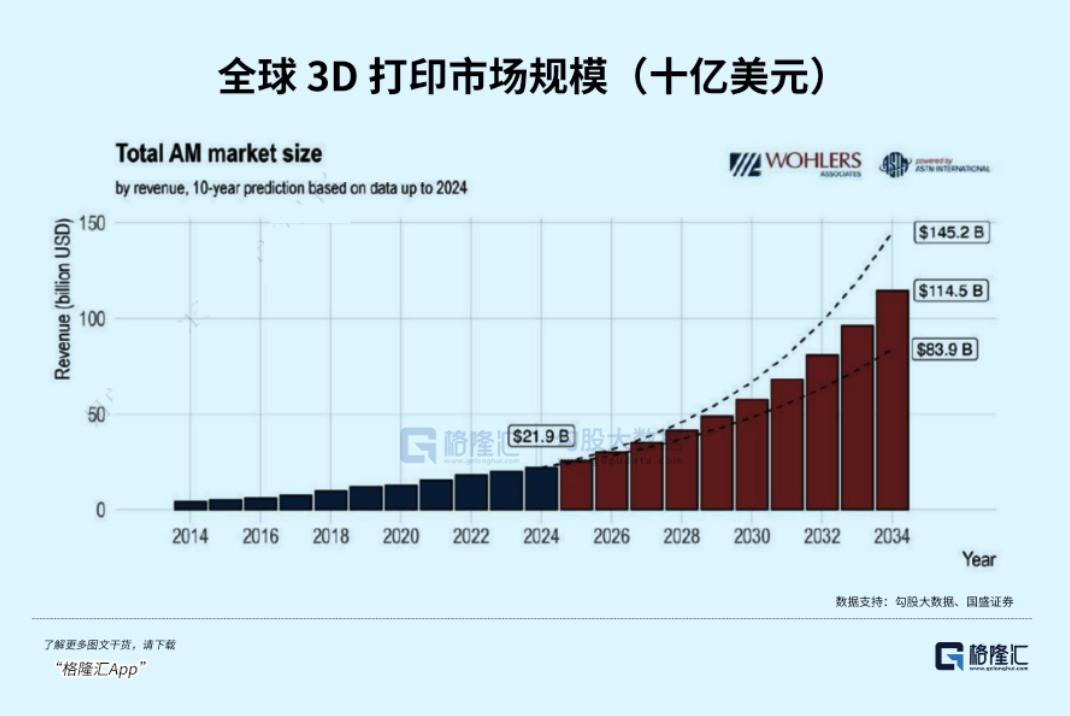
The global 3D printing industry has long bid farewell to the stage of modest growth and entered a new era of large-scale expansion. According to WOHLERS' statistics, the global market size reached $21.9 billion in 2024. Under a neutral forecast, it is expected to grow to $114.5 billion by 2034.
As a major manufacturing country, Chinese manufacturers have captured over 90% of the global entry-level device market, thanks to their high cost-performance ratio and rapid technological iteration capabilities. They are the absolute dominant players.
Data from the General Administration of Customs shows that 3.7777 million units of 3D printing equipment were exported from China in 2024, with an export value of 8.9 billion yuan. In the first three quarters of 2025, the export volume reached 3.491 million units, almost approaching the level of the whole of last year.
According to industry practice, the fourth quarter is the peak season for exports. Therefore, the annual export volume in 2025 is likely to exceed 5 million units, and the export value is also expected to reach the 10 billion yuan mark for the first time.
The continuous breakthroughs in domestic production rates have also enabled Chinese enterprises to gain a foothold in the mid- to high-end market. Currently, the domestic production rate of metal 3D printing equipment has increased from less than 30% five years ago to 60%, and the local supply chain coverage rate of non-metallic materials has exceeded 85%, an increase of over 20 percentage points compared to 2023.
For example, BLT's SLM metal printers and Farsoon Technologies' multi-laser equipment have performance comparable to that of European and American products but are priced 30% lower. They have successfully entered the supply chains of aerospace and new energy vehicle manufacturers.
The government has also provided a lot of support. The Ministry of Commerce has included desktop 3D printing equipment in the key subsidy scope of "digital product consumption." Guangdong Province aims to exceed 180 billion yuan in industrial scale by 2025, and Jiangsu Province has established a 1 billion yuan industrial fund. These policy dividends are continuously lowering the application threshold of the industry.
02 Technology is Improving, and Application Scenarios are Flourishing
Technological breakthroughs are the key for 3D printing to move from a "niche" to a "mass" market.
In the industrial-grade field, the precision of SLM metal printing has exceeded 0.01 mm, meeting the manufacturing requirements for precision components of aerospace engines. Key progress has also been made in carbon fiber 3D printing. The printed components have strength comparable to that of steel but weigh only 1/4.5 of steel, and their tensile strength has increased by 84.6%. They are particularly suitable for the lightweight requirements of aerospace and new energy vehicles.
Technological upgrades in the consumer-grade field have accelerated the popularization of 3D printing. AI modeling technology can "generate 3D models with a single click based on text descriptions or images." Creality 3D's intelligent slicing system allows the equipment to be "ready to use right out of the box," completely solving the problems of "complex operation and difficult learning" of traditional equipment.
Meanwhile, the printing efficiency has increased by five times compared to three years ago. A delicate figurine that used to take several hours to print can now be completed in just a few dozen minutes. The price of entry-level equipment has dropped from 3,000 yuan to less than 1,000 yuan, a decrease of 60%, making it accessible to ordinary consumers and small and medium-sized enterprises.
The improvement of the material system and the reduction in costs have further expanded the application boundaries. The price of titanium alloy powder, the core material for metal printing, has dropped from 600 yuan per kilogram in 2023 to less than 300 yuan per kilogram, a halving in just two years.
The full-blown explosion of application scenarios has become the "strongest engine" for the industry's growth, with humanoid robots and commercial aerospace standing out. The joints and skeletons of humanoid robots require "lightweight, high precision, and customization," which 3D printing technology can perfectly meet. As companies like Tesla and XPeng continue to launch new products, the relevant demand is sure to increase continuously.
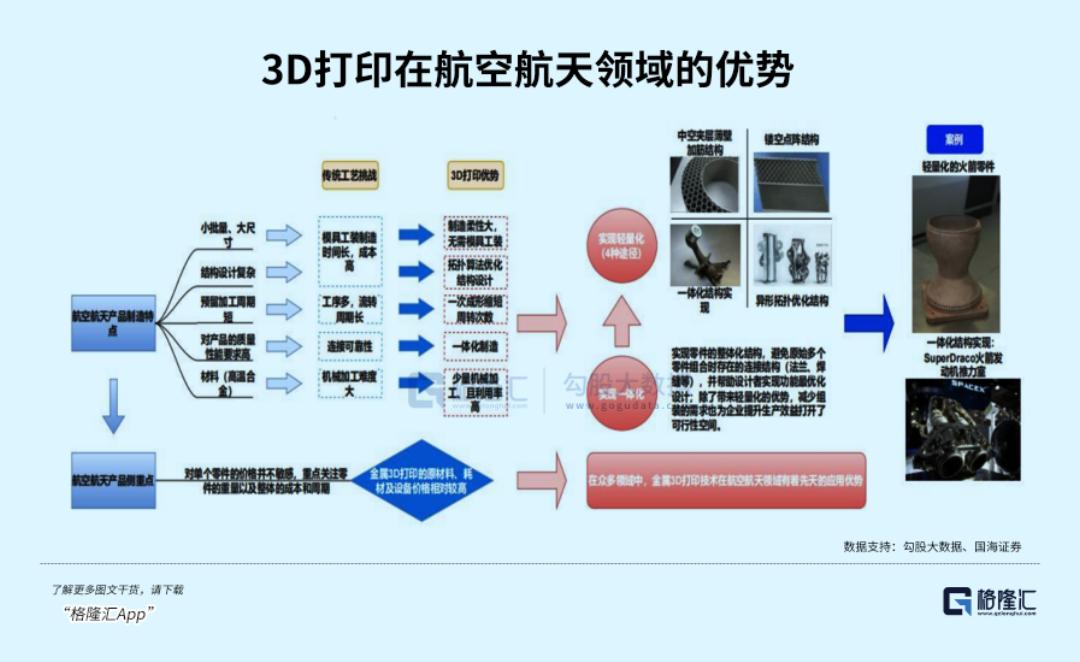
In the field of commercial aerospace, 3D printing is truly a "magic tool for cost reduction and efficiency improvement." Traditional rocket engines require thousands of parts for assembly, while the integrated molding technology of 3D printing can reduce the number of parts by 80%, directly reducing the cost by 90% and shortening the production cycle from six months to one month.
85% of the components of SpaceX's Raptor engine are 3D printed. The core components of China's Zhuque-3 rocket are manufactured by BLT and have successfully entered orbit, reducing the single-satellite manufacturing cost by 150,000 yuan. One rocket can drive equipment demand worth 10 - 15 million yuan.
In addition, 3D printing has penetrated into more people's livelihood fields. During JD.com's 618 promotion, the transaction volume of categories such as 3D-printed trendy toys and customized furniture increased by more than three times year-on-year, indicating a full awakening of consumer demand.
03 Gold Rush Directions: Seize Core Opportunities with Three Main Lines
2025 is the starting year of "order implementation and capital acceleration" for 3D printing. In 2026, there will be a triple resonance of "technological dividends, scenario explosion, and globalization." The growth logic of the industry is very clear.
For investors, grasping the following three main lines can help them accurately position themselves for industry opportunities:
Core Equipment Main Line: Dual-Driven by Industry and Consumption
Equipment is the foundation of the industry and will directly benefit from the growth in demand across all scenarios. In the industrial-grade field, BLT, as the leading enterprise in commercial aerospace metal printing, has a market share of over 40%. Farsoon Technologies' multi-material compatible equipment has entered the supply chains of BYD and CATL, and its technical strength has been recognized by the industrial side.
In the consumer-grade field, Creality 3D ranks first with a global market share of 39% and is sprinting for an IPO on the Hong Kong Stock Exchange. Tuozhu Technology has achieved high premiums through its independent website DTC model, and the number of users on its ecological platform has exceeded 10 million, showing great growth potential.
Core Materials Main Line: The Core Carrier of Domestic Production Dividends
Materials are like the "blood" of 3D printing, and there is still a lot of room for improvement in the domestic production rate. In the field of carbon fiber composite materials, AVIC Metmat's titanium alloy powder has performance close to the international level and is supplied to core customers such as China Aerospace Science and Technology Corporation and BLT. The price of Youyan Powder Materials' titanium alloy powder is only 60% of that of imported products, showing obvious cost-performance advantages. In the field of ceramic materials, CCTC's zirconia powder is used for dental printing and has the highest domestic market share.
Emerging Application Main Line: Direct Beneficiaries of Incremental Scenarios
Enterprises at the application end will directly receive the explosion of terminal demand and have strong growth flexibility. In the field of humanoid robots, Lizhong Group has landed a 75 million yuan structural parts order and has great potential to expand its customer base in the future. In the field of commercial aerospace, Yinbang Co., Ltd. is deeply involved in the "Liangxi Constellation" project and provides key printed parts for rockets.
04 Conclusion
From consumer printers priced at a few thousand yuan entering thousands of households to 3D-printed components helping rockets soar into space and robots achieve mass production, 3D printing technology has completed its transformation from a "concept" to a "reality" and has become the core carrier of new-quality productive forces.
Chinese enterprises not only monopolize the global consumer-grade market but also break the monopoly of overseas giants in the industrial-grade field. Driven by both exports and domestic production, the structural opportunities in this industry deserve close attention.
For investors, now is a critical period to lock in core targets and grasp long-term value. We will continuously track the entire 3D printing industry chain, not only focusing on equipment technology iteration and material cost breakthroughs but also exploring potential investment opportunities from multiple dimensions such as the global competitive landscape, the pace of domestic substitution, and the progress of scenario implementation.
This article is from the WeChat official account “Gelonghui Financial Hotspots” (ID: glh_finance). The author is the editor of Gelonghui.