Doubao mobile phones are being restocked for a limited-time sale. There were previous reports that the company was summoned by regulators. A person familiar with the matter said: "It wasn't a summons; it was just a small-scale industry exchange."
The Doubao phone, which quickly gained popularity due to its AI takeover function, has once again opened a small number of purchase qualifications. Previously, it was involved in rumors of being "surrounded" by mainstream apps and being interviewed by regulators.
On December 16th, ZTE Mall quietly opened the waiting list channel for the F-code (F-code comes from the English word "Friend" and is a voucher for priority purchase rights provided by mobile phone brands to core users) of the Doubao AI phone, restoring limited purchase qualifications.
Meanwhile, reporters from Time Weekly noticed that on the second-hand trading platform Xianyu, the highest asking price for the Doubao AI phone has reached the astonishing sky-high price of "1 million yuan per unit".
This phone, jointly launched by ByteDance and ZTE and equipped with the Doubao Assistant, features the "AI proxy" function: users only need to give instructions to the AI assistant, and it can automatically open apps, search for products, complete orders, and even play Honor of Kings on behalf of users, send messages, and swipe videos.
Since its launch on December 1st, the Doubao AI phone has triggered a market rush. The model with an original price of 3,499 yuan has been speculated to tens of thousands of yuan in the second-hand market. It can be said that "one phone is hard to find, and there is a price but no market."
However, just three days after its launch, the Doubao AI phone was "surrounded" by mainstream apps such as WeChat, Meituan, and Alipay. On December 3rd, apps such as WeChat and Alipay successively restricted the operation permissions of the Doubao phone assistant, and users were unable to use the phone to call relevant apps to complete operations.
When reporters from Time Weekly tested the Doubao AI phone on December 16th, they found that the phone assistant could no longer perform operations such as sending WeChat messages, sending red envelopes, and ordering takeaways on Meituan. The system prompted "Unable to execute." Only a small number of apps such as JD.com can currently accept calls and achieve autonomous takeaway ordering and other operations.
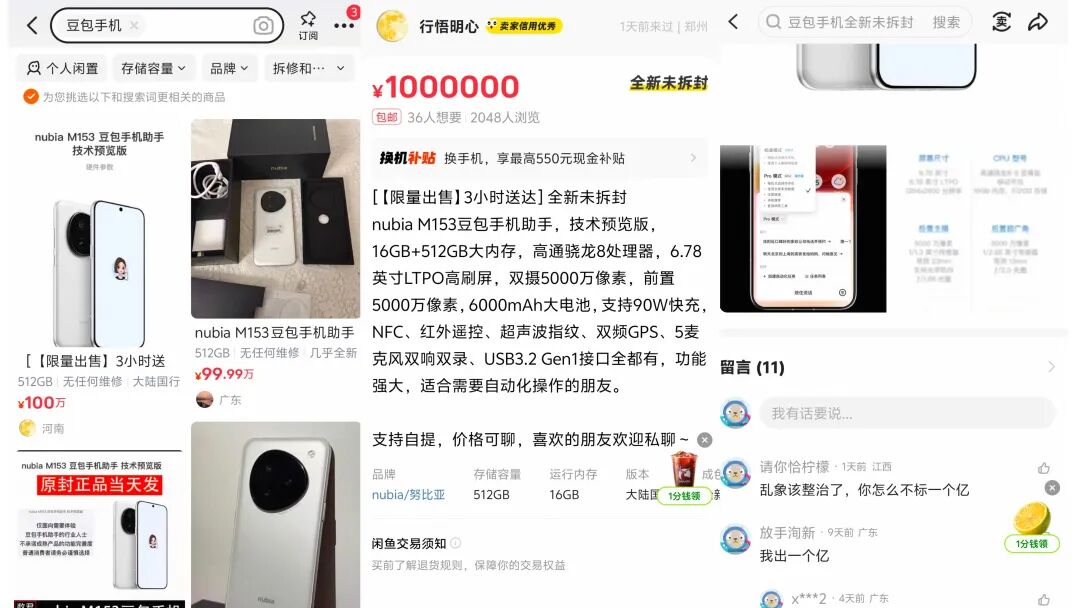
△Source: Screenshot by Time Weekly reporter from Xianyu
The Beginning and End of the Surrounding: App's "High-Risk" Judgment
In fact, the operation of the phone by the AI assistant is not unique to the Doubao AI phone.
Since 2024, mobile phone manufacturers such as Honor, OPPO, vivo, and Xiaomi have successively released AI phones equipped with AI functions and launched their own exclusive AI phone assistants. For example, vivo has Blue Heart Xiao V, Huawei has Xiaoyi, and Xiaomi has Xiaoai Classmate.
In November 2024, Zhipu AI demonstrated the updated intelligent agent AutoGLM capabilities at an open day. Its main functions include "adapting to eight major apps such as WeChat and Taobao." Zhang Peng, the founder and CEO of Zhipu, even directly let AutoGLM call WeChat on-site to send 100 WeChat red envelopes.
So far, the autonomous operation of certain apps or the calling of functions by AI intelligent agents has almost become a fixed program at mobile phone press conferences. However, against the background of the widespread popularity of mobile phone AI functions, the fundamental reason why the Doubao AI phone was "surrounded" is that it has system-level AI calling permissions, which has raised high vigilance among platform providers such as Tencent and Alibaba.
After the launch of the Doubao AI phone, mainstream apps such as WeChat and Alipay quickly responded and restricted the operation permissions of the Doubao phone assistant. Many users found that when using the Doubao Assistant, WeChat would force them to log out.
Article 8.2 of the "Tencent WeChat Software License and Service Agreement" clearly states: "Users shall not log in to or use WeChat and its services through third-party software, plug-ins, cheats, or systems not developed or authorized by Tencent, or perform automated operations." This means that WeChat has determined the automated operations of the Doubao phone assistant as "cheating" behavior.
ByteDance quickly responded and issued a statement on December 3rd: The Doubao phone assistant will not replace users in relevant authorization and sensitive operations. In addition, it emphasized that there is no hacking behavior during the autonomous operation of WeChat. However, it did not respond to the reason for being blocked by WeChat, whether the function can be restored, and the estimated time.
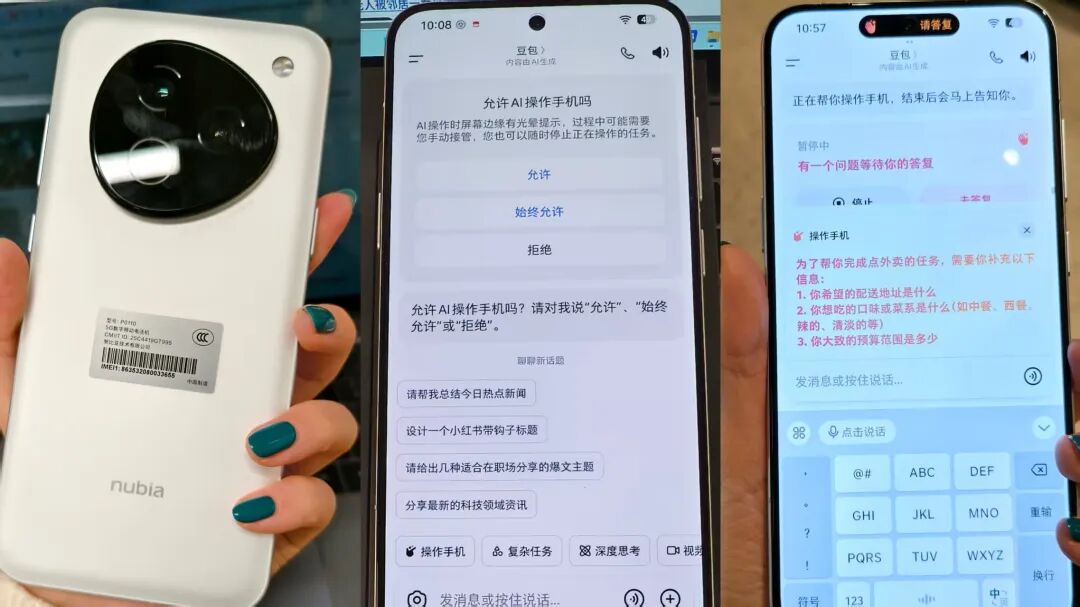
△Testing the Doubao AI phone, Source: Photo taken by Time Weekly reporter
The Doubao AI phone is not the only one whose WeChat calling is restricted. On December 16th, when reporters from Time Weekly tried to give the instruction "Help me send a WeChat message or text message to XXX" to vivo's AI phone assistant Blue Heart Xiao V, the responses were all "This function depends on third-party apps. We are actively communicating with third-party apps to promote function adaptation. We apologize for the inconvenience caused." Currently, this phone can also only call a small number of apps such as JD.com, Pinduoduo, and Dianping.
After the start of this App permission confrontation, the Doubao phone assistant has issued multiple statements.
The Doubao phone assistant said: "In some scenarios, we have made some standardized adjustments to the AI's ability to operate the phone." It also emphasized that during the process of user-authorized operations, there is no system permission to directly skip authentication links such as passwords and face recognition. The Doubao phone assistant uses the system's native screenshot interface and cannot take screenshots of protected content such as bank keyboards.
On December 13th, there were market rumors that ByteDance was interviewed by regulatory authorities due to issues such as network security. In response, a person close to ByteDance who is familiar with the situation refuted the rumor to reporters from Time Weekly, saying that "it was not an interview, but just a small-scale industry exchange."
Different from the previous hot purchasing scene, this time only a small number of places are open and there is no production expansion plan. Priority is given to enthusiasts who have not purchased the phone. Users who have purchased, abandoned the purchase, or returned the phone cannot apply repeatedly. There is no guarantee that those on the waiting list will get the F-code.
△Source: AI image made by Time Weekly reporter
Compliance Pain Points: Concerns about AI Phone Out-of-Control
Compared with the previous sales strategy of the Doubao AI phone, the rules for restarting the F-code waiting list this time are obviously more cautious.
Previously, the Doubao AI phone was sold in a limited quantity using the F-code model. The limited quantity led to extremely high premiums in the second-hand market. Now, the strategy of only opening a small number of places and having no production expansion plan may indicate that the manufacturer has realized the compliance risks of system-level AI permissions and is adopting a "small-step forward" strategy.
Currently, ByteDance's exploration in the field of AI phones is facing dual challenges of technological innovation and compliance with the existing application ecosystem. The incident of the Doubao AI phone being "surrounded" reflects the core compliance pain points of end-side AI in cross-application permissions.
"The original intention of the barrier-free permission was to assist people with disabilities (such as providing screen-reading functions for the visually impaired) and the elderly (such as providing anti-mistouch functions). However, with the iteration of technology, this permission has evolved into a global control tool for AI agents, enabling cross-App reading and operation." Peng Gen, the general manager of Hanhua Feitian Information Security Technology Co., Ltd., told reporters from Time Weekly.
However, the abuse of this permission may enable the AI assistant to bypass the sandbox isolation mechanisms of apps such as WeChat and Taobao and read sensitive content such as chat records, verification codes, and bank card information, similar to opening a "God's-eye view."
Tian Junwei, a lawyer from Shandong Nayuan Law Firm, pointed out to reporters from Time Weekly: "The abuse of AI permissions will give rise to two core risks: payment security risks and personal privacy leakage."
Facing the "surrounding" of the Doubao AI phone, the industry is exploring a balanced path between technological innovation and ecological compatibility.
"The one-step implementation of the Doubao phone assistant has made users gradually abandon the review of permissions." Wang Lei, a professor at Beijing Institute of Technology, said. "In the AI era, the principle of minimum necessity is facing challenges."
Gao Limei, a lecturer at the School of Civil, Commercial and Economic Law of China University of Political Science and Law, suggested: "Adopt the principle of presumption of fault for AI agent providers. If there is privacy leakage or property loss, the provider needs to prove that they have fulfilled their duty of care; otherwise, they need to bear the responsibility."
Technically, Wang Yue, the deputy director of the Information System Research Institute of the Department of Electronic Engineering at Tsinghua University, proposed: "An independent identity and a dedicated data path should be established for AI agents, similar to issuing an ID card for AI. Every operation of it can be recorded and traced."
Currently, apps such as Taobao and WeChat have popped up verification codes during user operations to confirm at any time that the operator is a real person rather than an AI.
"The calling of apps by AI may also involve unfair competition. Currently, the operations of major apps are not only to protect user privacy but also to safeguard the interests of the platforms themselves." Lawyer Tian Junwei pointed out to reporters from Time Weekly.
The series of problems faced by the Doubao AI phone obviously reflect the deep-seated conflicts between the future application of AI technology and the existing Internet ecosystem. Some experts believe that technological applications are bound to be accompanied by disputes. Only when every operation of AI can be traced can it truly become a life assistant that users can trust.
This article is from the WeChat public account "Time Weekly" (ID: timeweekly), author: He Shanshan, published by 36Kr with permission.