Elon Musk painted an extremely big pie and criticized nuclear fusion as extremely stupid.
Elon Musk has painted another big picture.
Elon Musk publicly slammed "controlled nuclear fusion as extremely stupid"
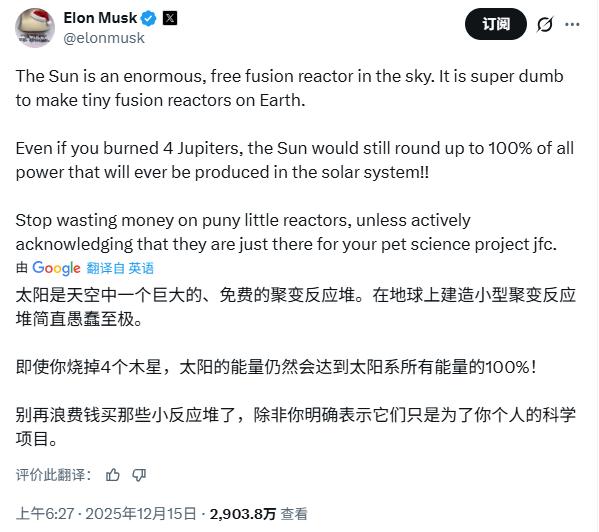
On December 15th, Musk publicly downplayed controlled nuclear fusion on X. He said, "The sun is a huge, free nuclear fusion reactor in the sky," and bluntly stated, "Building small nuclear fusion reactors on Earth is simply extremely stupid."
Finally, he gave sincere advice: Stop wasting money on those small reactors!
Controlled nuclear fusion is often called the "artificial sun," which artificially simulates the sun's nuclear fusion process on Earth.
The essence of solar energy is the energy released by the nuclear fusion reaction inside the sun, which relies on its own strong gravitational force to confine the nuclear fusion. However, the Earth does not have enough gravitational force, so it can only be achieved through artificial confinement technology.
As early as 2023, Musk put forward a similar view. He said in a podcast that as long as solar panels can be used to generate electricity and stored through batteries, 24 - hour power supply can be achieved.
By then, a single solar panel measuring 100 miles by 100 miles (about 25,900 square kilometers, equivalent to 1.5 times the area of Beijing) could meet the entire electricity demand of the United States.
Move the artificial intelligence data center into space
Some netizens believe that his harsh criticism of controlled nuclear fusion is to support the industrial chain behind him.
Musk has painted a huge picture: SpaceX plans to build a data center in space. They are upgrading the Starlink V3 satellites to be able to carry artificial intelligence computing chips, and the project will start in 2026. The goal is to build a globally - covered space computing power network.
It should be noted that the training and inference of large artificial intelligence models require a large amount of computing and consume an astonishing amount of energy. According to the International Energy Agency, by 2035, the annual power consumption of artificial intelligence will reach 1,200 terawatt - hours (1 terawatt - hour is approximately equal to the annual power consumption of Qinghai Province), which is nearly a quarter of the total power generation of the United States in 2024 (4,390 terawatt - hours).
By then, what will play a decisive role in the development of artificial intelligence will not be factors such as models and computing power, but the most basic electricity.
Microsoft signed a 20 - year nuclear power agreement and invested in the restart of the Three Mile Island Nuclear Power Plant; Amazon invested $500 million in X - energy and plans to build 5 gigawatts of nuclear power capacity by 2039...
While tech giants like Microsoft, Amazon, Google, and OpenAI are all scrambling to build nuclear power plants to ensure power supply, Musk directly plans to move the data center into space.
Solar power can provide a continuous supply of electricity. Moreover, the space environment is close to absolute zero, which serves as a natural cooling system for the data center. The cooling cost can be significantly reduced, and there is no need to spend a lot of effort on site selection like other companies on Earth.
In his vision, the Starship is expected to deploy 100 gigawatts of computing power annually, achieving complete self - sufficiency and even having a surplus in the future.
In this way, the Starship will be responsible for sending Starlink satellites equipped with artificial intelligence chips into space to build the data center. The laser links between Starlink satellites can enable high - speed data exchange between satellites, providing a two - way data transmission channel between space and Earth for the space data center. On the ground, xAI, Tesla cars, and Optimus robots will all rely on the AI computing power of the space data center, forming a perfect closed - loop system.
It was reported that SpaceX plans to go public in the second half of 2026. Part of the funds raised will be used to develop the space - based data center. The financing scale will exceed $30 billion, and the valuation will reach $1.5 trillion, making it the largest IPO in history. Musk is also expected to become the world's first trillion - dollar billionaire.
Jensen Huang, the CEO of NVIDIA, once thought that a space data center was just a dream, meaning that if Musk achieved it, NVIDIA would be in trouble.
Even more terrifying is that Musk's vision doesn't stop there. Artificial intelligence is not the last field he will enter.
High difficulty in achieving controlled nuclear fusion
In addition, space solar power does have its unique advantages compared to controlled nuclear fusion.
Since the International Thermonuclear Experimental Reactor project was established in 2006, the total investment has gradually increased to 25 billion euros (about 206.9 billion yuan), but the progress has been continuously delayed. Initially, it was planned to achieve the first plasma in 2016, but now it has been postponed to 2034 for operation.
The main reason is the unimaginable technical difficulty.
It requires heating the plasma to a temperature above 100 million degrees Celsius to ensure that the atomic nuclei have enough kinetic energy to undergo fusion. There is no solid material on Earth that can withstand such high temperatures.
Moreover, the high - temperature plasma is extremely unstable and unpredictable, making it difficult to achieve stable confinement.
Currently, it is generally believed that it will take at least 30 more years to achieve the commercial application of nuclear fusion power.
Musk's method is much simpler. The sun's nuclear fusion reaction will continue for another 5 billion years, and the energy used by humans is so small that it can be almost ignored. There is no need to worry about resource depletion at all.
At the same time, the conversion efficiency of solar cells has been increasing year by year. In the past decade, the cost of photovoltaic power generation has dropped by more than 80%, getting rid of the dependence on subsidies and achieving large - scale commercialization.
Space solar power generation is not affected by day - night cycles or weather conditions and can generate electricity 24 hours a day.
According to the solar power generation plan, in the initial stage, the power generation equipment needs to be sent into orbit in batches by rockets and then assembled in space.
This places high requirements on the carrying capacity of rockets and the launch cost. SpaceX is currently one of the only two companies in the world that have successfully achieved reusable rocket technology. The other one is Blue Origin founded by Jeff Bezos.
However, compared with ground - based power generation, the cost is still high.
These devices also need to operate in extreme environments, including extremely low temperatures, vacuum, and cosmic rays. Once the data center is deployed in space, any hardware failure or software update will become extremely difficult.
China's "Long March 12A" rocket is scheduled to make its maiden flight in the middle and late days of this month, and it will attempt the first - stage rocket recovery technology for the first time.
In January this year, Hong Kong media reported that China is planning to build a "Space Three Gorges" on an orbit 36,000 kilometers away from the Earth, which will collect solar energy in space and transmit it to the Earth.
However, there is currently no more official information about this plan.
This article is from the WeChat official account "Technology Daily Push" (ID: apptoday). The author is Zhao Zhishan, and the editor is Zhou Weipeng. It is published by 36Kr with authorization.