Outstanding Partner for Commercializing Robotics: A Comprehensive Guide to the SesameX Multi-dimensional Embodied Intelligence Computing Platform by Black Sesame Technologies
I. Introduction
Against the backdrop of the accelerated evolution of the global robotics industry, an increasingly clear consensus is emerging: For robots to truly enter the real world, it depends not only on higher computing power or more complex algorithms but on a set of intelligent computing foundations that can operate stably in the long term, evolve continuously, and be widely adopted by the industry.
In the past decade, robots have evolved from the stage of "programmable execution" to "perception-driven control," with vision, positioning, and motion control gradually maturing. However, as deep learning and the Transformer architecture enter the field of robotics, robots are starting to undertake more complex tasks of understanding, decision-making, and collaboration, and the system complexity has increased exponentially. The constantly changing lighting, environment, human behavior, and task goals in the real world have gradually exposed the bottlenecks of the traditional robot architecture of "fragmented modules and static deployment."
In this context, Black Sesame Technologies has launched the SesameX multi-dimensional embodied intelligent computing platform. The goal of SesameX is not to build a closed full-stack system but to provide an open, scalable, and mass-producible intelligent computing base for the industry partners, helping robots evolve from "operable" to "growable" and from single-point capability demonstration to long-term commercial implementation.
II. SesameX Multi-dimensional Embodied Intelligent Computing Platform: Enabling Robots to Truly Evolve from "Operable" to "Growable"
At the early stage of platform design, SesameX took "growability" as one of its core goals. The so-called growth does not simply rely on the expansion of the model scale but means that the system can operate stably in the real environment and gradually optimize its behavioral performance through feedback.
Traditional robot systems are often designed with tasks as the center, where perception, planning, and control are separated from each other. Once the model is deployed, it enters a long-term static operation state. Once the environment changes or the task complexity increases, the system needs to be redesigned and recalibrated, making it difficult to support large-scale implementation.
By introducing a unified computing structure, task expression method, and execution scheduling mechanism at the platform level, SesameX enables robots to have the basic conditions for continuous evolution in terms of architecture. Perception models, planning algorithms, and control strategies from different sources can operate collaboratively within the same platform and form a stable closed-loop feedback during the system operation, thus supporting the gradual improvement of robot capabilities over time. This design enables robots to have a realistic path to evolve from "task execution type" to "cognitive understanding type" and then to "whole-brain collaborative type" at the engineering level for the first time.
1. How to Achieve Whole-Brain Intelligence?
Black Sesame Technologies has proposed "Whole-Brain Intelligence" as the long-term design goal for the robot computing platform. This concept does not emphasize the breakthrough of a single model or computing power but draws on the way the human brain works collaboratively in multiple regions, unifying and coordinating the capabilities of language understanding, spatial perception, decision-making reasoning, and motion control at the system level.
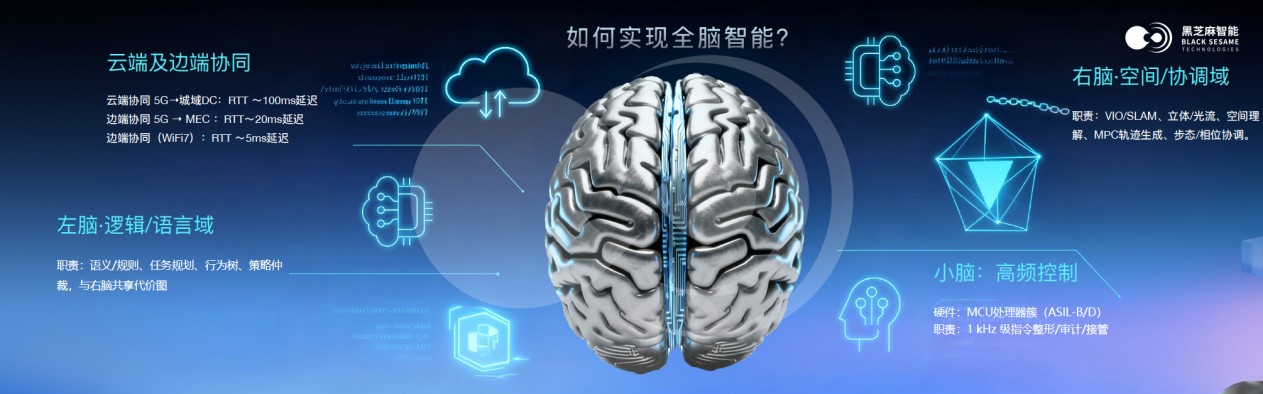
In the SesameX platform, whole-brain intelligence is not achieved through a single "super model" but through the collaboration of the following levels:
At the computing level, through the unified scheduling of heterogeneous computing units (CPU, NPU, DSP, MCU, etc.), different types of tasks can be efficiently executed on appropriate computing resources;
At the system level, through a unified task expression and execution mechanism, perception, planning, and control no longer rely on manual splicing but form a continuous information flow;
At the model level, through the combination of multi-modal models and atomic capabilities, models from different algorithm systems and ecological partners can naturally collaborate.
In this way, SesameX reorganizes the intelligent capabilities originally scattered in multiple subsystems into a continuously collaborative whole, enabling robots to form stable and consistent cross-modal understanding and behavioral output in complex environments, rather than fragmented responses.
2. How to Face the Safety Challenges of Robots?
Different from highly structured scenarios such as automobiles, robots usually share space with humans. Safety is not only about preventing hardware failures but also a system-level capability. Safety means predictable behavior, interpretable states, recoverable abnormalities, and the ability to protect humans to the greatest extent in extreme situations.

SesameX does not regard safety as an independent module but integrates the safety concept throughout the entire platform architecture. From perception input, computing power scheduling, task execution to control output, clear safety constraints and fallback mechanisms are introduced at each layer.
The platform uses a multi-level safety system from L0 to L5, enabling robots to automatically enter a controlled state, including speed limitation, replanning, or safe shutdown, in case of sensor abnormalities, abnormal model outputs, resource contention, or task conflicts. This system-level safety design makes robots no longer rely on the correctness of a single point but have the characteristics of overall controllable and predictable operation, providing a necessary prerequisite for commercial deployment.
3. How Do Robots "Act and Protect Humans"?
To achieve both safety and autonomy in the real environment, SesameX abstracts complex safety requirements into a six-layer safety mechanism, extending from physical behavior to data and system safety, forming an overall protection structure from the bottom up.
During the execution process, the system continuously monitors the sensor status, motion trends, human-robot distance, and decision-making stability. Once potential risks are detected, the platform can take intervention measures at different levels, from action constraints to strategy degradation, to ensure that the behavior does not cross the line.
At the highest data security layer, the platform uses local inference, encrypted transmission, and system integrity protection mechanisms to prevent data leakage and system tampering. This design makes robots not only safe and controllable at the physical level but also have a reliable foundation at the digital level.
4. How to Integrate Perception, Computing Power, and Intelligence into a Complete Organism?
In the real world, robots often face such a contradiction: The sensors "see clearly," and the computing power is "strong enough," but the overall behavior is still slow and fragmented, and even unstable actions and judgments occur in complex scenarios. This phenomenon does not stem from the insufficient capabilities of a single module but from the lack of a unified collaborative mechanism at the system level.

Taking a typical service or inspection robot as an example, when the robot moves in a crowded environment, it needs to complete multiple tasks simultaneously: The vision system continuously identifies pedestrians and obstacles, the positioning system updates its own pose, the planning module adjusts the path in real-time, and the control system ensures smooth movement; at the same time, the upper-level task logic may also be receiving new goals or instructions. If these capabilities run in independent subsystems respectively, and the data flows through multiple copies and asynchronous scheduling, the system is prone to problems such as cumulative delay, lagging decision-making, or inconsistent behavior.
The design starting point of SesameX is to reorganize these originally scattered capabilities into a unified and collaborative whole. At the computing level, through the integration of heterogeneous computing power, perception, reasoning, and control are no longer "fighting alone" computing units but are connected to the same computing power network and managed by a unified scheduling mechanism. Different tasks are assigned to the most appropriate computing resources according to their real-time requirements and safety levels, thus avoiding the interference of key control tasks by high-load reasoning tasks.
At the system level, through a unified data path and task expression method, SesameX incorporates perception results, decision-making logic, and control instructions into the same execution link. Data from cameras, lidars, or other sensors can directly enter the reasoning and planning stages with the least intermediate copying, shortening the reaction path from "seeing" to "acting." This end-to-end consistent data flow enables robots to respond more quickly to sudden changes in a dynamic environment.
At the intelligent expression level, the platform decomposes complex behaviors into reusable and combinable intelligent units through the combination of atomic models and task graphs. For example, in warehousing, commercial service, or inspection scenarios, capabilities such as obstacle avoidance, following, positioning, and interaction can be dynamically combined according to the real-time environment, rather than relying on a fixed process. This "building-block" intelligent structure enables robots to flexibly adjust their behavioral strategies when facing different scenarios, rather than being limited to a preset path.
Through the above multi-level collaboration, SesameX transforms robots from "systems assembled by multiple modules" into an organic whole with unified perception, unified decision-making, and unified action logic. Robots are no longer just performing single-point tasks but can form coherent, stable, and predictable behavioral performance in complex environments, providing the necessary system reliability for real-world applications.
5. How to Achieve Closed-Loop Evolution?
The real world is always more complex than the experimental environment. Factors such as changes in lighting, environmental reflections, human flow density, ground materials, and equipment aging will continuously affect the performance of robots during long-term operation. Many robots perform well in the initial tests, but as the deployment time prolongs, problems such as positioning drift, decreased recognition accuracy, and conservative or unstable actions occur, ultimately requiring frequent manual intervention.

SesameX introduces the concept of "closed-loop evolution" in platform design, aiming to enable robots to continuously accumulate experience in real operation rather than stop growing after deployment. This closed loop is not limited to a certain training framework or toolchain but naturally incorporates the robot operation process into the continuous optimization link through standardized data and interfaces.
In actual scenarios, while performing tasks, robots continuously record key operation indicators, including perception stability, model inference delay, task success rate, and abnormal trigger situations. This information is not simply accumulated as logs but is structured and used to judge the performance differences of the system in different scenarios.
When a robot encounters performance degradation or abnormal behavior in a new environment, the platform can locate the source of the problem by comparing historical operation data: whether the perception model is insensitive to specific lighting, whether the planning strategy is too conservative in a crowded environment, or whether the computing resource allocation is unreasonable, resulting in delay fluctuations. This analysis based on operation data provides a clear direction for subsequent optimization.
In the optimization stage, SesameX does not forcibly limit the model update method. Partners can choose to fine-tune the model locally or retrain it in the cloud combined with the simulation environment. The platform supports model updates, parameter adjustments, and strategy rollbacks through a unified interface, minimizing the impact of the optimization process on on-site operation.
After the new model or strategy is deployed back to the robot, the system will gradually verify its effectiveness under controlled conditions and continue to enter the next round of feedback. This incremental iteration method enables the robot's capabilities to steadily improve during long-term operation without bringing uncontrollable risks due to a single update.
Through this closed-loop mechanism, robots are no longer one-time delivered products but systems with continuous evolution capabilities. As the deployment scale expands, data from different scenarios can also promote the optimization of algorithms and system design in reverse, forming a positive cycle of mutual promotion between technology and application and providing long-term value for commercial implementation.
III. SesameX Multi-dimensional Embodied Intelligent Computing Platform: A "Full-Stack Self-Developed Platform for Systematized Computing from Edge Modules to Whole-Brain Intelligence"
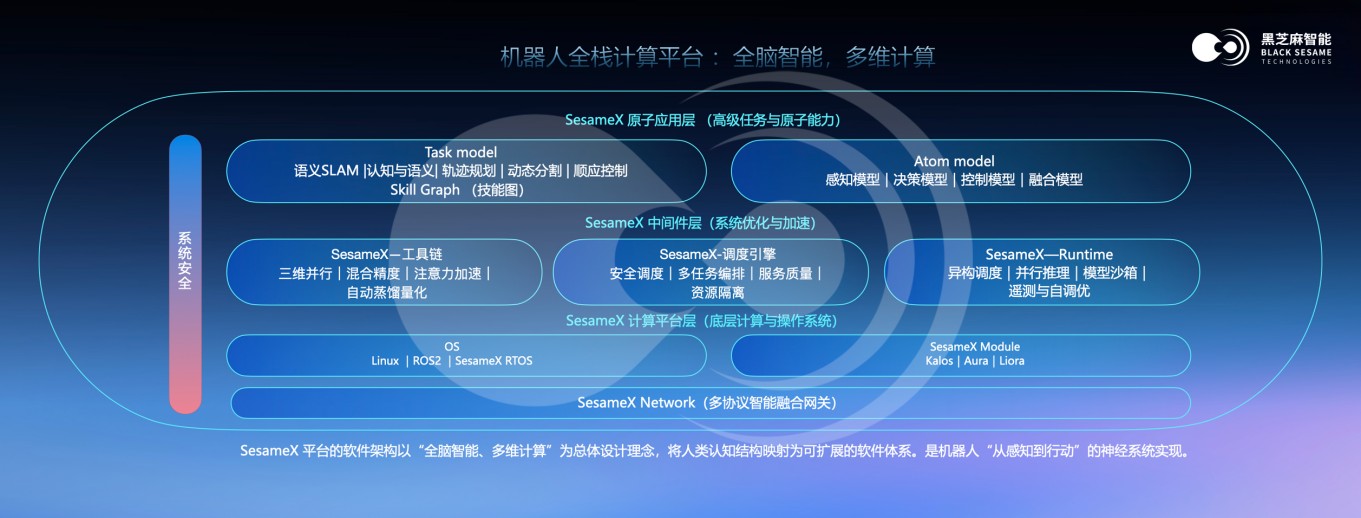
The SesameX multi-dimensional embodied intelligent computing platform provides a complete computing system from hardware modules to system software. Its goal is not to replace the industry ecosystem but to provide a reliable and scalable basic platform for robot manufacturers and algorithm partners. Through modular design, unified interfaces, and compatibility with mainstream ecosystems, the platform helps partners reduce the complexity of system integration and accelerate the process from product R & D to mass production.
1. Computing Platform Layer - Module
The computing system of SesameX consists of three self-developed computing modules, Kalos, Aura, and Liora, which are designed to meet the computing power needs of different types and complexities of robots. At this computing platform layer, what we provide is not just three individual modules but a complete computing platform system. The modules are highly integrated with complex designs such as SoC, memory, power supply, power management, and clock, and are compatible with mainstream motherboard interfaces, supporting a variety of I/O, including MIPI, CAN - FD, Ethernet, USB, SPI, and I2C, allowing developers to directly design system-level solutions.
The platform has reliable performance that can stably output from real-time control to large model inference. At the same time, Kalos and Aura have compact sizes (69×55mm and 82×54mm respectively), which are very suitable for deployment in sensitive spaces or mobile scenarios. With this platform-based design, developers only need to design the motherboard to complete the overall machine planning, greatly reducing the R & D threshold.
Overall, the value of this layer lies in providing a mass-producible and solid hardware foundation for robots, helping robots of different forms quickly enter the functional debugging and commercial testing stages at the lowest cost.
2. Computing Platform Layer - Network
As the system-level communication and data orchestration layer, SesameX Network is responsible for building different computing modules, heterogeneous computing units, and various peripherals inside the robot into a unified real-time collaborative system, and at the same time supporting the stable wireless interconnection between the robot, edge nodes, and the cloud.
In this layer, the network subsystem builds the internal backbone based on Time-Sensitive Networking (TSN), enabling the perception → computing power → control link to have predictable end-to-end delay and bandwidth guarantee; by integrating multiple high-bandwidth data channels, it can simultaneously carry high-resolution MIPI video streams, 10GbE data exchange, and high-speed access to shared SRAM across units, realizing parallel data supply for vision, SLAM, and inference tasks.
The system also implements a low-latency wireless collaborative protocol for WiFi7/5G, enabling the robot to maintain millisecond-level link jitter when performing distributed inference and task sharing with edge nodes. The underlying data pipeline uses a Zero-copy path design, allowing the perception stream from ISP/DSP to directly enter the inference path of NPU/CPU, avoiding additional delay and power consumption caused by multi-level cache copying. With the above communication mechanisms, SesameX Network builds a scalable real-time collaborative computing structure for robots, enabling them to maintain consistent real-time performance and data consistency in single-machine, cluster, and edge-cloud collaborative environments.
3. Computing Platform Layer - OS
At the operating system layer, the SesameX computing platform provides a unified software operating environment, supporting Ubuntu, ROS 2, and the self-developed SesameX - RTOS, thus achieving compatibility and balance between the general development ecosystem and real-time control requirements. The platform natively integrates ROS 2 and can seamlessly connect with mainstream industry algorithm frameworks; at the same time, through the collaborative scheduling mechanism of RTOS and Linux, it enables deterministic time slice allocation and interference isolation between high-frequency control loops and large model inference tasks. The system-level security isolation capability supports strong isolation between the kernel and user space for different tasks and different permissions, ensuring operational safety and verifiability.
In addition, the OS layer provides a unified software abstraction, enabling multiple modules