In the era of embodied intelligence, how can Shanghai solve this problem?
At the beginning of the year, Elon Musk hyped up his company's robot Optimus during Tesla's earnings conference call, claiming its performance was "the best in the world." However, he then suddenly changed the subject, saying, "I'm worried that companies ranked second to tenth might all be from China [1]."
Musk wasn't just scaremongering. 2025 is regarded as the year when humanoid robots enter mass production. But in reality, while European and American giants like Tesla have been facing continuous problems, Chinese humanoid robots have been in the spotlight from the beginning to the end of the year.
From performing the yangge dance on the Spring Festival Gala to hosting the world's first half - marathon for humanoid robots in Beijing, and recently, the "ZhiYuan YuanZheng A2" walking 100 kilometers to set a Guinness World Record, China has firmly taken center stage.
On December 12th, the 2025 Global Developers' Pioneer Conference and the International Embodied Intelligence Skills Competition held in Shanghai once again focused the industry's attention on China. The humanoid robot industrial chain centered around Shanghai is also revealing its full picture to the world.
Embodied Intelligence: The New Benchmark for AI
Embodied intelligence is not a new concept. It can be traced back to the paper "Computing Machinery and Intelligence" by Alan Turing, the father of artificial intelligence, and it first gained popularity in the 1980s.
The core idea of embodied intelligence is to generate intelligence through the interaction between a physical entity and the environment. In 1990, the robot Kismet launched by MIT even had auditory, visual, and basic "sensory" abilities. The AIBO (Aibo) launched by Sony in 1999 was also one of the early products of embodied intelligence.
According to the definition of IDC, "Embodied intelligence is an intelligent system formed by integrating artificial intelligence into various physical entities, enabling the entities to have the capabilities of autonomous perception, learning, decision - making, and action in the physical environment, so as to flexibly adapt to the physical environment and tasks [2]." It is also an AI that can act autonomously and has limbs.
Humanoid robots are currently the most advanced and complex carriers of embodied intelligence. The emergence of generative AI has made it possible for humanoid robots to become a reality. Large - scale models can significantly improve key abilities such as language interaction, environmental perception, and task decision - making, enabling robots to perform tasks like real humans.
At the ITF World 2023 Semiconductor Conference, Jensen Huang clearly positioned embodied intelligence as "the next wave of the artificial intelligence wave." Since then, the humanoid robot industry, driven by the double helix of technology and capital, has rapidly evolved from a concept explosion to industrial implementation, and Chinese companies have started to enter the center of this AI wave.
Behind the rapid rise of Chinese technology companies in this field is China's significant progress in the AI field over the past decade.
According to the latest Artificial Intelligence Index (Stanford HAI 2025) released by Stanford University, from 2013 to 2023, the total number of AI papers published globally nearly tripled. Among them, the proportion of AI papers from China almost doubled from about 12% in 2013 to 23.2% in 2023, ranking first among all regions [3].

Data source: Stanford HAI 2025
In addition, when calculated by institutions, among the 100 most cited AI papers globally in 2021 and 2022, the most were from Google. However, in 2023, Google and Tsinghua University tied for first place. The top - ten institutions that year also included the Hong Kong University of Science and Technology, the Shanghai Artificial Intelligence Laboratory, and the Chinese Academy of Sciences [3].
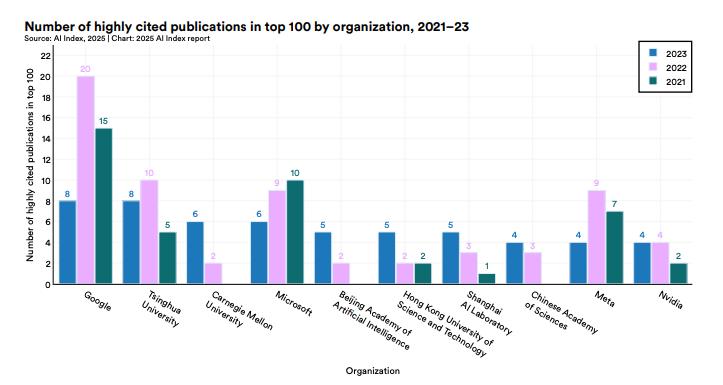
Data source: Stanford HAI 2025
In an interview in January this year, Geoffrey Hinton, the "father of deep learning," said that although China has not fully caught up with the United States in the AI field, it is very close [4].
In Hinton's view, China's abundant reserve of science and engineering talents is a powerful driving force for the development of the AI industry. Moreover, China's STEM education is better than that of the United States. "They have more well - educated talents."
Beyond academic accumulation and talent reserves, China's strong manufacturing capabilities and industrial ecosystem have also provided sufficient impetus for the development of humanoid robots in the country. When Jensen Huang came to China for an interview in July, he further pointed out China's unique advantages: first, excellent AI technology; second, outstanding integration ability of the robot body; third, a strong manufacturing foundation [5].
These three points precisely form a solid foundation for the coordinated ability of software and hardware - Only by deeply integrating the advanced AI "brain" with the precise and reliable mechanical "body" can the potential of robots be truly unleashed.
Therefore, with humanoid robots as a new benchmark, the world has begun to re - evaluate China's ecological niche advantages in the AI competition.
China's Position
At the 2025 CES in January this year, Jensen Huang brought 14 humanoid robots to the grand finale of his company's booth. Six of them were from Chinese companies, giving the world a clear sense of the rapid development of humanoid robots in China.
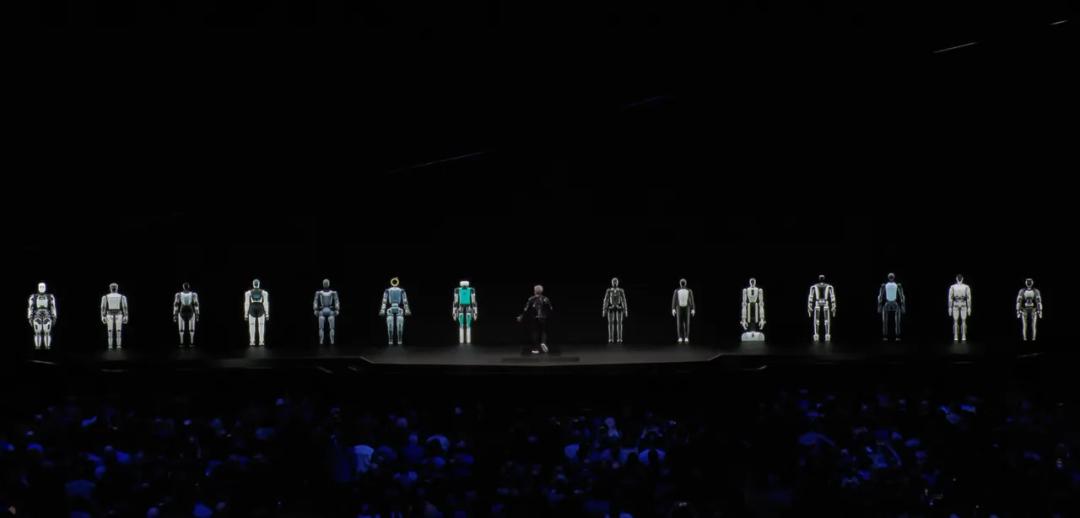
Jensen Huang presented 14 humanoid robots
In the same month, Bloomberg reported, citing the view of Reyk Knuhtsen, an analyst at Semi Analysis, saying, "China may replicate the disruptive impact it has had in the electric vehicle field in the humanoid robot field. However, this time, the disruptive impact may far exceed a single industry and may even change the labor market itself [6]."
To summarize, there are roughly four difficulties in the large - scale implementation of humanoid robots:
First, the capital dilemma. It is difficult to raise funds, and cash is consumed quickly. Many star startups have gone bankrupt on the verge of mass production due to a lack of funds.
Second, the short - board in the supply chain. IDC points out that embodied intelligent robots require the support of multi - technology products and complex system integration, which poses challenges to the supply chain. European and American enterprises have incomplete supply chains, rely on imported components, and have high costs. Moreover, core components such as planetary roller screws still rely on manual production, which restricts mass production.
Third, it is difficult to achieve commercial implementation. On the one hand, the application scenarios are fragmented, and most applications remain at the level of scientific research demonstrations. There are few industrial - level application cases, making it difficult to form economies of scale. On the other hand, the cost of the whole machine is high, and there is still a long way to reach the critical point of commercial profitability.
Finally, there are technical bottlenecks. The main problems are the insufficient intelligence of the "brain" and the difficulty in coordinating the "cerebellum." These are both theoretical and engineering bottlenecks.
However, these difficulties are precisely the strengths that China has accumulated over the years in the fields of technology and manufacturing.
In terms of policies and resources, China has included "embodied intelligence" in the government report, issued top - level designs such as the "Guiding Opinions on the Innovative Development of Humanoid Robots," and established a national - level innovation center. This provides long - term and stable strategic expectations and resource guarantees, guiding the orderly development of the industry and avoiding disorderly competition among capitals.
In terms of the supply chain, China is the only country that has all the industrial categories in the United Nations industrial classification. It can achieve "building - block" production and system - level integrated delivery, thus providing a low - cost and fast - response hardware foundation.
Reyk Knuhtsen believes that due to economies of scale and manufacturing advantages, Chinese enterprises have already out - priced their American competitors [6]. When the price of Chinese domestic robots has dropped to $16,000, Morgan Stanley predicts that the price of Tesla's Optimus Gen2 will still be around $20,000, even on the premise of using components from China.
In terms of commercial implementation, China has the largest and most diverse application scenarios in the world, including industrial, commercial, and household scenarios. As Jensen Huang said, China has a very large manufacturing foundation to deploy robots. Currently, many domestic humanoid robots have already entered automobile factories and unmanned pharmacies, providing massive data and clear requirements for technological iteration.
In terms of the engineering integration of the "brain" and "cerebellum," China has a large number of engineering talents in the fields of AI, robotics, and automation, which is crucial for overcoming technical bottlenecks and solving the "last mile" problem from the laboratory to the factory.
China's industrial chain is being integrated into a powerful closed - loop system of "innovation - manufacturing - application," and at the center of this system is the high - end manufacturing industrial chain centered around Shanghai.
Shanghai Takes Center Stage
On November 20th, the ZhiYuan YuanZheng A2, developed by ZhiYuan Robotics, completed a 100 - kilometer walk from Suzhou to Shanghai, setting a Guinness World Record for the long - distance walking of humanoid robots with a distance of 106.286 kilometers.
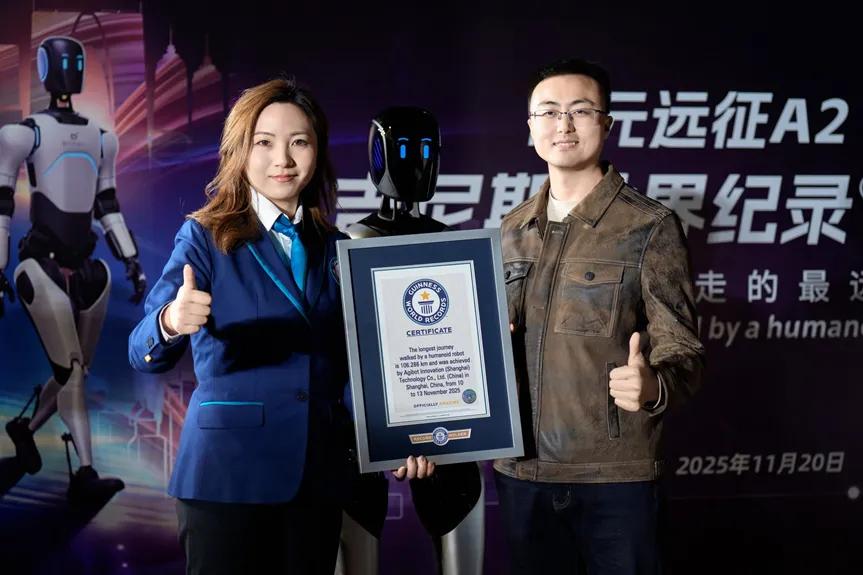
The ZhiYuan YuanZheng A2 set a Guinness World Record
Wang Chuang, a partner, senior vice - president, and president of the embodied business department of ZhiYuan Robotics, said on that day that the completion of this feat by the YuanZheng A2 means that the performance of the robot's body hardware, the "cerebellum" balance algorithm, and durability have matured, laying a foundation for large - scale commercial use [7].
ZhiYuan Robotics is one of the pioneers in the Chinese humanoid robot field and one of the first global enterprises to promote humanoid robots to large - scale production and commercial application. On December 8th, the 5000th general - purpose embodied robot, LingXi X2, of ZhiYuan Robotics rolled off the production line in Shanghai.
As a Shanghai - based enterprise, the rapid development of ZhiYuan Robotics is also a micro - cosmo of the humanoid robot industry in Shanghai.
As one of the central cities for high - end manufacturing in China, Shanghai was the first in the country to launch an implementation plan for promoting the development of a new generation of artificial intelligence in 2017, proposing the "Intelligent Shanghai (AI@SH)" initiative. Since then, Shanghai has regarded AI development as a priority strategic choice and has made arrangements for AI.
In August this year, the Shanghai Municipal Government issued the "Implementation Plan for the Development of the Embodied Intelligence Industry in Shanghai," once again becoming one of the first cities in the country to include embodied intelligence in the government report and issue a systematic implementation plan.
The "Plan" clearly states that by 2027, the "Three Hundred" goals will be achieved: gathering 100 backbone enterprises, implementing 100 innovative application scenarios, promoting 100 internationally leading products, and promoting the scale of the core industry to exceed 50 billion yuan.
Currently, Shanghai has formed three core advantages in embodied intelligence: a foundation in large - scale models and the AI industry, a complete industrial ecosystem, and rich application demonstration scenarios.
In terms of models, Shanghai has developed basic large - scale models such as MiniMax and JieYue XingChen. More than 80 large - scale models have been registered, leading the country. At the same time, it has national - level top - notch research institutions such as the Shanghai Artificial Intelligence Laboratory, providing software - hardware coordinated solutions for cutting - edge fields such as embodied intelligence.
In terms of the ecosystem, with Zhangjiang, Pudong as the core carrying area, Shanghai has attracted and gathered enterprises in the embodied intelligence industrial chain such as ZhiYuan Robotics, Fourier Intelligence, and Kepler Robotics, covering core links such as humanoid robots, dexterous hands, high - density batteries, and tactile sensors.
For example, since its establishment, Kepler Robotics has established a technical route of software - hardware coordination. The robots it has developed not only have advanced hardware designs but also have self - developed a complete set of algorithm systems from decision - making to control, representing Shanghai's profound engineering capabilities in this field.
As of now, the scale of Shanghai's robot industry accounts for about one - third of the national total. While becoming a gathering place for hardware engineers, it also provides rich open - source projects and cooperation opportunities for global software and hardware developers.
In terms of application, Shanghai's unique advantage lies in its rich and diverse scenarios. Currently, robots have entered mature scenarios such as automobile manufacturing, commercial entertainment, and logistics assembly. The government encourages enterprises to iterate their products in real - world scenarios through financial support and continuously optimize the software - hardware coordination performance through practical feedback.
This marks that Shanghai's embodied intelligence has entered the practical stage, providing a valuable "testing ground" for global developers.
At the same time, top - level summits such as the World Artificial Intelligence Conference and the Global Developers' Pioneer Conference held every year not only showcase technological achievements but also aim to build an open community, which has repeatedly attracted the attention of global industrial giants and front - line developers to Shanghai, making it a platform for local enterprises to promote their technologies and products globally.
At the 37th Shanghai Mayor's International Business Leaders' Advisory Council Meeting held recently, Bob Moritz, the global chairman of PwC, said bluntly that from scale, talent, and scientific research to infrastructure and execution, AI has become one of Shanghai's greatest competitive advantages [8].
Epilogue
In 2019, the Tesla Shanghai Gigafactory set the "China speed" of only 10 months from construction to production. Elon Musk praised it as the "factory with the best quality and the lowest cost." Now, this factory produces a complete vehicle every 30 seconds and contributes nearly half of Tesla's global production capacity, setting a global benchmark for efficiency.
The same fertile ground is nurturing a more disruptive future. Facing the global dilemma of the lack of a supply chain for humanoid robots, Shanghai has built a complete ecosystem from large - scale models, core components to whole - machine integration, promoting the practical application of embodied intelligence.
In the field of electric vehicles, Shanghai has proven its ability to build a world - class "gigafactory." On the journey of embodied intelligence, Shanghai will replicate this experience and, with more thorough preparations and a determined attitude, seize this historical opportunity.
References
[1] Why the Rise of China Robots Is Worrying Elon Musk, Bloomberg
[2] The Blueprint Begins to Take Shape - IDC Releases the Market Analysis Report on Embodied Intelligent Robots, IDC
[3]Artificial Intelligence Index Report 2025, Stanford University HAI
[4] AI Godfather Hinton's Interview at the Beginning of the Year: China's AI Is Catching Up with the US Thanks to Talent Education and Self - Research, CSDN
[5] Jensen Huang: China Has Very Unique Advantages in Developing Humanoid Robots, China Daily
[6] U.S. tech giants are betting big on humanoid robots — but China's already ahead, analysts say, CNBC