Unitree Launches the World's First Robot App Store: Aiming to Create an Apple-like User Ecosystem
On December 13th, Beijing time, Unitree Technology launched the world's first application store for robots, similar to Apple's "APP Store".
This software store allows users of Unitree Technology, that is, those who already own products under Unitree Technology, to either download motion algorithm model software officially released or uploaded by other users to the application store, or upload and share their own developed and trained motion algorithm model software with one click.

This is a pioneering move in the robotics field. Previously, there was no similar practice in the industry. Unitree Technology is trying to build a user ecosystem similar to Apple's.
Moreover, this is an attempt by Unitree Technology to open up a new engine for user growth. After all, currently, most of Unitree Technology's users are research institutions and B - end users, while C - end early adopters account for a small proportion.
Through the application store, sharing motion model software can enable developers to earn additional income to offset development costs, and also save later - comers the time and cost of development.
At the same time, it also aims to create entertaining products to expand the user growth space.
Applications of entertainment or service robots may open up user growth space
The three debut actions in the public beta: Funny Actions, Twist Dance, and Bruce Lee are applications with entertainment effects.
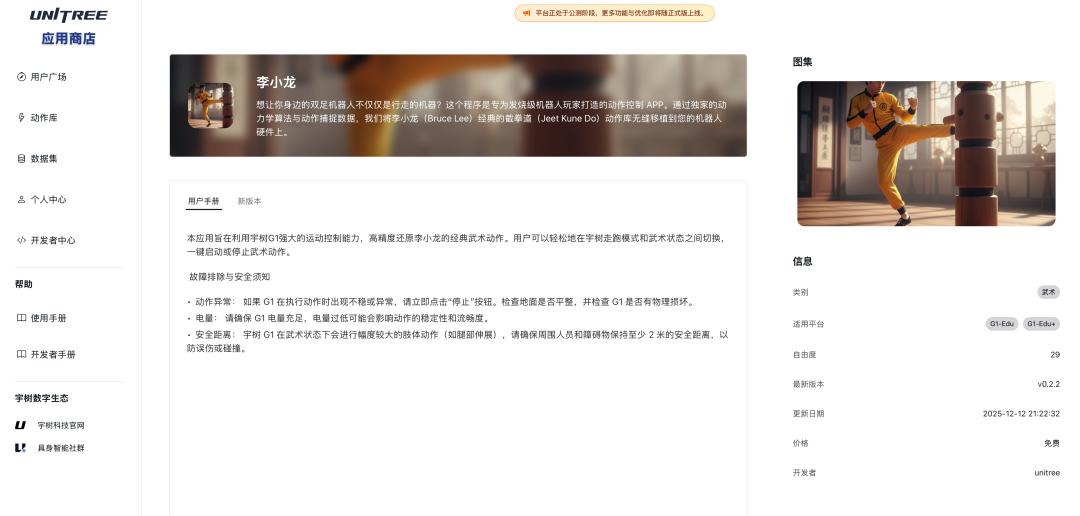
In the official introduction, the "Bruce Lee" program is an action control APP specially designed for hardcore robot players. Through exclusive dynamic algorithms and motion capture data, we have seamlessly transplanted Bruce Lee's classic Jeet Kune Do action library to your robot hardware.
This application aims to utilize the powerful motion control capabilities of Unitree G1 to accurately restore Bruce Lee's classic martial arts actions. Users can easily switch between Unitree's walking - running mode and martial arts state, and start or stop martial arts actions with one click.
The overall process is to make it as convenient to install motion software on the applicable platform as installing mobile software, but the experience will be more diverse.
Once this action library is enriched, that is, more developers are willing to upload their developed and tested motions to the application store for sharing, it may activate the C - end user market.
Especially in the field of service robots, after all, each specific scenario and even each action of service robots require long - term development, testing, and iteration to meet user needs.
Unitree's application store initiative is a collaborative effort.
However, the difficulty is also very high. Even in the field of large - scale pure software models, OpenAI once tried to launch a similar application store, but it has remained lukewarm so far.
In the hardware field, which is currently known as the hottest "Physical AI" field, with the combination of fun, playability, and practicality, as well as Unitree Technology's willingness to invest funds in operation, can it gradually develop?
Technically, Unitree's application store uses a distributed microservice architecture and includes four core modules: User Plaza, Action Library, Data Set, and Developer Center. You can connect to the robot through the mobile APP and deploy the complex cloud - based control algorithms to the robot terminal with one click, just like installing mobile software.
At the same time, the platform also aggregates data sets collected from real robots, supporting users to upload data or download data sets shared by others for algorithm training and optimization.
Unitree has proposed three major goals to be achieved within three years:
1. Connect 100,000 robot devices;
2. Cultivate 100 developer enterprises with an annual revenue of over 10 million;
3. Form 10 application scenarios worth tens of billions.
IDC predicts that by 2027, the scale of the robot application store will reach $18.7 billion, and Unitree Technology's first - mover advantage is expected to account for more than 15% of the market share.
So, what is the current situation? And what problems will it encounter?
Over 1,200 developers have settled in and 237 applications are on the shelves
According to reports, currently, 237 applications have been launched on the platform, covering fields such as logistics and warehousing (with the highest proportion of 38%), industrial manufacturing (29%), and service robots (17%).
In terms of developers, over 1,200 developers have settled in so far.
Divided by industry, the above - mentioned three major fields of logistics and warehousing, industrial manufacturing, and service robots account for 84%.
Divided by region, developers show a regional clustering effect: developers in the Yangtze River Delta account for 42%, those in the Pearl River Delta account for 27%, and those in the Beijing - Tianjin - Hebei region account for 19%. The developers in these three regions account for 88%.
To some extent, the regional clustering effect is even higher than the industry clustering effect.
From the perspective of industry concentration, it can be seen that the three industries in the robotics field that are expected to be commercialized first are logistics and warehousing, industrial manufacturing, and service robots.
Actually, each industry represents a large - scale market, and there are also more niche fields. These niche fields happen to require each user to first develop a suitable motion model.
At this time, the role of the application store launched by Unitree Technology is evident. As mentioned before, later - comers can obtain the corresponding software capabilities by paying after purchasing the hardware, and early - comers who have trained motions can offset their development costs.
More importantly, it can reduce the waste of social costs caused by repeated development.
The publicly cited cases are that JD Logistics improved the operation efficiency of its robot cluster by 230% and shortened the order processing time from 4.2 hours to 1.3 hours by deploying an intelligent scheduling application; BYD's Xi'an factory reduced the welding defect rate from 0.8% to 0.2% and saved 1.26 million yuan in costs annually by deploying a welding quality inspection application.
However, the question is whether industrial users, whose core demand is to reduce costs and enhance product competitiveness through these industrial or industry - specific applications, are willing to share the results of their hard - earned training with their competitors. This is a question mark.
Compared with applications that improve production efficiency, entertainment - oriented applications may be more likely to arouse user enthusiasm.
Perhaps Unitree has thought this through, otherwise, it wouldn't have launched three more entertainment - focused applications for public beta on the homepage.
Now, large - scale models are competing in applications, and so are robots.
This article is from the WeChat official account "Chezhi" (ID: invehc), author: Michael Yuan, published by 36Kr with authorization.