How to plan an enterprise data lake to successfully realize the value of data

Did you know that enterprises generate over 2.5 trillion bytes of data every day? In an era where the volume and complexity of data are exploding, traditional databases can no longer meet enterprises' needs for speed, scale, and diversity of information. The implementation of a data lake is precisely to address this issue - it provides a unified and scalable infrastructure for storing raw data, including structured, semi - structured, and unstructured data.
A data lake is the cornerstone of modern analytics and artificial intelligence, enabling real - time insights, self - service business intelligence, and predictive modeling. In this article, we will explore the definition of a data lake, the importance of building a data lake for enterprise success, and how to effectively design a data lake. You will also learn about best practices, common pitfalls to avoid, and real - world examples of how leading enterprises are transforming data lakes into engines of innovation and competitive advantage.
Summary of Key Points
A well - designed data lake can accelerate the speed of insights for analytics and AI workloads, improving scalability and efficiency.
Emphasize governance, metadata management, and architecture design from the start to ensure long - term success.
Use modern platforms to efficiently unify batch processing, stream processing, and machine learning workloads.
Give priority to continuous improvement through pipeline automation, monitoring, and optimization.
Maintain close collaboration between business and IT teams to drive data adoption, build data trust, and achieve continuous value.
View the data lake as a strategic asset, not just a storage system, as it powers innovation and growth across the enterprise.
1. What is a Data Lake
A data lake is a centralized storage system that allows organizations to store all structured, semi - structured, and unstructured data at any scale. Additionally, it serves as a single repository for collecting and storing raw data from various sources (such as databases, APIs, IoT devices, and applications) in its original format until it is needed for analysis.
Unlike data warehouses that use a schema - on - write approach (where data must be structured before storage), data lakes use a schema - on - read approach. This means that data can be analyzed in any format and is only structured when needed, providing flexibility for various analytics and AI use cases.
Data lakes are crucial for modern analytics, artificial intelligence, and machine learning processes. Moreover, they enable organizations to combine historical and real - time data, supporting advanced use cases such as predictive analytics, fraud detection, and personalized recommendations.
For example, insurance companies use data lakes to process IoT and telematics data for risk analysis, while retail companies use data lakes to build a 360 - degree view of customers, integrating sales, behavior, and feedback data to enhance customer engagement. Similarly, manufacturing enterprises can integrate IoT sensor data for predictive maintenance and improve operational efficiency.
2. Why Build a Data Lake
Today, enterprises need to manage vast amounts of data from sensors, applications, customer interactions, and third - party systems. Correspondingly, traditional databases often struggle to scale or effectively handle such diverse data. Deploying a data lake provides a flexible, cost - effective, and future - proof solution for data storage and analysis.
Business Drivers:
Growing Data Volume and Variety: Organizations are generating structured, semi - structured, and unstructured data at an unprecedented rate, which requires scalable storage.
Need for Real - Time Analytics: Enterprises want to gain insights immediately for decision - making, rather than waiting for batch processing cycles.
Data Democratization and Self - Service BI: Cross - departmental teams need easy access to trusted data for analytics, reporting, and AI use cases.
Technical Advantages:
Scalability across Cloud Platforms: Cloud - based solutions such as AWS S3, Azure Data Lake Storage, and Google Cloud Storage offer near - infinite scalability and flexibility.
Cost - Effectiveness through Separation of Storage and Compute: Separating storage from compute resources allows enterprises to optimize performance and reduce costs.
Foundation for Modern Architecture: A data lake serves as the backbone of the data lakehouse framework, combining the flexibility of a data lake with the performance of a data warehouse.
3. Core Architecture of a Data Lake
A data lake organizes data through multiple layers that work together to transform raw information into valuable business insights. Understanding these layers helps organizations design efficient data platforms.
Layer 1: Ingestion Layer
The data ingestion layer brings data from various sources into the data lake. This layer handles both batch data that arrives on a schedule and streaming data that flows continuously in real - time. Commonly used tools include Apache NiFi for flexible data routing, AWS Glue for serverless ETL, and Azure Data Factory for cloud - based orchestration.
The data ingestion layer connects to databases, applications, IoT devices, social media feeds, and file systems. Additionally, data is transferred in its original format without any transformation, preserving the full information for subsequent analysis.
Layer 2: Storage Layer
Once the data arrives, the storage layer stores it in a scalable and cost - effective repository. Raw data is stored in cloud storage, such as Amazon S3, Azure Data Lake Storage, or Google Cloud Storage. Some implementations use Hadoop HDFS for on - premise deployments. This layer supports all data types, including structured databases, semi - structured JSON files, and unstructured documents or images.
This storage uses a flat architecture rather than hierarchical folders, making data easily accessible. Additionally, this layer separates storage from compute, allowing organizations to scale both independently based on demand.
Layer 3: Processing Layer
The processing layer transforms raw data into a usable format through steps such as cleaning, validation, and enrichment. Apache Spark can process batch and streaming data at scale. Databricks provides unified analytics capabilities, integrating data engineering and data science. Snowflake offers cloud - based processing services with automatic scaling capabilities.
This layer typically organizes data into different zones: the bronze zone for raw data, the silver zone for cleaned and validated data, and the gold zone for datasets ready for business analysis. Additionally, the processing layer applies business rules, removes duplicates, standardizes formats, and creates aggregations.
Layer 4: Governance Layer
Governance ensures that data remains trustworthy, secure, and compliant throughout its lifecycle. A data catalog (such as Unity Catalog, AWS Glue Catalog, or Azure Purview) records the existence and meaning of data. Access policies control who can view or modify specific datasets.
Lineage tracking shows the origin of data and how it evolves through various processes. Additionally, the governance layer is responsible for enforcing data quality rules, managing metadata, and maintaining an audit trail for compliance. As the size and complexity of the data lake grow, the importance of this layer becomes increasingly prominent.
Layer 5: Consumption Layer
Finally, the consumption layer provides users with tools to extract value from the data. Business intelligence platforms such as Power BI and Tableau can directly connect to the data lake for generating reports and visualizations. Data scientists use notebooks and machine learning frameworks to build predictive models.
SQL users query data through engines such as Presto or Amazon Athena. Self - service analytics allows business users to explore data without technical expertise. Therefore, this layer democratizes data access within the organization while maintaining governance control.
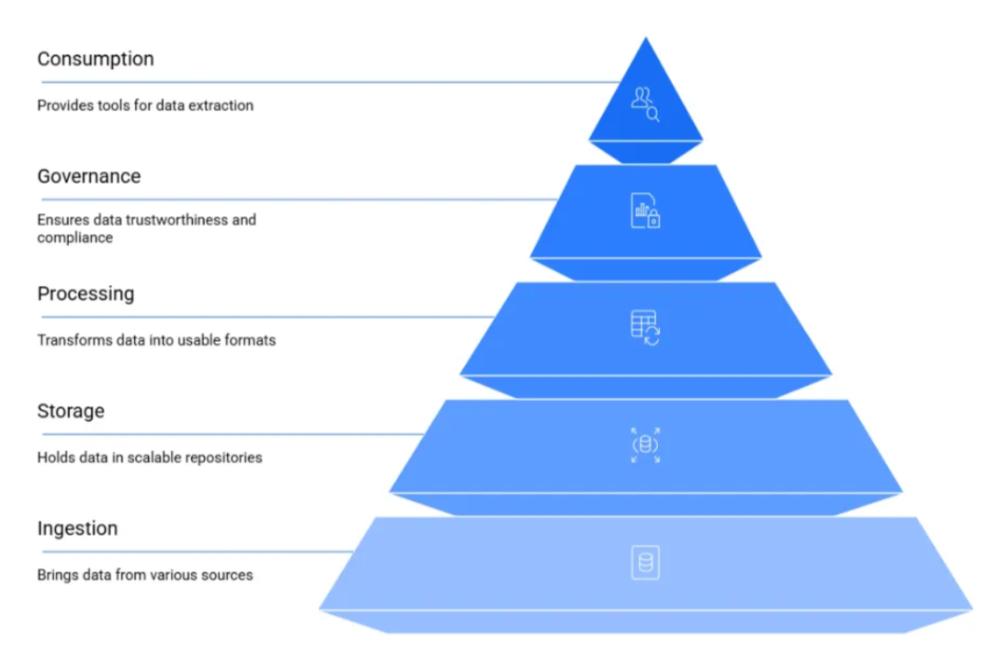
The above figure shows how data flows through these layers:
Source → Data Ingestion: Data comes from databases, applications, sensors, and files.
Ingestion → Raw Storage: Raw data enters the storage layer without any modification.
Raw Data → Processing: Data quality goes through the bronze, silver, and gold stages in sequence.
Processing → Governance: Metadata, lineage, and access control track all transformations.
Selected → Analytics: Business - ready data for BI tools and ML models.
Key Architecture Principles
Schema - on - Read: Unlike traditional data warehouses that require a predefined schema, data lakes store information first and then apply structure when reading the data. This flexibility can accommodate various data types and changing business needs.
Separation of Duties: Each layer is responsible for specific duties without interfering with each other. This modular approach allows individual components to be replaced without redesigning the entire architecture.
Scalability: Cloud - based storage and compute resources can be scaled independently based on demand. Enterprises only pay for the resources they actually use.
Multi - Purpose Platform: The same data lake can serve data scientists exploring data patterns, analysts creating reports, and applications using processed data. This unified platform eliminates data silos and avoids costly data synchronization.
The modern data lake architecture provides organizations with a flexible and scalable platform that supports diverse analytics needs while ensuring governance and security. If implemented correctly, these five layers can work together to extract trusted insights from vast and diverse data.
Data Migration Tools: Simplify and Streamline Complex Data Transfers
Enable organizations to efficiently manage and execute complex data transfers, ensuring accuracy, minimizing downtime, and maintaining data integrity throughout the migration process.
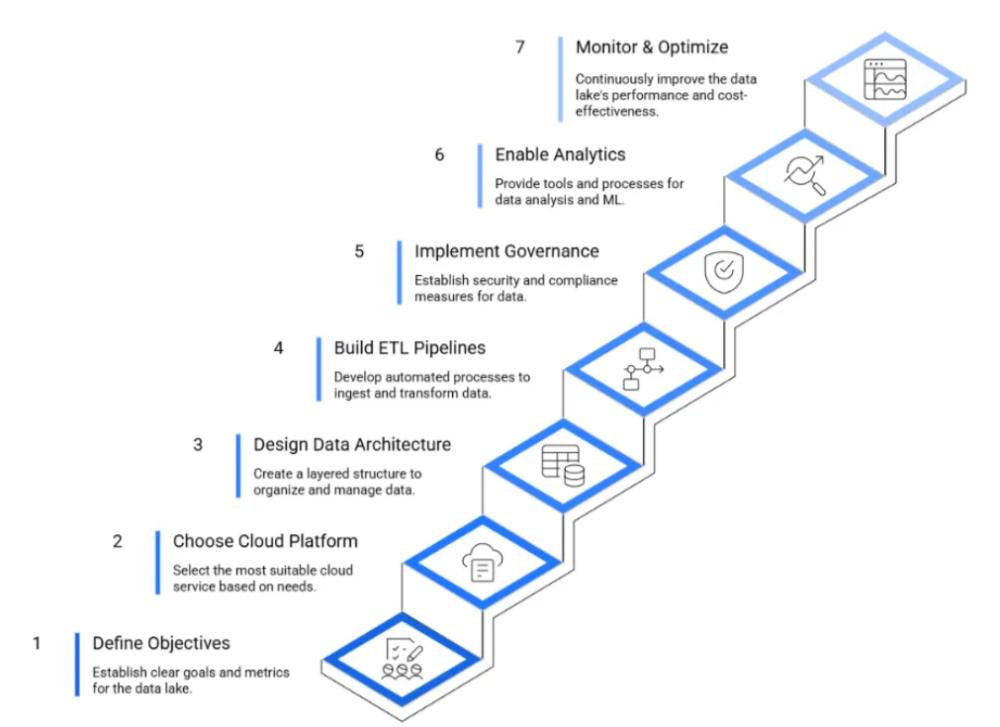
4. Step - by - Step Guide to Data Lake Implementation
Step 1: Define Objectives
First, clarify the "why". List your priority use cases (e.g., customer churn analysis, IoT device monitoring, fraud alerts). Translate them into key performance indicators (KPIs) and success metrics, such as time to insight, data freshness, and cost per query. Identify data sources, users, compliance requirements, and expected data growth over the next 12 - 24 months.
Step 2: Select a Cloud Platform
Choose the primary cloud platform based on skills, tools, and integration requirements:
AWS: Amazon S3 for storage, AWS Glue for metadata/ETL, Athena/EMR for querying.
Azure: ADLS Gen2 for storage, Synapse/Fabric for analytics, Purview for governance.
GCP: Use Cloud Storage to store data, BigQuery for analysis, and Dataflow/Dataproc for processing. Consider data residency, networking, pricing models, and compatibility with the native ecosystem.
Step 3: Design the Data Architecture
Adopt a medallion - style design to keep data organized and trustworthy:
Raw/Bronze: Landed data stored in its original format for traceability.
Refined/Silver: Cleaned, deduplicated, standardized schema, and enriched with reference data.
Selected/Gold: Business - ready tables optimized for BI/ML. Define naming conventions, partitioning, file formats (Parquet/Delta), and retention rules.
Step 4: Build ETL/ELT Pipelines
Extract data from APIs, databases, applications, and IoT streams. Use change data capture (CDC) whenever possible. Validate schemas, set up quality checks (null values, ranges, reference rules), and add metadata (source, load time, version). For ELT, push heavy transformation tasks to the data lake engine (e.g., Spark/SQL). Use schedulers and event triggers for automated runs.
Step 5: Implement Governance and Security
Designate data owners and administrators. Register datasets in a catalog with business terms. Track data lineage from source to report. Enforce identity and access management (IAM) roles (readers, engineers, owners), row/column - level security, encryption of data at rest and in transit, and private networks. Record access and changes for auditing.
Step 6: Enable Analytics and Machine Learning
Expose curated data to BI tools (Power BI, Tableau, Looker). Enable query federation if cross - system connections are required. Set up notebooks and machine learning pipelines for feature engineering and model training. Version - control and store features and models; set up MLOps for deployment and monitoring.
Step 7: Monitor, Scale, and Optimize
Create dashboards to monitor pipeline health, data freshness, failure rates, and costs. Optimize partitioning, compression, and caching. Use lifecycle policies to tier cold data to more cost - effective storage media. Configure compute resources reasonably and scale automatically to handle peaks. Review usage quarterly; archive unused datasets and decommission obsolete pipelines.
5. Best Practices for Data Lake Implementation
Building a successful data lake requires more than just storage - it requires planning, governance, and continuous optimization. Here are the key best practices to ensure long - term success.
1. Start Small and Define Use Cases
Instead of trying to migrate everything at once, start with well - defined, high - value use cases. Pilot projects such as customer analysis, IoT monitoring, or fraud detection can help validate the architecture and return on investment before scaling up.
2. Enforce Naming Conventions and Metadata Standards
Use consistent naming conventions for datasets and maintain detailed metadata. Standardized naming improves searchability, facilitates automation, and supports management tools such as data catalogs.
3. Enable Data Quality Checks and Lineage Tracking Early
Build data validation, anomaly detection, and lineage capture into the data pipeline from the start. Tracking data flow ensures accuracy, transparency, and simplifies debugging during audits.
4. Implement Role - Based Access Control and Encryption
Follow the principle of least privilege and encrypt data at rest and in transit. Use identity and access management (IAM) policies to control permissions and prevent unauthorized access.
5. Integrate Data Catalog Tools
Adopt catalog and governance tools such as AWS Glue Data Catalog, Azure Purview, or Google Data Catalog to improve discoverability, lineage visibility, and compliance management.
6. Optimize Storage through Partitioning and Tiering
Partition large datasets by date, region, or category to speed up queries. Use compression (e.g., Parquet format) and tiered storage (hot, warm, cold) to reduce costs and improve performance.
7. Continuously Document and Test Processes
Maintain technical and business documentation for each data process. Additionally, schedule regular tests of data ingestion and transformation pipelines to detect problems early.
By following these best practices, enterprises can ensure that their data lake implementation remains scalable, controllable, and can efficiently support analytics and AI workloads.
6. Common Pitfalls and How to Avoid Them
Even with the right tools and a well - thought - out plan, many data lake projects fail to reach their full potential due to overlooking certain challenges. Here are some common pitfalls and corresponding preventive measures.
1. Lack of Governance - Leading to a "Data Swamp"
Without clear ownership, standards, and a governance framework, data lakes can become difficult to manage over time. From the start, designate data administrators, enforce data retention policies, and use cataloging tools to keep data organized and discoverable.
2. Lack of Metadata Management - Leading to Difficulty in Discovery
If metadata is not collected or maintained, teams will have difficulty finding relevant datasets. Implement automated metadata extraction and tagging to ensure that datasets are searchable, well - documented, and context - relevant.
3. Ignoring Cost Optimization - Leading to Unnecessary Cloud Expenses
While cloud storage is inexpensive, unmanaged compute, frequent queries, and redundant backups can cause costs to skyrocket