The mass production of 5,000 units is not the end. The new starting point of ZHIYUAN determines its survival in the next round.
In the past two years, the humanoid robot industry has been driven by emotions and imagination. Videos of robots "dancing, pouring water, and shaking hands" have continuously flooded the internet, and the entire industry has accelerated forward in the heat of concepts. However, as capital gradually returns to a calm state, a more critical question emerges: Can robots really step off the stage and enter real life?
At this very juncture, ZHYUAN Robotics (hereinafter referred to as "ZHYUAN") announced that its 5000th humanoid robot has officially rolled off the production line in mass - production. Meanwhile, three major production bases have been opened simultaneously, and the full - link manufacturing capability has taken shape. ZHYUAN has become one of the first players in the industry to cross the threshold of "engineering replication".
However, mass production is not the end. When ZHYUAN stands at the door of large - scale mass production, what it has to face is no longer just technical demonstrations, but the rapidly changing business reality of the entire industry.
The 5000th Robot Rolls Off the Line: ZHYUAN Leads the Way into Large - Scale Manufacturing
ZHYUAN announced that its 5000th general - purpose humanoid robot, "Lingxi X2", has officially rolled off the production line. This means that Chinese embodied intelligence enterprises have finally brought "mass production" from PowerPoint presentations into reality.
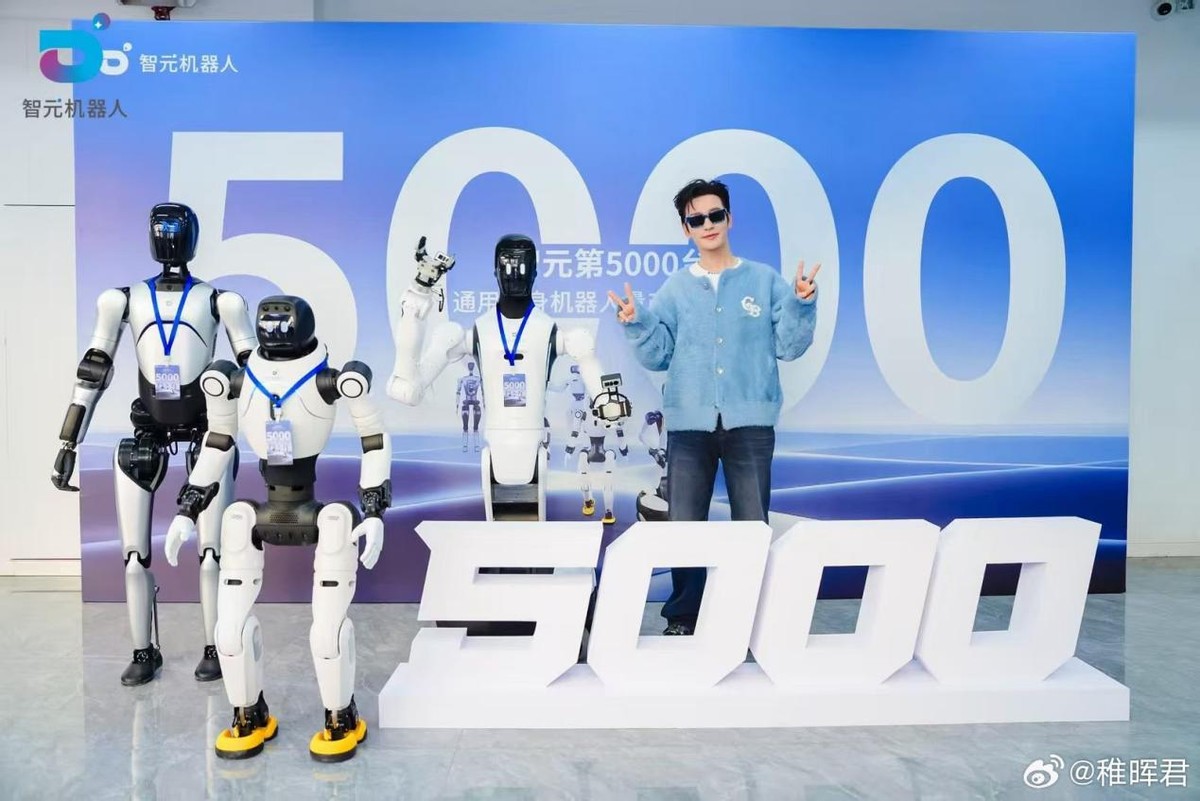
Image source: Weibo @ZhiHuijun
Looking at the long - term timeline, this is more like a starting gun for the Chinese humanoid robot industry to truly enter the deep - water zone. The industrial logic has also shifted from the "competition of prototypes" to the "battle of scale".
For the past decade, the competition in the humanoid robot field has been stuck at the prototype stage. Whether it was the ebb of American capital after Google sold Boston Dynamics in 2015 or Tesla's high - profile display of the Optimus prototype in 2022, the market's attention has often been focused on the technological demonstrations of a particular moment, rather than the systematic manufacturing capability.
However, the real threshold for humanoid robots has never been the number of joints or cables, but the ability to integrate technology into the assembly line and precisely replicate robots in a large - industrial way.
ZHYUAN's completion of the mass production of the 5000th robot indicates that it has crossed an important critical point in the mass production of the humanoid robot industry. It has formed a reusable industrial closed - loop in terms of the supply chain, manufacturing system, algorithm stack, overall machine tuning, and cost model. This is the key watershed for humanoid robots to move from technological prototypes to large - scale manufacturing.
In particular, domestic enterprises have long lacked a complete manufacturing foundation in the field of humanoid robots. They have been highly dependent on imports or scattered supplies for key sensors, actuators, and joint modules for a long time.
ZHYUAN's demonstrated mass - production capability has shown the industrial chain a predictable and stable demand, thus driving the synergy of the local supply chain and forming economies of scale. This is the prerequisite for all latecomers to reduce costs and shorten the iteration cycle.
However, whether ZHYUAN can enter the self - accelerating "singularity" zone after achieving the goal of mass - producing 5000 robots requires further verification. After all, humanoid robots are different from the photovoltaic and lithium - battery industries. Once the mass - production scale breaks through the cost - dilution range, the cost of photovoltaic and lithium - battery products will drop rapidly, and the application scenarios will naturally expand. The application threshold of humanoid robots is much higher than that of consumer electronics, and the implementation of scenarios is also more complex.
Now, with a production scale of 5000 robots, ZHYUAN stands at the forefront of the industry but also faces a more brutal problem first: Production capacity is a core challenge, and application ability is even more so. If the mass - production scale outpaces the application ability, manufacturing will not become an advantage but rather a reverse force that devours costs and accelerates the consumption of cash flow.
This is also the real meaning of the 5000th robot. It forces ZHYUAN to enter uncharted territory and pushes it to find a solution in the triangular relationship among mass - production capacity, cost structure, and scenario application.
Leading in Mass Production ≠ Leading in Application: The Key Lies in Entering Real - World Scenarios
Just as another change is taking place at the industry watershed of humanoid robots: The landing scenarios are shifting from "show" to "use".
This year, starting from the sudden popularity of Unitree robots at the Spring Festival Gala, the demand for commercial performances, corporate annual meetings, wedding ceremonies, etc. has exploded. The robot rental market has quickly fallen into a state of "one robot is hard to find".
However, by the end of the year, the market has clearly reversed. The dividends of the show - field have rapidly faded, and the rental prices have dropped sharply. Some manufacturers are even buying back robots at close to the cost price. This means that the stage era has suddenly ended.
In such an industry climate, the roll - off of the 5000th robot is both a milestone and a "countdown" to find results more quickly. If humanoid robots cannot enter real - world scenarios of rigid demand, mass production will only lead to inventory accumulation, cash - flow pressure, and supply - chain burden, rather than a positive business cycle.
Looking at ZHYUAN's existing products, the problem becomes clearer. Take the Lingxi X2 as an example. It has millisecond - level interactive response and the ability to understand and perceive the world through vision, and has obvious advantages in tasks such as precise grasping and command response.
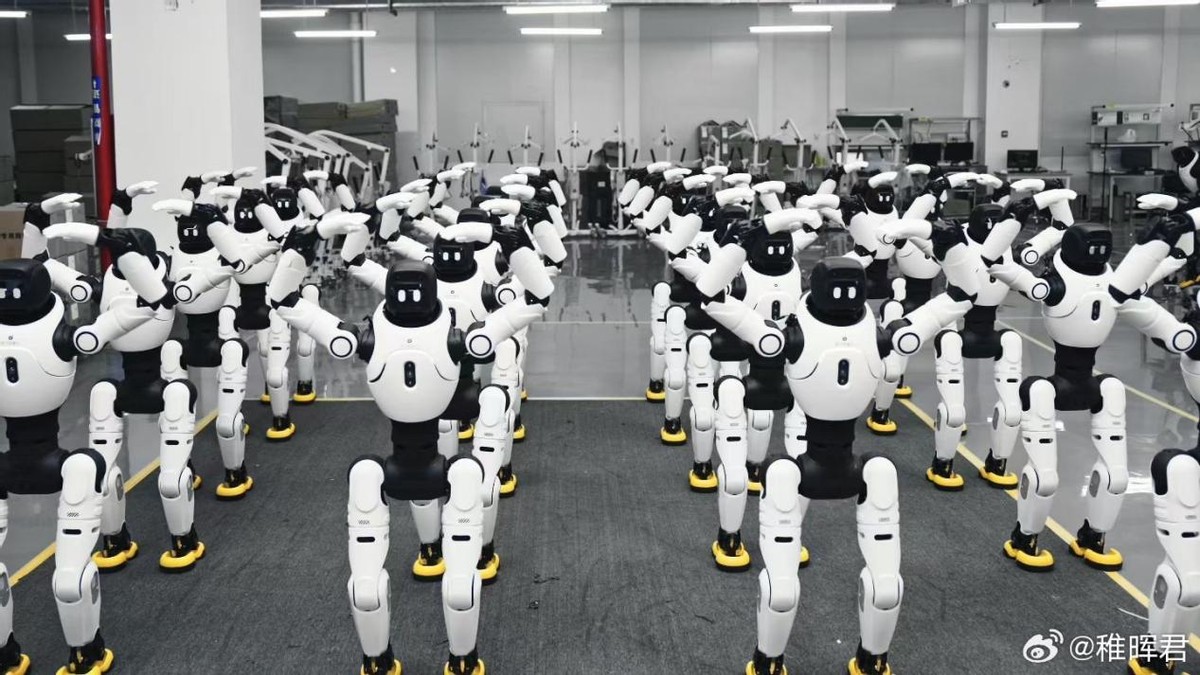
Image source: Weibo @ZhiHuijun
However, the competition in the robot industry is moving deeper. It is no longer about "whether it can move" but about the strength of generalization ability. Currently, the generalization ability of ZHYUAN's robots is still concentrated on basic tasks: routine action sequences such as inspection, handling, simple assembly, and scenario inquiry.
The pain point is that once the complexity of actions increases, robots are prone to problems such as unstable strategies, ineffective path planning, and lack of operational robustness. This is not only a challenge for ZHYUAN but also a common bottleneck for all humanoid robot enterprises.
Moreover, the "breadth" of its existing commercialization map cannot make up for the gap of "lack of depth". Although ZHYUAN has covered eight scenarios including explanation and reception, cultural and entertainment commercial performances, industrial manufacturing, logistics sorting, security inspection, data collection and training, scientific research and education, due to its weak generalization ability, the performance of robots in new scenarios or tasks is always limited.
The biggest risk behind this is that if the depth of scenario adaptation is insufficient, customers' willingness to pay is weak, and the ROI is not strong enough, then the larger the scale, the faster the losses will be.
This is why it is generally believed in the industry that the current competition is no longer about "who releases the robot first" but about "who can make the robot truly enter scenarios of rigid demand". The depth of scenario adaptation determines the strength of customers' willingness to pay. The willingness to pay directly affects the speed of scale expansion, and scale expansion in turn determines whether the cost - reduction path can be realized.
Therefore, at this point in time, while promoting mass production, ZHYUAN needs to shift from being "good - looking" to being "useful", and from "showing value" to "creating production value". This is not a choice but a matter of survival.
The Large - Scale Model Becomes the Biggest Variable: Can ZHYUAN Cross the Gap with the Power of AI?
As the mass - production speed comes to the forefront, the core problem exposed by humanoid robots has begun to shift from "what it can do" to "how to learn".
When traditional strategies frequently fail in complex scenarios and manual rules are difficult to support large - scale replication, the industry is becoming increasingly aware that hardware is no longer the bottleneck. Instead, it is how to use software and large - scale model capabilities to define robots.
In the past, robot intelligence relied on methods such as real - world scenario data collection, custom - strategy writing, and manual annotation. However, this kind of "weak - generalization" technical system naturally lacks the potential for large - scale application. It requires a large amount of repeated training and scenario adaptation, resulting in high costs and low efficiency.
At this time, the emergence of general large - scale models for robots has changed this path. For example, the synthetic data, strategy migration, and environment simulation capabilities brought by general models such as GPT enable robots to learn complex actions in virtual scenarios and then migrate them to the real world.
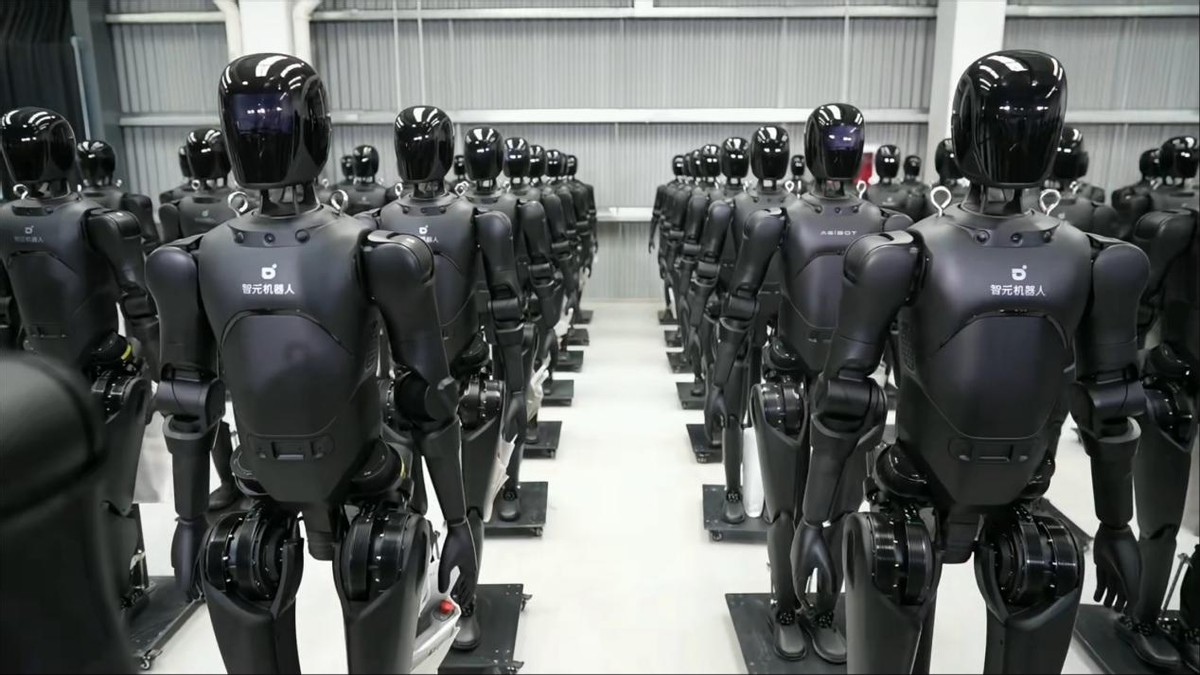
Image source: Weibo
Moreover, large - scale models can automatically generate interaction strategies, perception paths, and planning schemes, breaking through the bottleneck of traditional robots' reliance on manual rule design.
Furthermore, humanoid robots are a product of the integration of software and hardware. Without a base model and the support of large - scale models such as VLA, full - scale commercialization cannot be achieved only through the progress of the supply chain and hardware.
For ZHYUAN, this means that the ceiling of the robot's generalization ability has finally loosened.
If engineering mass production determines whether ZHYUAN's robots can be "manufactured", the large - scale model determines whether they can be "put into use". The former is an industrial ability that builds a scale advantage, while the latter is an intelligent ability that determines the long - term moat.
That's why the large - scale model is becoming the biggest variable that will determine the outcome of the next round of competition. It will determine whether ZHYUAN can transform the scale advantage of the 5000th robot into the ability to cross the generalization gap.
The problem is that the path of large - scale models cannot be advanced linearly. In the initial stage of construction, large - scale models require structured data, scenario feedback, and continuous optimization, all of which rely on large - scale deployment.
For ZHYUAN, the faster the mass production, the more it needs the model ability, cost structure, and real - world scenarios to keep up. If these three elements are not synchronized, scale will become a burden, causing it to fall into a reverse cycle of "ability lagging behind production capacity".
Now, the real question that ZHYUAN needs to answer is whether it can make the improvement speed of generalization ability catch up with the expansion speed of production volume. Can it form a positive amplification effect among algorithms, scenarios, and scale? The answers to these questions will determine ZHYUAN's final outcome: a fleeting success or an industry leader.
Conclusion
Up to the 5000th robot, ZHYUAN is indeed leading. However, starting from the 5000th robot, it will face all the unsolved problems in the industry head - on, from showy skills to production implementation, from the show - field traffic to real - world rigid demand, and from leading in engineering to the final competition in generalization ability.
The 5000th robot is not the end of glory but a cruel new starting point.
This article is from the WeChat public account "Hong Kong Stock Research Society" (ID: ganggushe). Author: Hong Kong Stock Research Society. Republished by 36Kr with permission.