Where can the AGI anxiety of independent developers be resolved?
Three months after AJ, an indie developer, launched his first indie game on Steam, after deducting the platform commission, his income was only $312.
On the other hand, Chen Yunfei, who left a big company, with the help of AI, created a game called "Kitten Fill Light" from concept to launch in just one hour. It reached the Top 20 on the iOS chart and earned nearly one million in a year.
As the AGI wave sweeps across, the development threshold has been leveled. The stories of AJ and Chen Yunfei are like two sides of a coin, reflecting the real cross - section under the AGI wave: on one side is the living environment faced by most indie developers, and on the other side is the opportunity seized by a few indie developers riding on the technological wave.
According to the "White Paper on the Developer Ecosystem in the AI Era", 13.7% of Chinese developers are active as indie developers. A group of digital nomads who choose the path of independent creation are eager to create value with code, but at the same time, they are also facing a long - term battle about survival, creation, and belonging.
Who are indie developers?
In the past, becoming a full - stack engineer required mastering complex knowledge and skills in multiple fields such as front - end and back - end, databases, and operations and maintenance. It was a career goal with high thresholds and high investment.
The emergence of AGI is reshaping the competitive landscape and creating more opportunities for indie developers. Advanced large models represented by GPT - 5 and Claude Opus and their increasingly mature development toolchains have lowered the technical threshold of "full - stack development" in an unprecedented way.
Indie developers usually refer to individuals or very small teams who independently engage in the development of software, applications, games, or other digital products and are not affiliated with large companies or organizations.
Today, the group of indie developers is rising at an astonishing speed and has become the most dynamic variable in technological change. Among the development teams registered and with information recorded on the Chinese indie game community indienova, about half of the teams have only one member. They are forced to become "octagonal warriors", independently taking on various tasks such as planning, programming, art, and copywriting.
The business models and income sources of indie developers
"Can indie development make money?" This has become the most concerned question for potential entrants.
When indie developers get rid of the singularity of the traditional employment model, their income sources have become diverse and flexible.
Indie developer A once said, "In the past, I was responsible for complex system architectures in a big company. Although my income was stable, the manifestation of my personal value was limited by the organizational goals." After transforming into an indie developer, the core of his income lies in transforming "technology" into "products" and "services".
For them, it's not just about simply taking on projects, but about flexibly choosing different paths to transform technical capabilities into value.
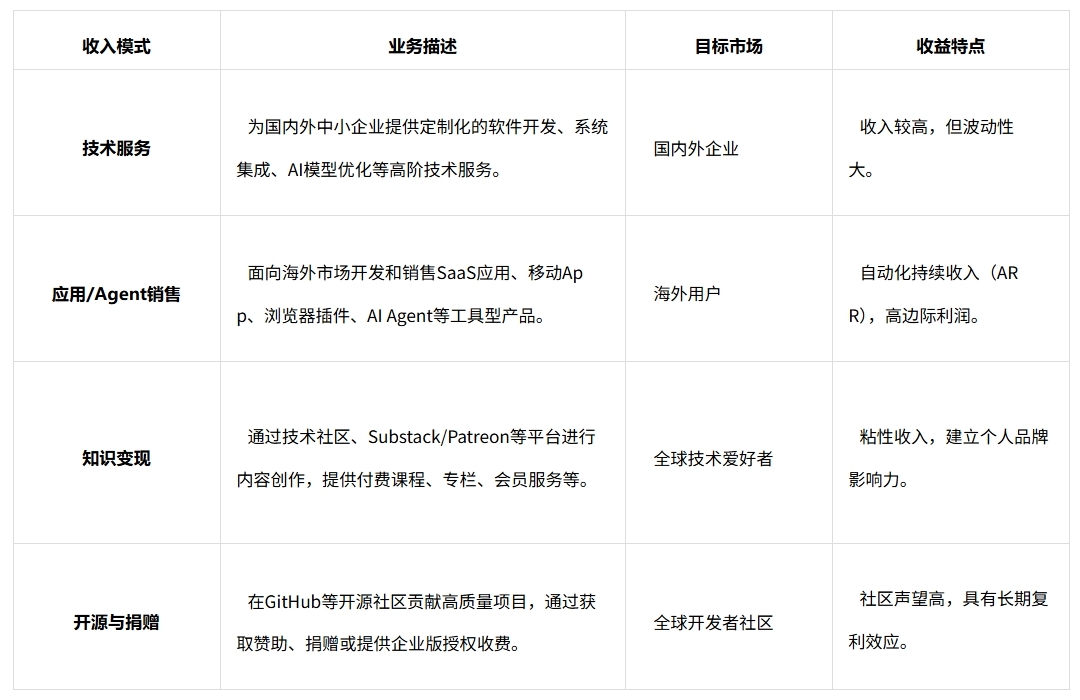
According to Internet information, their main business sources come from the following four aspects:
However, behind the diversified possibilities is a very cruel income reality.
A survey in 2025 based on more than a thousand samples (data from the Internet) shows a clear and sharp income stratification:
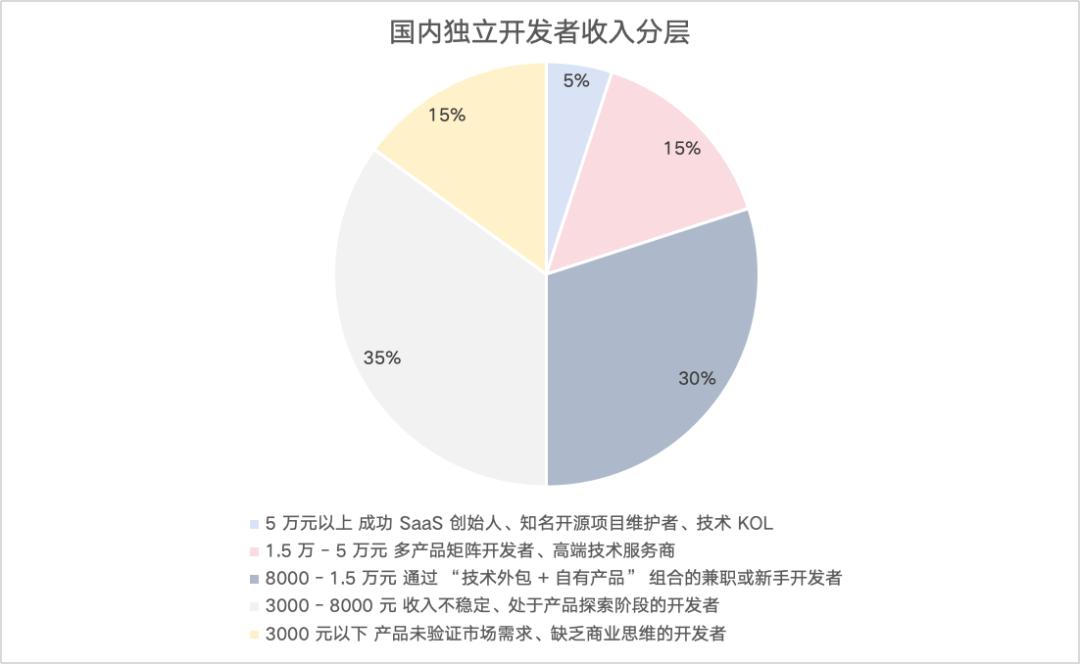
This set of data reveals a fact: only about 20% of indie developers can reach or exceed the relatively stable salary level in first - tier cities, and more than half of the developers are still struggling between making ends meet and having fluctuating incomes.
The multiple challenges faced by indie developers
Undoubtedly, in the field of indie developers, some successful cases are indeed very eye - catching:
A 17 - year - old AI indie development teenager earned one million dollars in just four months;
After the AI food record application "Book of the Stomach" developed by Zhao Chunxiang was launched for five months, the income reached $12,000, and it reached the third place on the Apple Food and Drink category chart;
Maor Shlomo, a 31 - year - old Israeli programmer, only invested $10,000 - $20,000 of personal funds and spent six months polishing a side project. It was successfully acquired by Wix, a website building giant, for $80 million (about 600 million RMB) in cash, and there was zero financing throughout the process.
However, these cases that make the news headlines are very far away for the vast majority of indie developers.
Indie developer B felt this particularly deeply: He polished an Agent. After it was launched in China for a month, there were tens of thousands of users, but there were less than ten payers. While a similar - function product overseas created a million - dollar income in just three months. "At that moment, sitting in front of the screen, a huge question mark welled up in my heart," he said. "How does a good product find its stage?"
Coincidentally, Eric Farraro, the author of the "Meteorfall" series, confidently launched his new work "Bramble Royale" on Steam but encountered dismal sales. The game, which took four years and an investment of $60,000 (about 438,000 RMB) to develop, ended up in a fiasco, selling only 621 copies in the first week with a total income of only $7,100.
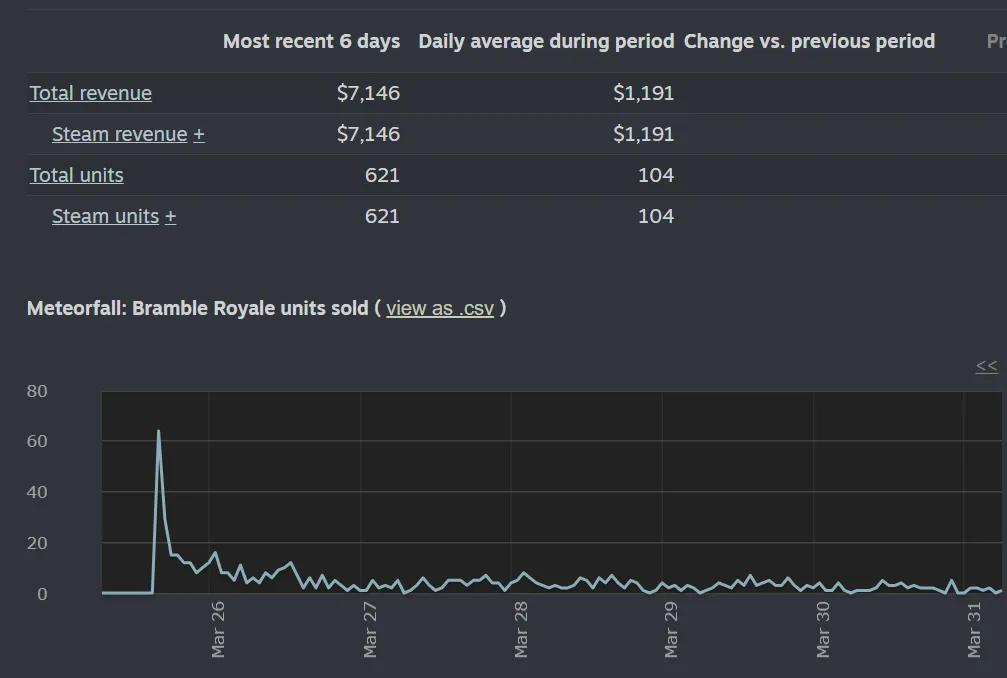
In addition, among the more than 15,000 new games launched on Steam in 2025, 40% of the games had a total income of less than $100, making many indie developers say that "the peak of the gold rush is over".

In addition to "unstable income sources", other challenges have also arrived.
Extremely polarized market ("winner - takes - all"): In cutting - edge fields such as AI, core resources such as high - quality training data, computing power, and supporting ecosystems are extremely scarce. The top 10% of leading teams take away 90% of the funds in the market.
Lack of social security and welfare: Indie developers lack social security under the traditional employment relationship and face greater risks in medical care, pension, etc.
"Fighting alone" is difficult to compete with "company endorsement": Indie developers have scarce individual resources and are difficult to compete with companies' systematic operations and brand endorsements.
Lack of communication and learning environment: Separated from the company environment, lacking formal technical exchanges, cross - departmental collaboration, and informal social networks, they are prone to fall into an "information island", and the update speed of their technical stack and the ability to solve complex problems are limited.
Personal and family concerns: Issues such as personal household registration and children's enrollment may become the main obstacles for indie developers to take root and develop.
Do indie developers need a "home"?
In the process of dealing with these external challenges, the internal desire for "connection" and a "support system" has become even stronger. Under the wave of AGI, facing numerous difficulties, more and more indie developers are seeking the possibility of gathering and cooperation.
However, an online community alone is not enough. Only offline spaces can create more opportunities for "collisions".
On December 8th, the Zhongguancun AI North Latitude Community released the city's first artificial intelligence OPC service plan to support "single - person entrepreneurship".
During the same period, a similar physical space also appeared in Hangzhou. The first offline physical space of the largest domestic model open - source community, "Model Zoo Community", the "Model Zoo Community (Hangzhou) Developer Center", was established in the Yungu Center of the Zijin Port Science and Technology City in Xihu District, transforming the "weak connection" of the virtual community into "strong cooperation" in the real world.
These explorations show that a healthy developer ecosystem requires the joint construction of multiple parties. It is not only a physical space but also a systematic project that can integrate policies, communities, resources, and trust.
In this context, a response deeply rooted in the needs of indie developers is unfolding - The International Digital Nomads (Indie Developers) Development Seminar in the AGI Era will be held in Haikou on December 19th. This seminar is co - hosted by CSDN and the Haikou Fuxingcheng Internet Information Industrial Park. The core agenda includes: analyzing the technology and market in the AGI era, interpreting the policies of the Hainan Free Trade Port, and officially launching the International Digital Nomads Base.
In the AGI era, while the threshold for value creation is decreasing, the threshold for creating lasting value is increasing. The path of indie developers is destined to start from "going alone" but will never end with "being alone". When the little stars gather, they can illuminate their own world.
What kind of "developer home" and fellow travelers do you expect? Welcome to leave a message in the comment section.
This article is from the WeChat official account "CSDN", and is published by 36Kr with authorization.