智能眼镜的时代真来了吗?如来
If you've taken a stroll on the streets or near subway entrances in major first - tier cities recently, you've probably noticed that advertisements for smart glasses are bombarding billboards everywhere.
Meanwhile, a number of new smart glasses companies have emerged on various platforms in recent years, with continuous financing news. Internet giants like Quark and Xiaomi have successively entered the smart glasses market, holding large - scale product launches.
Investors in the consumer electronics field have also started to frequently discuss the next - generation entry point after smartphones.
A shared vision of future technology is taking shape this year.
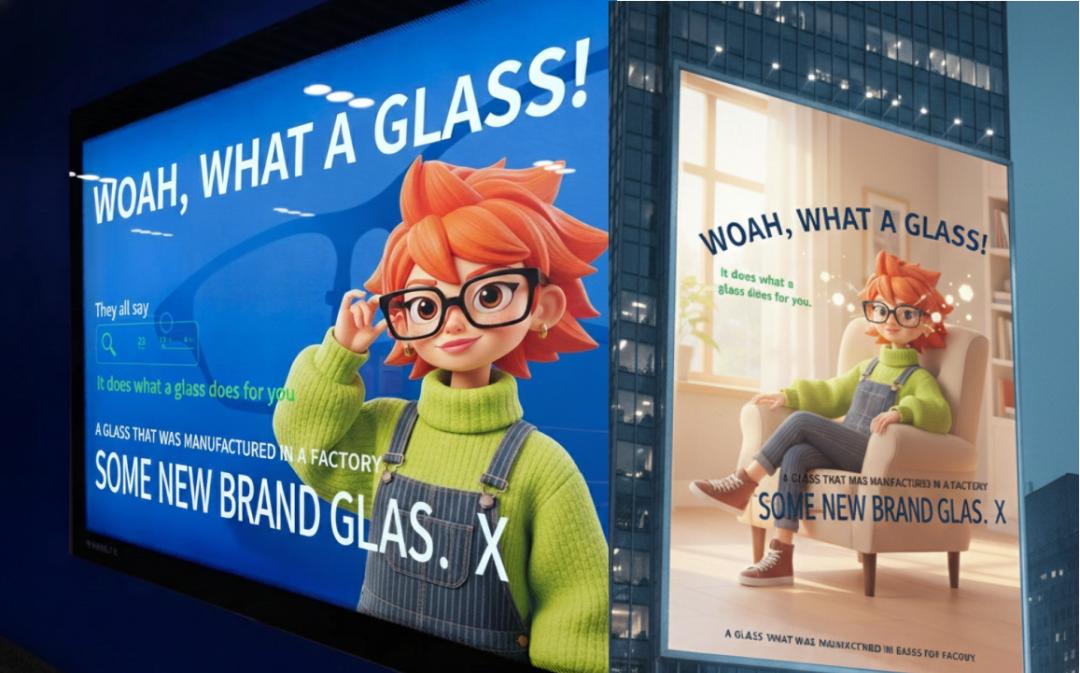
Schematic diagram of smart glasses advertisements from various brands. Image source: NanoBananaPro
However, confusion has arisen among investors and consumers: Where exactly is the "smartness" of these products promoted as "smart" and "AI - empowered"? Can the technological breakthroughs of these products support a brand - new hardware era?
Or is this just another over - hyped pseudo - trend with technology that fails to meet real - world needs?
In a newly emerging market where there is no consensus on definitions, new players are constantly emerging, and rules are yet to be established, narratives are often more alluring than facts.
But facts carry more weight than narratives. Therefore, this article aims to explore three key questions:
1. Why did smart glasses become a hot topic in 2025?
2. In the current dynamic landscape, how can we determine what a real smart glass is?
3. Where are the breakthrough points for the next - generation computing entry point?
Anxiety about AI Entry: What Form to Bet On
The popularity of smart glasses stems from the convergence of three underlying logics: anxiety about AI entry points, the spread of the concept of spatial computing, and capital's bet on the next smartphone form.
Due to the rapid development of generative AI represented by ChatGPT from 2023 to 2025, a new user demand has emerged:
"I want to access AI anytime, anywhere without taking out my phone every time."
Mobile phone interaction requires users to initiate actions first: opening apps, entering content, and clicking buttons. However, AI is shifting from passive response to active judgment, that is, predicting needs in advance based on the environment, situation, and user behavior and automatically completing tasks.
In this technological context, we need a device form that is closer to human perception and less disruptive to daily life than smartphones.
Glasses that are close to the field of vision, can be worn continuously, free up hands, and can perceive the real - world synchronously naturally become the optimal entry point for the next - generation human - machine interaction.
On the other hand, devices like Vision Pro, Pico, and Quest have demonstrated the potential of spatial computing: Computing is not limited to a small mobile phone screen but can interact with the real world.
Although these devices are currently bulky, have limited battery life, and are not suitable for daily wear, they are like prototype devices for the next generation, inspiring an optimistic outlook in the industry:
If Vision Pro can provide such an immersive experience and Pico can achieve basic spatial understanding, isn't it just a matter of time before these capabilities are integrated into glasses?
Looking at the development pattern of consumer electronics, since smartphones became the mainstream device, industry players have been searching for the next entry point in the past decade.
However, applications such as smartwatches, earphones, and foldable screens only circulate within the smartphone ecosystem and do not have independent entry - point value.
With the emergence of generative AI, the anxiety has intensified: If AI is the most important technological ability in the future, what will be the most suitable carrier?
Is it the smartphone, or a new device form?
Capital is eager to bet on the smart glasses category because it has the following characteristics: a clear but unoccupied category; a natural match with the AI narrative; and an imagination space similar to that of smartphones before the birth of the iPhone.
Therefore, the current phenomena such as advertisements, financing, and the startup wave are not because the vision of smart glasses has been realized, but because the entire industry is competing for the right to define the future entry point.
The Current Smart Glasses: In a "Three - No" Era
The chaos in the smart glasses market in 2025 lies in the absence of a clear category definition.
In a mature consumer electronics category, no one mistakes a calculator for a pager or a PHS for a smartphone.
However, smart glasses are in an extremely awkward situation:
Currently, any device with lenses, a screen, and Bluetooth connectivity on the market labels its products as "AI" and "smart" glasses.
This chaos has nothing to do with industry ethics or standards but is a typical characteristic of an industry in its early stage: no standards, no boundaries, and no anchor points.
This chapter attempts to establish a classification system for smart glasses based on core capabilities and technical architectures rather than brands and price ranges, so that we can better understand this chaotic early - stage market.
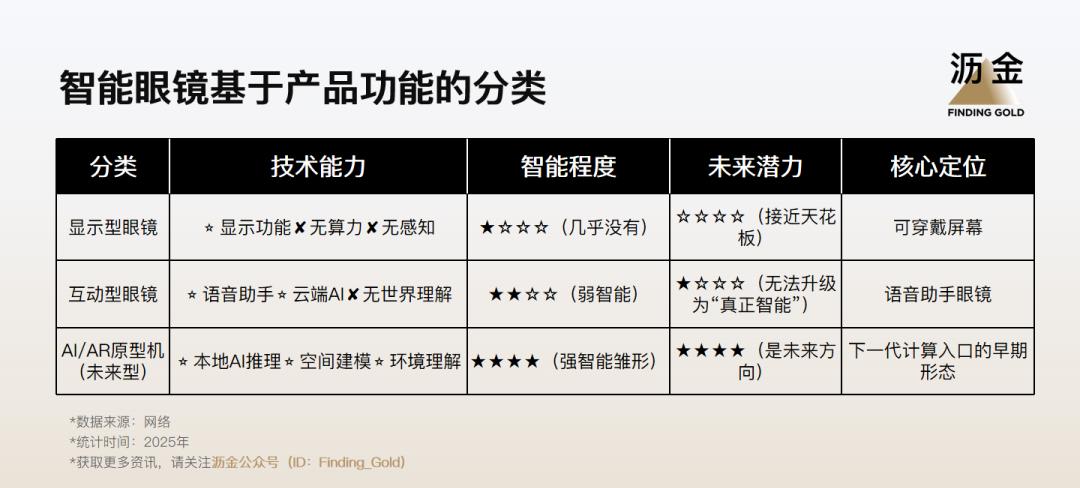
The most common type of smart glasses on the market is the first - type "display glasses," which also receive the most marketing and have the largest number of single products.
They are essentially projectors on lenses, with the main functions of watching videos and notifications. They do not have computing and spatial understanding capabilities. The so - called "AI functions" rely on the computing power of large models in smartphones.
The marketing scenarios usually include watching dramas on the subway and two people in the same space watching different content.
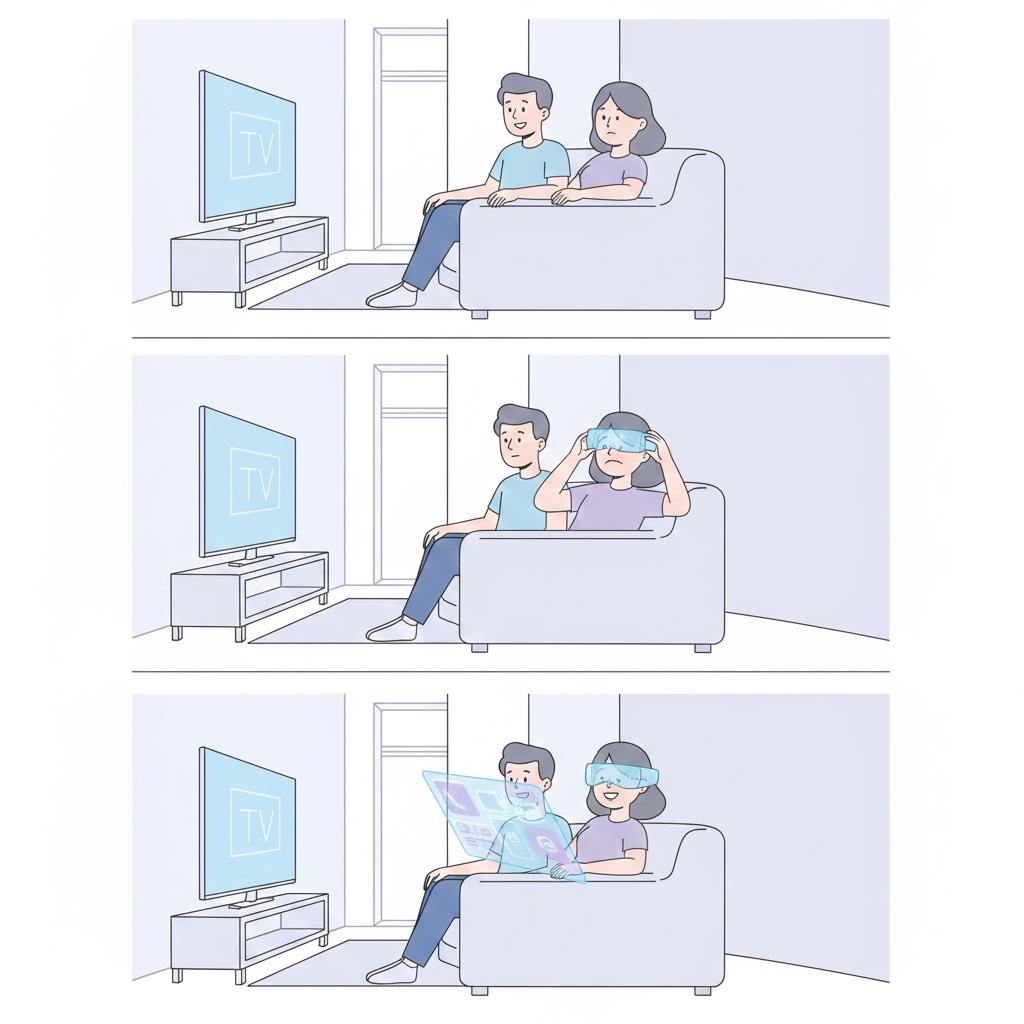
Marketing scenarios for display glasses on the market: Two people in the same space consuming different video content. Image source: NanoBananaPro
The large number of such products is due to mature technology, low barriers to entry, and rapid commercialization. A contract manufacturer can create a new brand with a simple design change.
However, problems have arisen: Riding on the wave of AI smart glasses, these more entertaining displays are packaged as smart glasses. When advertisements repeatedly mention "AI assistance," "next - generation computing," and "smart interaction," consumers find it difficult to understand that these are actually not related to real intelligence.
This type of product is one of the sources of the current market chaos.
The second - type products are "interactive glasses." They show some signs of intelligence but are still far from meeting the criteria of smart glasses.
Compared with simple display glasses, they have more advanced capabilities: basic voice assistants, the ability to run cloud - based AI, gesture or head - controlled operations, and basic shooting and navigation functions.
However, they have two drawbacks: limited or no local computing power, resulting in high latency and instability; and they do not understand the world, essentially remaining passive voice assistants waiting for instructions.
The third type is the so - called real AI smart glasses that the industry and investors are looking forward to.
Although there is no unified industry standard, it can be seen from the technical white papers of Apple, Meta, Google, Microsoft, Qualcomm and mainstream AR/XR papers that any device called "AI smart glasses" must have five basic capabilities:
1. Local computing ability (LocalCompute/On - DeviceML)
2. Spatial understanding ability (SLAM/Depth/SceneUnderstanding)
3. Real - time interaction (Low - LatencyInteraction)
4. Strong battery life and light weight (Ergonomics/PowerEfficiency)
5. Readily available AI ability (Vision+LLM+Multimodal)
In plain language, AI smart glasses must be an AI that can see and understand the world and share the same real - world environment with you at any time.
Currently, only XR devices like Vision Pro, Pico, and Quest come close to these capabilities. However, they are still experimental products on the way to the future and far from being suitable for daily wear.
According to this standard, there is currently no real AI smart glasses on the market. The entire industry is still in the stage of exploring lightweight products from prototypes.
In summary, there are three fundamental reasons for the industry chaos.
Firstly, the alluring narratives. Concepts such as "hands - free," "portable AI," and "next - generation entry point" are so futuristic that manufacturers can't wait to attach the corresponding labels.
Secondly, consumers lack reference products. For smartphones, consumers know what a mature product is. However, due to the lack of benchmark products in the smart glasses category, consumers are easily influenced by marketing.
Finally, although the technology is not yet mature, the market urgently needs stories. Capital, manufacturers, and entrepreneurs are all competing for a head - start in the post - smartphone era. In this hype, many companies choose to make up for technological deficiencies with marketing, compensate for computing power with the cloud, and package intelligence with high - end displays.
As a result, products that claim to be "AI smart glasses" have vastly different capabilities, just like the difference between a PHS and a smartphone, belonging to two different eras.
Uncertain Future, Hard to Decide to Buy
After answering why the AI smart glasses market is hot and chaotic, this section will focus on the future: How far are we from AI smart glasses?
To understand the future, we must start from two aspects: hardware limitations and software bottlenecks. They jointly restrict the birth of the ideal product.
AI glasses first need to have two basic capabilities: accurately understanding the surrounding environment and keeping up with changes in user actions and line of sight.
To achieve these two points, the device must have multiple cameras, depth sensors, sustainable computing power, a battery, and heat dissipation. All these require space and energy.
The challenge is that the form of glasses limits the size, and computing power and batteries are subject to physical laws. You can't fit smartphone - level computing power into a frame weighing just a few dozen grams, nor can a micro - battery support continuous AI inference, and you can't have a hot chip close to your face.
Therefore, real AI glasses need to be as powerful as smartphones but as light as regular glasses, which is still impossible today.
This is why Vision Pro is bulky, Pico is still a headset, and all lightweight glasses can't provide a real AI experience.
If hardware limits the upper bound, software determines whether the experience is viable. Even the most advanced XR devices today still face the same core problem at the software level: Their understanding of the world is always a bit slower than humans.
When users quickly turn their heads, move, or interact with the environment, the device needs to re - identify the space, locate itself, and determine the relationships between objects. The SLAM technology it relies on is a mechanism that processes images after seeing them, which means the device is always dealing with past images. This lag causes problems such as slight drift, loss of positioning, and inconsistent actions.
To cross the boundary of current technology, software not only needs to recognize the environment but also understand it; not only understand it but also predict what will happen next.
Today's smart glasses can only passively follow user actions, processing what they see and always lagging behind. Future smart glasses must be able to understand the environment in advance and predict the user's next move, making the experience feel like a real extension of the senses rather than a mechanical response.
The shift from passive reaction to active prediction is the most critical ability transition for AI in wearable devices. Only by crossing this threshold can smart glasses truly enter the next - generation form. And with the current technological level, no manufacturer has achieved this.
Due to the dual limitations of hardware and software that have not been overcome, the entire industry is at a crossroads. When "immature technology" becomes an industry consensus, choosing the next path is no longer just an engineering problem but a strategic decision.
The smart glasses market we see today is actually moving in three different directions:
The "prototype route" starts with full capabilities and then compresses them into a lightweight form; the "evolution route" starts from a wearable form and gradually adds intelligence; and the "opportunistic route" quickly integrates existing technologies to meet specific scenarios. They lead to different futures.
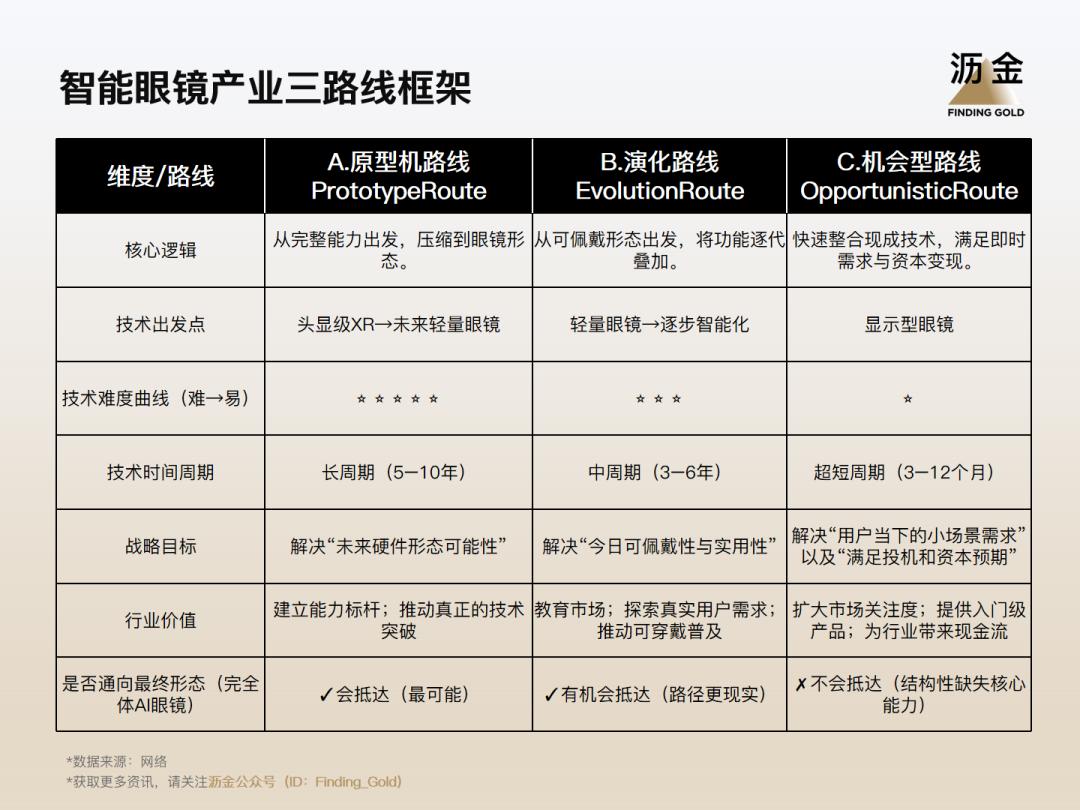
The core logic of the prototype route is to first build all the capabilities that a future entry point might need: high computing power, multi - modal sensors, spatial understanding, scene reconstruction, and real - time interaction. These devices do not aim to meet the "daily wear" requirement in the early stage but focus on validating the full form of the next - generation computing entry point.
Only after establishing the capability map can the technology be iteratively compressed into the form of glasses. The challenges are obvious - bulky, expensive, and limited battery life - but it undertakes the task of defining the future boundaries. This is a route from complexity to simplicity, first proving the future and then approaching reality.
The evolution route is different. It doesn't start with full capabilities but from the "wearable glasses form" itself, making incremental improvements around practical capabilities: shooting, live - streaming, voice assistants, real - time sharing, cloud - based inference, and lightweight spatial understanding... Each generation expands capabilities in real - world usage scenarios, finding a stable evolution path between "portability" and "intelligence."
The advantage of this route is that it is close to users' lives and has a fast iteration speed, gradually accumulating intelligent capabilities in a wearable form. However, its upper bound depends on how much the hardware can be compressed and when local computing power can be truly realized. It is more like a path from regular glasses to smart devices rather than compressing a computer into glasses.
The opportunistic route is currently the most common and has the fastest commercialization speed. It uses mature display technology and controllable costs to integrate display capabilities, optical solutions, and basic interaction into the form of glasses, targeting content consumption, private viewing, or single - scenario needs.
These devices often have excellent image quality, a lightweight structure, and clear usage scenarios, but their intelligence is mainly about "improving the existing experience" rather than "understanding the world." Its significance lies in quickly educating the market, lowering the category threshold, and promoting the popularization of the glasses form through functional products.
Although it is still far from real intelligence, it plays an important role in the early stage of the industry.
The starting points, difficulty curves, and time scales of the three routes are different: The prototype route addresses future possibilities; the evolution route addresses current wearability; the opportunistic route addresses users' immediate needs and also undertakes the tasks of validating the market in the early stage, quickly recovering cash flow, and enabling capital expectations to cycle.
In an industry that is still taking shape, these three paths are not mutually exclusive but together form the early ecological background of smart glasses: The prototype route raises the technological ceiling; the evolution route promotes the growth of real - world usage scenarios; the opportunistic route, with its relatively controllable product form, provides the commercial momentum needed for the entire industry to operate continuously.
The future complete AI smart glasses may not come entirely from a single route but are more likely to be the result of the convergence of these routes when technology matures and the market