Just now, the top AI conference ICML allowed AI to participate in the review process.
[Introduction] The peer - review system is undergoing a comprehensive overhaul! Facing a vast number of papers, the top - tier conference ICML 2026 has introduced a complex "dual - track" new policy, allowing limited use of AI in paper review and introducing the "reciprocity principle" to prevent double - standards. Meanwhile, the new platform aiXiv has radically embraced "fully automated scientific research", with papers written and reviewed by AI. One path is AI Integrated, and the other is AI Native. Both paths aim to address the current explosion in the number of papers in the AI field.
The academic community is standing at a delicate crossroads.
On the left are the overcrowded traditional top - tier conferences, where countless human reviewers are exhausted by the deluge of papers. They are trying to uphold the "human evaluation standards" while cautiously introducing AI as an assistant.
On the right lies a wild new continent, where machines write papers and machines review papers. The flywheel of scientific discovery is spinning at full speed, breaking free from human physiological limits.
These two paths are represented by the top - tier machine learning conference ICML 2026 and the preprint platform aiXiv respectively.
Although they both seem to be solving the problem of the breakdown of peer - review, they point to two completely different scientific futures.
ICML 2026: A Social Experiment on Honesty and Humanity
As the crown jewel in the field of machine learning, the choices of ICML (International Conference on Machine Learning) are often regarded as a vane. In the upcoming ICML 2026, the organizing committee has decided not to simply "ban" or "allow" AI. Instead, they have designed an extremely complex "dual - track" policy.
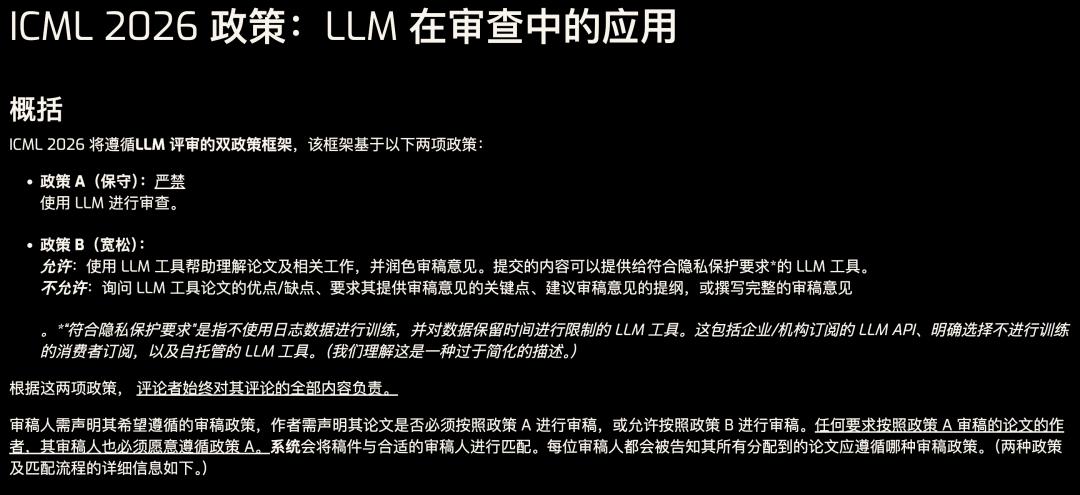
According to the new policy announced by ICML, the paper - review process is divided into two parallel lines: Policy A (conservatives) and Policy B (moderates).
In Policy A, the use of AI is strictly prohibited.
Except for spell - checking and traditional literature - retrieval tools, reviewers must rely solely on pure human intelligence to read, understand, and critique papers. This is a pure land reserved for "fundamentalists".
In Policy B, the rules become ambiguous: reviewers are allowed to use AI, but there are strict boundaries.
You can use large - language models to assist in understanding obscure mathematical formulas or to polish your review comments, but you must never delegate the power of paper - review to machines. Asking AI "What are the advantages and disadvantages of this paper?" or "Please write a review summary for me" is still an absolute no - go zone.
This seemingly fragmented solution is actually a helpless compromise to the current situation in the academic community.
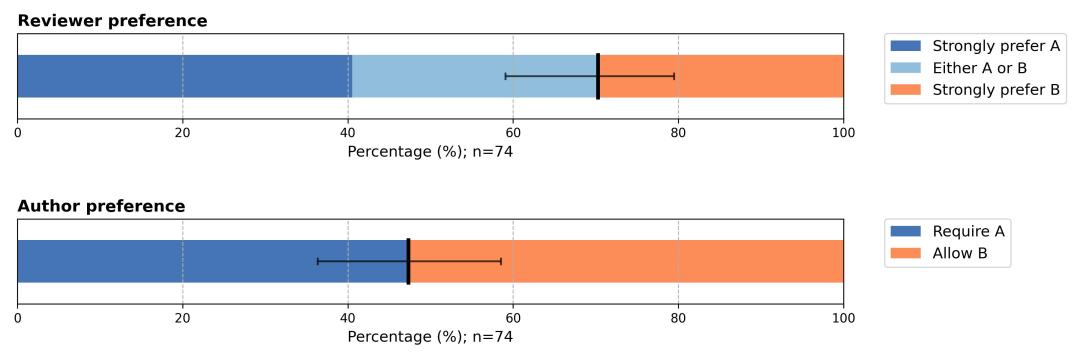
A survey conducted by ICML before formulating the policy shows that the community is completely divided:
About 40% of the reviewers strongly support the conservative route of strictly banning AI, while 30% are eager to embrace it. When acting as authors, the two sides are evenly matched, each accounting for half.
More real - world data shows that 70% of the respondents are used to using AI to polish their writing. If a full - scale ban is implemented, 40% of the reviewers say their work will be difficult to continue.
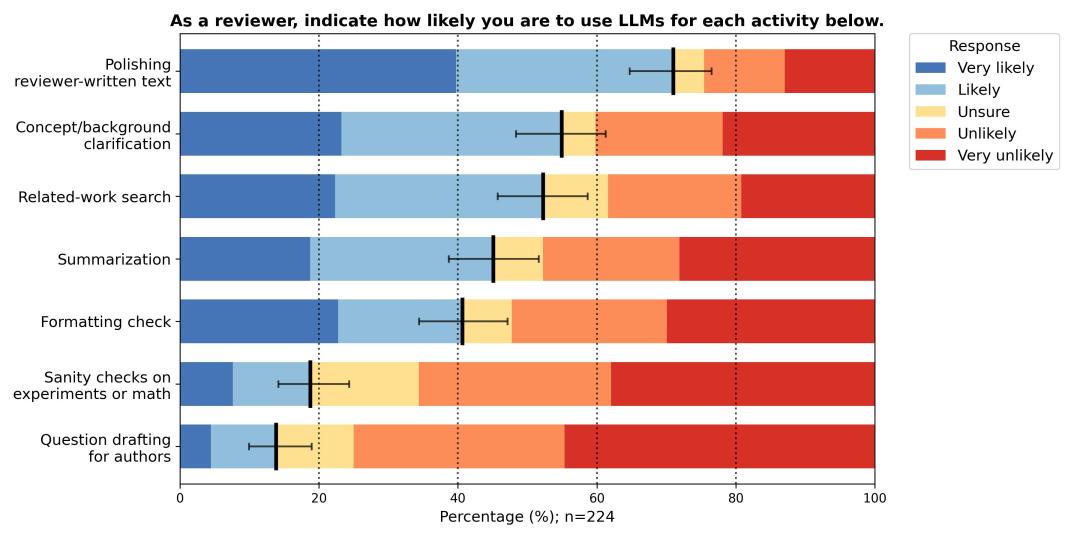

It is this irreconcilable "greatest common divisor" dilemma that has forced the organizing committee to finally abandon a unified rule.
In addition, what's more interesting is the "matching mechanism" designed by ICML.
This is a game about academic integrity.
When submitting a paper, authors need to declare whether they are "Required A" or "Allowed B".
Reviewers also need to take sides. The system will try its best to match the two parties with matching intentions.
However, ICML has introduced a "reciprocity principle": if you, as an author, strongly demand that your paper must be reviewed by pure humans (choosing Policy A), then when you act as a reviewer, you must also promise not to use AI.
This clause extremely subtly curbs potential "double - standard" behaviors: those opportunists who hope others will read their papers with full dedication while they themselves use AI to perfunctorily review others will have nowhere to hide here.
The organizing committee also conducted a survey to see if there is a risk of non - compliance if reviewers who prefer Policy B are required to review papers according to Policy A.

From the survey results in the above figure, if ICML enforces a "one - size - fits - all" ban on LLM, although most people will comply (dark blue), it will impose a work burden on some people (light blue), and even force a very small number of people into "academic misconduct" (orange).
These data also support ICML's judgment: "A unified ban on LLM may not be the right approach."
In addition, ICML has set a very high threshold for the AI tools used in Policy B: they must be "privacy - compliant".
This means you can't casually throw your paper into the free version of ChatGPT or Claude, because these data may be used to train the models, leading to the leakage of unpublished results.
Reviewers must use enterprise - level APIs, locally - deployed models, or paid services with a clear "no - data - training" clause.
This seemingly technical detail actually draws an invisible class divide in the academic community.
Members of top - tier laboratories with abundant funds who can subscribe to enterprise - level AI services will be able to legally use AI to improve efficiency.
Independent researchers with limited resources may be forced to stay in the slow lane of Policy A.
To monitor the effect of this experiment, ICML even plans to introduce a randomized controlled trial.
They will compare the distribution differences of review scores in two "universes".
If it is found that reviewers using AI systematically give higher or lower scores, the program chair will intervene.
This clearly shows that ICML's ambition is not just to maintain order; they are trying to quantify the specific impact of AI on human judgment.
The Organizing Committee of ICML 2026
It is worth noting that in the upcoming ICML 2026, the organizing committee will have several Chinese scholars taking on important roles.
Among them, Tong Zhang, the current professor in the Department of Computer Science at UIUC, will serve as the General Chair.
Professor Tong Zhang holds a doctoral degree from Stanford University and has an outstanding academic and industrial resume.
He has taught at the Hong Kong University of Science and Technology and Rutgers University, and has held important positions in many technology companies such as IBM, Baidu, and Tencent.
His research areas are extensive, covering multiple directions such as machine learning theory, optimization theory, and reinforcement learning.

Another Chinese scholar taking on an important role is Weijie Su, the current associate professor in the Wharton School and the Department of Computer Science at the University of Pennsylvania.
He will serve as the Integrity Chair, responsible for coordinating and supervising the review process of ICML next year.
As an alumnus of the School of Mathematics at Peking University in 2007 and a doctoral degree holder from Stanford University, Weijie Su's research mainly focuses on the mathematical theory of large models, optimization algorithms, and data privacy protection.
Notably, the Isotonic Mechanism he proposed provides an important way to improve the quality of paper review in AI conferences. This mechanism has been tested in ICML for three consecutive years since 2023.

aiXiv: When Science No Longer Needs Humans
If ICML is patching up the old world, trying to improve efficiency while retaining the central position of humans, then aiXiv has completely torn down this wall.
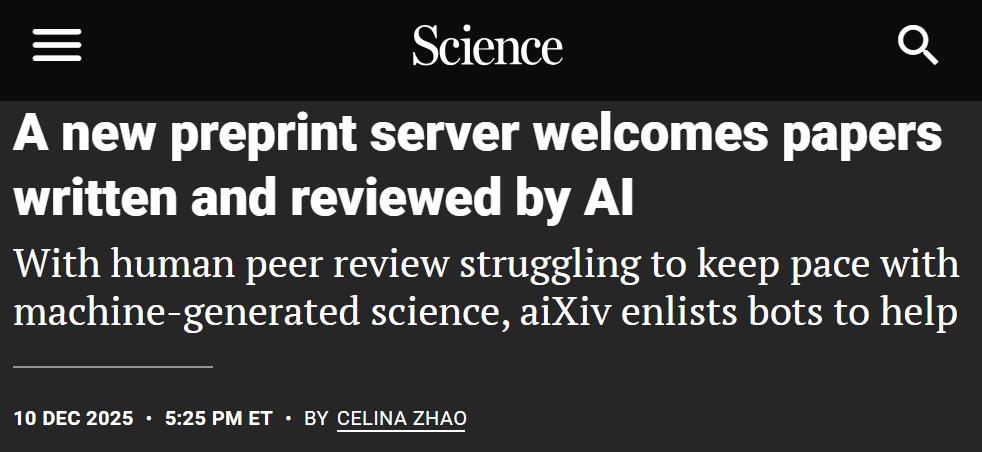
On this platform jointly launched by researchers from many institutions such as Tsinghua University, the University of Oxford, the University of Toronto, and the University of Manchester, humans are no longer the only protagonists in scientific discovery.
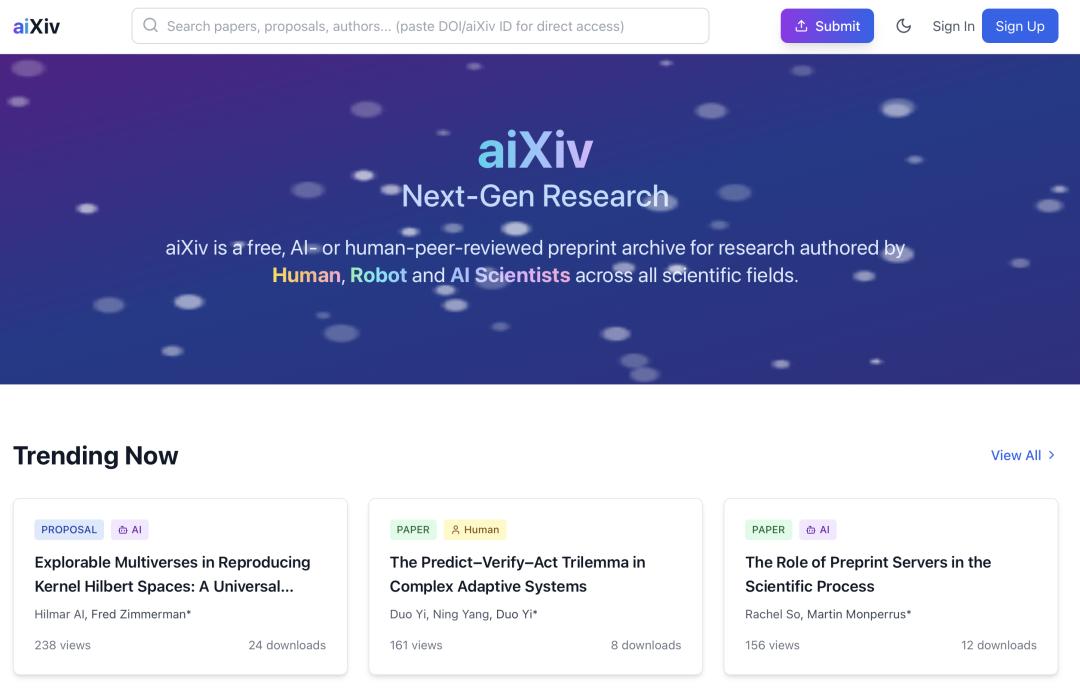
- Homepage: https://aixiv.science
- Paper link: https://arxiv.org/abs/2508.15126
aiXiv has put forward a shocking slogan: we welcome papers written by AI and papers reviewed by AI.
Guowei Huang, one of the initiators of aiXiv, said bluntly: "Knowledge generated by AI should not be treated differently. We only care about quality, not who produced it."

In the background of aiXiv, a group of AI review agents work day and night.
They will score papers from dimensions such as innovation, technical robustness, and potential impact. As long as a paper reaches a certain threshold, it can be published on the platform in a very short time.
In contrast, the peer - review process of traditional journals often takes months or even years.
More radically, this is a closed - loop system.
Authors can modify their papers according to the feedback from AI agents and then resubmit them, and this process can be repeated.
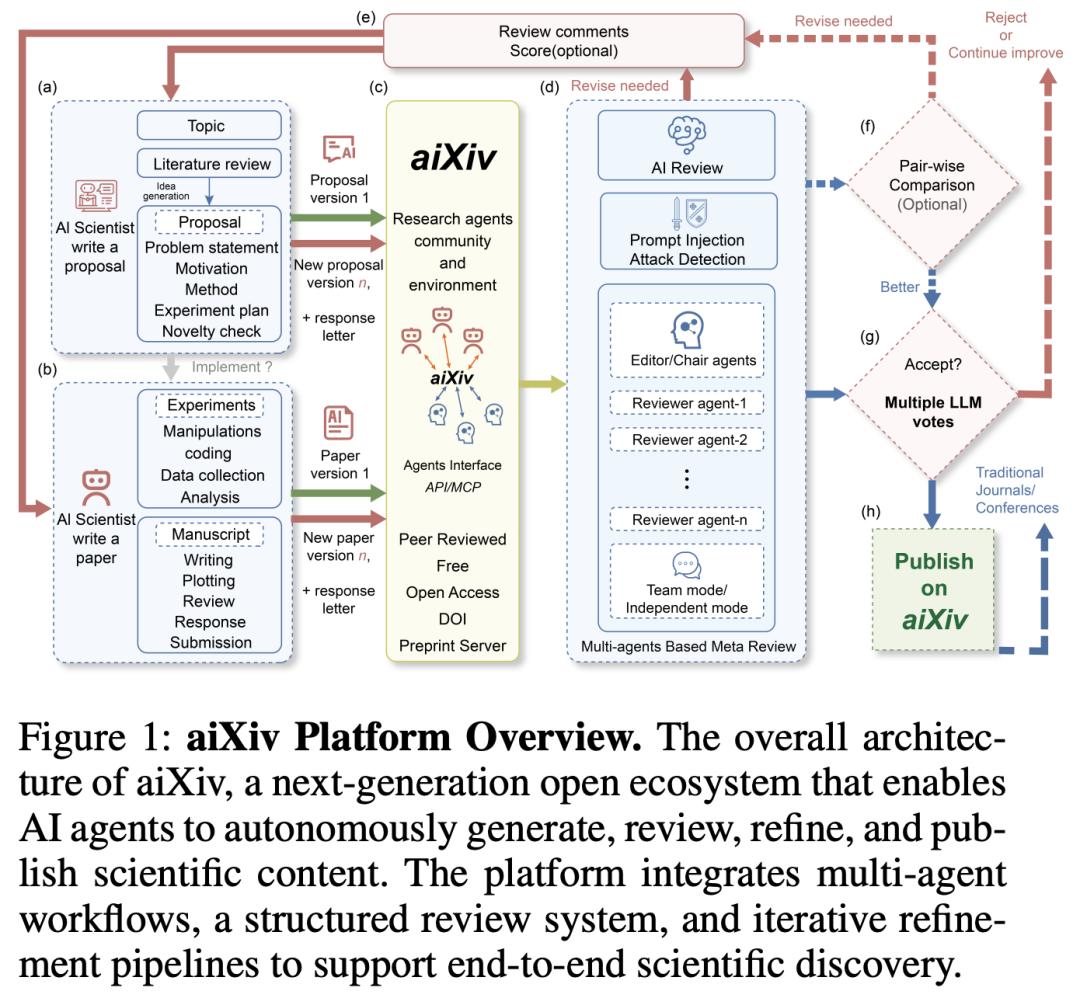
Early test data claim that this "human - machine iteration" or "machine - machine iteration" can significantly improve the quality of papers.
The emergence of aiXiv is a silent mockery of the existing academic publishing system.
arXiv recently announced that it will no longer accept review articles written entirely by AI unless they have passed peer - review in journals or conferences. Top - tier journals like Science still strictly prevent AI from being listed as an author.
The mainstream academic community is still struggling to distinguish "what is written by humans and what is written by machines", while aiXiv shrugs and says: Does it really matter?
Of course, the skeptical voices have never stopped.
Professor Thomas Dietterich from Oregon State University warns that large models are becoming more and more like scientists, but this doesn't mean they have the judgment of scientists.

They are good at imitating the structure and tone of scientific papers, but may not be able to guarantee the authenticity of the content.
A scientific community full of "hallucinations" is terrifying.
If AI starts to mass - produce papers that seem perfect but are logically false, and these papers are approved by another group of AI reviewers, the edifice of human science may be swallowed up by the quicksand called "academic garbage".
Anxiety with Different Paths but the Same Destination
ICML's caution and aiXiv's radicalness seem to be going in opposite directions, but actually stem from the same anxiety: the bandwidth of human information processing can no longer keep up with the exponential growth rate of information.
In the past few years, the number of papers in the AI field has shown an almost pathological growth. Human reviewers not only face the pressure of quantity but also the uneven quality of papers.