In 2026, AI servers will be extremely expensive.
In 2026, it will be a crucial window period for the system-level upgrade of AI servers.
Morgan Stanley stated in its latest research report that AI server hardware is undergoing a major design upgrade driven by GPUs and ASICs. In 2026, NVIDIA's upcoming GB300, Vera Rubin platform, and Kyber architecture, as well as AMD's Helios server rack project, will all bring higher computing power and cabinet density.
Correspondingly, there will be more effective power supply solutions, standard liquid cooling solutions, and higher requirements for PCBs and high-speed interconnections. This system-level upgrade will also make AI servers in 2026 "incredibly expensive."
Explosive Demand for AI Servers
The demand for AI servers continues to rise.
Morgan Stanley predicts that for NVIDIA's platform alone, the demand for AI server cabinets will soar from approximately 28,000 units in 2025 to at least 60,000 units in 2026, more than doubling. Meanwhile, AMD's Helios server rack project (based on the MI400 series) has also made good progress, further intensifying the market's demand for advanced AI hardware.
Currently, NVIDIA's Blackwell platform, especially the GB200 chip, is the core driving force in the current AI server market.
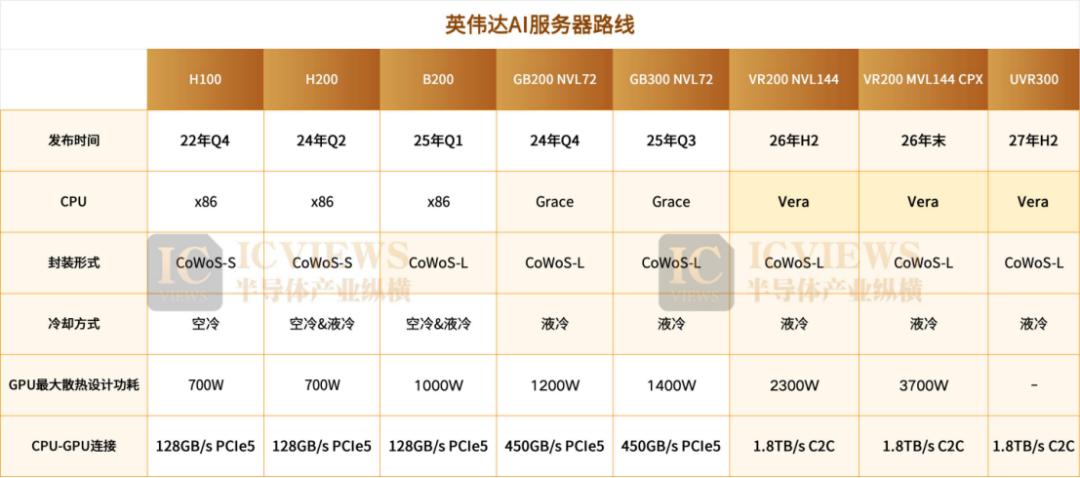
In 2026, AI hardware will shift from the H00/H200 era to a new cycle driven by NVIDIA's GB200/300 (Blackwell platform) and the subsequent Vera Rubin (VR series) platform.
The power consumption of chips continues to break through the upper limit. From the 700W TDP (TDP: Thermal Design Power) of the H100, to 1000W of the B200, then to 1200W of the GB200, and finally to the Vera Rubin (VR200) platform that will debut in the second half of 2026, the maximum TDP of its GPU will soar to 2300W, and the VR200 NVL44 CPX at the end of 2026 will reach as high as 3700W.
As the GPU power consumption approaches 4kW, traditional air cooling solutions are completely ineffective, and liquid cooling has become the only viable option. NVIDIA has made liquid cooling a standard configuration on the GB200 platform and is jointly developing customized cold plate interfaces with major OEM manufacturers to ensure efficient heat transfer to the cooling circuit.
In addition, the power supply system also needs to be reconfigured. Mainstream server manufacturers are migrating from 12V VRM to 48V DC bus to reduce conversion losses and improve power supply response speed. These changes mean that future AI data centers will no longer be just "rooms filled with GPUs." Instead, they will be complex engineering systems integrating power, cooling, and signal transmission, and their construction costs and operation and maintenance difficulties will increase significantly.
These are all the reasons why AI servers are becoming "more expensive."
AI Server ODMs Running at Full Capacity
After NVIDIA switches to the GB300/B300 of the Blackwell Ultra platform in the second half of the year, there will be a new cycle driven by the iterated Vera Rubin platform next year.
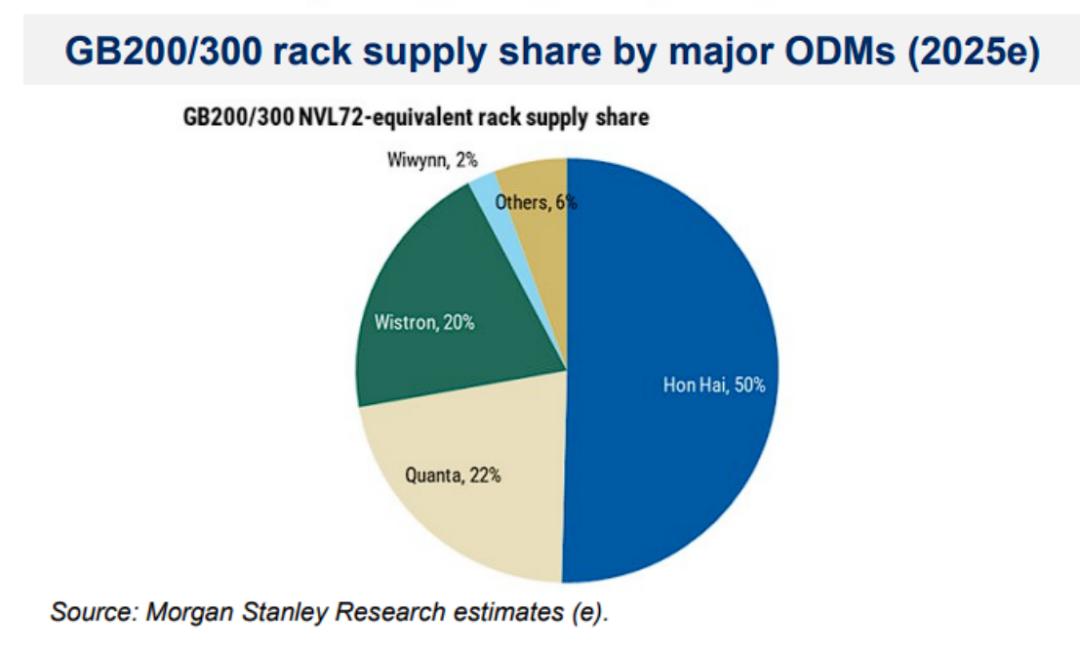
From the perspective of delivery entities, Hon Hai, Quanta, Wistron, and Wiwynn, four ODM manufacturers with NVIDIA Certified Systems certification, are the main suppliers of the current GB200/GB300 full cabinets. Among them, Hon Hai is the first manufacturer to complete the mass production and delivery of GB200 and GB300 full cabinets.
Hon Hai's shipments of AI server cabinets in the third quarter increased by as much as 300% quarter-on-quarter. Overall, Hon Hai's revenue from AI servers in 2025 is expected to exceed the target of NT$1 trillion, accounting for 40% of the market share. The management expects that there will be no major transition issues between the GB200 and GB300 and said that the GB300 will dominate shipments in the second half of 2025.
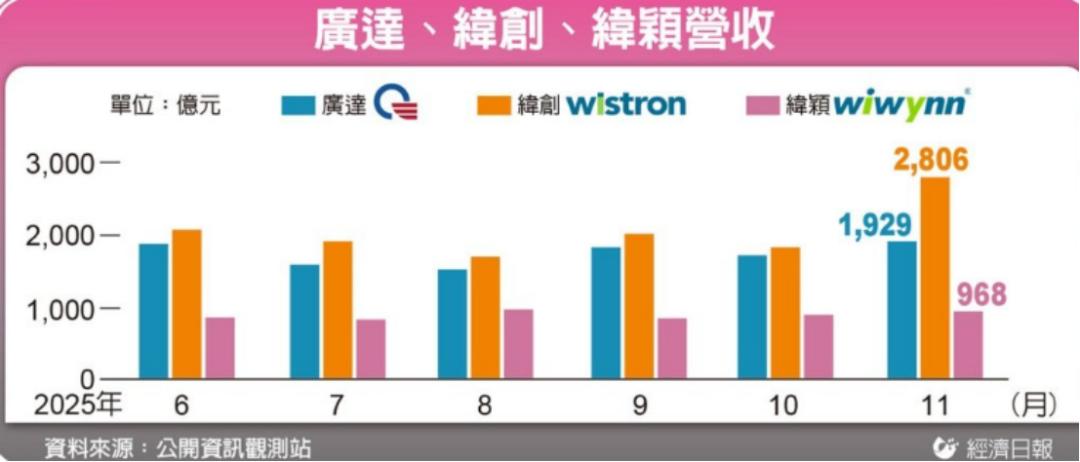
Recently, the revenues of Quanta, Wistron, and Wiwynn in November all reached record highs for a single month. Quanta and Wiwynn achieved revenues of NT$192.947 billion and NT$96.885 billion respectively, with month-on-month growth rates of 11.4% and 6.2% respectively. The latest data shows that Wistron performed the most prominently, with its consolidated revenue in November reaching NT$280.624 billion, a month-on-month increase of 51.6% and a year-on-year increase of as high as 194.6%.
Morgan Stanley predicts that the shipment volume of GB200 in November was 5,500 cabinets, a 29% increase from October. Among them, Quanta shipped 1,000 - 1,100 cabinets, Wistron 1,200 - 1,300 cabinets, and Hon Hai approximately 2,600 cabinets.
Looking at the market share of shipments of GB200 and GB300 rack servers by each ODM in 2025, Hon Hai accounts for more than half of the market share, as high as 52%; Wistron accounts for about 21%; Quanta accounts for about 19%. In terms of product types, GB200 accounts for as high as 81%, and GB300 accounts for about 19%.
Analysts expect that as NVIDIA's new GB300 architecture AI servers enter the peak shipping season, the performance of the three manufacturers this quarter is expected to reach new highs, driving their annual revenues to achieve excellent results with an annual increase of at least 50%.
Industrial Chain Upgrade
This year in late September, NVIDIA's GB300 AI servers were shipped. In the second half of 2026, the Vera Rubin series will be shipped, including power supplies and heat dissipation designs that are different from the GB series. This is an opportunity for component manufacturers to reshuffle their shipments and has also driven the upgrade of the entire industrial chain.
Power Supply
As AI workloads grow exponentially, the power demand of data centers has also skyrocketed. Take devices equipped with NVIDIA GB200 NVL72 or GB300 NVL72 as an example. They need to be equipped with up to 8 power racks to supply power to the MGX computing and switch racks. If the 54V DC power distribution is still used, under the megawatt-level power demand, the Kyber power rack will occupy up to 64U of rack space, leaving no installation space for computing equipment. At the 2025 GTC conference, NVIDIA demonstrated an 800V sidecar solution that can supply power to 576 Rubin Ultra GPUs in a single Kyber rack; another alternative is to configure a dedicated power rack for each computer rack.
The traditional 54V in-rack power distribution system was designed for kilowatt-level racks and can no longer meet the power supply requirements of megawatt-level racks in modern AI factories. NVIDIA is elevating its power supply strategy to a new strategic level. Through the next-generation Kyber platform, it is extending its technological moat from chip computing power to the entire power architecture of the data center, aiming to define the standard for future AI factories.
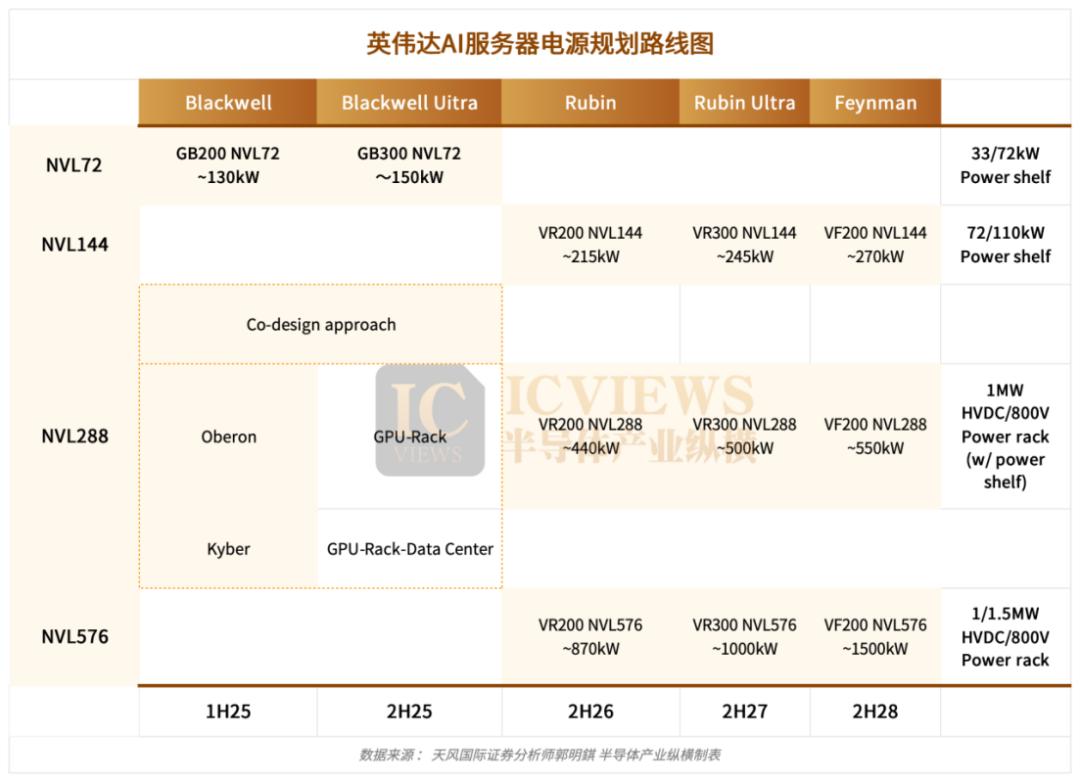
NVIDIA's AI server power supply strategy "Kyber" is advancing on two fronts, and its mass production target is set before the end of 2026, earlier than the market's general expectation of 2027.
According to the analysis of Guo Mingji, an analyst at TF International Securities, the scope of the reference design for the Kyber project has been significantly expanded. It is no longer limited to the GPU and cabinet levels but includes the power supply and infrastructure of the entire data center, including the application of 800 VDC/HVDC power distribution and solid-state transformers (SST). That is to say, since the Kyber era, the importance of the power supply architecture within NVIDIA has been elevated to the same strategic level as semiconductors.
Morgan Stanley predicts that by 2027, the value of the power supply solution designed for the Rubin Ultra cabinet (using the Kyber architecture) will be more than 10 times that of the current GB200 server cabinet. At the same time, by 2027, the value of the power supply solution per watt of power consumption in AI server cabinets will also double compared to the current level.
Heat Dissipation
As the performance of CPUs and GPUs in data centers continues to improve, their power consumption has also skyrocketed, and the trend of rising heat dissipation costs is very obvious.
NVIDIA's liquid cooling technology roadmap shows a clear progressive upgrade feature. In the early stage, the GB200 adopted a single-board one-way cold plate + air cooling combination solution, with the cold plate covering high-temperature areas such as the CPU and GPU, and air cooling responsible for low-temperature components such as the power supply. The new-generation GB300 has been fully upgraded to a full cold plate liquid cooling solution, which can stably handle a heat dissipation demand of 1400 watts. For the ultra-high power consumption scenario of future Rubin chips, NVIDIA has planned a coupling solution of two-phase cold plate liquid cooling and silent (immersion) liquid cooling.
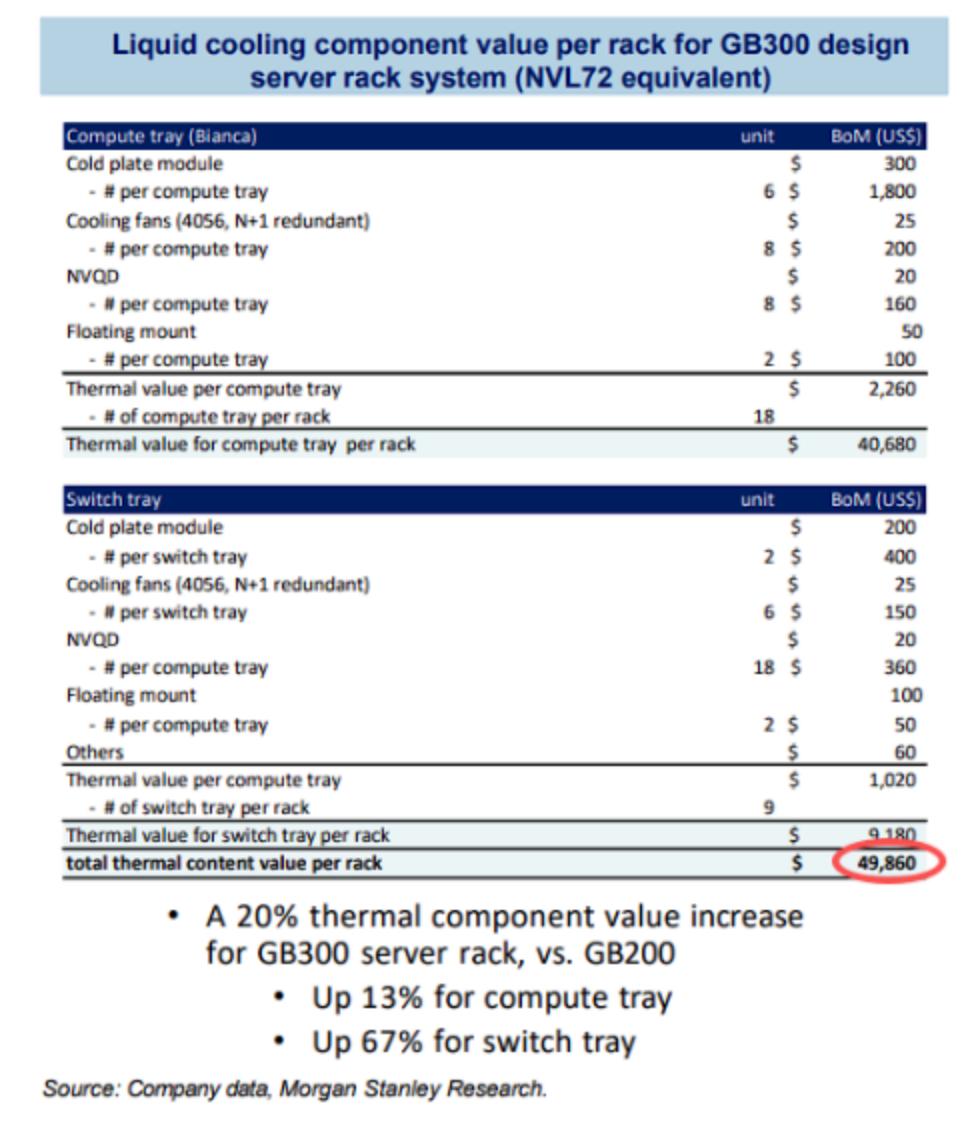
Specifically, for NVIDIA's GB300 NVL72 rack-level AI system, the value of the liquid cooling heat dissipation components alone is as high as $49,860 (approximately equivalent to nearly RMB 360,000), which is about 20% higher than that of the GB200 NVL72 system.
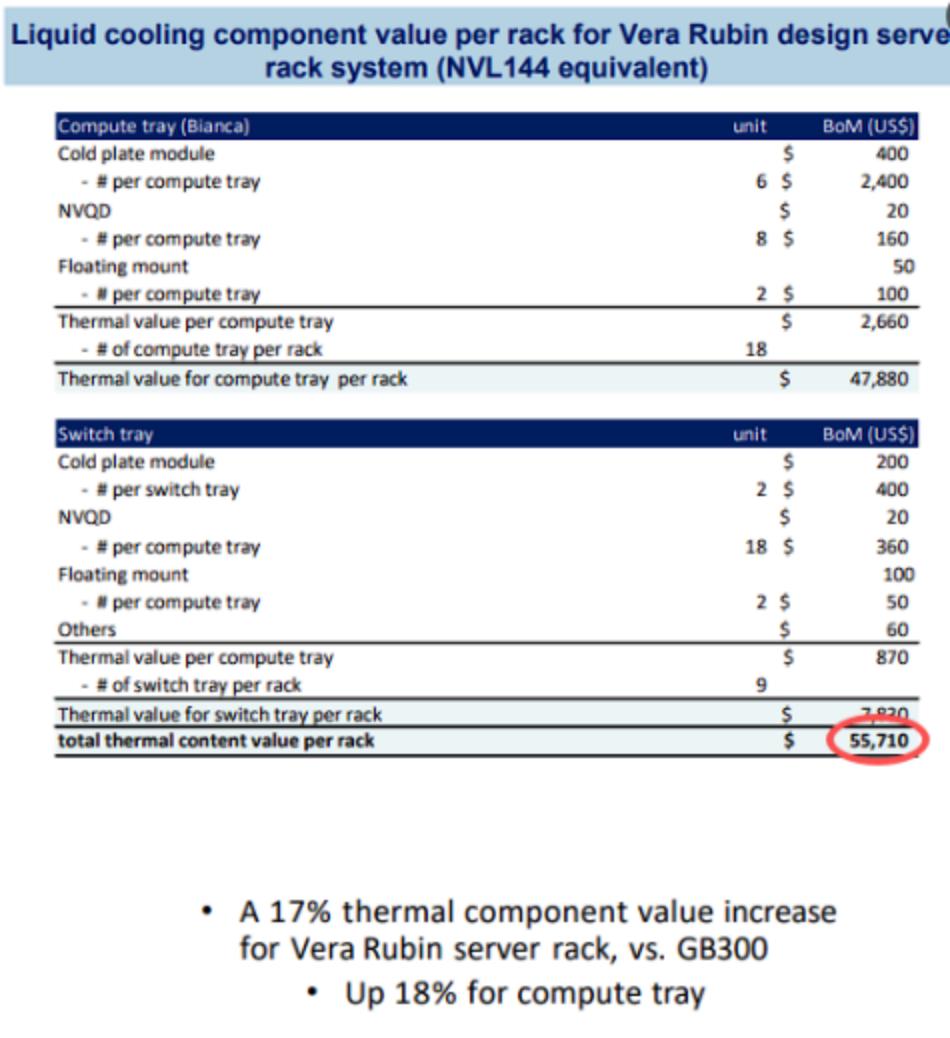
Data shows that the total heat dissipation cost of the next-generation Vera Rubin NVL144 platform will be even higher. As the cooling demand for computing brackets and switch brackets further increases, it is expected that the total value of the cooling components for each cabinet will increase by 17% to approximately $55,710 (approximately equivalent to nearly RMB 400,000), and the value of the cooling module designed for the switch bracket is expected to increase significantly by 67%.
High-End PCBs
The upgrade of hardware such as AI servers has driven a surge in the demand for high-end PCBs. Every time the GPU is iterated, there are higher requirements for the number of PCB layers, material grades, and sizes.
Currently, as the functions of servers are enhanced and computing power is improved, the usage of some functional boards, such as BMC (Baseboard Management Controller) boards, network cards, and PoE (Power over Ethernet) cards, has also increased. In terms of the iteration trend, the number of PCB layers is moving towards higher-end levels, and currently, it has generally reached 44 to 46 layers.
High-end PCBs are showing great demand potential. Prismark data shows that in Q1 2025, the global PCB market size increased by 6.8% year-on-year, and the demand growth rates of high-end HDI boards and high multi-layer boards with more than 18 layers reached 14.2% and 18.5% respectively. Currently, leading manufacturers such as Dongshan Precision and Huadian Technology are tilting their new production capacity towards high-end products with more than 18 layers.
More importantly, the iteration of PCB products is not only an increase in quantity but also a doubling of prices, which will be directly reflected in a significant increase in profits. For example, when upgrading from 400G to 800G or 1.6T, the price of PCBs does not increase by 20% or 30% but doubles.
Huadian Technology said that AI is still the most certain demand at present. From the overseas capital expenditure expectations, it can be seen that cloud computing manufacturers are competing to layout AI infrastructure. In 2025, the capital expenditures of META, Google, Microsoft, and Amazon increased by 60%, 43%, 45%, and 20% respectively year-on-year. The number of layers of AI servers has increased from the previous 14 - 24 layers to 20 - 30 layers, and the number of layers of switches has increased to 38 - 46 layers. Some products will also introduce HDI technology, and the added value of the industry is expected to increase.
Investors Are Ready with "Gold"
Cloud providers are ready. With the growth of demand for AI servers and the upgrade of costs, the capital expenditures of the world's eight major CSPs continue to expand, providing demand support for the "more expensive" AI servers.
TrendForce has revised up the annual growth rate of the total capital expenditure (CapEx) of the world's eight major CSPs in 2025 from the original 61% to 65%. It is expected that in 2026, CSPs will still maintain an active investment pace, and the total capital expenditure will further increase to more than $60 billion, with an annual increase of 40%, demonstrating the long-term growth potential of AI infrastructure.
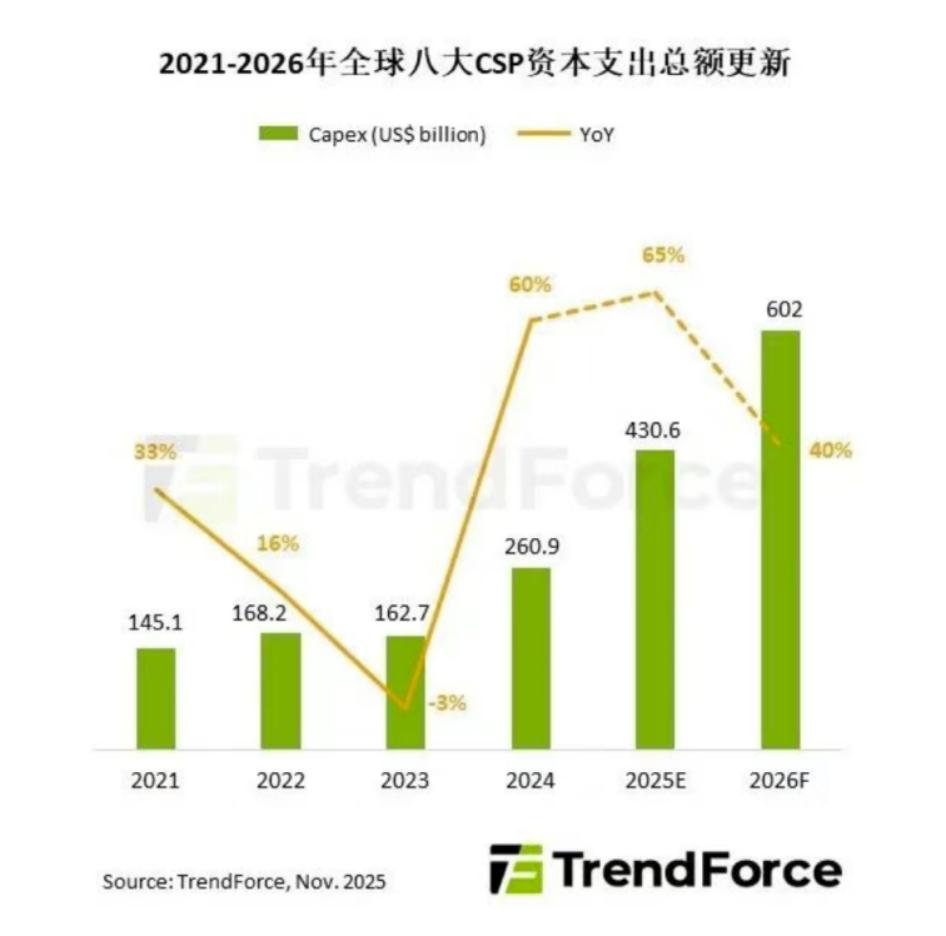
The eight CSPs included in this statistics are Google, AWS, Meta,