Farewell to "Wild Growth": How Does a Group Standard Establish a New Order for the Anti-Aging Market?
If the past decade was the golden age of hyaluronic acid and collagen, then looking back at the end of 2025, PDRN (Polydeoxyribonucleotide) is undoubtedly the "game - changing ingredient" throughout this year. It first became a phenomenon in the South Korean medical aesthetics market and then attracted major domestic brands to enter the fray. Now, it has become a global focus.
More notably, this regenerative and reparative ingredient derived from the DNA of salmonid fish testes is rapidly penetrating from medical aesthetic injections into daily skin care, driving continuous expansion of the industry scale. According to data from Cnyn Research, the global PDRN market size was approximately 180 million yuan in 2023 and is expected to reach 3 billion yuan by 2030.
This means that the compound annual growth rate of this market from 2024 - 2030 will be as high as 43%.
However, there are still many challenges behind this boom - scarce raw materials, high thresholds for production and purification, and low transdermal absorption efficiency. At the same time, in the domestic market, there are problems such as large differences in the quality standards of related ingredients and lack of standardization in efficacy promotion. Therefore, it is urgent to formulate unified industry standards.
Against this backdrop, a conference concerning the future of the industry was recently held. The Chinese Association of Plastics and Aesthetics joined hands with the well - known domestic brand UNISKIN to officially launch the formulation of the group standard "Specifications for the Application of PDRN/PN in Cosmetics", aiming to promote industry upgrading through technical standardization.
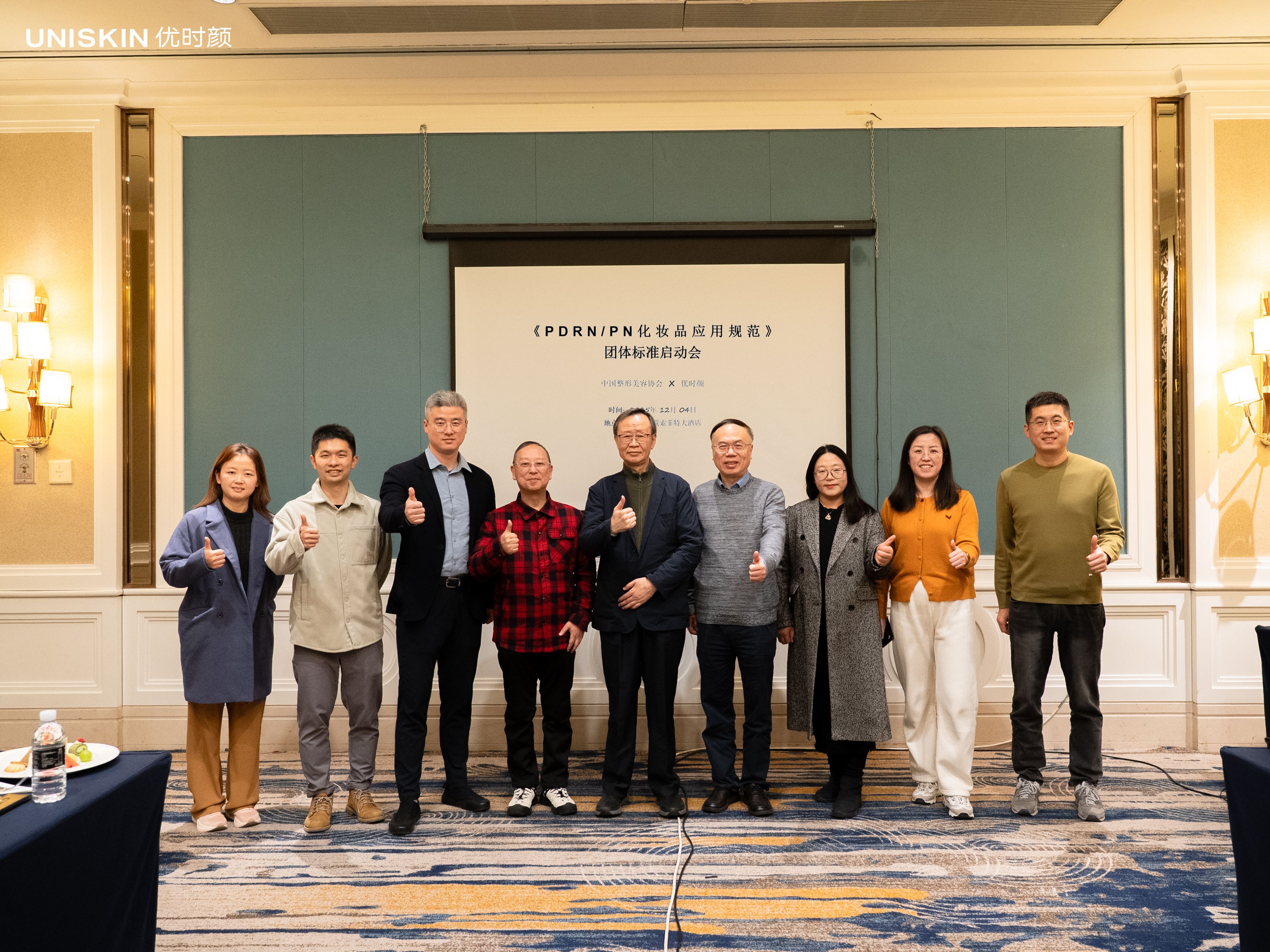
The site of the launch meeting of the group standard "Specifications for the Application of PDRN/PN in Cosmetics"
In a sense, this is not only a milestone for the industry to move towards standardization but also a deep recognition of anti - aging technology research and development and raw material application innovation.
"Cool Thinking" under the Track's Upwind: Opportunities and Pain Points of PDRN
Why has PDRN become the focus of the market? Its core advantage lies in its biological characteristics.
Specifically, this ingredient has a similarity of up to 98% with the base ratio of human DNA and is hailed as the "starter key for tissue regeneration". In clinical medicine, it has been verified to have excellent anti - inflammatory, reparative, and collagen - promoting regeneration abilities.
"Research results show that PDRN can activate multiple pathways, thereby promoting the synthesis of collagen and elastin in skin tissue. It also affects the expression of matrix metalloproteinase (MMP1) to provide energy for skin repair, thus exerting anti - wrinkle and other effects." Liu Yuyan, the sales director of Ruijiming (Shandong) Biotechnology Co., Ltd., pointed out at the meeting.
In response, Liu Wei, the president of the Standards Committee of the Chinese Association of Plastics and Aesthetics, said: "The efficacy of PDRN in the field of skin care goes far beyond this. The deeper mechanism from the perspective of skin science needs to be jointly improved by the industry." This professional guidance not only recognizes the value of PDRN in the skin care product field but also points out to the industry that the efficacy of PDRN is far from being fully explored, and its deeper mechanism still needs to be jointly explored and improved by all parties.
From an industry perspective, the transformation of PDRN from medical - grade to cosmetic - grade faces three major "roadblocks".
First and foremost is the scarcity of raw materials. High - quality, high - purity active PDRN raw materials are still limited, and there are huge differences in quality and efficacy among raw materials from different sources.
Secondly, there are high thresholds in technology and production. To maintain the activity of PDRN, the requirements for extraction and purification processes are extremely high.
Finally, the most prominent issue is the efficiency of "transdermal absorption". As a macromolecular polymer, without effective delivery technology, it is difficult to penetrate the stratum corneum of the skin, resulting in many products being just "conceptual additives".
More fundamentally than technical challenges is the lack of industry standards.
In this regard, Zhao Qiming, the president of the Anti - Aging Branch of the Chinese Association of Plastics and Aesthetics, emphasized: "Currently, in the domestic market, there are many problems in the application of PDRN, such as large differences in the quality standards of ingredients and lack of standardization in efficacy promotion. The industry urgently needs to formulate unified industry standards to provide clear technical guidelines for enterprise R & D, production, and marketing."
Against this backdrop, the collaboration between UNISKIN and the Chinese Association of Plastics and Aesthetics is particularly significant. It is not only a direct response to market pain points but also an attempt by a leading brand to pave the way for the long - term healthy development of the entire track by establishing a "benchmark".
Group Standard Establishment: Pressing the "Standardization Button" for the Billion - Dollar Market
The formulation of standards is often a sign of an industry's maturity.
At the launch meeting of the group standard "Specifications for the Application of PDRN/PN in Cosmetics", industry experts such as Zhao Qiming, the president of the Anti - Aging Branch of the Chinese Association of Plastics and Aesthetics, Liu Wei, the president of the Standards Committee of the Chinese Association of Plastics and Aesthetics, Lao Limin, the director of the Department of Dermatology of the Second Affiliated Hospital of Zhejiang University School of Medicine, Wang Qianqian, an associate professor at the Department of Dermatology of Huashan Hospital, Du Libo, a professor at the Institute of Chemistry, Chinese Academy of Sciences, Xie Yicheng, a professor at Zhejiang University, as well as enterprise representatives from UNISKIN and Ruijiming were present. Such a high - level lineup shows the industry's emphasis on this matter.
So, how will this standard establish a "new order" for the market?
According to the information disclosed at the meeting, this group standard aims to "standardize the quality, safety, and usage requirements of PDRN/PN raw materials in skin care products".
Specifically, it will clarify the scope of application, recommended addition amount, compatibility principles, and label markings of PDRN, and suggest standardized testing methods.
"Formulating standards can ensure stable product efficacy and consumer safety, and provide clear technical guidelines for enterprise R & D, production, and marketing." Professor Liu Wei, the president of the Standards Committee of the Chinese Association of Plastics and Aesthetics, said at the meeting.
Notably, the participating experts suggested clearly distinguishing the application scenarios of PDRN and considering the differences in efficacy requirements for daily skin care, medical aesthetic - grade, and special care - grade products. They also proposed conducting research and integration in terms of molecular weight ratio and concentration to provide certain evaluation criteria.
This means that future PDRN products will be matched with PDRN raw materials of different specifications and concentrations according to different skin care needs (such as post - operative repair, daily anti - aging, and sensitive skin care).
For the industry, this is like a "reshuffle". In the future, brands lacking core R & D capabilities will be exposed, while brands with technical strength can build deeper moats.
Breaking through Technical Barriers: Why PDRN - 850K?
If standards are the "rules" of the game, then core technology is the "weapon" for brands to break through.
In the cosmetic application of PDRN, the biggest point of contention lies in the molecular weight. The academic community generally believes that if the molecular weight of PDRN is too low, although it has good permeability, it is easily enzymatically degraded and has weak receptor - binding ability. If the molecular weight is too high (such as PN), although it has good film - forming and moisturizing properties, it is difficult to penetrate the skin and can only stay on the surface.
Therefore, finding the "golden molecular weight" is the key to breaking the deadlock.
In this regard, as a leading enterprise, UNISKIN's PDRN - 850K technology may provide the optimal solution for the industry at present. This is a specific specification of PDRN screened by the company in cooperation with Ruijiming based on a large number of basic studies and animal experiments.
Why 850K (a medium molecular weight in the range of about 50 - 1500 kDa)? Zhu Meiyan, the senior manager of basic research at UNISKIN, presented key data at this meeting.
Firstly, the balance between penetration and activity: Research shows that medium - molecular - weight PDRN in the range of 50 - 1500 kDa has the best effect in promoting collagen synthesis and wound healing. It retains enough biologically active fragments to activate the A2A receptor and initiate the cell repair pathway, and it is not as difficult to penetrate as the super - macromolecular PN.
Secondly, exclusive penetration - promoting technology: UNISKIN did not stop at raw material screening. To further solve the problem of transdermal absorption, they developed a fibroin composite modification technology and a specific combination of penetration - promoting agents.
Data shows that after treatment, the particle size of the PDRN - 850K aqueous solution is reduced from the sub - micron level to about 200 nm, and the distribution is more uniform. This means it can truly penetrate the stratum corneum and reach the dermis.
Thirdly, cell - level empirical evidence: Experiments have proven that PDRN - 850K can significantly improve the imbalance of fibroblast viability caused by UV damage. At the microscopic level, it activates the Wnt and JAK - STAT dual pathways synergistically, diverting inflammatory signals towards repair and survival. At the same time, it activates the TGF - β/SMAD pathway, increasing type I collagen (COL1A1) by 1.74 times and down - regulating matrix metalloproteinase (MMP1), achieving dual anti - aging effects of "promoting production + preventing degradation".
This pursuit of technical details is ultimately reflected in UNISKIN's products. Take the brand's Smile Eye Cream 4.0 launched this year as an example. It is the first major product to apply the PDRN - 850K technology, leading the eye anti - aging market to a new path with its superior permeability and exclusive mechanism of action.
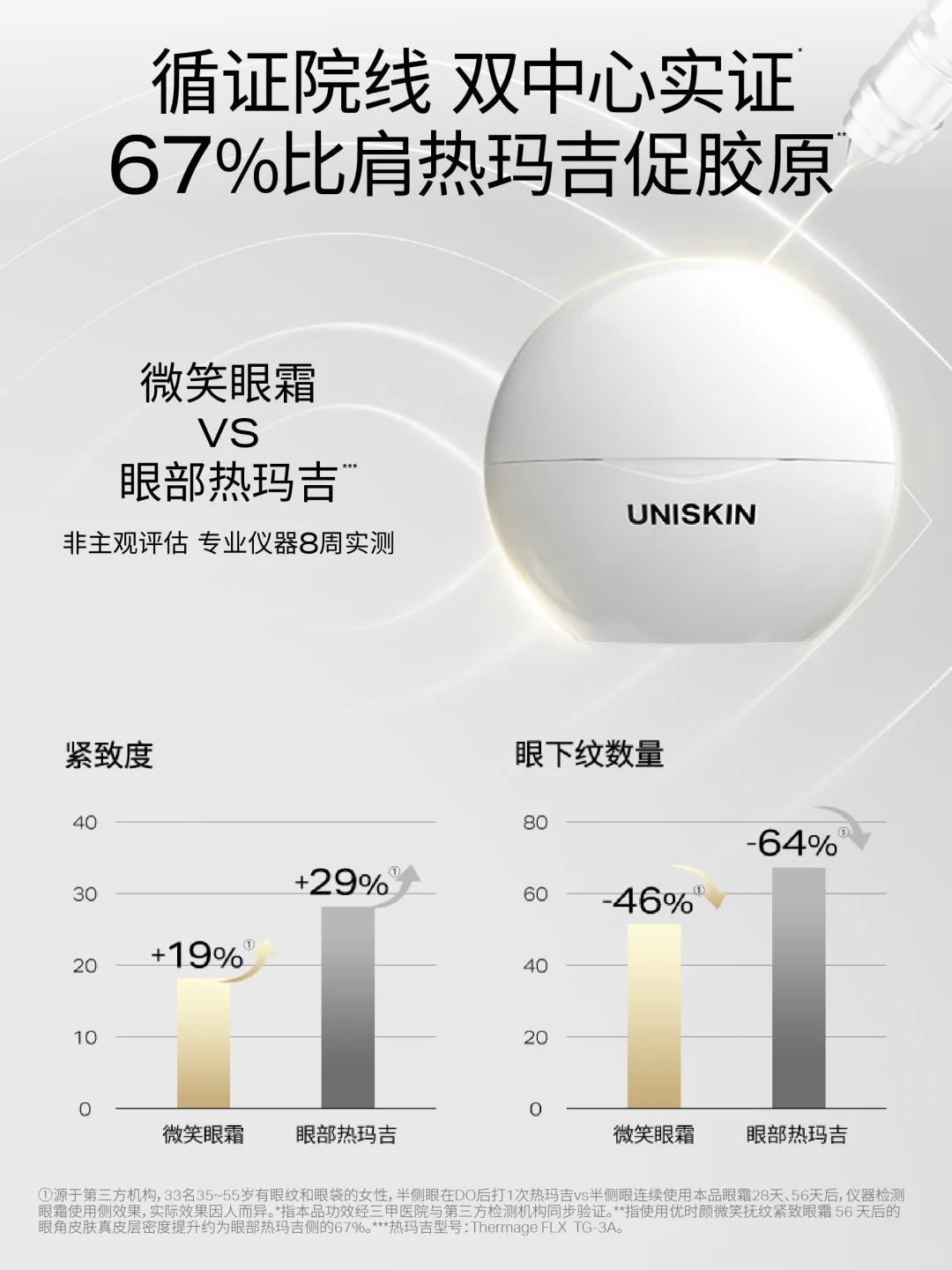
UNISKIN's Fourth - Generation Smile Eye Cream
Research shows that PDRN - 850K has been found to be able to improve the imbalance of fibroblast viability caused by UV damage through multi - pathway synergy, regulate the inflammatory response, and protect against photo - damage. It can not only be applied to daily skin care products but also is suitable for relieving skin damage in delicate areas such as the eyes and restoring a healthy skin state.
Notably, in addition to the Smile Eye Cream 4.0, UNISKIN is still expanding the application boundaries of PDRN - 850K by applying it to products such as hydrating lip oil, caring for delicate skin other than the eyes.
It is not difficult to see that in the highly competitive eye cream market, UNISKIN has established a strong competitive barrier with its scientific efficacy path (cell - level collagen enhancement) and medical aesthetic - grade raw material standards (PDRN - 850K).
Ecosystem Building: From Product Portfolio to "Comprehensive Skin Care"
When analyzing UNISKIN's strategic layout, it can be found that formulating the PDRN group standard is just one move in its grand chess game.
UNISKIN has never positioned itself as a simple "skin care brand". From its inception, it has been deeply rooted in the "medical" concept. The signal released by the joint launch of the group standard is very clear: UNISKIN's goal is to achieve seamless connection between medical aesthetic clinics and daily skin care and build a "comprehensive skin care" ecosystem.
The so - called "comprehensive skin care" is not simply "the same as those in beauty salons" but refers to a complete solution covering the user's skin life cycle.
In the current consumption context, consumers face a serious sense of disconnection: After having photoelectric treatments at a medical aesthetic clinic, what skin care products should they use at home? Are ordinary cosmetic - grade products gentle enough? Can they help prolong the effects of medical aesthetics?
UNISKIN's strategy is "two - pronged approach, closed - loop complementarity": UNISKIN MED (the beauty salon end) provides professional medical aesthetic diagnosis and treatment services and uses medical device - grade products for precise intervention and deep repair; daily skin care (the daily - use end) provides cosmetic - grade products based on medical evidence (such as the Smile Eye Cream) for daily maintenance and post - operative home care.
The application of the PDRN - 850K technology is a typical example of this strategy. The raw materials are from medical aesthetics (homologous high - purity), the technology has been clinically verified (safety and efficacy), and the products are used for daily anti - aging.
In this way, UNISKIN has broken down the barriers between home skin care and medical aesthetic repair.
As mentioned at the meeting, the participating experts suggested considering the differentiated applications of "daily skin care, medical aesthetic - grade, and special care - grade". In fact, UNISKIN is ahead of the curve - from gentle repair of cosmetic - grade products to precise treatment of medical device - grade products, the brand is building a strategic upgrade path from beauty salons to medical aesthetics.
Overall, this ecological layout has stronger user stickiness and higher brand premium compared with single - product sales. It makes UNISKIN not just a bottle on the shelf but a full - cycle partner in the user's anti - aging journey.
Future Evolution: Moving towards the Next Stage of Precision Anti - Aging
Since 2025, the Chinese cosmetics industry has entered the "second half".
In the first half, we witnessed the rise of ingredient - conscious consumers and the sales explosion of domestic brands. In the second half, the competition will focus on basic research, standard formulation, and the construction of technical barriers.
The joint launch of the group standard "Specifications for the Application of PDRN/PN in Cosmetics" by the Chinese Association of Plastics and Aesthetics and UNISKIN is far more than the birth of a standard. It symbolizes that leading Chinese beauty brands are starting to gain the "right to speak" in the industry and are capable of defining what is "good" and what is "standard".
For UNISKIN, this is not only the implementation of its brand concept of "Smile, Be Stronger" but also a leap from a "participant" to a "leader". Through the "troika" of "standard leadership (group standard) + technological innovation (PDRN - 850K) + ecological closed - loop (comprehensive skin care)", UNISKIN is redefining a new paradigm for periorbital and even full - face anti - aging.
Therefore, it is reasonable to believe that the era of wild growth in the PDRN market, which is worth hundreds of billions, is coming to an end. A golden age for brands that respect science and adhere to long - termism is gradually unfolding with the establishment of standards and the deepening of technology.