Elon Musk defiantly retorted to Waymo: You don't even have a chance to compete with Tesla.
"Waymo never really had a chance to compete with Tesla."
It's easy to guess that this bold statement comes from the ever-outspoken richest man, Elon Musk.
However, there's a reason behind his retort. It was actually triggered when the chief scientist of Google DeepMind posted a message implying that there's still a gap between Tesla's and Waymo's Robotaxis.
Taking this opportunity, Musk made another claim that within three weeks, Tesla's Robotaxi will remove the safety driver and truly start fully driverless passenger service.
Musk Retorts to Google Scientist: Waymo Has No Chance to Compete
The origin of Musk's passionate outburst comes from a post on the social platform X by Jeff Dean, the chief scientist of Google DeepMind, the chief scientist of Google Research, and the head of the Gemini project.
This post was originally intended to showcase Waymo's foundational model under Google.
This model constructs a world model architecture centered around a "rapid perception - in - depth reasoning" dual - system by integrating end - to - end and modular designs:
System 1 (Rapid Response): The sensor fusion encoder processes camera/lidar/radar data in real - time, generating object, semantic information, and embedded vectors to support millisecond - level driving decisions.
System 2 (In - depth Reasoning): Based on the Gemini large model, the visual - language model (VLM) uses a vast amount of world knowledge to understand rare scenarios (e.g., actively detouring when a vehicle catches fire).
Both are input into the world decoder to generate high - precision trajectory predictions and safety verification signals.
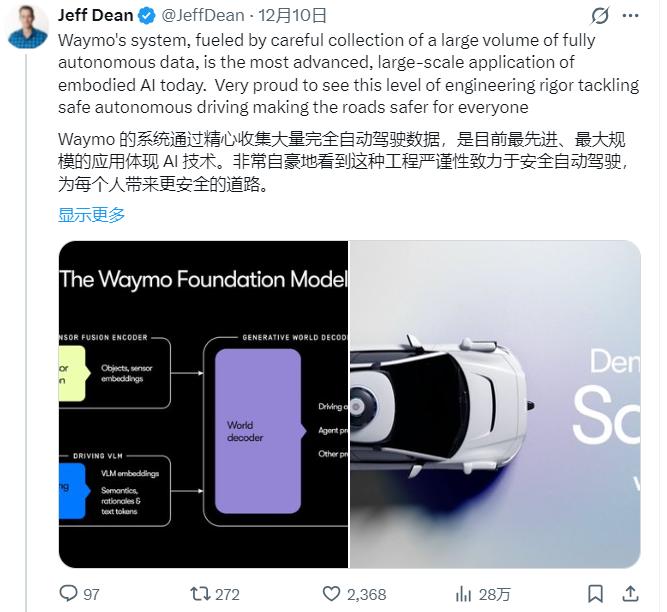
Originally just a simple introduction, but in the comment section, some netizens, eager for drama, asked him which is more advanced, Waymo or Tesla?
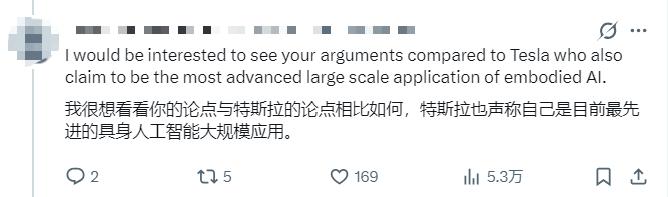
As expected, Jeff's reply supported his company's product, Waymo, and also implied there's a gap between the two:
I don't think Tesla's autonomous driving mileage is close to Waymo's.
He said that Waymo's latest publicly reported fully driverless passenger - carrying mileage is 96 million miles (about 150 million kilometers), and the safety data is quite convincing.
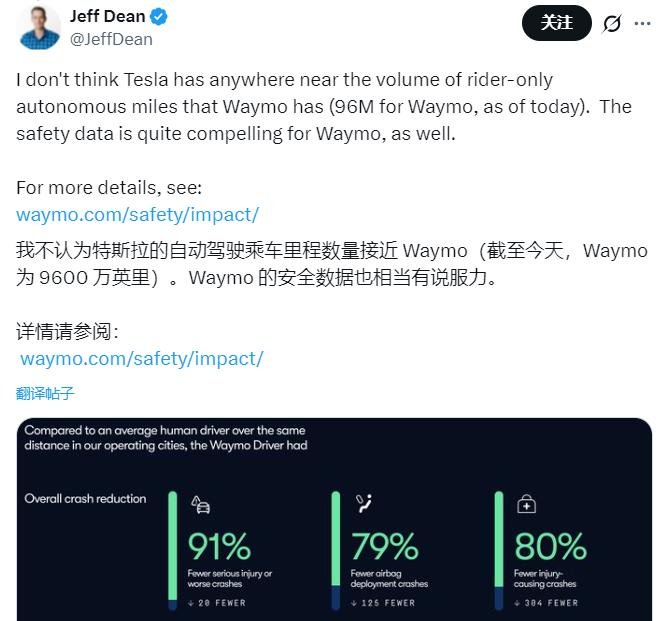
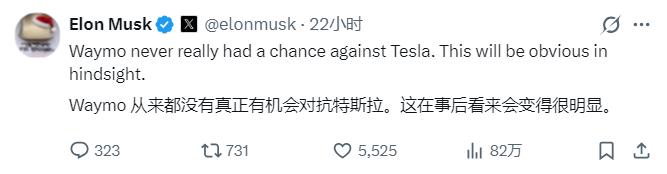
This "angered" the high - profile boss of X, Musk. He immediately replied to Jeff in the comments:
Waymo never really had a chance to compete with Tesla. In hindsight, this is obvious.
So, in the US Robotaxi market, which one is stronger?
Which US Robotaxi Is the Best?
To be fair, Waymo's and Tesla's Robotaxis currently have different advantages.
The "advantage" Jeff emphasized in his post focuses more on fully driverless mileage and safety.
In the Waymo official website link he shared, there are very detailed records of Robotaxi safety data, listing the accident rates of Waymo's fully driverless passenger - carrying (RO) in various situations, compared with the benchmark of human traffic accidents.
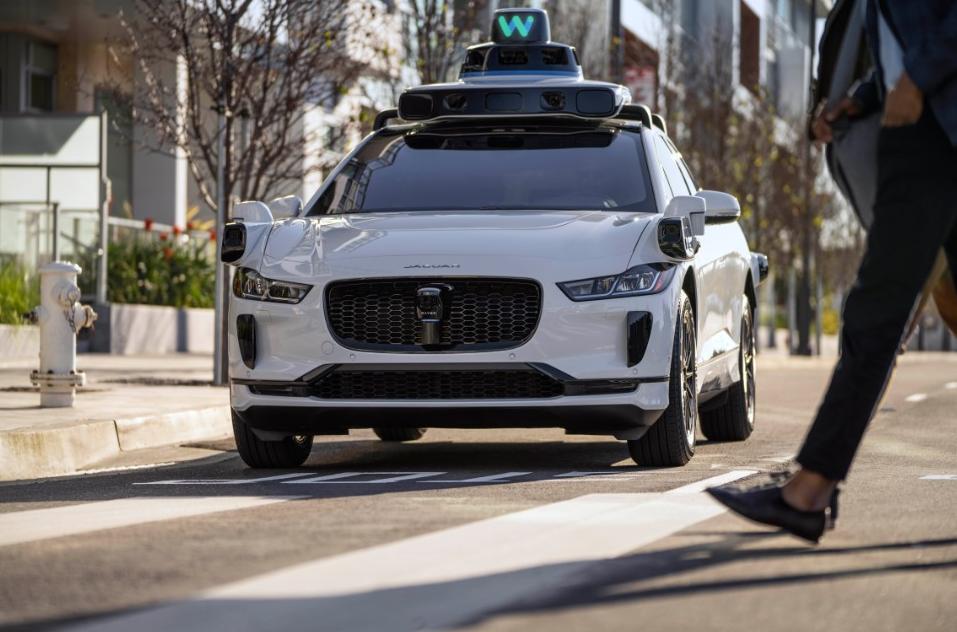
Let's look at some key data:
As of June this year, Waymo has accumulated 96 million miles of fully driverless autonomous driving passenger - carrying mileage.
Phoenix accounts for nearly half of this mileage. According to the latest disclosed data, Waymo has deployed a fleet of 500 vehicles in Phoenix, which is one - fifth of the total fleet.
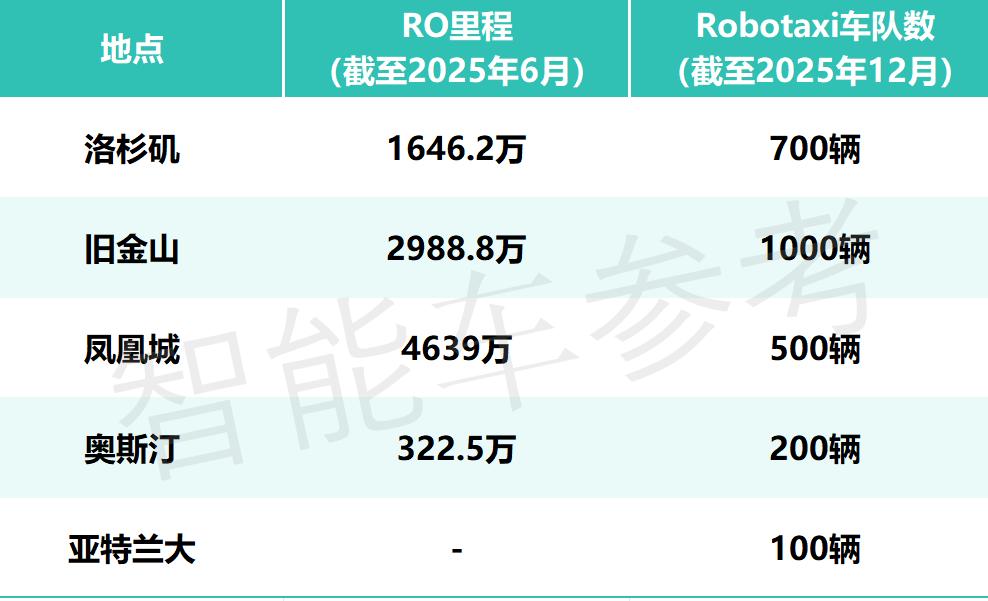
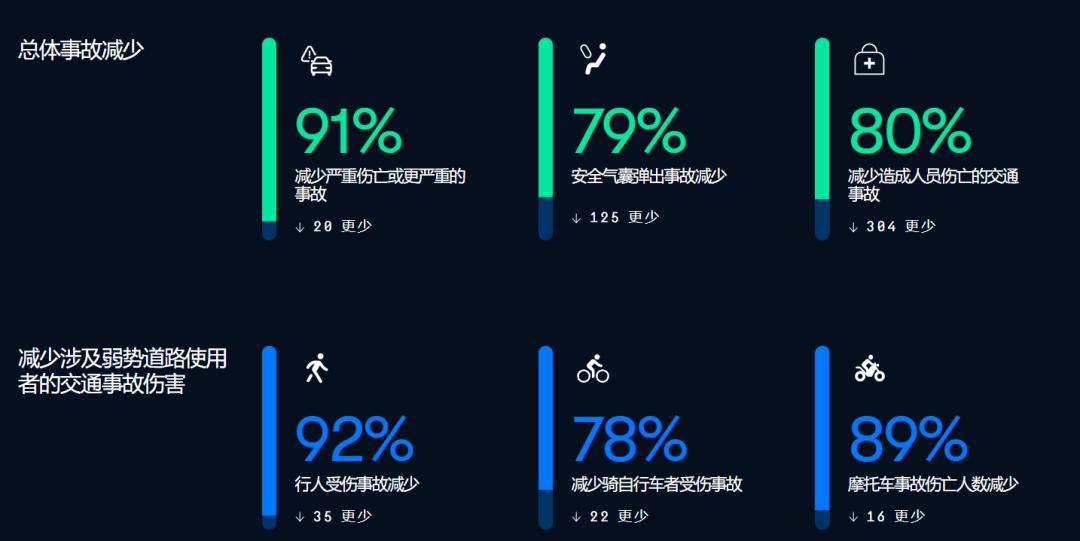
Specifically, in the cities where Waymo operates, compared with ordinary human drivers driving the same distance:
Waymo reduces the probability of serious casualties by 91%, airbag deployment accidents by 79%, and accidents causing casualties by 80%.
For vulnerable road users such as pedestrians, cyclists, and motorcyclists, Waymo claims that its Robotaxi can reduce accident rates by 92%, 78%, and 89% respectively.
There are also more intuitive comparison charts. In 7 scenarios such as front - to - front vehicle collisions, side collisions, and secondary collisions, Waymo outperforms the human average benchmark.
There isn't even a single recorded collision accident for Waymo's vehicles.
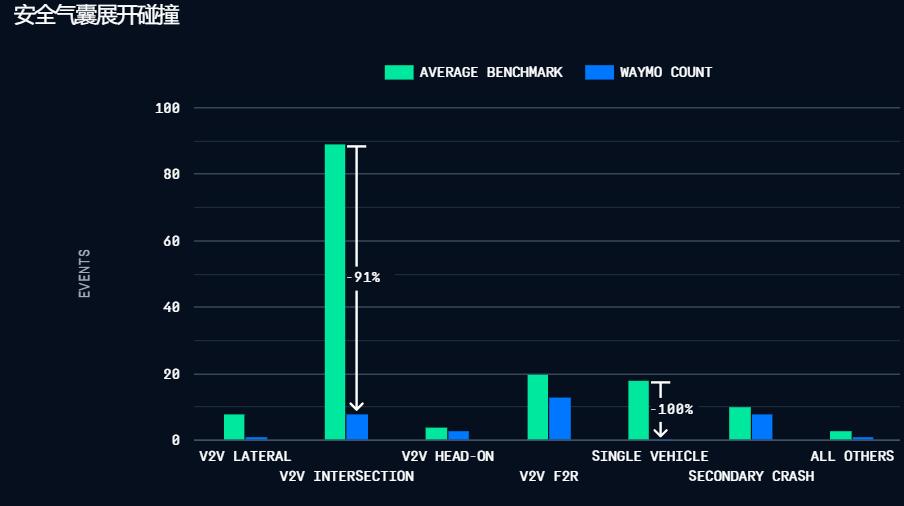
△
In summary, Waymo Driver outperforms human drivers in avoiding accidents that cause casualties and airbag deployments.
Tesla also regularly publishes safety reports, but not just for Robotaxi data. Instead, it focuses on the safety data of FSD, the core technology enabling its Robotaxi:
As of now, the total mileage of Tesla's FSD has reached 6.77 billion miles (about 10.9 billion kilometers). Compared with the overall road safety level in the US, FSD reduces the collision probability by over 80%.
Tesla's statistical method is different from Waymo's. It uses the mileage before an accident as the standard - that is, the higher the value, the fewer collisions and the safer it is.
In both severe collisions (airbag deployment) and minor collisions (no airbag deployment), the mileage driven before an accident with FSD enabled is significantly higher than that of manual driving without FSD.
When FSD is enabled, a major accident occurs on average every 5.1 million miles (about 8.21 million kilometers), significantly higher than the US average of 700,000 miles.
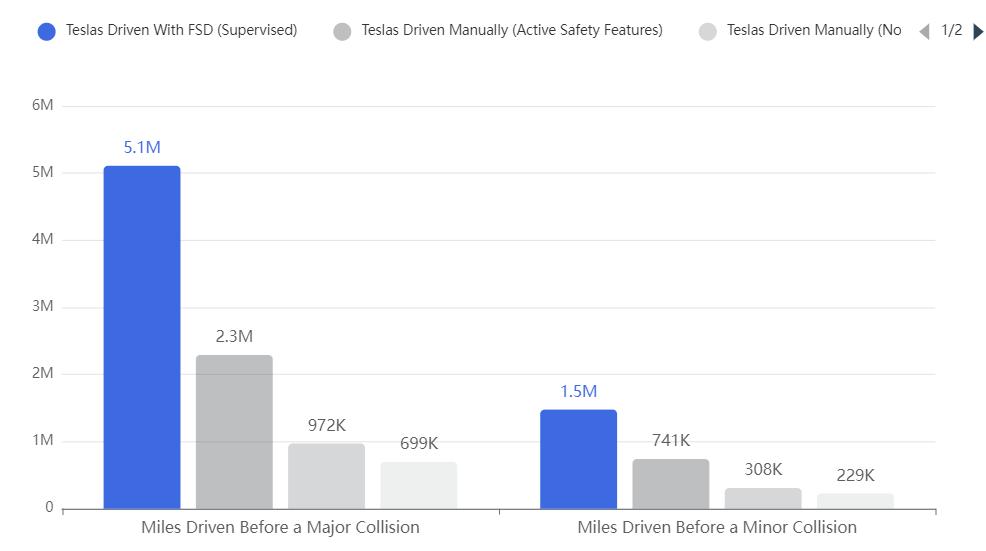
Tesla's statistics show that after enabling FSD, the accident rates of both severe and minor collisions can be reduced to 1/7 of the human level.
However, many people believe that the safety data of the two companies are not comparable at present due to the huge differences in statistical criteria.
Moreover, the data of FSD is still collected with a person in the driver's seat. Tesla's Robotaxi has not removed the safety driver yet, which is one of the reasons why some people are still on the sidelines regarding Tesla.
Coincidentally, Musk is planning to speed things up -
According to what he revealed at the xAI hackathon event this week, within about three weeks, Tesla's Robotaxi will start operating in Austin without any human on board, not even in the passenger seat.
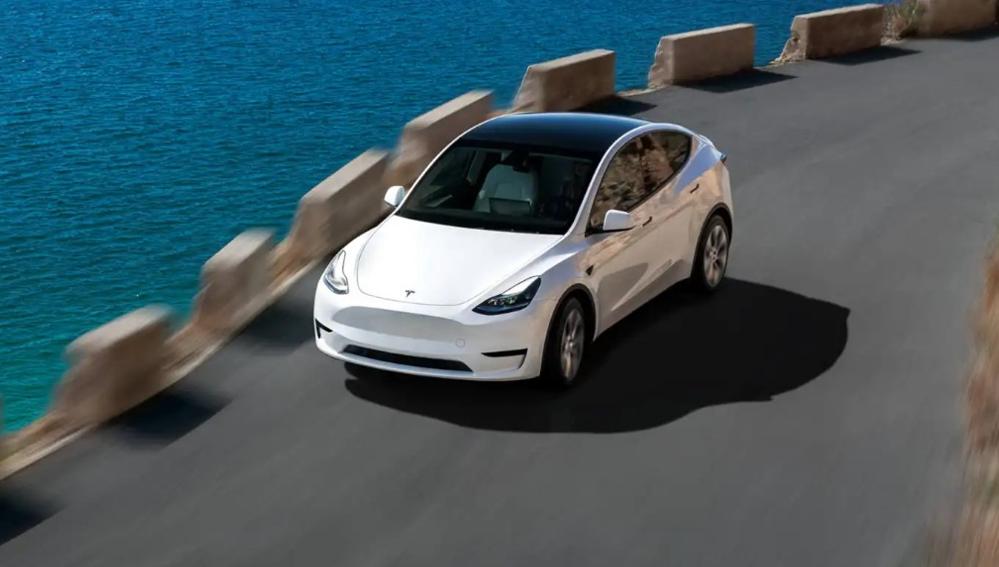
Counting the days, exactly three weeks later is December 31st. It seems that Musk is really going to fulfill his promise of "removing the safety driver by the end of the year".
This is already Musk's fourth public statement in a row, for four consecutive months, about "removing the safety driver" - although the target has been narrowed from all fleets to the Austin fleet.
The reason why Musk is so confident when facing Waymo, which has been operating on a large scale for a long time, may partly come from the speed of Tesla's progress.
Since the initial launch of its Robotaxi in June this year, in just half a year, Tesla's Robotaxi has expanded to more cities than Waymo.
Some netizens have released a US Robotaxi ranking, compiling relevant operating data.
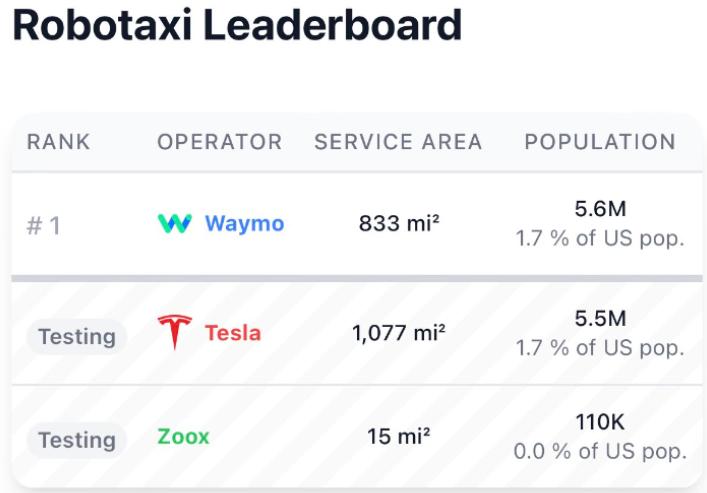
In terms of service scope, Waymo's operating area is about 833 square miles, equivalent to 2,157.5 square kilometers, roughly three times the area within Beijing's Fifth Ring Road.
As for the service population it can reach, it's about 5.6 million people, covering 1.7% of the US population.
Tesla's operating area is a bit larger, currently about 1,077 square miles (about 2,790 square kilometers), and the number of covered people is almost the same as Waymo's.
In addition, Tesla's vehicle cost is lower. The Model Y used for Robotaxi, the long - range rear - wheel - drive version, is priced at about $45,000 (about 318,000 yuan) in the US.
Waymo's currently operating Jaguar I - Pace model is priced as high as $77,300 (about 545,000 yuan) in the US, about 70% more expensive than the Model Y.
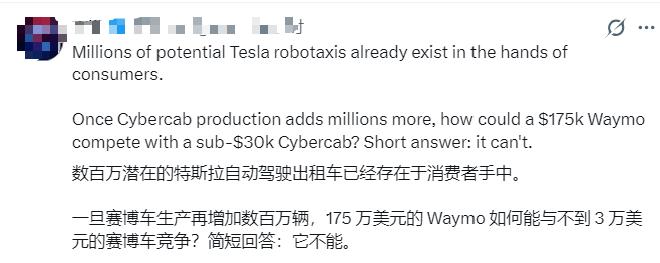
Tesla has another major advantage. As Musk once said, he might consider adding old owners' cars to the Robotaxi fleet. As a netizen put it:
Millions of potential Tesla Robotaxis are already in the hands of consumers.
One More Thing
However, can Tesla really expand its scale and surpass Waymo?
Han Xu, the CEO of WeRide, a company following a similar path to Waymo, made a new prediction at the QbitAI MEET2026 Intelligent Future Conference:
If Musk still uses mass - produced cars like Model 3 or Model Y and refuses to install lidar within three years, he definitely won't be able to achieve Waymo's current level in San Francisco.
He gave an example. In 2018, Musk said that he could drive from one parking lot to another without human intervention, like driving from New York to Los Angeles... But he still can't do it today, at least not with FSD V12.
Musk will indeed achieve many of the things he promised, but it's just a matter of time. Usually, it gets delayed by 8 or 10 years. "I'm looking forward to his success, but he needs to manage his time better."
This article is from the WeChat official account "Intelligent Vehicle Reference" (ID: AI4Auto), author: Jessica. It is published by 36Kr with authorization.