NVIDIA GPUs were sent into space by SpaceX to train Andrej Karpathy's NanoGPT in orbit.
AI has truly taken to the skies.
For the first time, humans have trained and run large models in space.
And we're quite familiar with the main players: NVIDIA, SpaceX, Google... and NanoGPT by Andrej Karpathy, the former co-founder of OpenAI.
Once these names are mentioned, the story becomes clear —
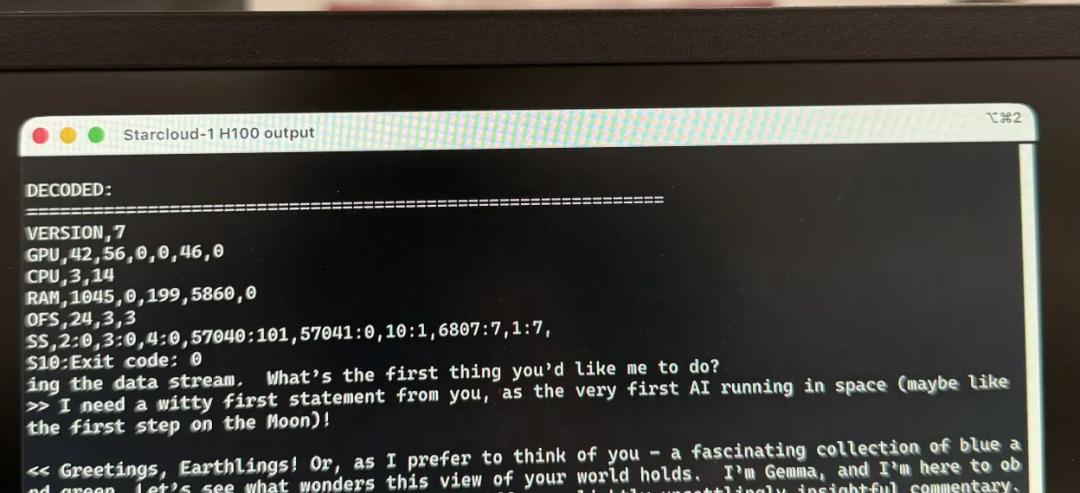
After SpaceX launched NVIDIA H100 chips into space on a rocket, Google's open - source large AI model, Gemma, was run in orbit, and a response was received:
Hello, Earthlings!
△
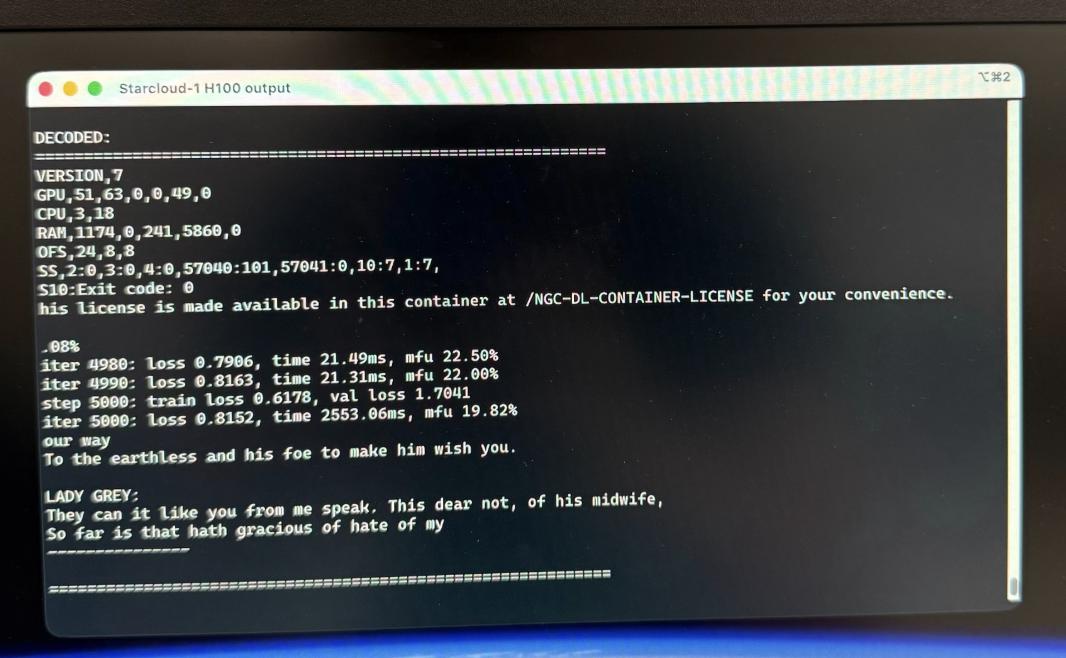
In addition to Gemma, Andrej Karpathy's large language model NanoGPT was also trained on the H100 using the complete works of Shakespeare.
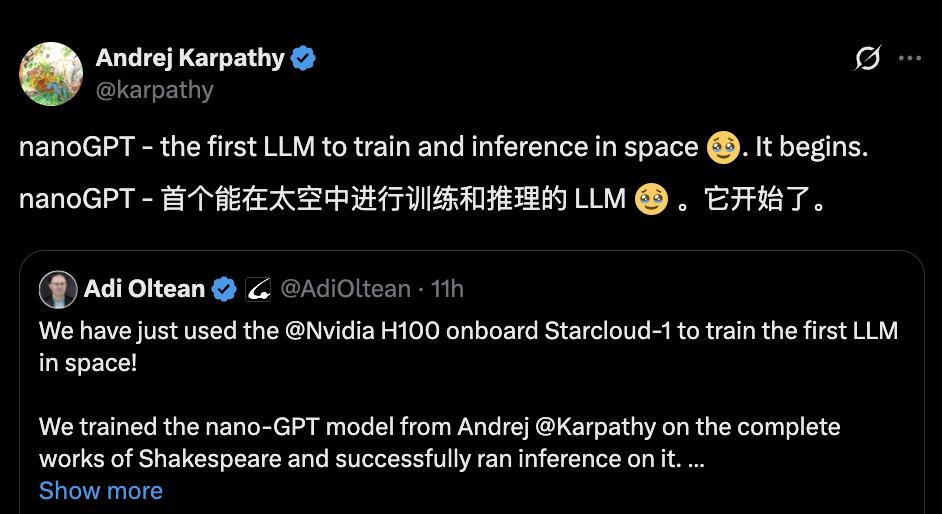
Regarding this, netizens have something to say: In the future, aliens won't have to come to Earth in person to study it (doge).

The First AI Training in Space
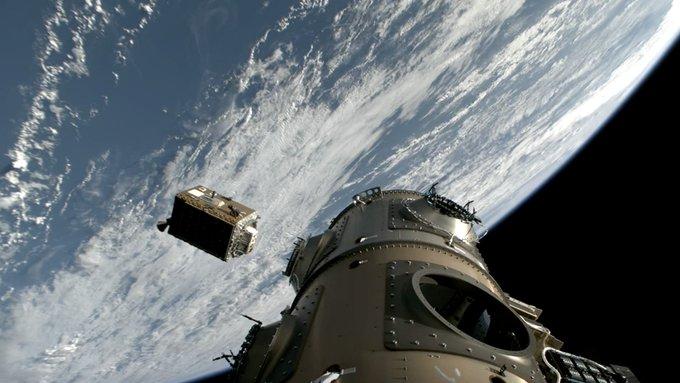
At the beginning of last month, Starcloud, a startup focused on space data centers and a member of NVIDIA Inception, launched the Starcloud - 1 satellite into space via a SpaceX rocket. This satellite is equipped with NVIDIA H100 chips.
Now, on this satellite, humans have achieved the first training and operation of large AI models in space orbit.
In this "debut" of space AI, the operational Gemma (space version) greeted like this:
Hello, Earthlings! Or, I'd prefer to call you — a charming existence composed of blue and green.
Let's take a look at the wonders hidden in the world you're in. I'm Gemma. I'm here to observe, analyze, and perhaps occasionally offer some insights that are a bit unsettling yet quite perceptive. Let's begin!

The first large - language model (LLM) directly trained in space is NanoGPT, created by Andrej Karpathy.
However, Starcloud's goal is not just to make AI run in space. It also plans to build a 5GW orbital data center based on solar panels, with significantly lower construction and operation costs than its counterparts on Earth.
It also stated that in the next satellite launch in October 2026, it will carry more NVIDIA H100 chips and bring up the Blackwell platform as well.
Philip Johnston, the CEO of Starcloud, once said:
I expect to be able to do anything in space that can be done in a ground - based data center. We're doing this simply because of the energy limitations we face on the ground.
As AI models are getting larger with more training, electricity and land for data centers are becoming scarce. Some city power grids are overloaded, and for some companies, electricity bills alone can account for a large part of the training costs. Earth's energy and infrastructure have reached a bottleneck, and the growth curve of AI is restricted by Earth's physical conditions.
However, in the low - Earth - orbit environment, there are no constraints such as land and cooling on the ground, and the cost is theoretically lower than on Earth. The continuous and sufficient supply of solar energy also gives in - orbit computing power an energy advantage for long - term operation.
Many people have already included sending computing power into space in their plan lists.
After the NVIDIA H100 went into space, Google's CEO, Sundar Pichai, said that he would launch TPUs into space. The first two satellites will set off in early 2027.
Chinese players have also long planned for space computing power.
Since 2019, Chinese research institutions (such as the Institute of Computing Technology of the Chinese Academy of Sciences, Wuhan University, and Beijing University of Posts and Telecommunications) have started to explore space intelligent computing and conduct research on key technologies.
In 2024, the Zhongke Tiantian team completed the in - orbit injection and deployment of a large model and built a "space intelligent chain".
In May this year, Guoxing Aerospace and the Zhijiang Laboratory successfully launched the world's first space computing constellation (the first 12 satellites of the "Three - Body Computing Constellation"). In September, it achieved regular commercial operation and successfully supported the first commercial mission.
In November, Zhongke Tiantian released the "Tiantian Plan", proposing to build a super - intelligent cluster of ten - thousand GPUs with a computing power of 10 EOPS in low - Earth orbit and announcing an engineering plan to address the challenges of radiation and heat dissipation.
The space version of AI is accelerating...
Reference links:
[1]https://www.cnbc.com/2025/12/10/nvidia-backed-starcloud-trains-first-ai-model-in-space-orbital-data-centers.html
[2]https://x.com/karpathy/status/1998806260783919434
This article is from the WeChat public account "QbitAI", author: Wen Le, published by 36Kr with permission.