Competing for sky-high advertising slots on the Spring Festival Gala? Unitree and ZhipuAI are reported to be in a battle for positions, and investors are starting to get anxious.
According to media reports, Unitree Technology and Zhipu Robotics are vying for the sponsorship slot of this year's Spring Festival Gala at high prices. Among them, Zhipu offered 60 million yuan, while Unitree's offer was as high as 100 million yuan. Currently, Zhipu has responded that "it's not true," but Unitree has not made a statement.
Questions followed: "Is the industry bubble so big? Are they spending money like water?"
Relevant data shows that since the beginning of this year, the total investment and financing amount related to the domestic robot industry chain has exceeded 80 billion yuan. According to statistics from the "BUG" column, among the enterprises that have publicly released robot products this year, the cumulative financing amount has also exceeded 20 billion yuan.
While a large amount of hot money is pouring in, investors are starting to worry.
An investor who has invested in many robot unicorns told the "BUG" column bluntly: "There are too many humanoid robot enterprises in the market now. We won't invest in new projects anymore." Another investor was equally pessimistic. "80% of the existing companies are likely to be eliminated."
Yu Qing, the president of the Zhejiang Robotics Association, told the "BUG" column: "Most of the current humanoid robots are still controlled manually. There are at least two or three people behind one robot, which completely increases the cost but fails to achieve the expected efficiency."
A Whole Year of Hundred - Million - Yuan Financing
According to IT Juzi data, in 2025, there have been as many as 557 investment and financing events related to the domestic robot industry chain, with the total financing amount exceeding 83.952 billion yuan. Among them, the valuations of leading enterprises such as Zhipu and Unitree have reached the level of tens of billions.
According to statistics from the "BUG" column, as of November 30 this year, among the domestic enterprises that have disclosed obtaining financing and have relevant robot products, the cumulative financing amount of only the top 20 has reached 20.6 billion yuan. This includes: UBTECH received a cumulative financing of HK$7 billion (about 6.3574 billion yuan) through three placements this year; Tashizhihang received a cumulative financing of about 1.708 billion yuan through two angel rounds this year; and companies such as Leju Robot, Xingjidongyuan, and Yinhe Tongyong received more than 1 billion yuan in financing through multiple rounds of financing this year.
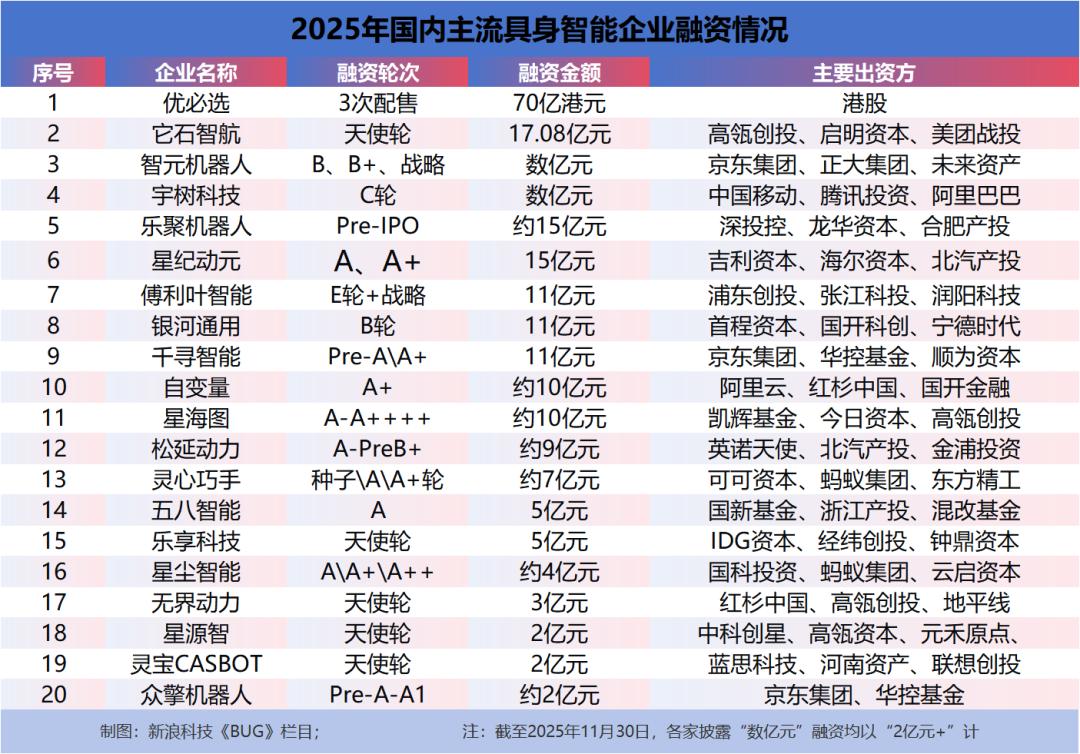
It is worth noting that as the most - watched humanoid robot enterprises this year, both Zhipu Robotics and Unitree Technology have obtained financing successively this year. Zhipu Robotics received capital support four times, but the specific financing amount was not disclosed. Unitree Technology also received "hundreds of millions of yuan" in financing, but the specific amount was not disclosed.
"There are too many enterprises, and 80% will be eliminated."
However, with the influx of a large amount of hot money and new players, the currently popular humanoid robot track is also raising concerns about "bubbles" among many investors and industry insiders.
Recently, an investor who has invested in nearly 10 humanoid robot enterprises said: "The bubble in this field is relatively serious. The valuation of some companies has increased five times in a year, but there hasn't been much substantial progress." In his opinion, in the future, the humanoid robot industry may experience "severe" ups and downs. "80% of the existing humanoid robot companies are likely to be eliminated."
Xu Mou (pseudonym), an investor who has successfully invested in many robot unicorns, also said pessimistically in a communication with the "BUG" column: "There are already too many humanoid robot enterprises in the market. There is no need to invest in new enterprises. We need to wait and see."
Recently, Li Chao, the deputy director of the Policy Research Office of the National Development and Reform Commission, publicly mentioned that "the current humanoid robots are not fully mature in terms of technical routes, commercialization models, and application scenarios." He also warned to "prevent the 'crowded' listing of highly repetitive products."
In fact, there are many problems in the actual implementation process of humanoid robots, mainly reflected in high energy consumption, low precision, and insufficient intelligence. These are the main reasons for being "not favored."
The above - mentioned investor pointed out that in terms of intelligence, neither the basic algorithms nor the data collection of current humanoid robots has reached the convergence stage, resulting in high costs for algorithm research and development. Moreover, it is difficult for the robot "brain" to achieve good generalization ability. Most robots are in the "manual remote control" or customized development stage, with high usage costs and thresholds.
In terms of energy consumption, a single humanoid robot has thirty to forty degrees of freedom throughout its body, and each joint movement requires energy consumption. However, products such as motors and reducers on the market can hardly provide high - efficiency solutions.
According to industry estimates, a 50 - kg - load humanoid robot consumes 2300 Wh of energy when working continuously for 4 hours. However, the current energy density of market batteries remains at 250 - 300 Wh/kg, and it is difficult to break through the "endurance - weight - cost" impossible triangle.
In terms of "precision" control, the industrial scenario requires a repeated positioning accuracy of ≤0.02 mm. However, the perception error of most RGB - D cameras used in current humanoid robots under dynamic occlusion is >5 cm, which is not even one - tenth of the industrial standard. This also leads to "insufficient precision" of humanoid robots in the precision assembly process.
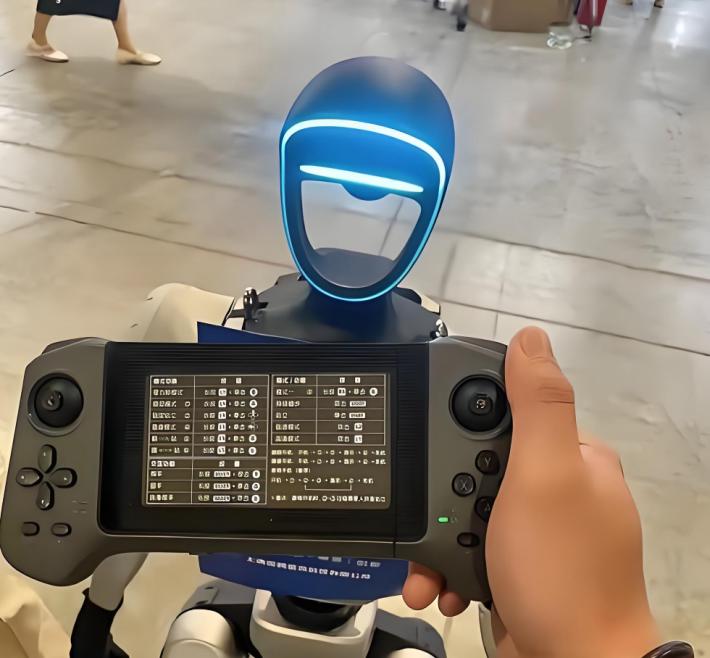
"From energy consumption to usage cost, current humanoid robots are not very cost - effective and have poor practicality." Yu Qing, the president of the Zhejiang Robotics Association, said bluntly in a communication with the "BUG" column: "The purpose of people using tools (robots) is to reduce costs and increase efficiency, but current humanoid robots are the opposite. Most of the robots we come into contact with and what people see are still controlled manually. There are at least 2 - 3 people behind one robot, which completely increases the cost but fails to achieve the expected efficiency."
Tian Feng, the dean of the Fast Thinking and Slow Thinking Research Institute and the former founding dean of the SenseTime Intelligent Industry Research Institute, also sighed in a communication with the "BUG" column: "Currently, the main application scenarios of humanoid robots in the consumer market are still education or toys. Moreover, most of these robots can only perform simple actions such as walking and squatting. To complete actions such as dancing, pre - programming is required, and the threshold for secondary development is extremely high."
"Assembling robots actually has no moat."
So, how can the humanoid robot industry avoid being hurt by excessive "hype"?
In Tian Feng's view, the current development of the domestic humanoid robot industry is similar to the early stage of the PC industry in the 1970s, with prosperity and bubbles coexisting. The "Intel" (intelligent robot chips) and "Microsoft" (robot operating systems) leading enterprises in the era of domestic robots have not yet emerged. What people are doing now mainly focuses on the body part - just like assembling PCs back then, buying a bunch of parts and assembling a PC, and now it's assembling humanoid robots.
In his opinion, "assembling robots" actually has no moat and the value is very limited. What is truly valuable is to engage in the more core upstream parts supply and software ecosystem of the body. Taking hardware as an example, at the level of core components, the three major components of robot planetary roller screws, harmonic reducers, and six - axis force sensors account for 70% of the joint cost. However, 70% of the global market share is monopolized by enterprises such as Japan's Harmonic Drive. The imported unit price is in the tens of thousands of yuan. Although domestic alternative products are cheaper, their lifespan and precision are much worse. "If these core components cannot reduce the cost through self - research or large - scale production, domestic humanoid robots will ultimately only remain at the bottom of the value chain and the profit they can obtain will be limited."
Yu Qing called on: "Don't just focus on humanoid robots. Artificial intelligence is supposed to serve people. A healthy development is to form an ecosystem and an industrial closed - loop. Ultimately, it should focus on reducing the cost and increasing the efficiency of the industrial economy."
Just like the new energy vehicle industry, when the motors, electronic controls, and batteries of this industry are not fully developed, it is difficult to produce an electric vehicle with good performance and an affordable price. The same is true for humanoid robots. When the key components and software such as the intelligent brain are not mature, assembling so many robots at this time will surely result in unaffordable prices.
Even if users are acquired through loss - making sales, they may eventually be lost due to the lack of product performance.
This article is from the WeChat public account "Sina Technology." Author: Xiaolang who works hard on writing. It is published by 36Kr with authorization.