Review of 2025: Unveiling the Profitability of New Entrants in the Automobile Industry
In the first nine months of 2025, both the production and sales of new energy vehicles in China exceeded 10 million units, marking another historic turning point.
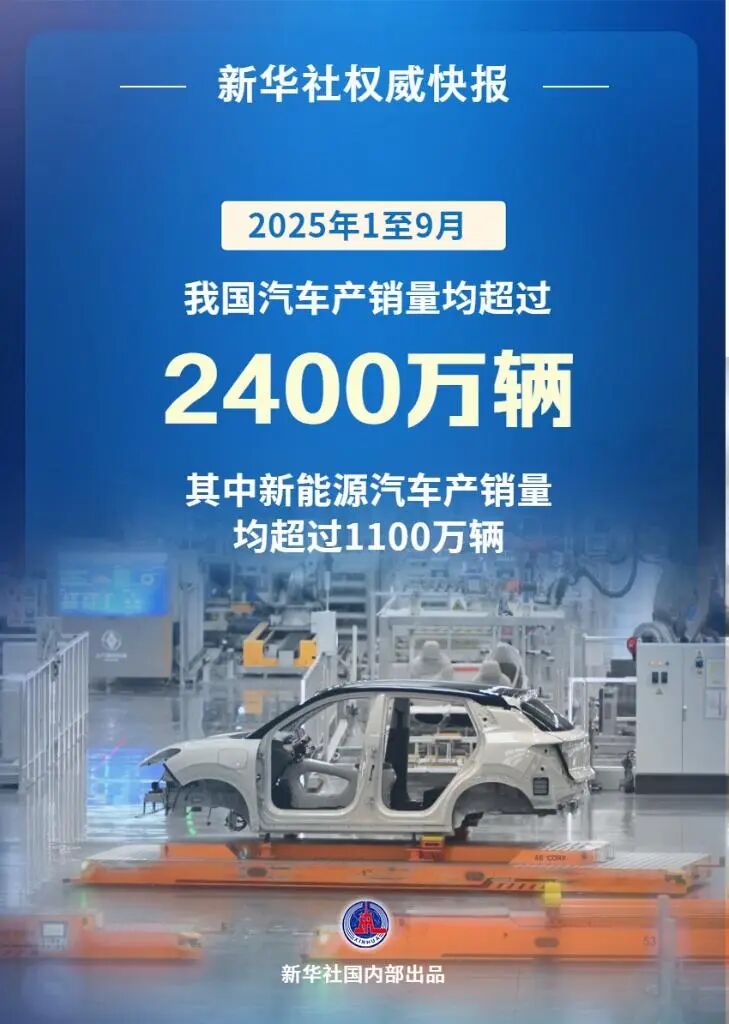
Picture/ The production and sales of new energy vehicles both exceeded 11 million units from January to September 2025. Source/ Screenshot from Internet's New Energy View
Almost at the same time, the new car - making brands that used to "lose money on every car sold" either turned losses into profits or significantly narrowed their losses, and launched a fierce attack on profitability.
Recently, the third - quarter reports disclosed by leading new car - making brands showed that except for Li Auto, which was the first to achieve profitability but faced short - term pressure and turned from profit to loss, the financial reports of other leading players were relatively impressive.
Among them, after successfully turning losses into profits in the first half of 2025, Leapmotor continued to make profits in the third quarter; Xiaomi Auto achieved its first quarterly profit in the third quarter. Although XPeng and NIO were still in the red, their losses were significantly narrowed, and they repeatedly identified the fourth quarter of 2025 as the sprint node for profitability.
From "burning money for market share" to "value creation", the new car - making brands seem to be bidding farewell to the painful period of continuous losses. Behind this are the double breakthroughs in self - developed technology and product layout.
1. Can leading new car - making enterprises break the curse of "losing more money with more sales"?
"Losing 49,000 yuan on each car sold in the first quarter and 63,900 yuan on each car sold in the second quarter", "Losing more than 80,000 yuan on average for each car sold", "Losing about 5 billion yuan every quarter" ... In the past, "losing money on every car sold, and the more you sold, the more you lost" was regarded as one of the biggest labels of new car - making brands.
However, with the continuous breakthroughs in the production and sales scale of new energy vehicles and the further increase in market penetration, new car - making brands are breaking the curse of "losing more money with more sales" and moving towards the dawn of profitability.
Among them, Leapmotor's performance was the most remarkable. According to its third - quarter report, during the reporting period, the company's revenue reached 19.45 billion yuan, a year - on - year increase of 97.3% compared with 9.86 billion yuan in the same period of 2024. At the same time, after achieving a positive semi - annual net profit for the first time in the first half of 2025, Leapmotor achieved a single - quarter profit of 150 million yuan in the third quarter, with a net profit of 180 million yuan in the first three quarters.
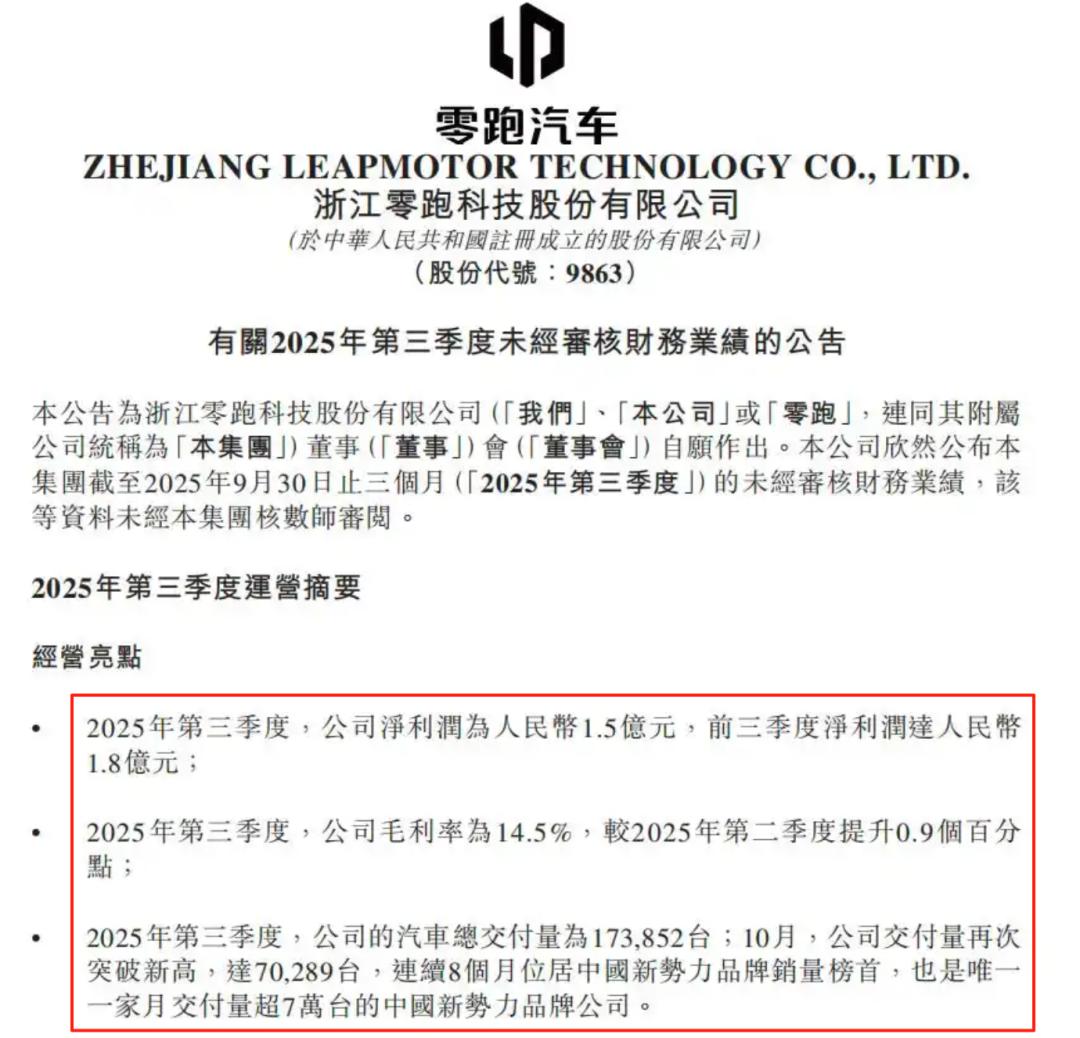
Picture/ Partial data from Leapmotor's Q3 2025 financial report. Source/ Screenshot from Internet's New Energy View
Besides Leapmotor, the "newcomer" Xiaomi Auto also achieved quarterly profitability in the third quarter of 2025. According to Xiaomi's third - quarter report, the revenue of Xiaomi's innovative businesses such as smart electric vehicles and AI reached 29 billion yuan in the third quarter, a year - on - year increase of 199.2%. This data not only made it the fastest - growing business segment within the Xiaomi Group but also brought a net profit of 700 million yuan, achieving quarterly profitability for the first time.
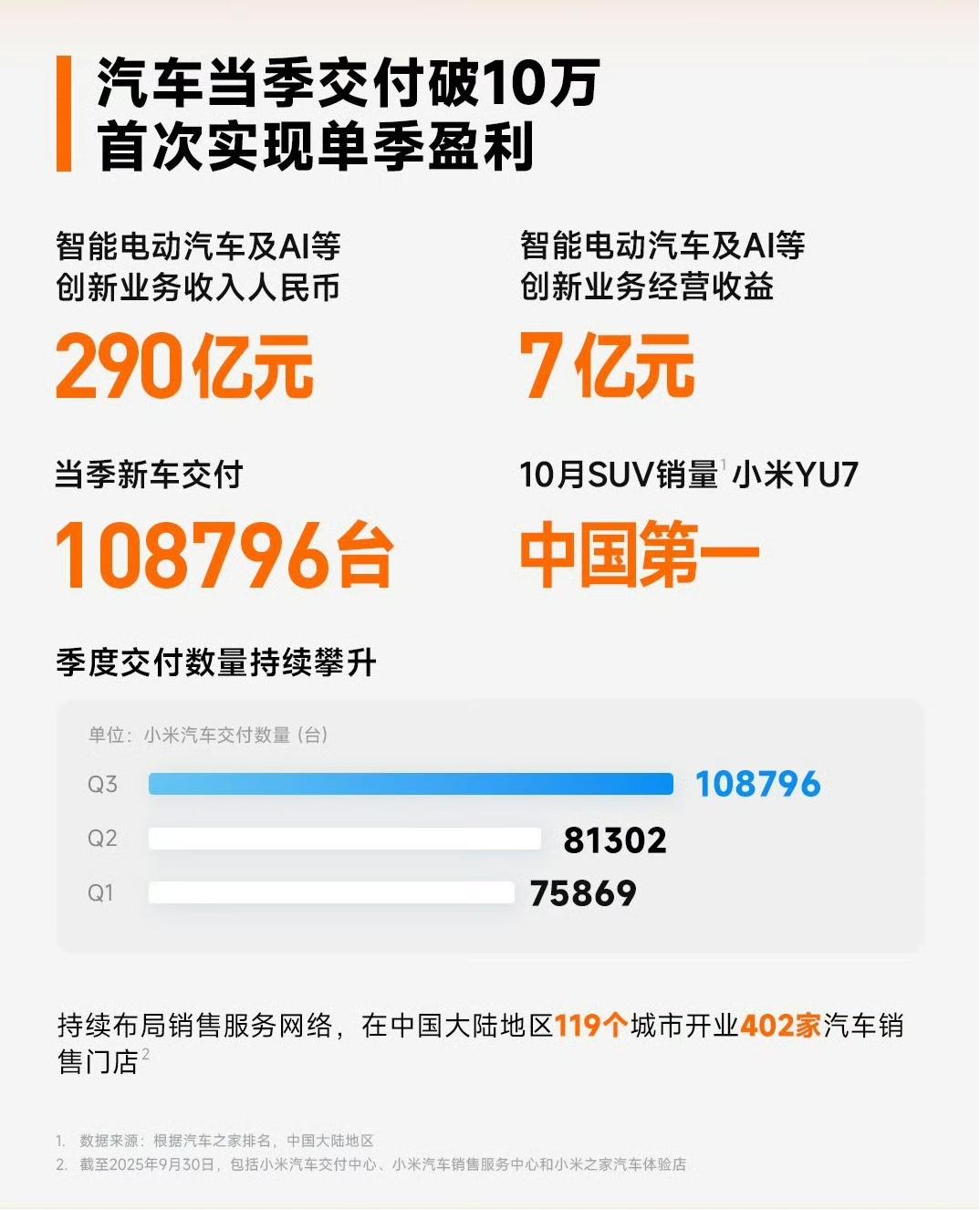
Picture/ Partial data from Xiaomi Auto's Q3 2025 financial report. Source/ Screenshot from Internet's New Energy View
Compared with Leapmotor and Xiaomi, although XPeng has not yet emerged from the "quagmire of losses", it also delivered a report card of "double breakthroughs in revenue and gross profit margin" in the third quarter.
In the third quarter, XPeng's revenue exceeded the 20 - billion - yuan mark for the first time, reaching 20.38 billion yuan, a year - on - year increase of 101.8%. The net loss was significantly narrowed by 78.9% to 380 million yuan, approaching the break - even point. Before the release of the third - quarter report, Gu Hongdi, vice - chairman and co - president of XPeng, said in an interview with the media: "We are very confident of achieving break - even in the fourth quarter."
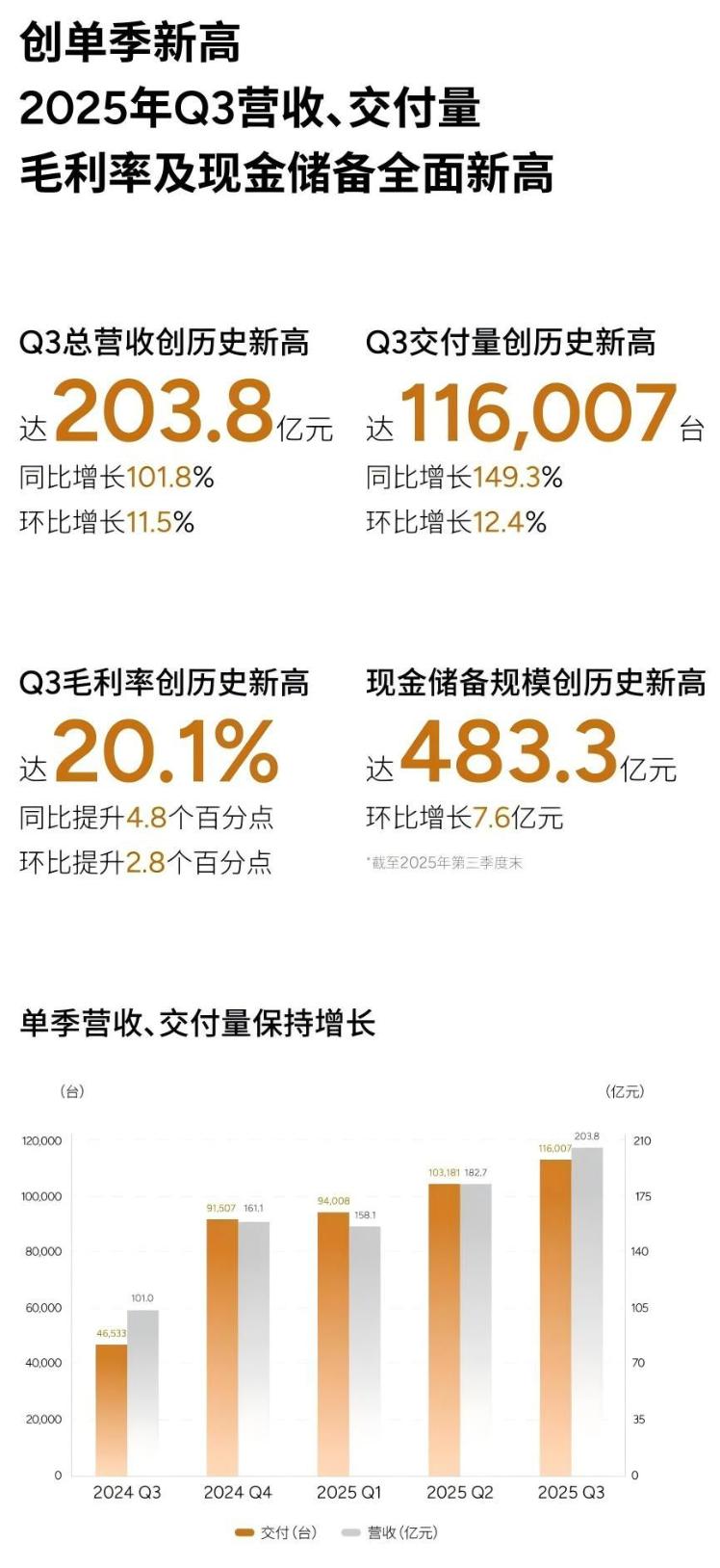
Picture/ Partial data from XPeng's Q3 2025 financial report. Source/ Screenshot from Internet's New Energy View
NIO, a "big loser", also narrowed its losses like XPeng. When disclosing the third - quarter report, the most frequently used word by NIO was "reaching a record high".
According to the financial report, NIO's revenue in the third quarter of 2025 reached a record high of 21.79 billion yuan, and the net loss was narrowed by 31.2% year - on - year to 3.481 billion yuan. The adjusted net loss (non - GAAP) was 2.735 billion yuan, a year - on - year narrowing of 38.0% and a quarter - on - quarter narrowing of 33.7%.

Picture/ Partial data from NIO's Q3 2025 financial report. Source/ Screenshot from Internet's New Energy View
Li Bin, CEO of NIO, clearly stated that "According to NIO's plan this year, the company will achieve profitability in the fourth quarter, which will be an important turning point after more than a decade of losses."
It is not difficult to see that achieving profitability before the end of 2025 seems to have become the common goal of leading new car - making brands.
However, contrary to the industry's profit wave, Li Auto, which had been profitable for 11 consecutive quarters, unexpectedly fell into losses in the third quarter. The financial report showed that Li Auto's revenue in the third quarter was 27.4 billion yuan, a year - on - year decrease of 36.2%, and the net profit turned from profit to loss of 624 million yuan.
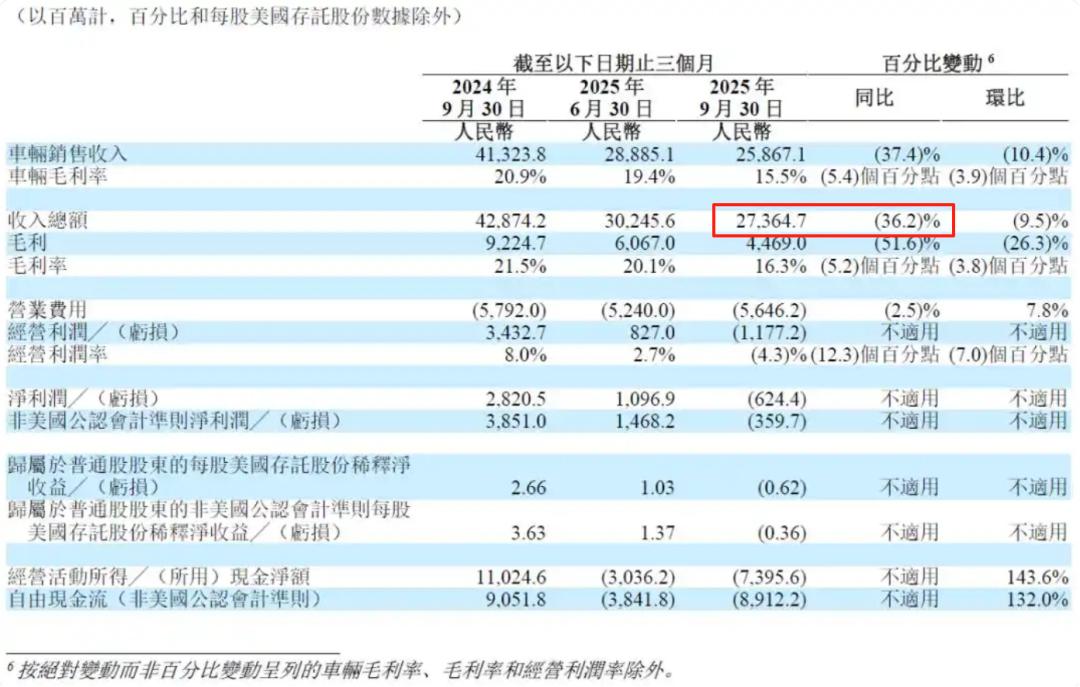
Picture/ Partial data from Li Auto's Q3 2025 financial report. Source/ Screenshot from Internet's New Energy View
2. Is self - developed cost reduction + multi - brand layout the profit code?
It is an industry consensus that economies of scale are a necessary condition for vehicle manufacturers to achieve profitability. This is also verified from the delivery data of each new car - making brand in 2025 and their corresponding financial statements.
In the first three quarters of 2025, Leapmotor, Xiaomi, XPeng, and NIO delivered a cumulative total of 395,500, 266,700, 313,200, and 266,000 new vehicles respectively.
As more cars are sold, the gross profit margin is also constantly increasing.
Data shows that in the third quarter of 2025, Leapmotor's gross profit margin increased to 14.5%. In contrast, its gross profit margin was 8.1% in the same period of 2024 and 13.6% in the second quarter of 2025; XPeng's gross profit margin was 20.1%, a year - on - year increase of 4.8 percentage points, which was also the first time XPeng's gross profit margin exceeded 20%. NIO's comprehensive gross profit margin in the third quarter was 13.9%, and the gross profit margin for vehicle sales was 14.7%. Li Bin mentioned in a conference call after the third quarter that the company's overall gross profit margin is expected to reach 18% in the future.
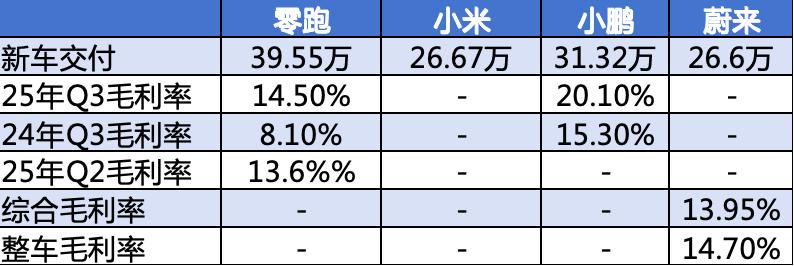
Picture/ Profitability of some auto companies. Source/ Screenshot from Internet's New Energy View
The increase in the gross profit margin is, on the one hand, due to the crucial role of economies of scale, and on the other hand, it is the inevitable result of self - developed cost reduction by enterprises.
Leapmotor has emphasized more than once that the more competitive prices of its products are not because the products are not good enough, but because it has achieved extreme control over costs.
So far, Leapmotor has achieved self - research and self - manufacturing of core components that account for 65% of the vehicle cost, and has successively launched a series of leading smart electric technologies such as the industry's first eight - in - one electric drive and the industry's first mass - produced CTC battery - chassis integration technology.
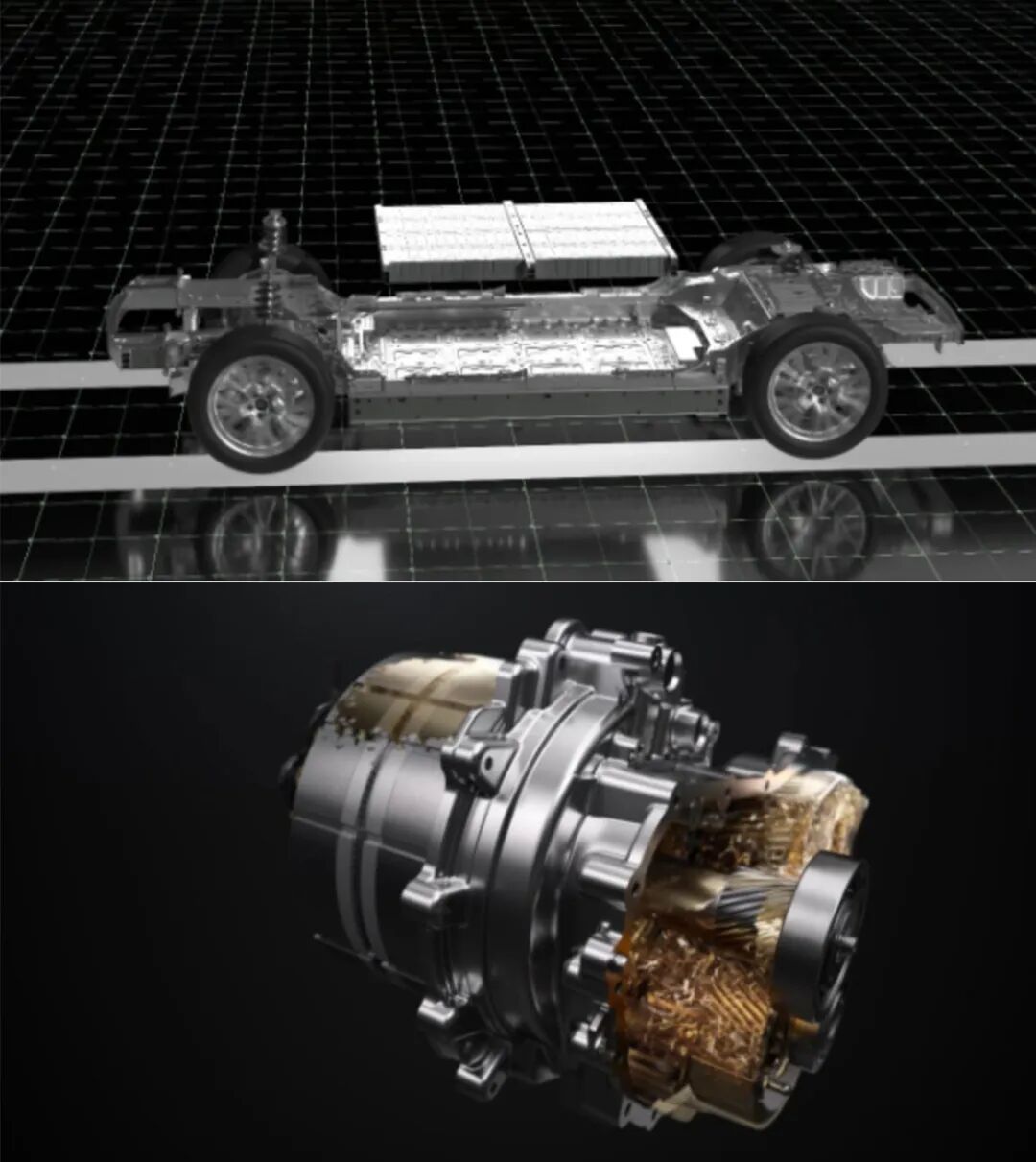
Picture/ Leapmotor's self - developed CTC battery chassis and electric drive. Source/ Screenshot from Internet's New Energy View
In particular, its self - developed LEAP full - domain self - developed technology architecture, through a highly integrated design, optimizes the overall performance and driving experience while maximizing technology and cost control, thus making the products more cost - effective.
NIO has also stated externally that the self - developed Shenji chip has significantly reduced the cost of each vehicle. At the same time, through in - depth cooperation with suppliers such as Innovusion and SenseTime, through joint R & D and other methods, the cost has been further diluted.
It is worth mentioning that NIO's battery - swapping business, which it has persisted in for ten years, has begun to show returns. Li Bin mentioned in July this year that NIO's investment in technology and ten - year technology accumulation, whether it is the investment in full - stack self - research or the continuous and firm investment in battery - swapping for ten years, are the cornerstones of the success of the LeDao L90.
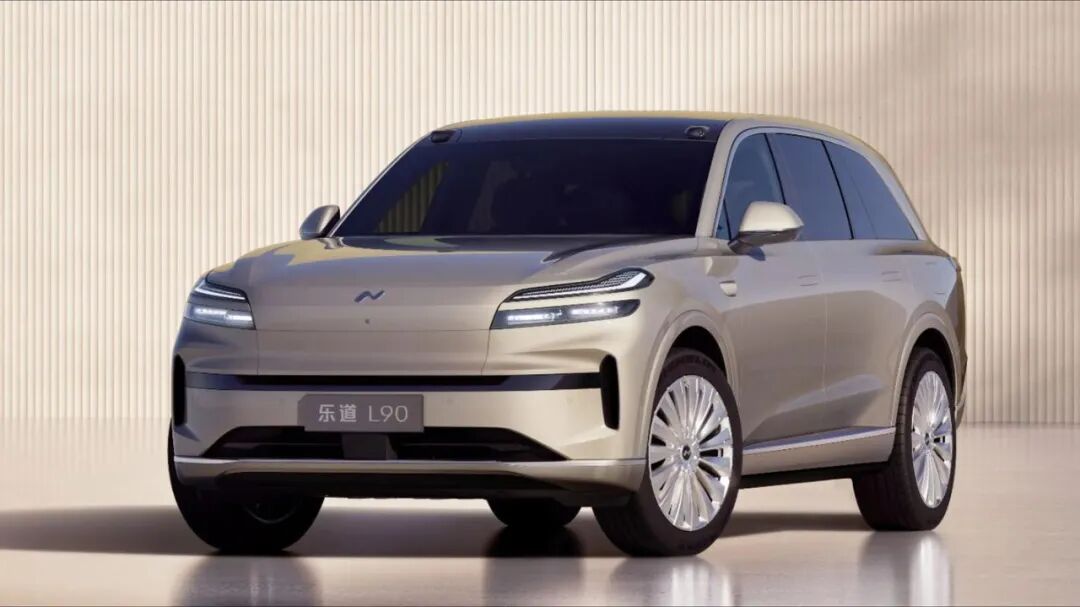
Picture/ LeDao L90. Source/ Screenshot from Internet's New Energy View
On the one hand, self - developed technology reduces costs; on the other hand, a multi - brand layout strategy is adopted, and product prices are continuously lowered to further stimulate sales.
For example, NIO uses a multi - brand layout of "high - end NIO + mid - range LeDao + entry - level Firefly" to cover markets in different price ranges; Leapmotor first focused on the 150,000 - 200,000 yuan mainstream consumer market. After the economies of scale showed results, it launched the D19 to target the high - end market, the Lafa5 to target the young market, and the A series to focus on the commuting market; after successfully "breaking the circle" with the XPeng Mona M03, XPeng set its sights on extended - range power and adopted a dual - line layout strategy of "super extended - range + pure - electric" to further amplify the cost - reduction results.
In this way, new car - making forces have bid farewell to the early "blindly piling on features" involution model and entered the stage of "rational optimization" aimed at profitability.
3. Is the large - scale profit explosion period coming soon?
In fact, the leading new car - making brands' achievement of profit breakthroughs in 2025 is not accidental or a fluke, but an inevitable result of the industry's development to a certain stage.
The gradual improvement of infrastructure such as charging piles, the maturity of consumer education and acceptance, and the successive breakthroughs in sales ... Under the resonance of multiple factors, 2026 is expected to be the year of large - scale profit explosion in the new energy industry, and the "elimination round" may also reach a conclusion.
In terms of production and sales scale, Cui Dongshu, secretary - general of the Passenger Car Association, mentioned in November that in 2026, the sales and ownership of new energy vehicles will continue to reach new highs, and the new energy penetration rate is expected to exceed 60%.
