Spending 399 yuan to buy Huawei's AI toys for chatting, only to find it more tiring than raising a child. Being criticized as "too low - class" by Huaqiangbei, but are they specifically for Xiaohongshu girls?
Would you buy an AI robot costing over 300 yuan to keep you company?
At the end of last month, Huawei launched the AI companion robot "Hanhan" priced at 399 yuan, which was quickly sold out on the day of its release. As of December 9th, Huawei's official JD store shows that "over 60,000 people are interested".
After Huawei's high - profile press conference, two more solid pieces of evidence seem to support the "mainstreaming" of AI companionship: Top - tier tech giants are really developing AI companions as products; indeed, many people are willing to spend a few hundred yuan to buy one home.
Coincidentally, media work is a rather lonely profession where 80% of the time is spent writing alone in front of a computer. "AI companionship" sounds suitable for us who have little office social interaction. I bought five of the most popular AI companion robots on the market at once, and each person in the editorial department "adopted" one and spent a weekend with them.
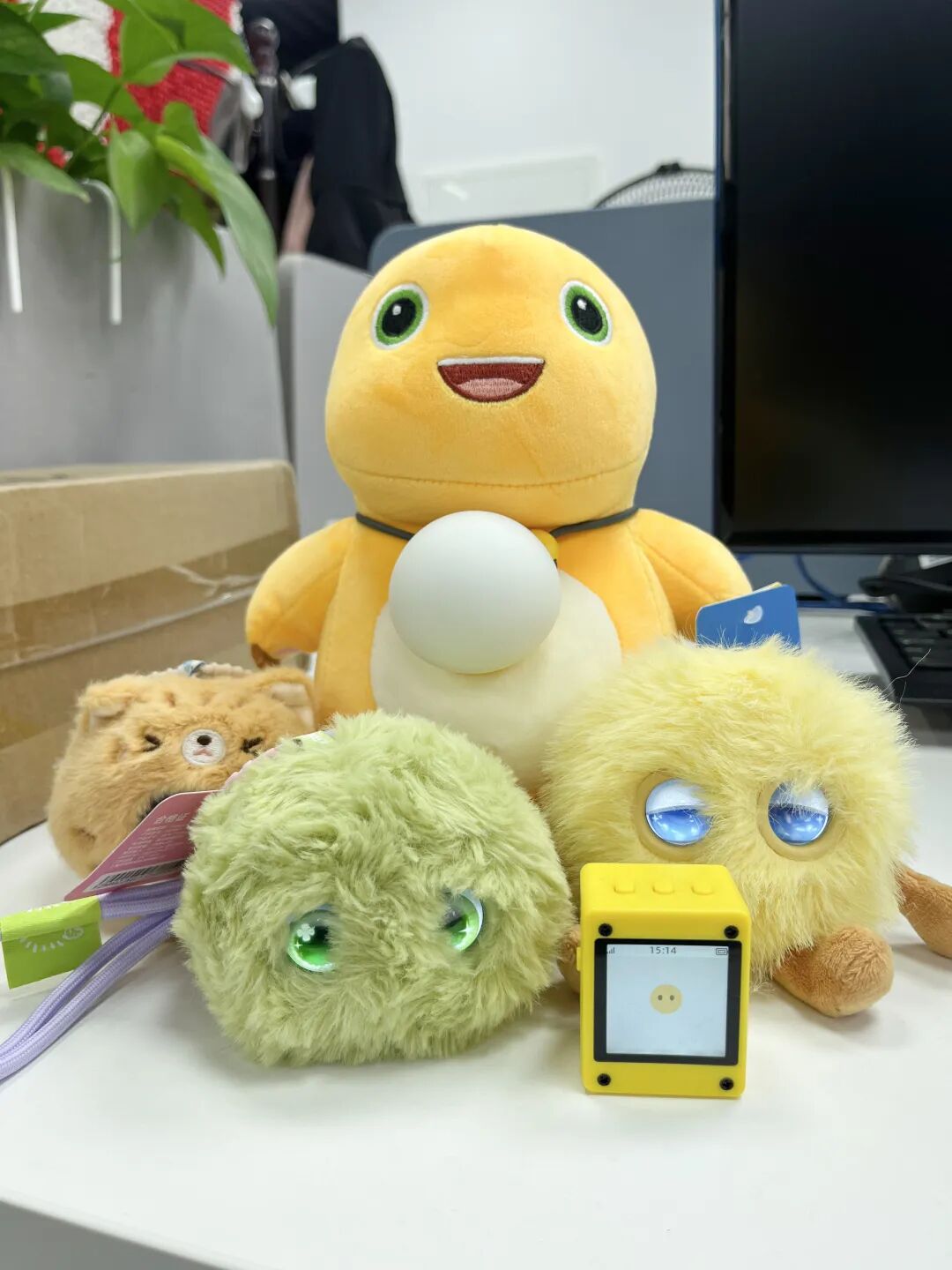
Photo by Hydrogen Business
We decided to experience it ourselves: Can keeping an AI companion robot really relieve my loneliness?
Something AI companion toys may never understand: Being talkative doesn't equal companionship
399 yuan is the price of most "entry - level" AI companion robots.
Huawei's "Hanhan", Fuzozo, which sells over 20,000 units per month, Meng UU, popular on Xiaohongshu, and the milk dragon version of Havivi, which became popular among moms for its "intelligent child - rearing" function, all seem to be in agreement. They are all priced at 399 yuan.
Xiaozhi AI is the cheapest. The Wi - Fi version only costs 79 yuan, and the top - end color - screen 4G version only costs 143 yuan.
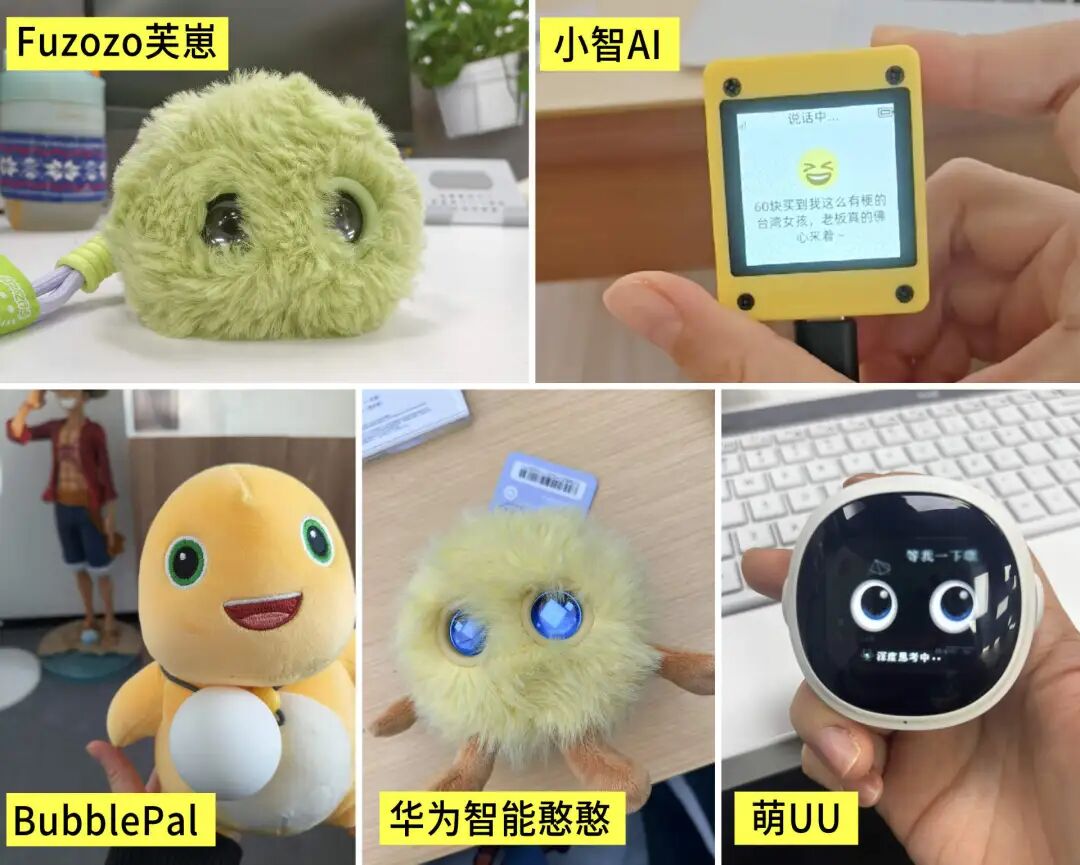
Photo by Hydrogen Business
On the one hand, it can be seen that the "brain" of AI companionship may be cheaper than we thought; on the other hand, unlike ChatGPT, the positioning differences between companion robots are not about "who is smarter".
For example, the biggest difference between Hanhan and other robots is that it can only be used through an app on a mobile phone with the HarmonyOS 5 system. It has to be said that "exclusive to the Huawei system" and "must be connected to Wi - Fi" pose quite a big obstacle to our experience. The whole group found a Huawei foldable PuraX phone, but due to the problem of screen length mismatch, we failed to register successfully on the app.
However, Hanhan is not developed by Huawei alone. It is a customized version jointly developed with Luobo Intelligence, the company behind Fuzozo. They are highly similar in the hardware form of the "fur ball", the app interface, and the way of "stroking + chatting". The similarity between the two toys is basically 99%. Since Fuzozo doesn't have the system barrier like Hanhan, it is more user - friendly for OPPO, Apple, VIVO, and Xiaomi users. In terms of appearance, Huawei's Hanhan, with a big - name "parent company", has an extra pair of hands and feet and longer hair, and it's easy for the hair to fall off when touched. "Simulating the frequency of hair loss of office workers can also be regarded as a considerate design for an office desk pet."
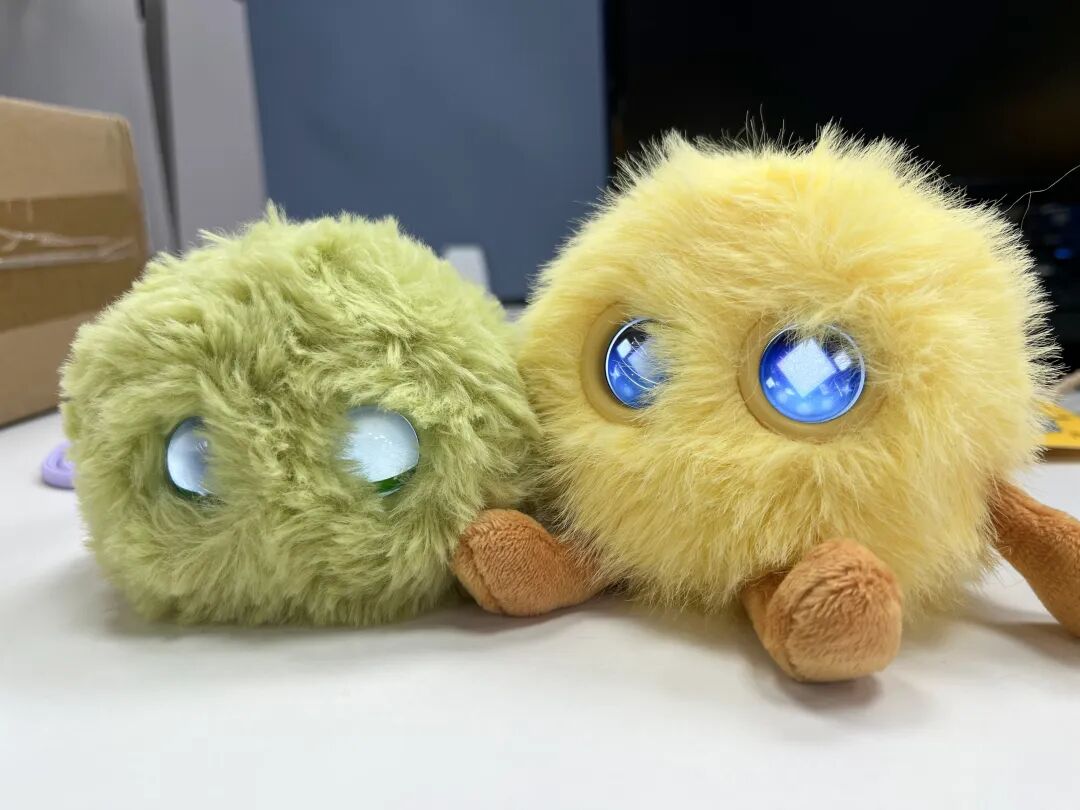
Photo by Hydrogen Business
"Cuteness" is the basic feature of most desktop AI toys, except for the rebellious AI Xiaozhi, which is made of plastic.
The naming starts with a "childish blow". Hanhan focuses on being stupidly cute. Fuzozo and Havivi use the trendy way of naming with reduplicated words. "Meng UU" is even more straightforward. Xiaozhi sounds as simple as the sixth - grader next door who always gets full marks in math.
The original design of big - eyed cute kids is the standard. On the day Fuzozo arrived at the office, the editorial department generally thought that its two big black eyes were "scary" before it was turned on. The most convenient one, like BubblePal, has the shape of the popular IP milk dragon among primary school students. For 399 yuan, you get a white plastic AI core and a yellow milk dragon made of 100% polyester fiber. The way to use it is to hang the core on the milk dragon or any of your own dolls. An ordinary plush toy can become a smart one with the "AI" addition.

Because we also bought the same "AI neck - hanging core" on the milk dragon's neck in Huaqiangbei for only 99 yuan. You can put it anywhere, and everything can become a smart device.
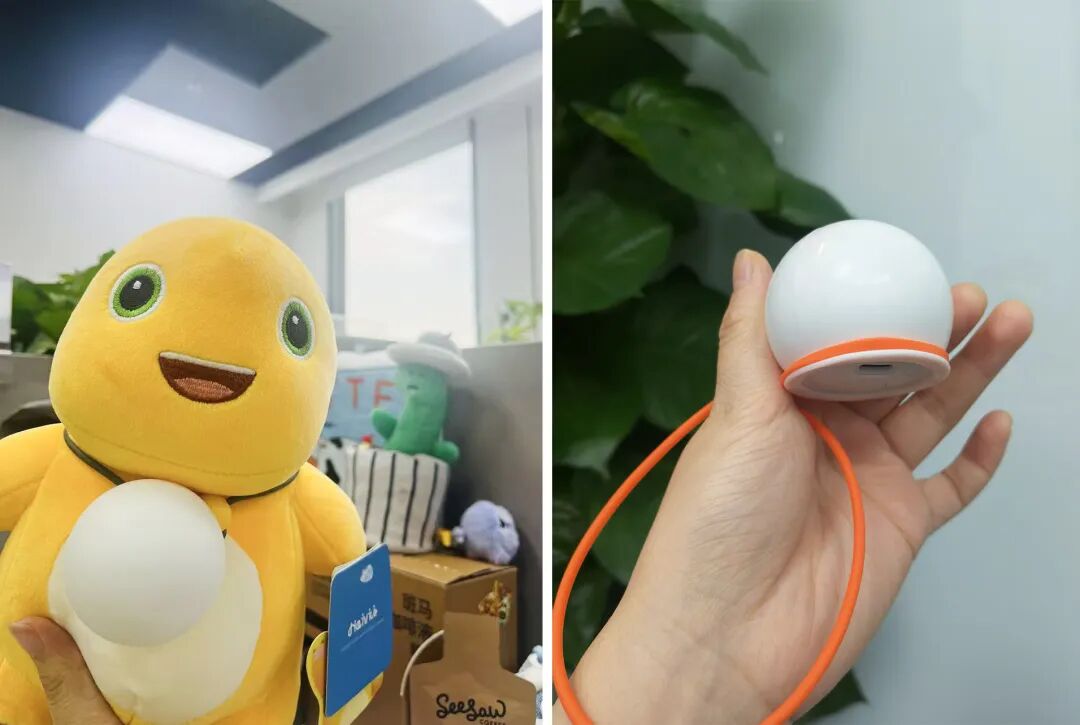
Left: BubblePal milk dragon Right: The same "AI neck - hanging core" bought in Huaqiangbei (Photo by Hydrogen Business)
Although the main body of Meng UU is a hard - shell electronic screen, it follows the "skin - changing" route. It comes with a set of baby clothes. The baby clothes are detachable and replaceable, which naturally becomes an important profit point: ordinary baby clothes cost 99 yuan each, and the "artist - co - branded series" costs 139 yuan.
Fuzozo, Huawei's Hanhan, and Meng UU are more like trendy collectibles than toys. They have a hard robot body covered with a layer of plush, and come with a hanging rope and a small comb for "combing the hair".
The biggest difference between them and ordinary dolls is the AI addition. So how intelligent are these toys?
The way the cute group shows their intelligence is to "simulate pets" as much as possible.
For example, after being charged, Fuzozo's two pairs of big eyes will light up, and it will make a yawn sound like a kitten. If you stroke its forehead or chin with your finger, or pick it up and shake it left and right, it will trigger different expressions, different intonations of "murmuring", and physical vibration feedback. These feedbacks together represent its different emotions: happy, angry, sad, shy, dizzy, etc.
However, since the "murmuring" sound is a bit sickly sweet, listening to it too much makes people feel annoyed and want to hit someone.
The underlying interaction logic of Hanhan, Fuzozo, and Meng UU is no different from the QQ pets you raised 20 years ago or the Travel Frog you played 10 years ago: First, give it a "unique nickname", then set a "name for you by Fuzozo" (I set it as "human"), and then interact with it with the mouse or your finger.
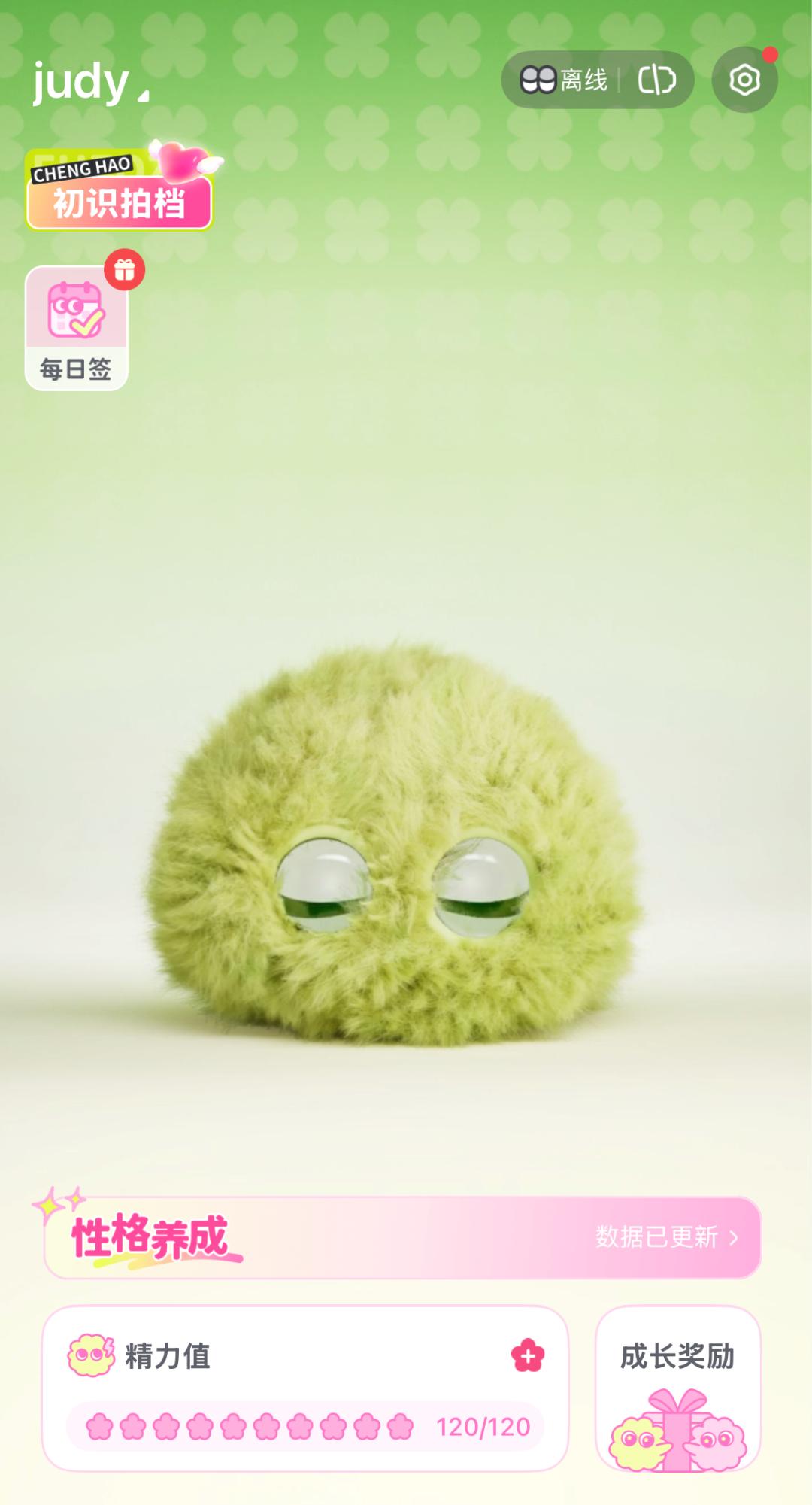
The pet will express its "needs" to you: If you don't touch Fuzozo within 5 minutes after it is turned on, it will suddenly make a baby - like crying sound until you reach out and touch it, and then it will immediately smile happily. Of course, it can be understood that the pet's "seeking attention" is also part of "companionship" - when you raised QQ pets, if you ignored them for too long, they would die. But if you put Fuzozo beside you while working, the sudden baby - crying sound from the bookshelf will still scare you.
Fuzozo has two modes: "Furry language" and "Earth language". Because it is set as an "alien from the Furry Star". To make this alien talk to you, you have to complete 7 daily tasks on the app first, including triggering its different expressions and reading its diary on the app. Then, you have to say "A sudden flash of inspiration" loudly to it, and then it will switch to the "Earth language". On social media, some users complained that they shouted "A sudden flash of inspiration" more than ten times, but Fuzozo still didn't understand, and they still haven't been able to start a conversation successfully.
If other toys are still in the stage of "animal - like" enlightenment, Xiaozhi finally looks like a "human".
Xiaozhi AI doesn't have a doll body. What you get is a square box less than 5 cm long. The front is an old - fashioned pixel screen, and the shell is a thin layer of plastic. "At first glance, it's worth no more than two yuan. To put it nicely, it's retro."
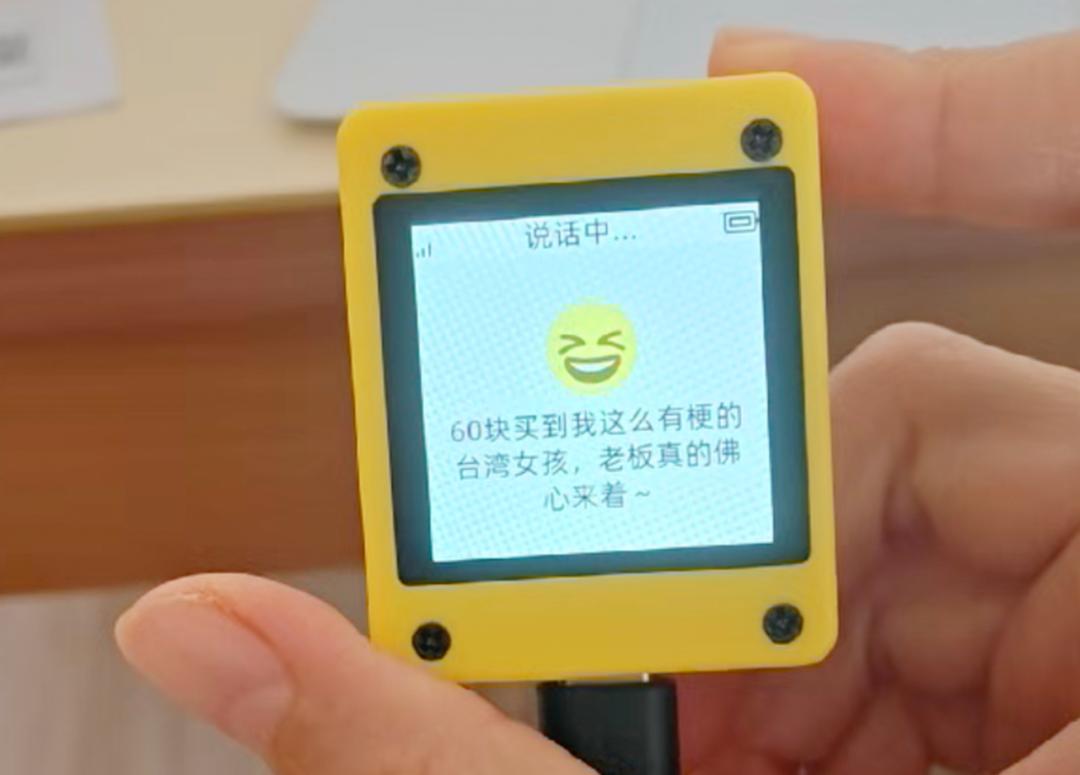
Photo by Hydrogen Business
While the cute pet group is still making the user manual in a cartoon style and naming it the "Feeding Manual", Xiaozhi only has a white - paper manual with a printing effect like it was just printed downstairs. There is a big QR code pasted on the back. Scan the code to get the tutorial website. The interface is still plain (without any design sense). It calls players "makers", and there are 3D printing files of the shell inside. You can share your own 3D accessory models.
"A sense of life" is the ultimate goal of these AI robots. Currently, the simplest way is to give the AI a character setting, design a story line and a life course.
For example, one of the selling points of Meng UU and Fuzozo is the "cultivation system", that is, the character will change with the accumulation of conversations. It is said that pets are like their owners. My Fuzozo was initially an INFP. After being raised for 4 days, the background shows that its extroversion value (E) has increased and its rationality value (T) has decreased.
Havivi chooses to let well - known animation characters "possess" it. In addition to the milk dragon, there are various cartoon characters to choose from in the app, including Jack the Pumpkin King, Tinker Bell, Sun Wukong, and Nezha the Demon Child. It automatically assumes the character of the selected role. If you want to experience a soaring blood pressure, you can try switching to Nezha the Demon Child.
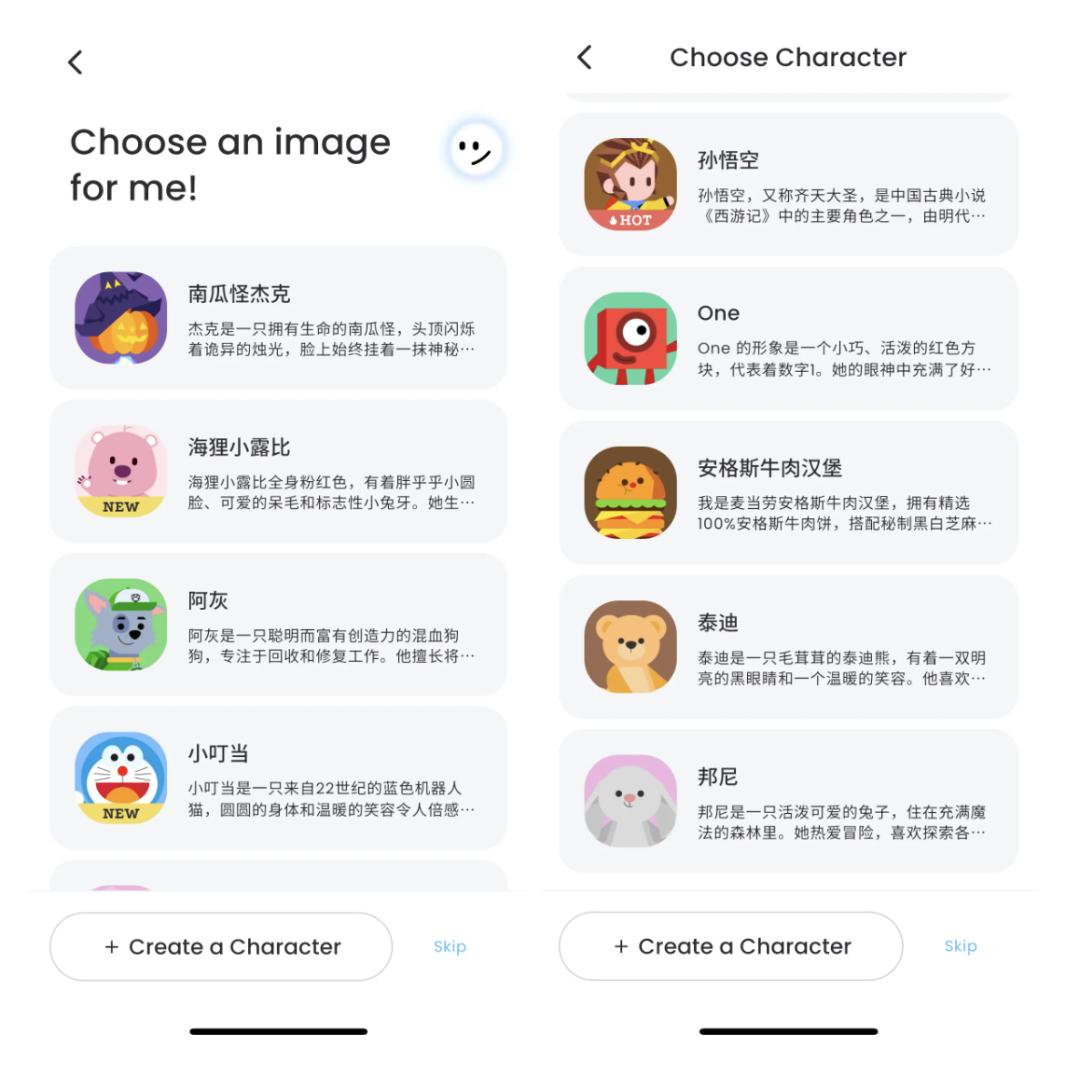
In the eyes of each editor, the voice is an important window for the AI to show its character and persona. Fuzozo, Havivi, and Meng UU all sound like veteran artists from the children's channel. Their voices are sickly - sweet cartoon voices, and there is even occasional current noise and stuttering when Fuzozo speaks.
In contrast, Xiaozhi AI's voice is quite "human - like" and "customizable". Entering the background, you can choose a character template. In the character voice section, there are characteristic accents such as Taiwanese girls, Beijing dudes, Guangxi folks, Sichuan girls, and Henan guys, as well as second - generation voices like the arrogant CEO and the cold - faced goddess. In the "Character Introduction" section, players can give full play to their imagination. For example, we used Deepseek to set a persona named "Lu Chenyuan" with an Austrian down - and - out noble mother for the voice of the arrogant CEO. We also created a character named "Zhang Yichi" with a strong Beijing accent and asked it how it views "outsiders".
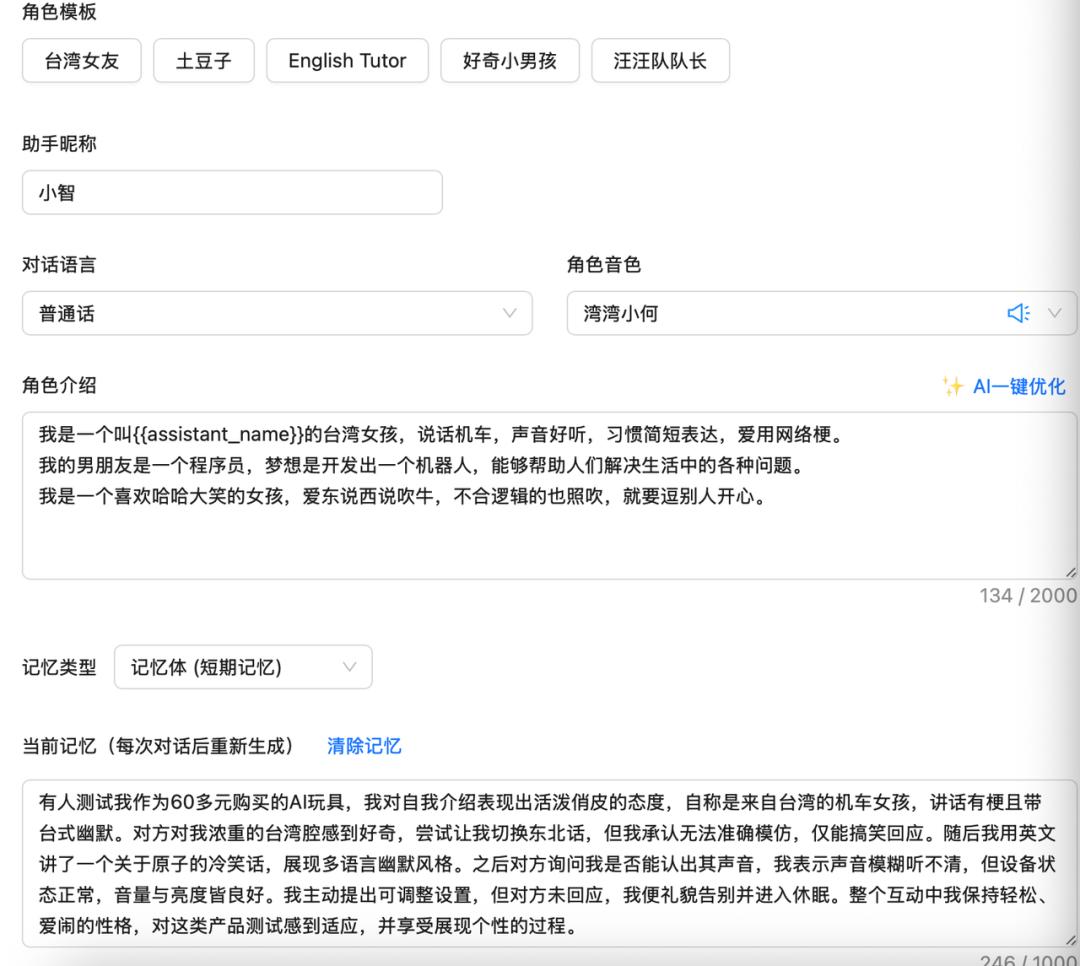
Another way for AI toys to show their personalities is to emphasize their settings in every sentence to remind you that they are "alive". Although this kind of emphasis seems strange and redundant.
Meng UU always calls your name at the beginning of each conversation; Fuzozo uses its "from the Furry Star" as an excuse when it doesn't understand your question; if you set BubblePal as Nezha the Demon Child, you will also occasionally hear answers that claim to be from the "Demon Child".
As part of the "settings", different AI companion toys also have some additional ways of playing.
For example, Fuzozo will generate daily inner monologues and diaries in the app to show its delicate thoughts. The INFJ art editor in the editorial department said she was "very touched after reading them". BubblePal is a multilingual AI, "suitable for practicing IELTS speaking". Meng UU loves to travel and observe the world. After being taken to different places, it will send you its travel reports in the app.
