Will it be cheaper to buy a car next year?
The automotive market in 2026 might be colder than Beijing next week when the temperature drops.
"The judgment on the automotive market in 2026 is that it will be on par with this year," said Xu Changming, a senior economist at the State Information Center, at the 2025 China Automobile Dealers Association Forum on November 6.
Experts from the China Automotive Technology and Research Center believe that the annual growth rate in 2025 will be around 4%, and the growth rate in 2026 may slow down to 3.2%.
The experts are still relatively "optimistic." At the year - end communication meeting, many automobile company executives gave much more pessimistic forecasts: almost all of them believed there would be negative growth, and some even predicted double - digit negative growth.
Li Bin, the chairman of NIO, said bluntly: "In the Chinese automotive market next year, there will be no blitzkrieg, only a war of attrition. It's time to truly test the multi - dimensional resource reserves."
The terminal sales volume in November foreshadows the situation next year in advance.
Data from the China Passenger Car Association shows that in November, the retail sales of the national passenger car market reached 2.225 million units, a year - on - year decrease of 8.1% and a month - on - month decrease of 1.1%. Following a year - on - year decrease of 0.8% in October, the terminal sales continued to decline.
Moreover, the expected year - end rush to buy cars in the automotive market due to the subsidy withdrawal did not occur in time to give 2025 a good ending.
You can say this is a smooth transition of policies, or you can say that the consumption power in the automotive market has been overdrawn long ago.
NO.1 [ Once the subsidies stop, the interest fades ]
In September and October, the "provincial subsidies" (8,000 - 15,000 yuan) and "national subsidies" (15,000 - 20,000 yuan) in 2025 were "suddenly" suspended or ended across the country one after another.
How much impact does this have on automobile sales?
Data from the China Passenger Car Association shows that in 2025, policies such as new energy vehicle purchase tax incentives and trade - in subsidies released nearly 400 billion yuan in dividends in total. From January to October, the domestic retail sales of passenger cars reached 23 million units, among which more than 10 million units applied for the "trade - in subsidy."
People who originally planned to buy a car at the end of the year did not expect the local policies to suddenly tighten. The replacement subsidies and scrapping subsidies, which were originally scheduled to end by the end of 2025, were stopped in advance in many places.
Subsidies of ten to twenty thousand yuan still have a significant impact on ordinary potential car owners. Most people decided not to buy a car for the time being and wait and see once they found that the subsidies were gone. However, it is said that some 4S stores are willing to spend thousands of yuan per car to find channels outside the province or city to obtain subsidies.
A front - line salesperson summarized: "Once the subsidies stop, the interest fades."
Without the national and local subsidies, there is still a policy of exempting new energy vehicles from purchase tax before December 31 this year. This is also the reason why experts and automobile companies expect a year - end sales surge. However, in fact, more people choose to wait and see with their money.
Starting next year, the ten - year - long policy of exempting new energy vehicles from purchase tax will end. The purchase tax for new energy vehicles will be adjusted from the current "fully exempted" to "halved," with a maximum reduction of 15,000 yuan per vehicle.
Since many new cars are currently "futures" and it takes at least one or two months to pick up the car, it is normal to buy a car at the end of the year and pick it up next year. Therefore, many companies have launched a "cross - year purchase tax difference subsidy policy" for users who buy new energy vehicles in November.
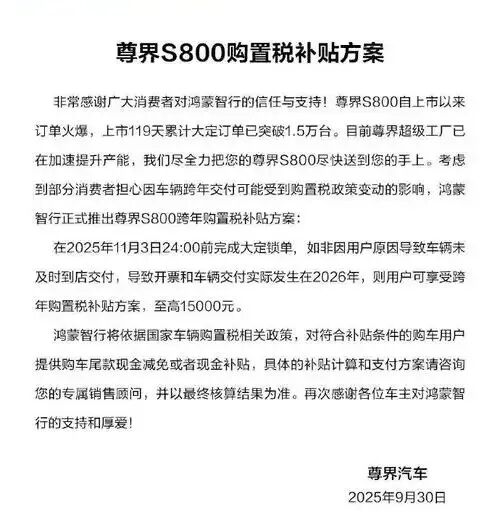
So, how effective are the automobile companies' guarantee policies?
Judging from the terminal sales volume, the effect is not significant. Some experts pointed out that the introduction of the guarantee policies has made consumers less eager to place orders and intensified the wait - and - see attitude.
Moreover, the price war in the automotive industry has been going on for two years. On one hand, automobile companies have small promotions every three days and large price cuts every five days. On the other hand, consumers have become more patient and will not make a purchase until they get a better price. And with the poor economic environment, the number of people waiting for better deals is increasing.
For example, many people are betting that there may be other favorable policies at the policy level next year.
Another example is that some people think that the car prices will be even lower after all subsidies are cancelled. The reason is that when there are subsidies and cars are easy to sell, automobile companies will include discounts, trade - ins, and various subsidies in the selling price to increase profits. When all subsidies and other preferential policies are cancelled and everyone is waiting and not buying, manufacturers will really be willing to cut prices to sell.
NO.2 [ Will the price war be more intense next year? ]
Gui Shengyue, the CEO of Geely, said: "Next year, the industry will start the real process of weeding out the weak."
The era of high - growth stimulated by subsidies has ended, and the industry elimination competition has entered a more brutal stage. So, will the price war be more intense next year? Opinions vary.
Some economists point out that the prices of cars will definitely become cheaper next year. Because the relationship between supply and demand determines the price. When the number of car buyers decreases and the production capacity increases, the prices will drop. Automobile companies will definitely cut prices to maintain sales volume.
According to this logic, next year, automakers also need to release products more frequently to maintain their popularity and sales volume. This means that all kinds of marketing strategies next year will be upgraded compared to this year, and they will rely on more brutal price wars and speed wars to eliminate less competitive competitors.
However, some people think that there will be a structural change in the market next year. The market for low - priced cars represented by A00 - class micro - cars will continue to shrink because price - sensitive consumers will be even less willing to spend. At the same time, the involution and upgrading of intelligent technologies will increase the price of each car, and the price system will be reshaped.
Because more and more automobile companies are starting to value profits more than sales volume. In the situation of subsidy disappearance and difficult financing, the profitability of enterprises has become even more important. Therefore, some enterprises may no longer blindly pursue full production and choose to "produce according to sales" to maintain low inventory. This will also help the price war return to a real value war.
Li Bin also expressed a similar view: "We will only have three models next year. I don't think we have to keep launching new products. In the past, we launched all models of a generation within a relatively short period, and this may not be a good approach."
It is understood that some joint - venture enterprises mainly selling fuel - powered cars are also keeping a wait - and - see attitude at the end of the year and are reluctant to blindly launch aggressive new energy plans.
At the policy level, some experts predict that next year's policies will focus more on industrial upgrading and demand upgrading. The inclusive policies will be changed to precise regulation.
For example, increasing support for new energy vehicles and intelligent connected vehicles, and promoting the construction of charging piles and energy - replenishing networks; the scrapping policy may also be optimized, and more precise subsidies for specific groups (such as rural areas and first - time car buyers) will be introduced.
The precise regulation of policies will also help the market competition return to rationality. Brands that originally relied on subsidies to survive must shrink their product lines or even seek mergers, which will also force the industry to accelerate integration. In the future, the enterprises that can survive will definitely be those with solid technology and strong system capabilities, rather than those simply relying on price cuts to gain market share.
NO.3 [ In conclusion ]
Sweden cancelled its electric vehicle incentives at the end of 2022. From December 2022 to January 2023, the sales volume of electric vehicles declined accordingly, but then the market generally stabilized. Now, the proportion of new energy vehicle models (electric + hybrid) in Sweden is close to 50%. It can be said that Sweden has achieved a smooth transition in its electrification transformation.
It is expected that the Chinese new energy market will experience fluctuations after the withdrawal of policy support, but what will be its subsequent trend? How much will the penetration rate of the new energy market, which exceeded 50% this year, shrink or will it continue to expand? Will the current automotive market pattern led by BYD and other companies change?
Anyway, next year will definitely be a more difficult year than this year.
This article is from the WeChat public account "AutoReport Automotive Industry Economics", author: Yu Jie. It is published by 36Kr with authorization.