Microsoft promises to invest over $30 billion in Canada and India to build "sovereign AI".
To take control of the global data ecosystem, Microsoft pledged on December 10 to invest over $30 billion in Canada and India, simultaneously launching large - scale infrastructure construction on both continents.
In Ottawa, Canada, Microsoft announced that it would invest C$19 billion (approximately $13.4 billion) by 2027 to expand the local cloud in Canada. One of the key commitments is that if a foreign judicial body attempts to access data stored in Canada, Microsoft will take legal action and other means to resist.
Meanwhile, Microsoft significantly upgraded its India strategy, promising to increase the investment to $17.5 billion. This amount has nearly sextupled compared to the target set in January 2025. As planned, Microsoft's Azure AI services will be deeply integrated into the Indian government's welfare portal, covering about 310 million laborers.
In June 2025, Microsoft announced the details of its European cloud sovereignty plan, confirming that the data stored by customers will remain within Europe and comply with European regulations. This new plan, called "Microsoft Sovereign Cloud," will offer three different options for businesses across Europe: sovereign public cloud, sovereign private cloud, and national partner cloud.
From a strategic perspective, these actions mean that Microsoft's focus is shifting from the "super - factories" concentrated in the United States to a distributed, national - level infrastructure layout. This "sovereign AI" model directly responds to the increasingly strong demands of governments around the world: data must be stored within the country, and the core AI systems must be locally controlled.
By localizing computing power, Microsoft is essentially building a "moat" to cope with increasingly strict data localization laws.
Technological Sovereignty: Azure Local and Litigation Commitment
In addition to financial investment, Microsoft has also introduced specific technological mechanisms to strengthen data boundaries, including three major technological pillars:
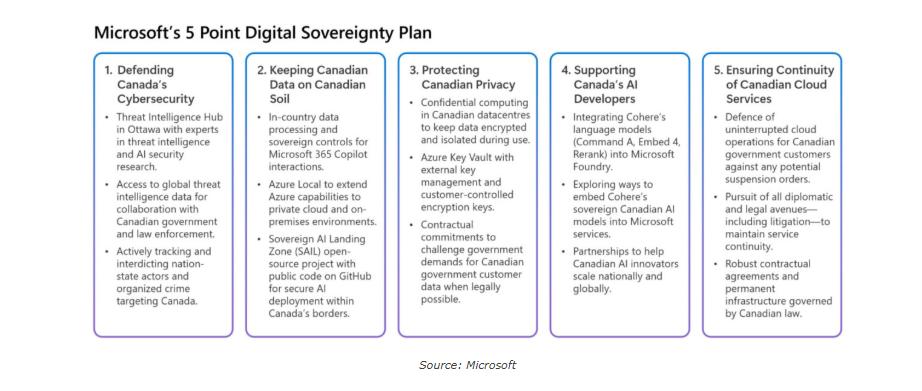
Figure: Microsoft's Data Sovereignty Plan
First, Microsoft strengthens its data residency commitment: it provides in - country data processing for Copilot (AI assistant) interactions, ensuring that sensitive AI queries and responses physically remain within Canada.
Second, expand Azure Local services: extend Azure cloud capabilities to customers' own environments, enabling institutions to run Azure services on private clouds or local servers. This is crucial for hybrid or offline scenarios where data cannot be transmitted over the public network.
Third, launch the Sovereign AI Landing Zone (SAIL): as an open - source project on GitHub, SAIL provides a set of standard architectural blueprints to help institutions configure environments with built - in compliance control and governance functions.
For highly regulated industries (such as defense and government affairs), Microsoft has launched Azure Local (upgraded from Azure Stack HCI), which supports cloud operations in a completely offline and physically isolated environment. This architecture retains the Azure management plane, allowing sensitive workloads to run locally to meet extremely strict regulatory requirements.
To dispel concerns about the potential extraterritorial jurisdiction of the US Cloud Act, Microsoft President Brad Smith made a clear legal commitment: "If in the future we face an order in Canada to suspend or stop operations, we will use all available legal and diplomatic means, including filing lawsuits, to safeguard access to critical infrastructure."
Human Resources Layer: Locking in a Vast User Base
Infrastructure is only half of Microsoft's layout. The other half lies in locking in and serving a vast user base that will use these facilities.
In India, Microsoft's investment plan includes deep integration with the "e - Shram" labor welfare portal. Azure OpenAI services will be directly embedded in the platform to provide job matching for more than 310 million informal workers.
Puneet Chandok, President of Microsoft India and South Asia, emphasized that this initiative is a strategy to build a complete ecosystem, rather than just a capital investment.
He elaborated on three fundamental pillars: deploying ultra - large - scale infrastructure to support AI loads for hundreds of millions of users; implementing "sovereign - ready" solutions to ensure trust; and prioritizing labor skills training with the goal of enabling the Indian people to shape the future of technology rather than passively accept it.
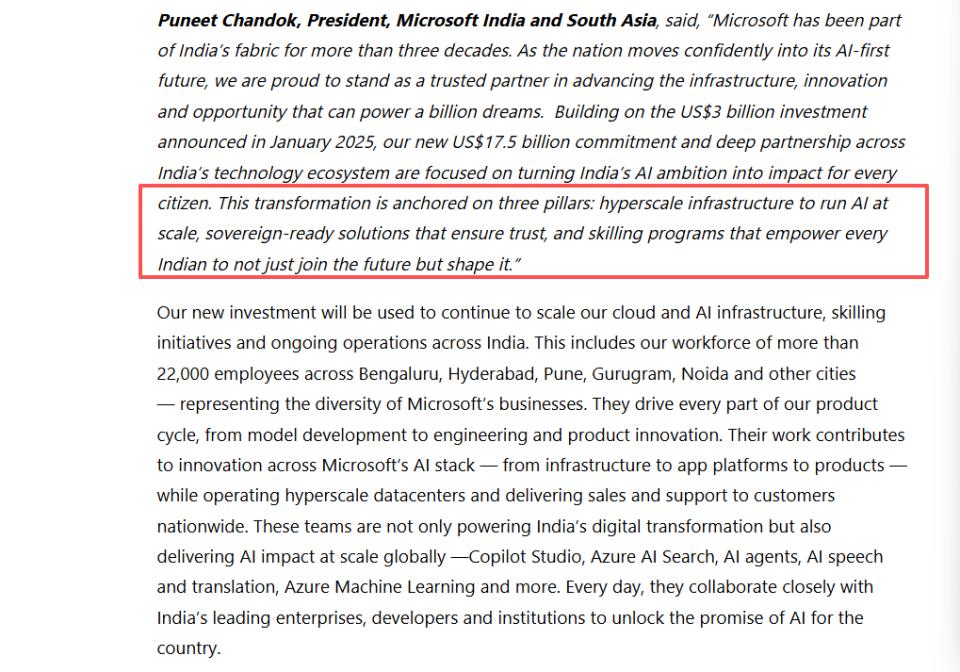
Figure: Puneet Chandok, President of Microsoft India and South Asia, announces details
As a supplement, Microsoft has raised its skills training target in India to cover 20 million people by 2030. In Canada, a smaller - scale but similar - natured plan aims to train 250,000 workers through cooperation with the Actua organization, focusing on indigenous people and remote communities.
Global Race: Infrastructure Arms Race
Microsoft's investments come at a time when the global competition for computing power and market share is intensifying.
Microsoft is not the only company promoting sovereign cloud services. OpenAI recently opened a new battlefield in Australia, partnering with NEXTDC to build a 550 - megawatt ultra - large - scale data center park.
The huge demand is distorting the supply chain: due to soaring memory prices, Micron Technology has decided to exit the consumer - grade memory market and prioritize fulfilling contracts with enterprise customers.
Amazon and Oracle have also strengthened their sovereign cloud services, with Oracle paying particular attention to this trend. Larry Ellison, the company's chairman and chief technology officer, once predicted that in the near future, the industry will shift on a large scale to the national sovereign cloud architecture.
Google is also implementing its ambitious "Thousand - fold Expansion" plan, but its focus remains on centralized self - developed chip clusters.
In contrast, Microsoft's distributed strategy offers a different path: it chooses to build "sovereign" computing power within sovereign countries, rather than simply exporting cloud services from the United States.
This article is from "Tencent Technology", author: Jin Lu. Republished by 36Kr with authorization.