ZhiYuan has reached the milestone of 5,000 units. How far is the humanoid robot from large-scale commercialization?
On December 8th, the 5000th general-purpose embodied robot, Lingxi X2, of Zhipu Robotics was officially mass-produced, offline, and delivered.
Peng Zhihui, the co-founder, president, and CTO of Zhipu Robotics, disclosed the cumulative offline data of the three major product lines on-site: among the 5000 units, there were 1846 units in the Lingxi X1/X2 series, 1742 units in the Yuanzheng A1/A2 series, and 1412 units in the Jingling G1/G2 series.
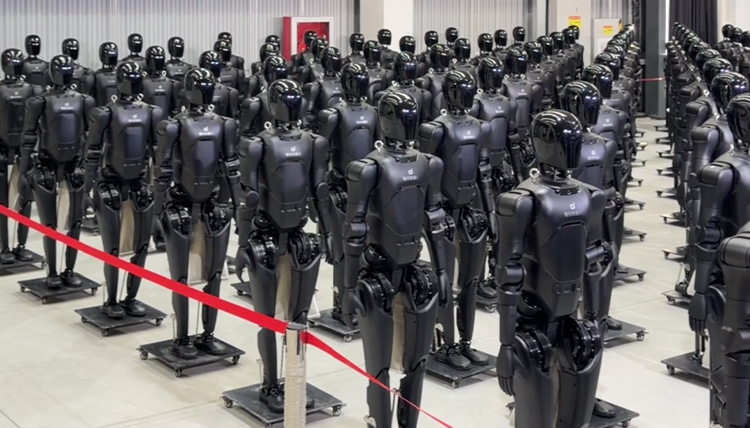
In the humanoid robot industry, which is still in the early commercialization stage, the progress of 5000 units has placed Zhipu in the first echelon of domestic mass-producing enterprises.
Judging from the public information of several leading domestic players, the entire industry is currently still in the stage of climbing from the hundreds-level to the thousands-level.
Unitree Technology has not disclosed the specific order volume. According to a research report from Kaiyuan Securities, the shipment volume of Unitree Technology's humanoid robots in 2024 was approximately 1400 units. Public information shows that as of November this year, Ubtech had delivered approximately 200 humanoid robots. Tan Min, the chief brand officer of Ubtech, stated externally that they have formulated a production capacity climbing plan. It is expected that by 2026, the annual production capacity of industrial humanoid robots will reach 5000 units, and will further expand to 10,000 units in 2027.
In the overseas market, Figure AI's automated production line has been officially put into operation. Currently, the annual production capacity is 12,000 units, and the plan is to increase it to 100,000 units within 4 years.
Regarding Optimus, Elon Musk has repeatedly stated that the production target this year is close to 10,000 units. However, according to recent data from multiple sources, its actual production progress is significantly behind this plan. According to calculations by Nomura Securities based on information obtained from supply chain enterprises, it may start to climb the production capacity after March 2026. It is expected to deliver 60,000 - 80,000 units of Optimus in 2026, and the weekly production capacity is expected to reach 1000 - 2000 units in the second half of 2026.
Nomura Securities released a research report judging that in 2026, the mass-production progress of the Chinese humanoid and quadruped robot industry will surpass that of Tesla.
According to data from Gaogong Industry Research, the total annual production capacity of several leading domestic enterprises in humanoid and quadruped robots is expected to reach 50,000 - 100,000 units in 2026. Among them, Ubtech, Unitree Technology, Zhipu, Fourier Intelligence, and DeepBlue Technology are making the greatest efforts and will be able to achieve considerable shipment volumes in 2026.
According to Nomura's calculations, in 2026, the above six enterprises will lead the release of industry production capacity. Under the baseline scenario, the total shipment volume can reach 110,000 - 200,000 units (including quadruped robots).
Under such a mass-production rhythm and competitive landscape, how Zhipu reached 5000 units has become the focus of external attention.
Peng Zhihui disassembled the path to 5000 units into three stages: from the initial small-batch trial production and real-scenario verification, to the official entry into large-scale mass production this year, and then to further in-depth market optimization around customer needs. In his view, whether a robot has real industrial value cannot be judged solely by parameters and single performance, but more depends on whether it can operate stably in real scenarios for a long time.
He said that currently, Zhipu has completed the rapid iteration of the robot body and three major intelligent technologies. The technological ecosystems such as the Lingchuang, Lingxin, and Jingling platforms, as well as the Lingqu OS, have also been gradually improved, and a stable supply chain for core components and sensors has been continuously built, laying a solid foundation for large-scale production.
"The offline of 5000 units means that Zhipu's large-scale manufacturing system has been initially verified. We can more confidently plan the production capacity blueprints of 10,000 units next year and 100,000 units in the future." Peng Zhihui said.

The 5000th general-purpose embodied robot, Lingxi X2, of Zhipu Robotics was officially mass-produced, offline, and delivered. Image source: Zhipu Robotics
After the technology reaches the mass-production threshold, greater challenges come from standards and costs.
Wang Chuang, a partner, senior vice president, and president of the general business department of Zhipu, revealed in an interview that the most difficult part is not from 1000 units to 5000 units, but to establish a real standard system that can constrain production between the first 200 units and 1000 units.
"At the beginning, when we had the first 200 units, we didn't have any standards," Wang Chuang said. How straight a robot should walk to be considered qualified, how much abnormal noise is acceptable, and how to determine the overall machine lifespan all had to be explored bit by bit in real use.
It wasn't until after 200 units that the problems on the production line began to converge. After 1000 units, R & D gradually withdrew from the front line, and the production line and quality system took over. From 1000 units to 5000 units, it really entered the stage of meeting indicators.
He further explained that now there are clear yield requirements for key components such as joints, reducers, motors, and encoders. Each process on the production line is set with an indicator of 98% - 99% to inversely constrain the supply chain and manufacturing system. "Reaching 5000 units means that the production line has basically run smoothly."
As the manufacturing process gradually converges, another direct change is the cost structure.
Wang Chuang revealed that the price of a Yuanzheng A2 once reached the million-yuan level at the beginning. Now, the price of the mainstream models has dropped to just over 500,000 yuan, and the overall cost has decreased by about half compared to the early stage. But he also emphasized that cost reduction is not a linear process. The real step mainly comes after the mold opening is completed, and then it is the slow cost reduction brought about by the scale effect.
Peng Zhihui also particularly emphasized the cost issue. "Our cost is still continuously and steadily decreasing, which will greatly enhance the comprehensive competitiveness of our future products."
In the manufacturing process, Cao Xu, the R & D director of the general business department of Zhipu Robotics, introduced a side closer to the factory details in an interview with Jiemian News and other media. He said that before leaving the factory, each robot needs to go through dozens of processes, including basic function testing, reliability testing, walking on composite roads, obstacle avoidance, navigation, voice interaction, and aging testing. Taking the aging testing as an example, each robot needs to run continuously for 4 hours, which is equivalent to simulating 1 - 2 days of high-intensity use.
Cao Xu said that a general-purpose embodied robot involves more than 400 kinds of parts and nearly a thousand components. After each component is assembled, it will enter an independent testing process, and a corresponding quality data file will be generated. Finally, when the whole machine is assembled, these data will be aggregated to form a resume of the whole machine.
Jiemian News reporters learned that currently, Zhipu has covered eight scenarios, including tour guiding and reception, cultural and entertainment commercial performances, industrial manufacturing, logistics sorting, security inspection, data collection and training, scientific research and education.

Image source: Zhipu Robotics
Beyond the short-term mass-production rhythm, several research institutions have given long-term expectations for the robot industry.
IDC predicts that by 2029, the global robot market scale will exceed $400 billion, and the Chinese market will account for nearly half. IDC predicts that the commercial sales shipment volume of Chinese humanoid robots will reach approximately 5000 units in 2025 and will increase to nearly 60,000 units in 2030, with a compound annual growth rate of over 95%.
A latest research report from Morgan Stanley suggests that by 2050, the global humanoid robot market scale is expected to reach $5 trillion, and the cumulative deployment volume will reach 1 billion units, which is equivalent to "approximately one humanoid robot for every 10 people."
For Zhipu, reaching 5000 units first is only the starting point of large-scale mass production, not the end of commercialization. As the industry's production capacity is released at an accelerated pace and more scenarios are implemented, whether humanoid robots can truly achieve large-scale commercialization still needs an answer from the market.
This article is from the WeChat public account "Jiemian News". The author is Xu Meihui, and the editor is Wen Shuqi. It is published by 36Kr with authorization.