After reviewing 60 domestic humanoid robot companies, we identified these three major characteristics.
Since 2023, humanoid robots have rapidly gained popularity in China. Leading teams have continuously received capital increases, some enterprises have launched the listing process, and the industry narrative has been continuously pushed up.
However, beneath the apparent boom, what is the actual structure of this industry? How many enterprises are there? How are the technological routes diverging? In which directions are the products converging? These questions have always been difficult to obtain a complete perspective from public information.
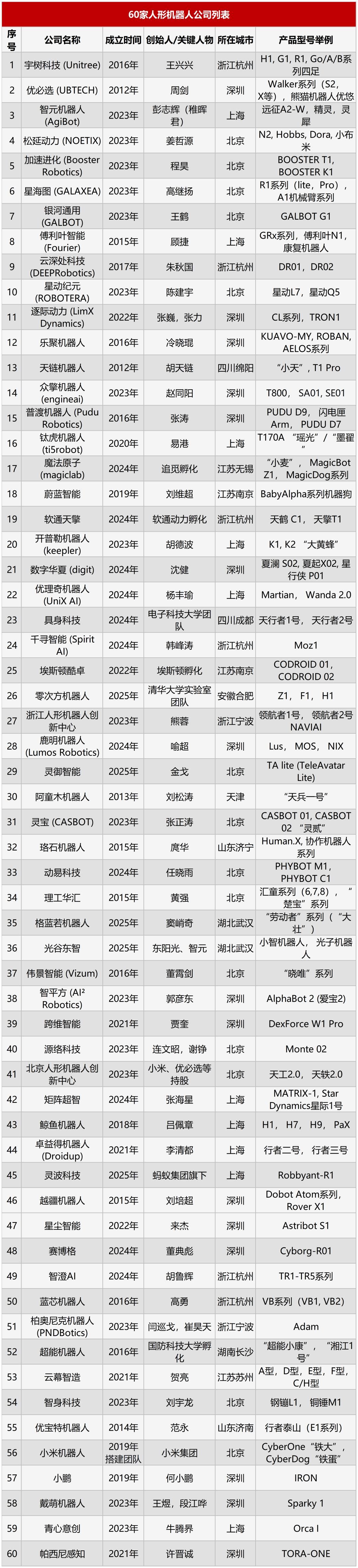
According to data from the National Development and Reform Commission, there are currently more than 150 humanoid robot enterprises in China. Silicon Base Observation has screened out 60 representative companies from them and conducted a preliminary review from the background of the founding teams to the main products, in order to piece together a picture closer to the actual situation of the industry.
From these 60 humanoid robot companies, Silicon Base Jun has discovered three major characteristics:
First, more than half of the humanoid robot enterprises were established between 2023 and 2025. The key drivers come from two events: the global explosion of ChatGPT and the enhanced demonstration effect of Tesla's Optimus.
Most of the teams founded before this period have a background in machinery, control, sensors, or scientific research. The product forms are mainly robot dogs, dexterous hands, commercial robots, and industrial robots. The mainstream route is "motion control + vision/tactile perception + traditional algorithms".
The new companies in the past two years are obviously different: the founding teams generally have a composite background in artificial intelligence or scientific research, emphasizing technological advantages such as large models, world models, and embodied intelligence. The industry narrative has also shifted from "engineering implementation" to "driven by intelligent capabilities", showing an obvious generational change.
Second, humanoid robot enterprises are mainly concentrated in Beijing, Shanghai, Suzhou, Hangzhou, Shenzhen, etc., and a small number of enterprises are scattered in provinces such as Sichuan, Hunan, and Shandong.
This distribution is not accidental:
On the one hand, these regions have a more mature industrial system, especially the automotive industry chain. It is easier to obtain supplies of key components such as sensors, actuators, reducers, and electronic controls.
On the other hand, the humanoid robot industry is a typical talent-intensive industry. Beijing, the Yangtze River Delta, and Shenzhen have a stronger talent appeal in the fields of artificial intelligence, automation engineering, and manufacturing processes, forming a continuous innovation potential.
To some extent, the regional structure of the industry also indicates that the future innovation centers may continue to strengthen in these regions.
Third, the product routes are significantly different, but the downstream scenarios highly overlap, and the competition is rapidly converging.
Although each company has made differentiated attempts in aspects such as motion architecture, control systems, sensing solutions, and AI capabilities, and the public product displays also show their own characteristics, the application scenarios they ultimately point to are highly concentrated - factories, scientific research and education, dangerous working conditions, and household chores.
This means a reality : in the short term, the downstream scenarios that can be scaled up are limited, and the competition among enterprises will inevitably be fierce.
In the stage when the demand has not really increased, technological investment, supply chain capabilities, customer resources, and the speed of pilot implementation will all become key factors determining whether an enterprise can survive the industry fluctuations.
The following is the specific list of these 60 humanoid robot companies:
1. Unitree Robotics, the most currently concerned humanoid robot enterprise
Hangzhou Unitree Robotics was established in August 2016. It focuses on the independent research, development, production, and sales of consumer-grade and industrial-grade high-performance general-purpose legged/humanoid robots and dexterous robotic arms. It has leading positions in comprehensive fields such as core robot components, motion control, and robot perception. Currently, its valuation has exceeded 10 billion yuan, and it has completed the IPO guidance.
Unitree's robot products include robot dogs and humanoid robots: the industrial-grade robot dogs Unitree B1/B2/A2 are mainly used in power inspection, fire rescue, etc., while the consumer-grade robot dogs Unitree Go1/Go2/A1 can be used in scenarios such as family entertainment, pet companionship, and home guarding. The general-purpose humanoid robots include Unitree H1/H1 - 2, Unitree G1, Unitree R1, and Unitree H2 (H2 humanoid).
2. UBTECH, one of the earliest humanoid robot enterprises in China
UBTECH Robotics was established in March 2012 and was listed on the main board of the Hong Kong Stock Exchange in December 2023. It is the world's first listed humanoid robot company.
UBTECH has full-stack technical capabilities for humanoid robots, including humanoid robot hardware and control technologies (robot motion planning and control technology, high-performance servo drives), artificial intelligence technologies (humanoid brain, humanoid cerebellum), robot and artificial intelligence integration technologies (SLAM and autonomous technologies, visual servo operation and human - machine interaction), and the robot operating system application framework ROSA2.0.
Currently, UBTECH's humanoid robots mainly include the industrial humanoid WalkerS2, WalkerS1, Walker S, the commercial humanoid Walker C, Walker X, the wheeled humanoid Cruzr S2, and the panda robot Youyou. It has taken the lead in realizing the application of humanoid robots and is the world's only humanoid robot company that has announced cooperation with multiple automobile enterprises.
3. AgiBot, a robot company founded by "Zhi Huijun"
AgiBot was established in February 2023 and is committed to the integrated innovation of A1 + robots, and the coordinated development of the three core AI capabilities of robot motion intelligence, interaction intelligence, and operation intelligence. AgiBot has three humanoid robot families: Expedition, Elf, and Lingxi. Its products cover a variety of commercial scenarios such as interactive services, flexible manufacturing, special operations, scientific research and education, and data collection.
In July this year, AgiBot announced that it would obtain the control right of Shangwei New Materials through the dual - track model of "agreement transfer + tender offer" through a shareholding platform, and the delivery was completed on November 6 this year.
4. NOETIX, a small robot with excellent motion performance
NOETIX was established in September 2023. Jiang Zheyuan, the founder and chairman of the company, was born in 1998 and dropped out of school to start a business during his doctoral studies at the Department of Electronic Engineering of Tsinghua University.
NOETIX's N2 robot is positioned as a sports master. It is 1.18 meters tall and has a maximum moving speed of 3.2 m/s. It won the silver medal in this year's Beijing Yizhuang Half Marathon and the Humanoid Robot Half Marathon. The price starts at 39,900 yuan.
In addition, there are products such as the humanoid robot Hobbs and Xiaonuo, the general - purpose humanoid robot Dora, and Xiaobumi (Bumi). Dora is 1 meter tall and can perform voice and visual interactions with large models. Xiaobumi, which was released in October this year, has a pre - sale price starting from 9,998 yuan. It is also the world's first humanoid robot priced under 10,000 yuan, targeting the education market.
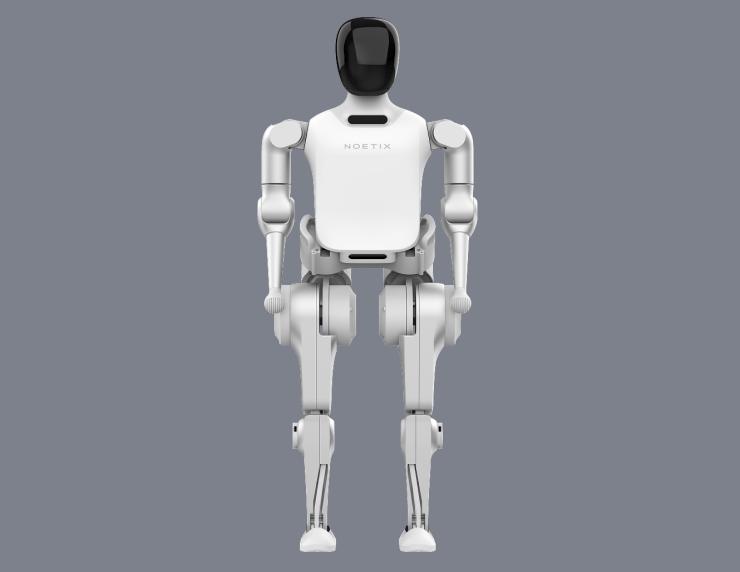
NOETIX N2
5. Booster Robotics, an enterprise that enables robots to play football
It was established in 2023. The founder, Cheng Hao, graduated from the Department of Automation of Tsinghua University with a master's degree. He studied under the domestic robot expert Zhao Mingguo and once served as the captain of the Huoshen Team of the Tsinghua University Robot Football Team for three terms. He first worked at Amazon for one year before starting a business. His startup project was acquired by ByteDance, and he served as the vice - president of the Feishu product. Then he resigned to start a business again. The team is from Tsinghua University, and Zhao Mingguo serves as the chief scientist.
Its products are mainly targeted at the competition and scientific research and education markets. The BOOSTER T1 robot is 1.18 meters tall and weighs about 30 kg. It features lightness, flexibility, and sturdiness, and can remain stable after being subjected to chest - breaking stones, being hit on the head with beer bottles, being struck by wooden sticks, and colliding with other robots. The entry - level platform for embodied development, BOOSTER K1, is 0.95 meters tall, weighs 19.5 kg, and the price starts at 39,900 yuan.
6. GALAXEA, an "academic school" favored by capital
It was established in September 2023 and focuses on the research and development of embodied intelligence basic models and embodied intelligent robots.
The founding team has a profound technical background. Gao Jiyang, the CEO, graduated with a doctorate in computer vision research from the University of Southern California and has successively joined Waymo and Momenta. Li Tianwei once served as a senior director at Momenta. Zhao Xing and Zhao Huazhe are both assistant professors at the Institute for Interdisciplinary Information Sciences of Tsinghua University.
GALAXEA's products are divided into the A1 series of robotic arms and the R1 series of robots. The R1 series is divided into three models: R1 lite, R1, and R1 Pro. The R1 lite is a dual - arm mobile platform for data collection. Both R1 and R1 Pro are general - purpose humanoid robots, using a wheeled chassis instead of a bipedal design.
According to media reports, in just over two years since its establishment, GALAXEA has raised nearly 1.5 billion yuan in financing. Meituan, Capital Today, Ant Group, and Hillhouse Venture Capital have all invested.
7. GALBOT, the "hidden master" in the field of embodied intelligence large models
It was established in May 2023. The founder, Wang He, graduated from the Department of Electronics of Tsinghua University with a bachelor's degree and then obtained a doctorate in electrical engineering from Stanford University. He once served as an assistant professor and doctoral supervisor at the Center for Frontier Computing Studies (CFCS) of Peking University and founded the Embodied Perception and Interaction Laboratory (EPIC Lab) at Peking University.
GALBOT currently has the GALBOT G1, a generalizable embodied large - model robot.
GALBOT is more prominent in the research of large - scale robot models. The general action tracking framework Any2Track it released can enable robots to accurately imitate various complex human actions and can also adapt to various real - world interferences in real - time.
The navigation large model TrackVLA it released can enable robots to complete autonomous movement, obstacle avoidance, etc. in untrained venues and can understand voice commands.
The recently released world's first cross - ontology full - domain panoramic navigation base large model - NavFoM (Navigation Foundation Model) enables robots to master the full - stack "basic knowledge of movement" and supports full - scene, multi - task, and cross - ontology replication.
8. Fourier Intelligence, an early humanoid robot startup
It was established in July 2015. The founder, Gu Jie, graduated from the Department of Mechanical Engineering of Shanghai Jiao Tong University and once worked at National Instruments Corporation in the United States.
Currently, Fourier Intelligence's robot products mainly include three GRx general - purpose humanoid robots, the open - source robot Fourier N1, and rehabilitation robots.
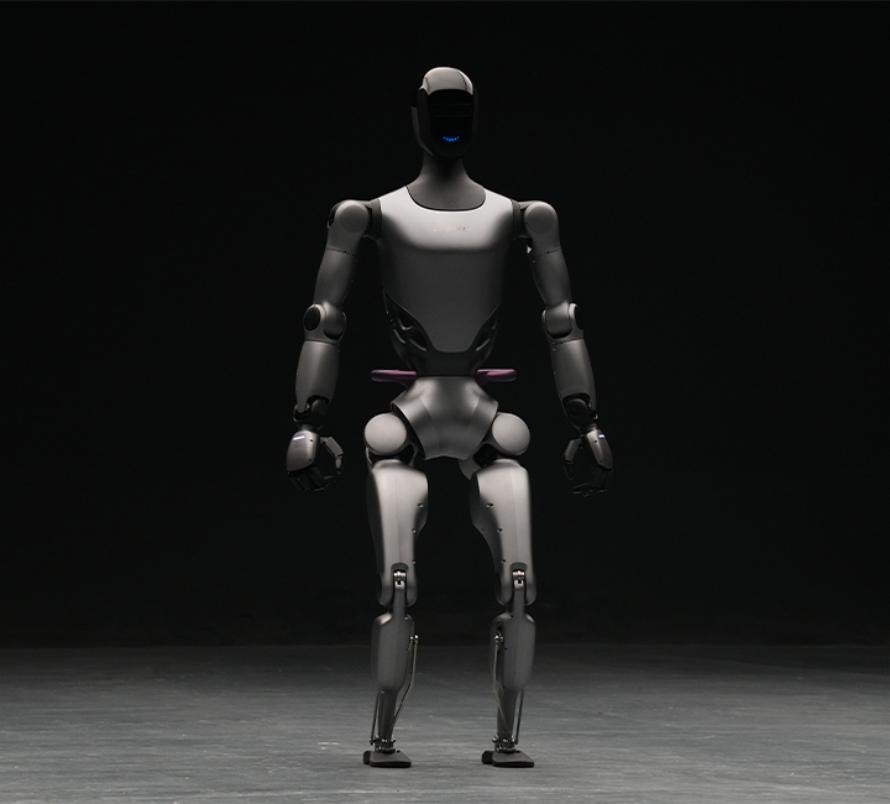
Fourier Intelligence GR - 2
9. DEEPRobotics, focusing on reliability solutions for specific scenarios
It was established in November 2017. The founder, Zhu Qiuguo, graduated from the major of Mechanical and Electronic Engineering of Zhejiang University and serves as an associate professor at Zhejiang University. Currently, DEEPRobotics has completed the shareholding reform and is sprinting for an IPO.
It mainly studied quadruped robots in the early stage. In August 2024, DEEPRobotics released the embodied intelligence general - purpose humanoid robot DR01, which has highly flexible movement and operation capabilities, adaptability to complex environments, integrated perception capabilities, and a strong autonomous learning ability.
In October this year, it released the DR02. The whole machine reaches the IP66 protection level and can operate continuously in an environment of - 20°C to 55°C, becoming the world's first full - size humanoid robot that can adapt to complex outdoor environments such as rain, humidity, and dust.
10. ROBOTERA, a robot company held by Tsinghua University
Beijing ROBOTERA Technology Co., Ltd. was established in August 2023 and was incubated by the Institute for Interdisciplinary Information Sciences of Tsinghua University. It is a humanoid robot enterprise held by Tsinghua University. The company is led by Professor Chen Jianyu, a doctoral supervisor at Tsinghua University and an expert in the field of robots and AI.
Currently, it has two humanoid robot products, Xingdong L7 and Xingdong Q5. The former is a full - size bipedal humanoid robot, and the latter is a humanoid service robot. The Xingdong L7 is 1.71 meters tall, has 55 degrees of freedom throughout the body, and the maximum joint torque reaches 400 N·m, leading in the industry.
11. LimX Dynamics, committed to building a general platform
LimX Dynamics was founded in January 2022. The founder, Zhang Wei, published the world's first paper on controlling humanoid robots based on reinforcement learning in 2018. Another co - founder is Zhang Li, the former COO of the self - driving startup WeRide.
LimX Dynamics focuses on legged robots. Zhang Wei once proposed the concept of "AI - based cerebellum". The company is positioned to make it easy for all robots to be put into use, aiming to reduce hardware costs, launch useful software tools, and build a robot platform.
Currently, its main products include the CL series of full - size humanoid robots and the multi - form bipedal robot TRON1, which are applied in fields such as intelligent manufacturing, industrial inspection, logistics and distribution, and household services.
12. Leju Robotics, an established humanoid robot startup
Leju Robotics was established in March 2016. The founding members are from Harbin Institute of Technology. Since its establishment, it has always focused on the research, development, and industrialization of humanoid robots. In August 2016, it launched the first - generation humanoid robot AELOS.
Currently, it has the general - purpose humanoid robot KUAVO - MY, which is about 1.47 meters tall and has more than 40 degrees of freedom throughout the body. It is connected to the Huawei Cloud CloudRobo embodied intelligence platform. In addition, the company also has 4 small and medium - sized bipedal humanoid robots, including ROBAN, AELOS PRO3, AELOS OpenHarmony Edition, and AELOS SMART.
